
History rarely announces itself when it is about to repeat a mistake. History-in-the-making tends to arrive disguised as “pragmatism“, dressed up as “realism“, accompanied by people who insist that “this time is different“. Looking back, the pattern is obvious. Living through it, the pattern is usually denied.
Just outside Ville de Luxembourg, in Hamm, there is a place where denial runs out of room. At the Luxembourg American Cemetery and Memorial, 5,070 American soldiers are buried in near-perfect rows, most of them killed during the Battle of the Bulge. At the head of those graves lies George S. Patton and his wife. They could have been buried elsewhere. They chose not to be. The symbolism is not subtle. Whatever one thinks of General Patton’s language, he understood what many still refuse: when political systems fail early, they outsource their moral reckoning to violence later.
That ground matters because the war those men fought was not caused by madness alone. It was prepared, normalized, and enabled long before the shooting started. In the 1920s and 1930s, parts of industrial capital decided that democracy was inefficient and unpredictable, that compromise was weakness, and that authoritarian order was preferable to social accountability. Fascism did not rise in opposition to capital. In many cases, it rose with capital’s blessing.
To understand how, you need a witness who does not look away.
Imagine Anne Frank, as a symbol revered, and as a consciousness allowed to live . . . and to sit for the next hundred years: in the hidden corners of power from the closets of boardrooms to the anterooms of ministries to the quiet spaces where people explain to themselves why something regrettable is nevertheless necessary.
She does not leave the room. She has learned that the most important thing a witness can do is remain present after the first explanation, after the second justification, after the tone shifts from certainty to irritation. She knows that is where truth starts to leak.
She stays with Henri Deterding longer now, not at the moment of his Nazi state funeral . . . for that was only the punctuation mark. She stays with Henri Deterding in the 1920s and 1930s where the real work was done. She watches him professionalize something that had previously been informal: the idea that capital could and should choose political systems based on efficiency rather than legitimacy. Deterding does not hate democracy in a crude way. He simply does not trust it. He believes markets need order, and if order requires brutality, then brutality becomes a regrettable but acceptable cost.
Anne notices the subtlety here. Deterding does not call himself immoral. He calls himself realistic. That word lodges in her memory, because she hears it again and again across the century.
She sees how Deterding’s Shell becomes more than a company. It becomes a diplomatic actor. A shadow foreign ministry. Oil flows replace treaties. Concessions replace consent. The ground is prepared for a world in which energy security is indistinguishable from political leverage. When fascism arrives offering stability and suppression of labor, Deterding does not hesitate. The alignment feels logical to him. He is the bezerker’s patron, dressed in a bespoke suit. Anne writes in the margin:
When realism refuses moral constraint, it eventually selects violence.
She follows the ghostline forward. She sits in Shell boardrooms in the late twentieth century, as internal scientists document climate destabilization with precision that will later be publicly denied. She hears the same word again . . . realistic. It is realistic, executives say, to protect shareholder value. It is realistic to manage perception. It is realistic to delay. Anne understands now that Deterding did not die in 1939. He metastasized into process.
She stays, too, with William Farish, because Farish is harder to see, and therefore more dangerous. Farish never needs to admire Hitler. He does not need ideology at all. He is the man who makes ideology irrelevant by insisting that systems must continue. Fuel must flow. Contracts must be honored. Legal obligations override moral ones. Anne sees how this posture allows anything to be supplied to anyone, as long as the paperwork is clean.
She notices that Farish’s real legacy is not in oil barrels but in professional ethics. In the rise of a managerial class trained to believe that their responsibility ends at the boundary of their job description. Lawyers who say, “I only advise.” Bankers who say, “I only structure.” Executives who say, “I only maximize.” Anne writes another line:
Atrocity scales best when responsibility is modular.
She watches this logic resurface decades later in climate finance, where emissions are externalized, impacts are discounted, and harm is treated as someone else’s column. She sees how Farish’s calm continuity becomes the spiritual ancestor of special purpose vehicles for fossil expansion, justified by fiduciary duty and shielded by complexity. The man disappears. The method becomes orthodox.
She remains, uncomfortably, with Henry Ford. Ford fascinates Anne because he sincerely believes he is improving the world. He sees disorder and wants to fix it. He sees labor unrest, cultural change, Jewish influence, and concludes that society has been led astray. He does not whisper these beliefs. He prints them. He distributes them. He industrializes them.
Anne realizes that Ford’s true innovation was not anti-semitism, which was old, but distribution. Hate with logistics. Grievance with supply chains. A worldview packaged so efficiently that it could cross oceans. Hitler understands this immediately. He recognizes a fellow system-builder.
Anne follows the ghostline forward again, into the present. She sits in rooms where data scientists discuss “engagement.” She hears how outrage retains attention. How polarization increases dwell time. How radicalization can be optimized without anyone intending radicalization. She sees Ford’s factory logic reborn in code. The same moral abdication appears, now spoken as neutrality:
“The algorithm isn’t ideological.”
“We just optimize for behavior.”
Anne knows this lie well. She has heard it before, just in different accents.
She then sits with the shapeshifters.
With Stephen A. Schwarzman, she understands that scale has become sovereignty. When asset managers own housing, infrastructure, energy, logistics, they no longer merely invest in society. They govern it, quietly. Rent replaces citizenship. Predictability replaces participation. Anne recognizes a new feudalism, optimized, frictionless, polite.
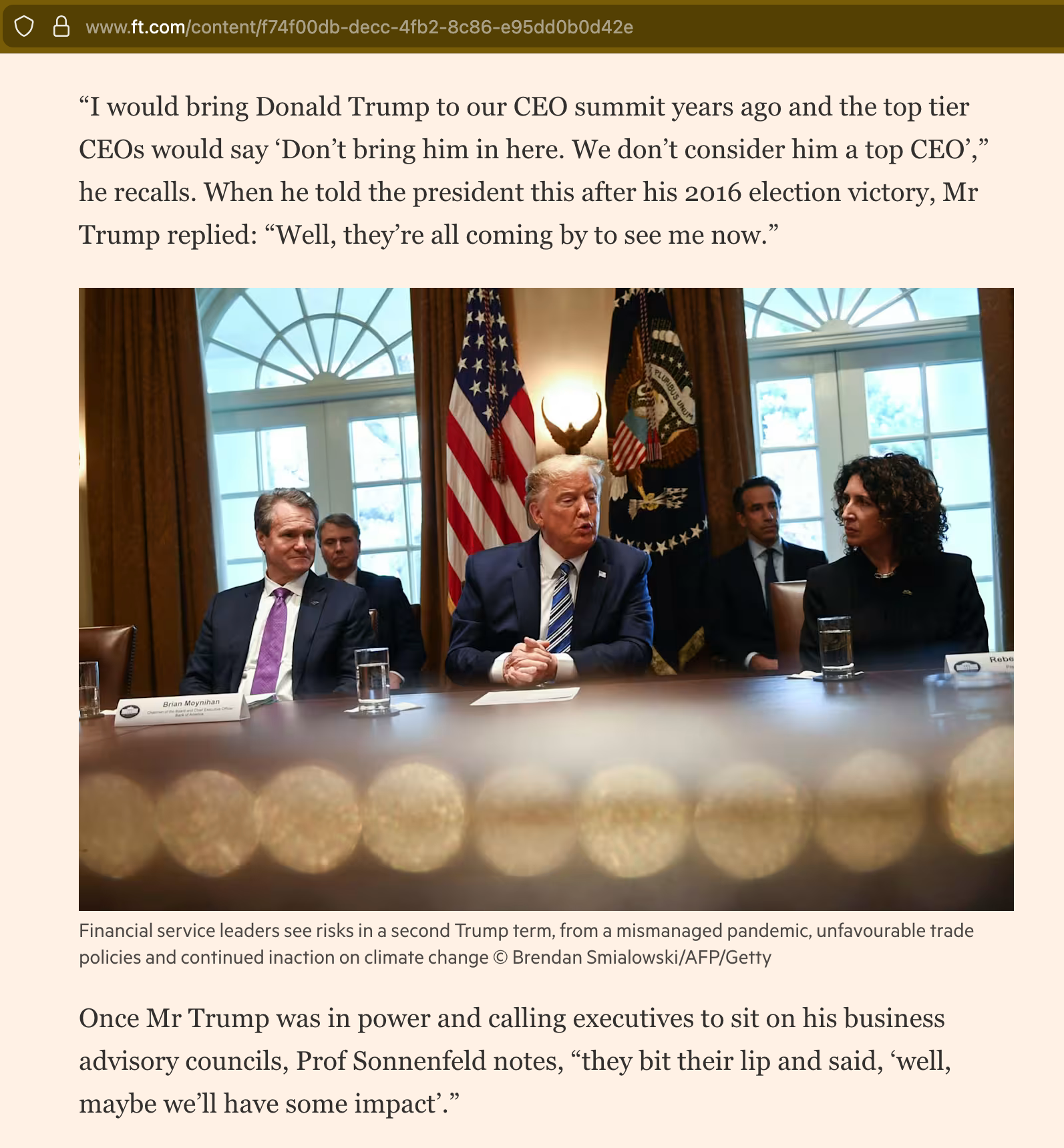
She sits in the Yale School of Management rooms of Jeffrey Sonnenfeld, and understands that power no longer needs propaganda. It needs curation. Who is invited. Who is treated as serious. Who is rehabilitated through dialogue. Anne watches how reputations are laundered not by denial but by inclusion. The most dangerous phrase she hears here is not “I support,” but “It’s complicated.”
She stays because this is where decency most often dissolves . . . not in overt cruelty, but in social comfort.
Then she moves deliberately to those who refuse that comfort.
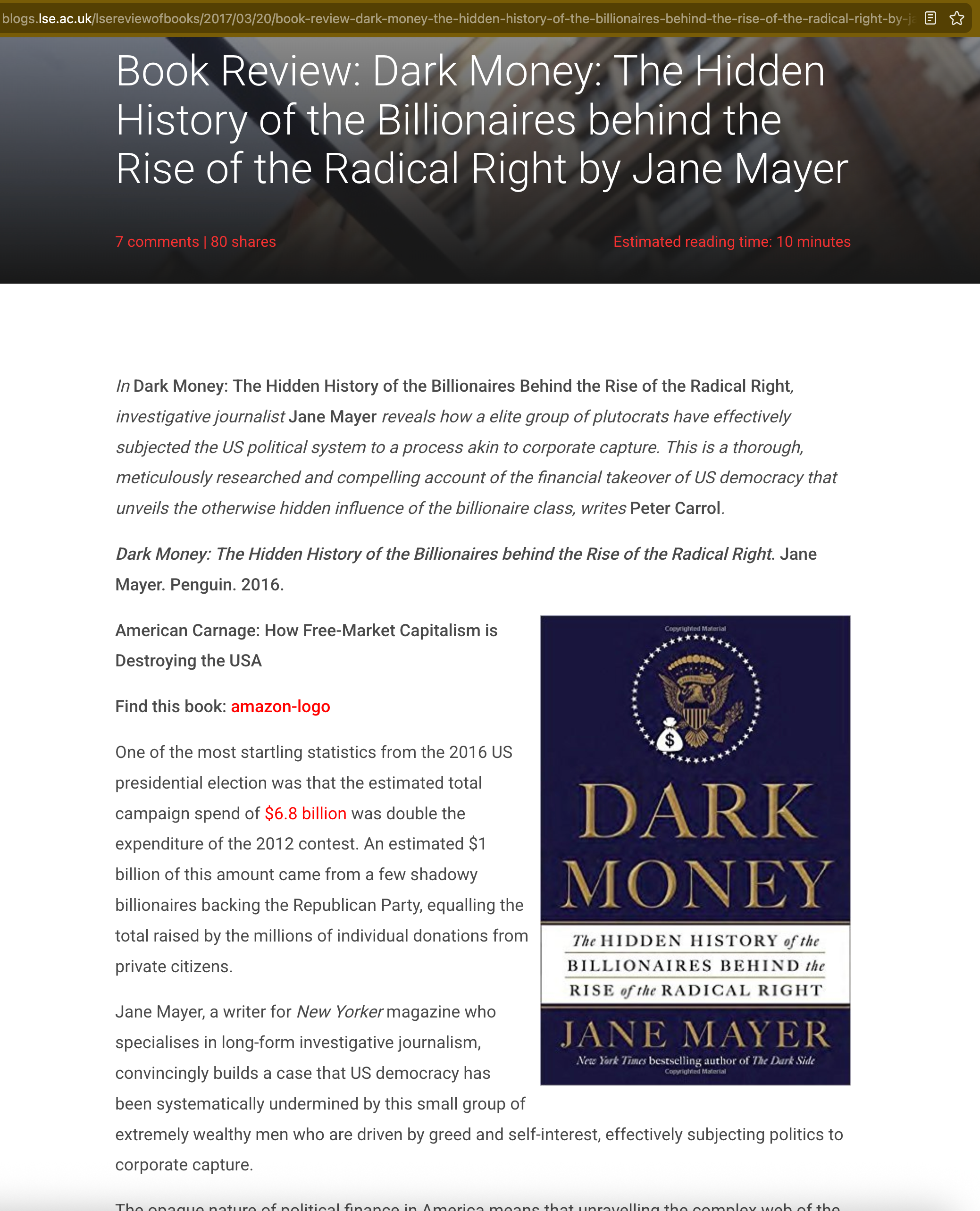
She sits with Jane Mayer longer now, watching the work itself. The hours tracing shell companies. The resistance from editors. The legal threats. The exhaustion. Anne understands that Mayer’s real contribution is not information, but method. Forensic citizenship. The insistence that power be mapped, named, and made legible.
Anne notices how often Mayer is accused of bias simply for insisting that structures be visible. She recognizes this as the standard defense of opacity. She writes:
Those who profit from invisibility always call “sight” partisan.
She stays, too, with Mark Jacobson, but not in conference rooms. She stays in the spreadsheets. In the peer review. In the modeling of load curves and storage. She watches how Jacobson’s work removes the last respectable refuge of delay. Once a 100 percent wind, water, and solar system is shown to be technically feasible, economically advantageous, and socially beneficial, every continuation of fossil dependency becomes a moral choice, not a technical one.
Anne understands that this is why Jacobson provokes such hostility. He does not argue ideology. He eliminates alibi. She underlines a sentence she has never actually heard spoken aloud:
When feasibility is proven, denial becomes confession.
Some of Patton’s heirs still wear boots. Most now wear suits. For over a decade, the Pentagon has formally classified climate disruption as a “threat multiplier”: a catalyst for instability, migration, and conflict. NATO’s strategic frameworks echo this. The security apparatus, the very institution built to manage violence, has become an unwilling prophet of prevention. Their analysis is not moral; it is tactical. They see the future Hamm cemeteries in drought-stricken regions and flooded capitals. To ignore the energy transition is not idealism. To ignore the energy transition is defying the counsel of generals and intelligence agencies. The most hard-nosed realists in the world agree with the climate scientists. The question is no longer about belief, but about heeding warnings from the very entities created to foresee threat.
In Hamm today, that inheritance feels uncomfortably contemporary. The uniforms are gone. The salutes are subtler. The rhetoric is cleaner. But the temptation has not disappeared. It has evolved.

Authoritarianism rarely arrives announcing itself as such. It arrives through deregulation framed as efficiency, through tax structures framed as competitiveness, through political financing framed as free speech. It arrives through money that moves quietly, routed through institutions designed to obscure its origin while amplifying its influence.
No one has mapped this terrain more carefully than Jane Mayer. In Dark Money, she documents the construction of a parallel political infrastructure, built over decades, designed to outlast individual candidates and operate largely beyond public scrutiny. Donor-advised funds, 501(c)(4)s, think tanks, litigation shops, media ecosystems . . . all legally constituted, all strategically aligned, all capable of reshaping policy without ever appearing on a ballot.
The point is not to moralize wealth. The point is to understand power. Climate policy does not fail repeatedly because the science is unclear or the technology unavailable. It fails because the political economy surrounding it is engineered to resist disruption. Dark money is not a sideshow. It is the operating system.
This is where geography re-enters the story. Financial Hubs (including here in Luxembourg) are not where these fortunes are made. It is where they are often administered and structured. Financial hubs sit inside a global architecture that allows capital to move efficiently, quasi-anonymously, and lawfully across borders. That architecture is not sinister by default. But when combined with permissive political-finance regimes elsewhere, it becomes an enabling environment for opacity. Dark money is not national. It is transnational by design.
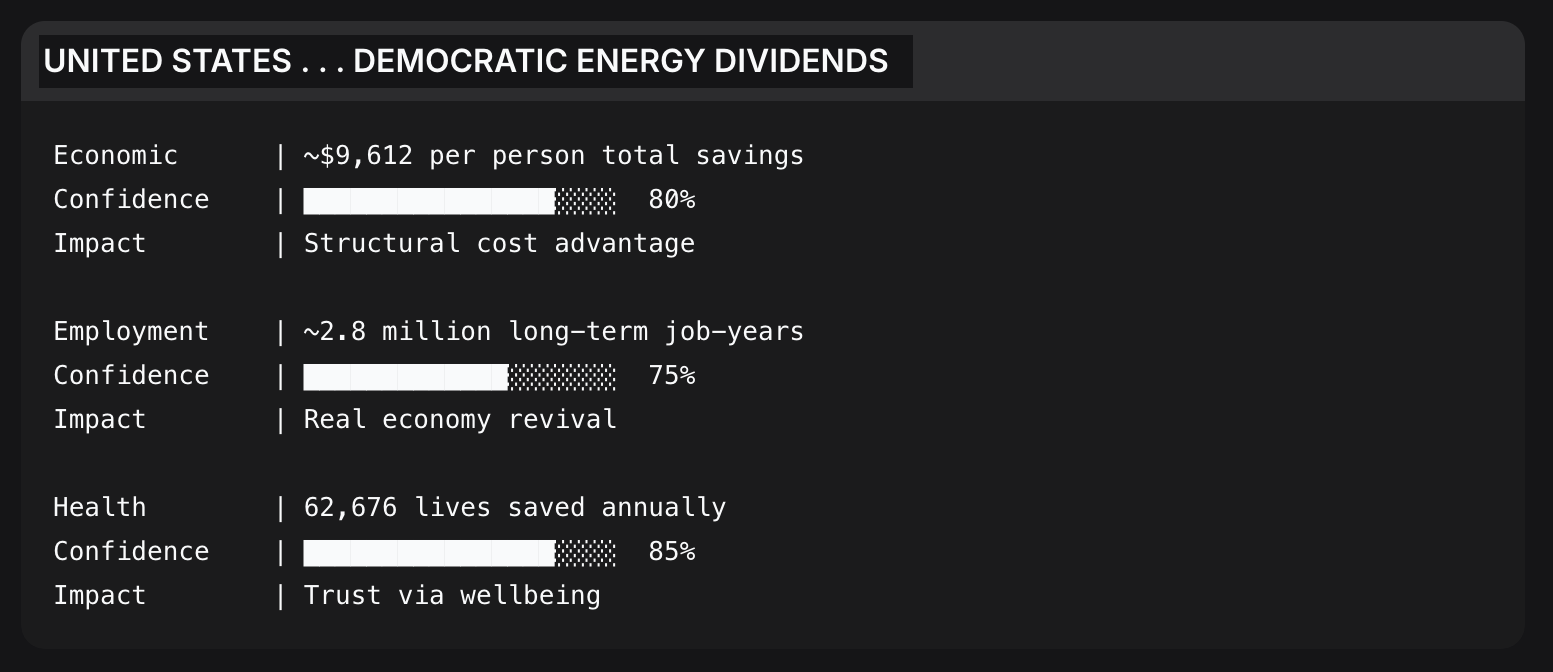
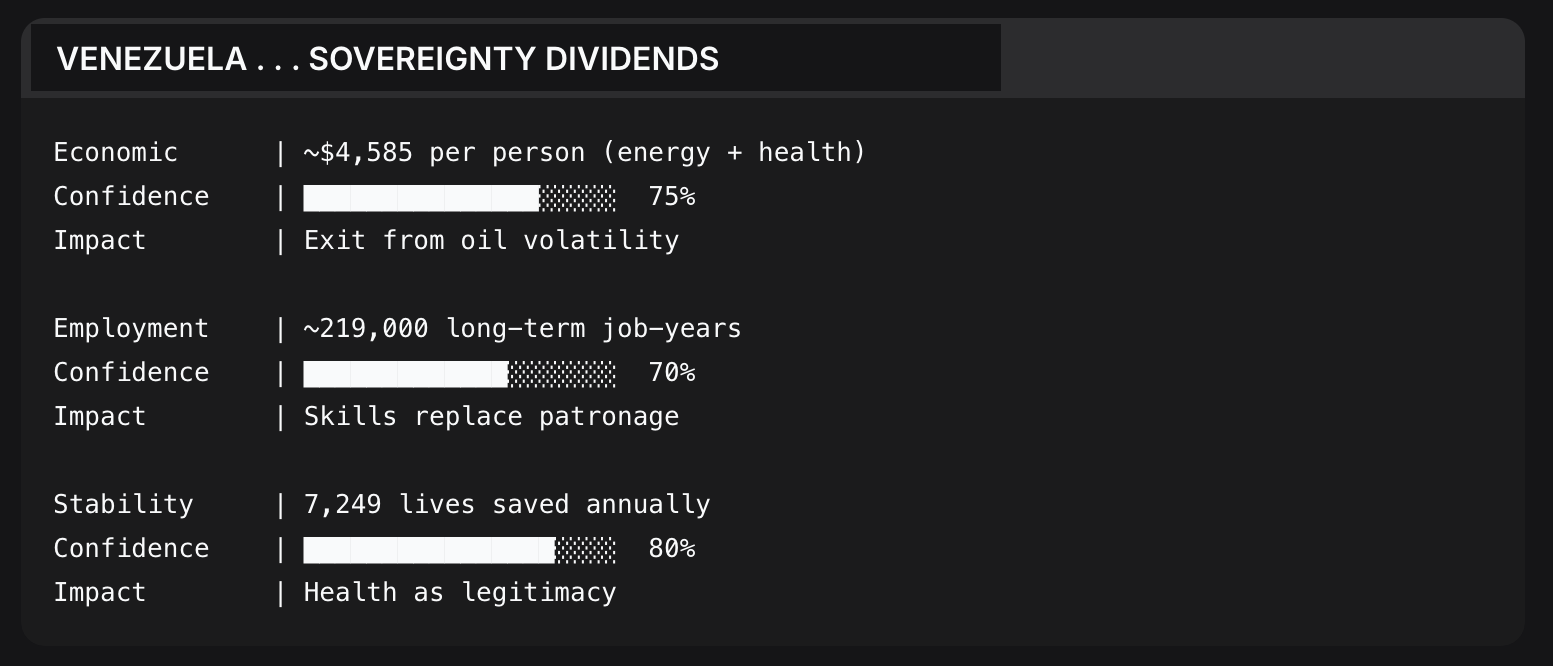
What makes our moment different is not virtue. It is capacity. For the first time, the material basis of the old excuse . . . that “there is no alternative” . . . has collapsed. The Solutions Project’s roadmaps prove that wind, water, solar plus battery-storage can power entire societies. This turns a moral imperative into an engineering and economic choice. The dividends are no longer speculative; they are quantified, country by country.
For example, here for the United States:
For example, here for Venezuela:
For example, here for The Grand Duchy of Luxembourg:
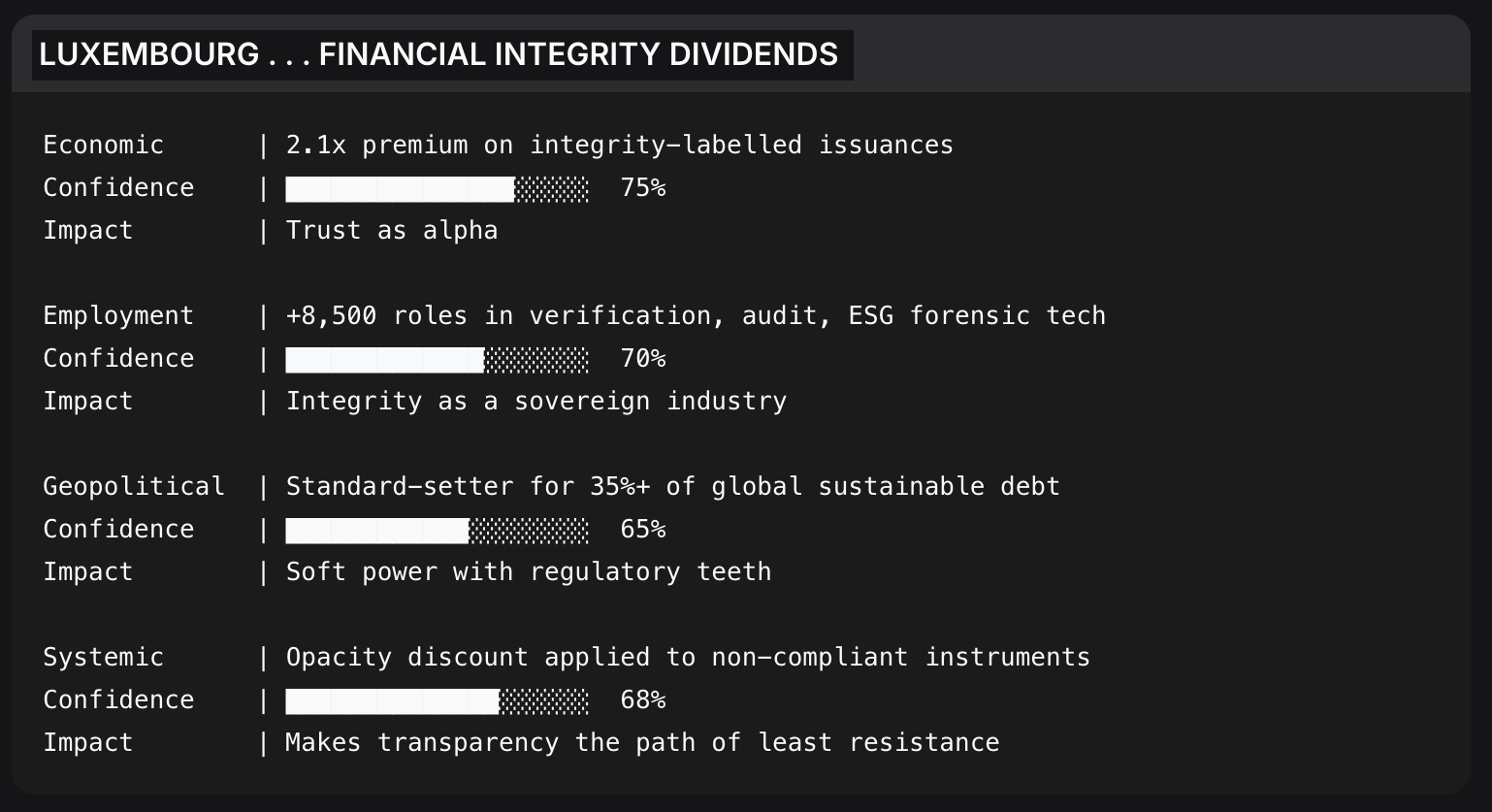
These are not promises. They are probabilities, and probabilities change responsibility.
Imagine: Anne Frank looks again at financial hubs (including here in Luxembourg), now not as “places” but as “control surfaces”. She sees how listing rules can function as moral levers. How disclosure requirements can force truth upstream. How verification capacity becomes civic infrastructure. She imagines financial hubs (including here in Luxembourg) choosing to require full provenance for sustainability-linked instruments. Anne Frank imagines opacity becoming a liability rather than a convenience. She understands that this would not be symbolic. It would be catalytic.
She draws a network in the margin. Lines from financial hubs (including here in Luxembourg) to the European Investment Bank, which already understands how standards create markets. Lines to the European Commission, which can align regulation with security. Lines to national development banks, export credit agencies, and a retooled World Bank that treats decarbonization as prevention, not charity.
But the witness refuses the easy myth that one court ruling, one bond standard, or one summit fixes the architecture. A system that expects one decisive win is not mature. A system that builds redundant pathways is.
This is why the financial architecture matters as prevention, not as symbolism.
A green bond can be a label. Or it can be a constraint.
A World Bank 2.0 does not simply lend more. It standardizes the architecture of integrity. It makes transparency a condition of scale. It treats social legitimacy as a risk parameter, not a charitable add-on. It stops rewarding fossil incumbency through backdoor subsidies and starts rewarding resilience through lower capital costs.
The EIB does what it has already shown it can do: issue credible use-of-proceeds bonds, anchor standards, and fund infrastructure that makes transition tangible for people who do not live inside policy documents.
Financial hubs (including here in Luxembourg) do what financial hubs are capable of at our best: make the instruments legible. Require disclosure that is not performative. Treat listing not as a prestige service but as a gatekeeping function, and recognize that finance hubs are moral actors whether they admit it or not.
And then we add the missing partner: a Resilience Alliance with teeth. National development banks and export credit agencies aligned with EU climate diplomacy; the European Commission’s external investment strategy enacted with seriousness; and the growing ecosystem of climate funds that can issue in capital markets rather than waiting for annual donor pledges.
If the money is cheap for fossil incumbents and expensive for clean transition in fragile states, we have simply engineered future conflict. If the money becomes cheaper for clean sovereignty than for extractive dependency, we begin to purchase peace in the only currency the system consistently respects: the cost of capital.
This is the part that loops us back to Hamm, because it is not sentimental. It is a hard lesson. If you want to reduce the probability of the next cemetery, you do not wait for heroism. You lower the temperature of the system. You remove choke points. You stop funding the conditions that generate desperation and then pretending to be surprised when desperation becomes violence.
General Patton and the US Third Army advanced because they had to. He was sent because decency had been postponed until it required force.
Anne Frank does not celebrate this blueprint. She is not naïve. She knows incumbents will resist. She knows standards are political. She knows realism will reappear, wearing new language. But she also knows something else now:
Again, the choice is explicit: The question for our generation is whether we will be decent earlier . . . in solidarity . . . and in ways that can be audited. Whether we will build a financial architecture that makes peace more profitable than conflict, and makes clean sovereignty cheaper than fossil dependence.
Anne Frank’s chair is now empty. It is in your company’s boardroom. It is in your university building. It is in your city zoning meeting. It is at your family’s dinner table when someone says: “it’s complicated.”
The chair is not a memorial. It is an invitation. A summons.
To sit. To listen for the moment knowledge becomes choice. Then, having inherited the witness of a century of rooms, to change the choice.
The buried in Hamm are not asking for your tears. They are asking for your vigilance.
To be, finally, the adult in the room.
Anne Frank stays.
Further Reading:
- Anne Frank House https://www.annefrank.org/en/anne-frank/secret-annex/landing/
- Luxembourg American Cemetery https://www.abmc.gov/cemeteries-memorials/about-luxembourg-american-cemetery/
- March of Times Newsreels from 1935 onwards: https://en.wikipedia.org/wiki/The_March_of_Time#Episodes
- Le sulfureux fondateur de la Shell – Henri Deterding Paperback https://www.amazon.fr/sulfureux-fondateur-Shell-Henri-Deterding/dp/2874667242#:~:text=Henri%20Wilhelm%20August%20Deterding%20n%C3%A9,de%20%22%20Napol%C3%A9on%20du%20p%C3%A9trole%20%22.
- Ghostline: the last line of a poem you need to make it whole.
- William Farish: https://en.wikipedia.org/wiki/William_Stamps_Farish_II#World_War_II_controversy
- Henry Ford Museum https://www.thehenryford.org/collections-and-research/digital-resources/popular-topics/henry-ford-and-anti-semitism
- Stephen Schwarzman defended Donald Trump at CEO meeting on election results. Blackstone founder dismissed ‘coup’ fears and forecast legal process would take its course #GiftLink https://giftarticle.ft.com/giftarticle/actions/redeem/b890a431-5629-4731-9ba1-ab7ec1a41bce
- Blackstone chief Stephen Schwarzman backs Donald Trump. Billionaire’s endorsement could lead to more Wall Street money for the former president’s campaign #GiftLink https://giftarticle.ft.com/giftarticle/actions/redeem/bc0f9017-0090-4969-a3ce-eef9427c7c8f
- Blackstone and Goldman Sachs CEOs see upsides to Donald Trump’s policies. Comments from Wall Street bosses come as president’s import tariffs fuel US recession fears https://giftarticle.ft.com/giftarticle/actions/redeem/36e9e292-841e-41de-941f-88544e0ab549
- Prof Sonnenfeld quoted in the Financial Times: “I would bring Donald Trump to our CEO summit years ago and the top tier CEOs would say ‘Don’t bring him in here. We don’t consider him a top CEO’,” he recalls. When he told the president this after his 2016 election victory, Mr Trump replied: “Well, they’re all coming by to see me now.” #GiftLink https://giftarticle.ft.com/giftarticle/actions/redeem/d3cf3f2c-a198-4951-9b9e-6a677798bba9
- Dark Money: The Hidden History of the Billionaires Behind the Rise of the Radical Right is a 2016 non-fiction book written by American investigative journalist Jane Mayer https://blogs.lse.ac.uk/lsereviewofbooks/2017/03/20/book-review-dark-money-the-hidden-history-of-the-billionaires-behind-the-rise-of-the-radical-right-by-jane-mayer/
- Dr Professor Mark Z. Jacobson’s Stanford University Curriculum Vitae https://web.stanford.edu/group/efmh/jacobson/
- The Solutions Project’s interactive map to see what 100% renewable energy could look like where you live in the year 2050https://thesolutionsproject.org/what-we-do/inspiring-action/why-clean-energy/#/map/countries/location/ALL
- US Defense Secretary Chuch Hagel to address “Threat Multiplier of Climate Change https://www.war.gov/News/News-Stories/Article/Article/603440/hagel-to-address-threat-multiplier-of-climate-change/
- NATO: Environment, climate change and security https://www.nato.int/en/what-we-do/wider-activities/environment-climate-change-and-security
- Sam Johnson, World Bank: Let’s Invest 10% of Road Budgets in Livable Streets by 2035 https://www.polisnetwork.eu/wp-content/uploads/2025/12/Opening-keynote_Sam-Johnson.pdf
- Sam Johnson, World Bank: https://blogs.worldbank.org/en/transport/going-all-in-on-active-mobility