There is a bad habit of filing crises into neat drawers: Greenland is geopolitics. Market volatility is finance. Climate overshoot belongs to another room entirely. Each has its experts, its panels, its jargon, and its soothing rituals of analysis. Reality does not respect those partitions. There is a single story about the most fragile infrastructure modern civilization possesses: trust.
Greenland matters not because of ice, minerals, or maps. It matters because it is peaceful, allied, and already embedded in a web of cooperative security. It is a place where nothing needs to be seized for mutual interests to be protected. When sovereignty is treated as conditional, the signal is unmistakable: commitments are provisional, agreements are reversible, and power no longer restrains itself.
That signal did not wait for tanks or treaties. Markets heard it immediately.
For decades, the rules were simple. When geopolitical risk rose, capital flowed into the dollar and U.S. Treasuries because they were assumed to sit above politics. They were the shock-absorbers of the global system. When a U.S.-generated crisis instead weakens those assets, something profound has shifted. Investors are no longer reacting to tariffs or theatrics. Professionals like PIMCO are pricing credibility risk. This is how emerging markets behave when trust erodes. It is unfamiliar territory for a hegemon. No mass sell-off is required. No dramatic retaliation. Power thins quietly through marginal decisions: slower reinvestment, portfolio drift, a growing instinct to park long-term capital elsewhere. Hegemony is not toppled. It dissipates.
Climate Action lives inside the same trust ecosystem. The withdrawal from climate treaties, the sidelining of scientific institutions, the casual dismissal of coordinated action: these are often framed as ideological denial. That misses the deeper problem. Climate Governance is not powered by belief alone. It is powered by reciprocity across time. Nations accept costs today because they trust others will do the same tomorrow. Once that trust weakens, everything becomes harder. Targets slip. Overshoot becomes more likely. Not because people stop caring, but because the system loses coherence. Every tenth of a degree still matters, as scientists rightly insist, but delay compounds just as ruthlessly as debt.
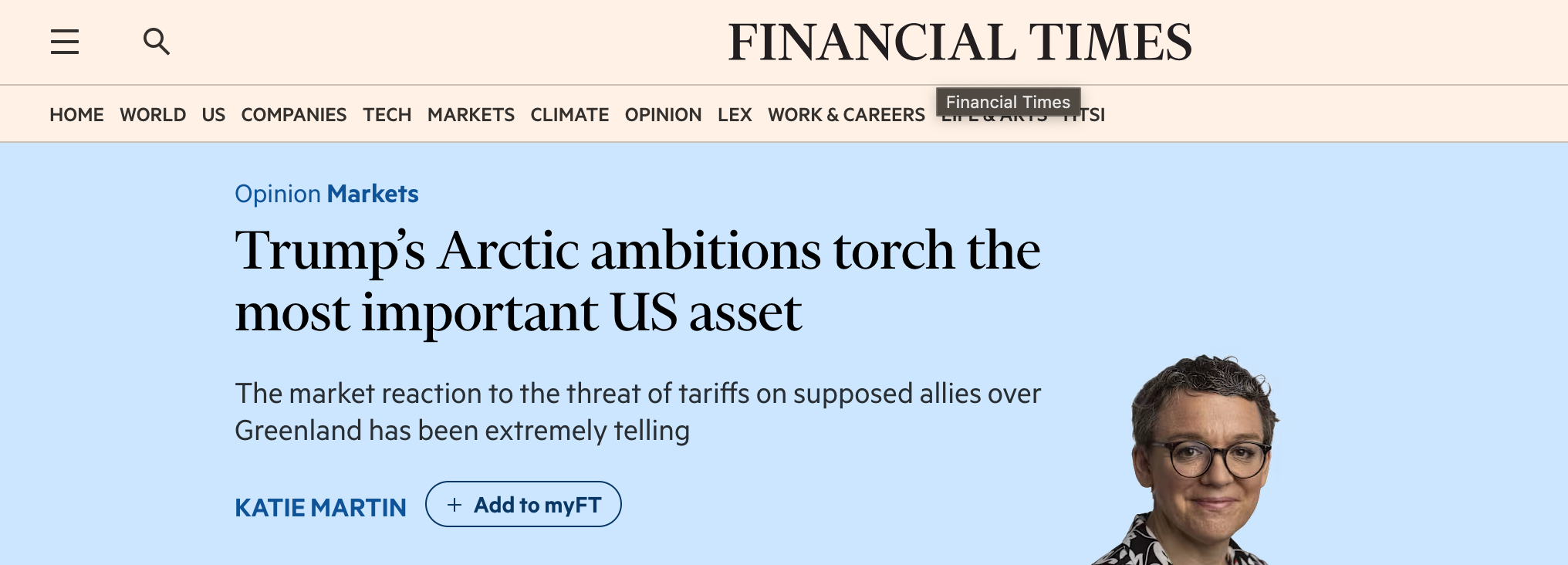
What connects Greenland, markets, and climate is not madness or ignorance. It is a worldview that treats interdependence as weakness, coordination as charity, and rules as optional for the powerful. It mistakes leverage for legitimacy. That mindset can dominate briefly. It cannot steward systems that require patience, mutual restraint, and long horizons. This is why the most credible warnings have not sounded hysterical. An intelligence analyst speaks of legitimacy collapse. A markets columnist describes trust as America’s most valuable financial asset, now squandered. Climate Journalists explain, almost wearily, why institutions still matter even when progress feels inadequate.
Different vocabularies, same diagnosis: in moments like these . . . what historian Heather Cox Richardson calls “hinge moments” . . . we might look to cultures with long memories of what happens when trust is broken, and what it takes to rebuild it. China’s history offers two parables that feel strikingly relevant.
The first is the Story of the Wooden Ox and the Gliding Horse (木牛流马). During the Three Kingdoms period, the strategist Zhuge Liang faced a seemingly impossible task: supplying his army through treacherous mountain passes. He could have commanded more porters, seized local resources, or demanded greater sacrifice from his men: short-term solutions that would have eroded morale and local trust. Instead, he invented the “Wooden Ox” and “Gliding Horse”: mechanical devices that eased the burden, improved efficiency, and sustained the campaign without exhausting the people or the land. The lesson was not about technological cleverness, but about governance through ingenuity and respect for systemic limits. He solved a logistics crisis by strengthening the system, not by plundering it.
The second is the ancient concept of Tian Xia (天下), often translated as “All Under Heaven.” Unlike empire, Tian Xia was not merely about control or domination. It was a framework for hierarchical harmony, where the ruler’s legitimacy depended on moral virtue, benevolence, and the maintenance of balance and trust between heaven, earth, and humanity. When rulers acted with ren (benevolence) and xin (trustworthiness), the system was stable and prosperity followed. When they ruled by force and deceit (ba dao, 霸道, instead of wang dao, 王道), the mandate was lost, and the system fractured. The fall of dynasties was often preceded not by external invasion, but by the internal erosion of xin (“trust”) between the ruler, the ministers, and the people.
These are not mere tales. They are echoes of a principle we are confronting globally: systems that rely on cooperation cannot be sustained by coercion. They require trust, maintained through consistent action, forethought, and respect for the whole.
For Teachers, Students, and Parents: The Hinge in the Classroom and the Home. These abstract fractures translate into concrete life paths. The “credibility risk” priced by bond traders today will shape the interest rates on your first home tomorrow. The unraveling of scientific cooperation will limit the tools you have to cope with a climate they inherit. This is not distant geopolitics: it is the architecture of your future. This is why this moment is a profound pedagogical imperative. We must move beyond teaching History as a series of past events, and toward systemic literacy: understanding how trust is built into institutions, how it is maintained, and how it is lost. Let the E.U.’s struggle for unity, or the parable of Zhuge Liang’s ingenuity, be your case studies. Let the question be: “What does trustworthy leadership look like in your community, your school, your friend group?”
The greatest antidote to cynicism is practiced integrity. For a student, that might mean rigorous citation in a paper, honoring a team commitment, or fact-checking a viral claim. For a parent or teacher, it means demonstrating that promises are kept, apologies are given, and processes are respected . . . especially when inconvenient. This is how trust is rebuilt: not with a single treaty, but through a multitude of micro-actions that make cooperation believable again.
There will be an equilibrium. But its shape . . . whether managed with wisdom like Zhuge Liang navigating the mountains, or forced through rupture like a dynasty losing the Mandate of Heaven . . . will depend not only on leaders in distant capitals, but on the culture of trust we nurture in our classrooms, families, and communities. We are all stewards of that culture now.
Systems that depend on trust do not collapse when they are attacked. They collapse when their participants, at every level, decide trust is no longer worth the effort.
The most urgent lesson we can teach, and learn, is that it is the only effort that ultimately matters.
– – –
Questions? Let’s chat. Send your questions to Climate Action Tiger and Youth4Planet’s chargé de mission Christian Thalacker christian@youth4planet.org
Further Reading:
- Financial Times Journalist Katie Martin’s opinion essay: “Trump’s Arctic ambitions torch the most important US asset . . . The market reaction to the threat of tariffs on supposed allies over Greenland has been extremely telling” #GiftLink https://giftarticle.ft.com/giftarticle/actions/redeem/d1e7ab3a-74f8-492e-b57d-988e88a15df4