Friday evening, along with more than hundred people in their seats at “Encore” in Luxembourg City . . . the gear-shaped trophies were shining on stage. Every second year, Eurosolar Lëtzebuerg’s Prix Solaire Luxembourgeois quietly gathers the country’s most determined solar innovators: citizens + communes + architects + cooperatives + educators . . . and entrepreneurs . . . into one room. It’s a gathering of people who are doing the work.

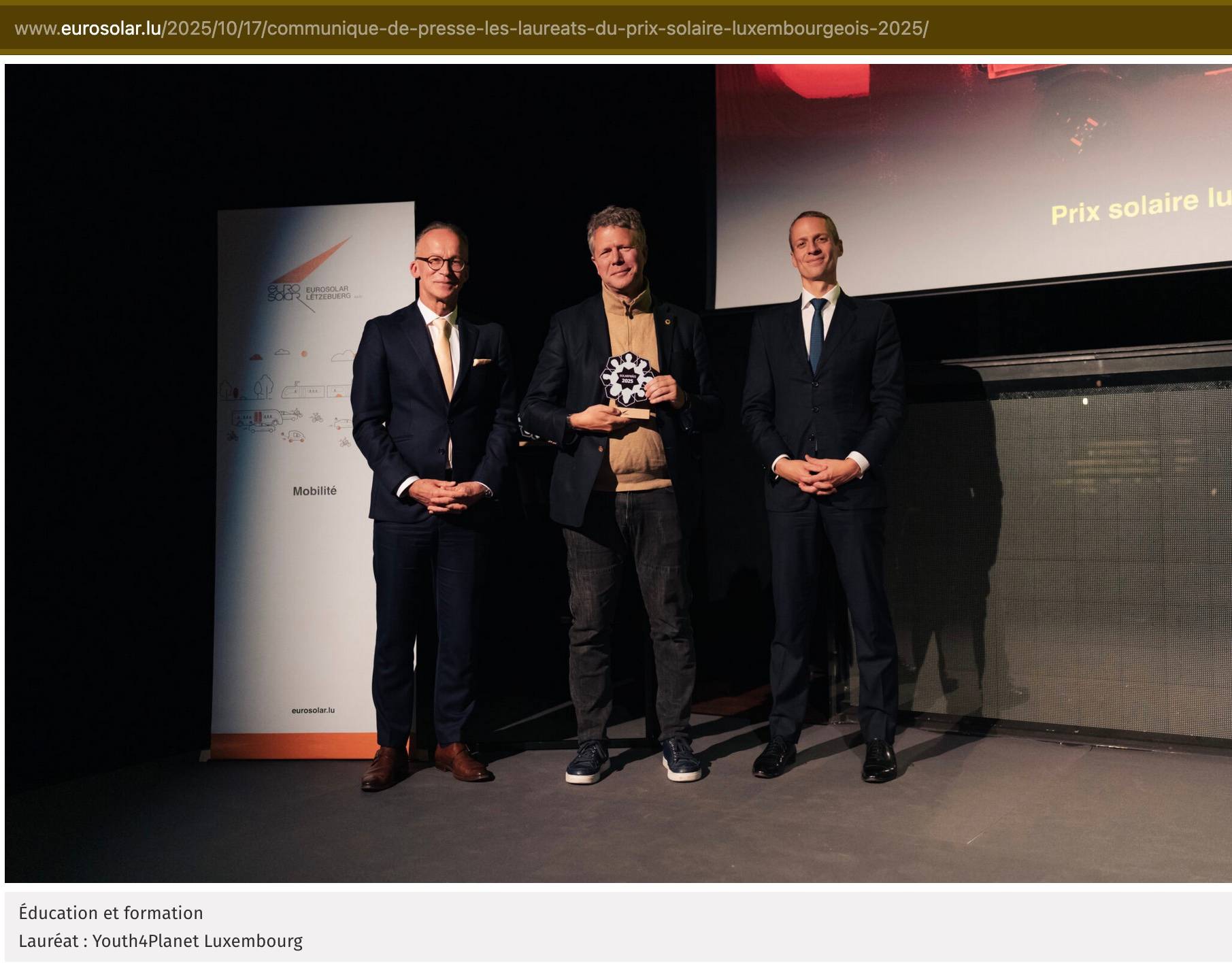
This year, Youth4Planet Luxembourg was honored to be considered in the Education and Training category . . . alongside St George’s International School and École Privée Notre-Dame Sainte-Sophie. Accepting the award on behalf of the CreatiVelo team, I was acutely aware that this was about recognizing a group of young people, builders, cyclists, educators, and storytellers who have decided that transition isn’t something to be explained from a podium but to be lived and shown on the streets.

The Eurosolar jury reflected the seriousness of the prize. Representatives came from the Ministry of the Economy + the OAI + the Klima-Agence + the Ministry of Environment . . . and the private sector. Their choices this year told a coherent story: the energy transition in Luxembourg is happening across multiple layers simultaneously: municipal + architectural + industrial + communal . . . and educational.

Communes like Niederanven are putting solar on rooftops and integrating photovoltaic canopies into everyday public infrastructure. Communities like Schwebach and Beckerich are demonstrating new models of collective energy production and storage, blending civic initiative with technical sophistication. Entrepreneurs like Solarcells and GPSS are investing in resiliency: domestic PV production and agrivoltaics. Individual citizens like the initiator of the HalerReimerStroos community energy group are proving that one committed person can bring dozens along. They are ALL correct.

In between the award categories, Eurosolar had brought in Timo Bovi, an energy market expert, to give a sober and data-rich presentation on the state of the solar+ sector. His slides told a story that should give pause to anyone still framing the transition as an aspiration. China has already crossed the 1,000 GW mark in installed solar capacity . . . the first country in the world to do so. Global investment in renewables is now outpacing oil, with grids, storage, and electrification surging behind it.
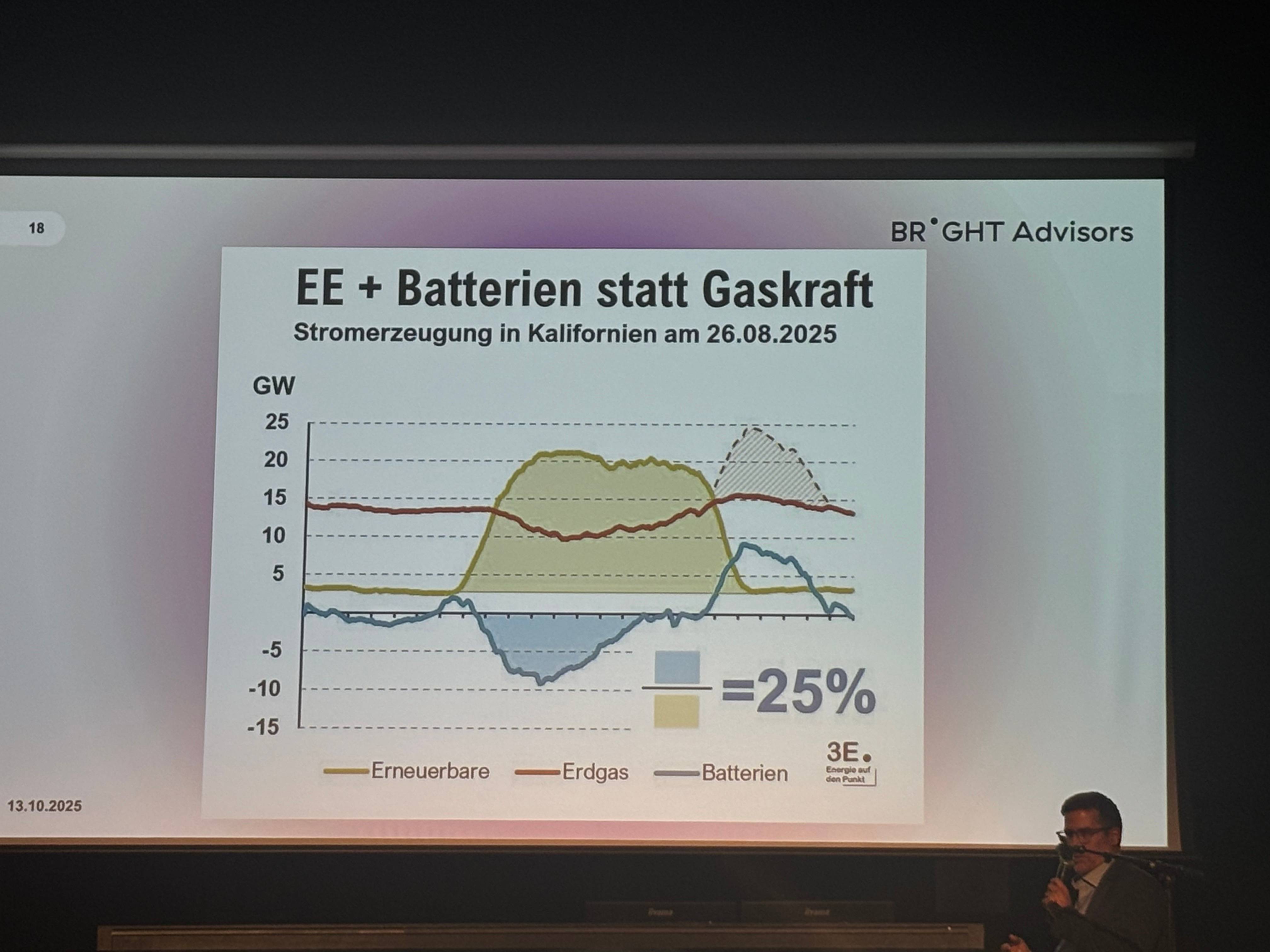
The transformation is technological AND economic. One chart showed the evolution of global energy investments over the past decade: oil plateauing, renewables accelerating, and storage growing into what was once a marginal segment. Another graph compared electricity generation costs in California: renewables plus batteries are now systematically displacing gas-fired generation on peak days, a clear operational reality, not a future scenario.
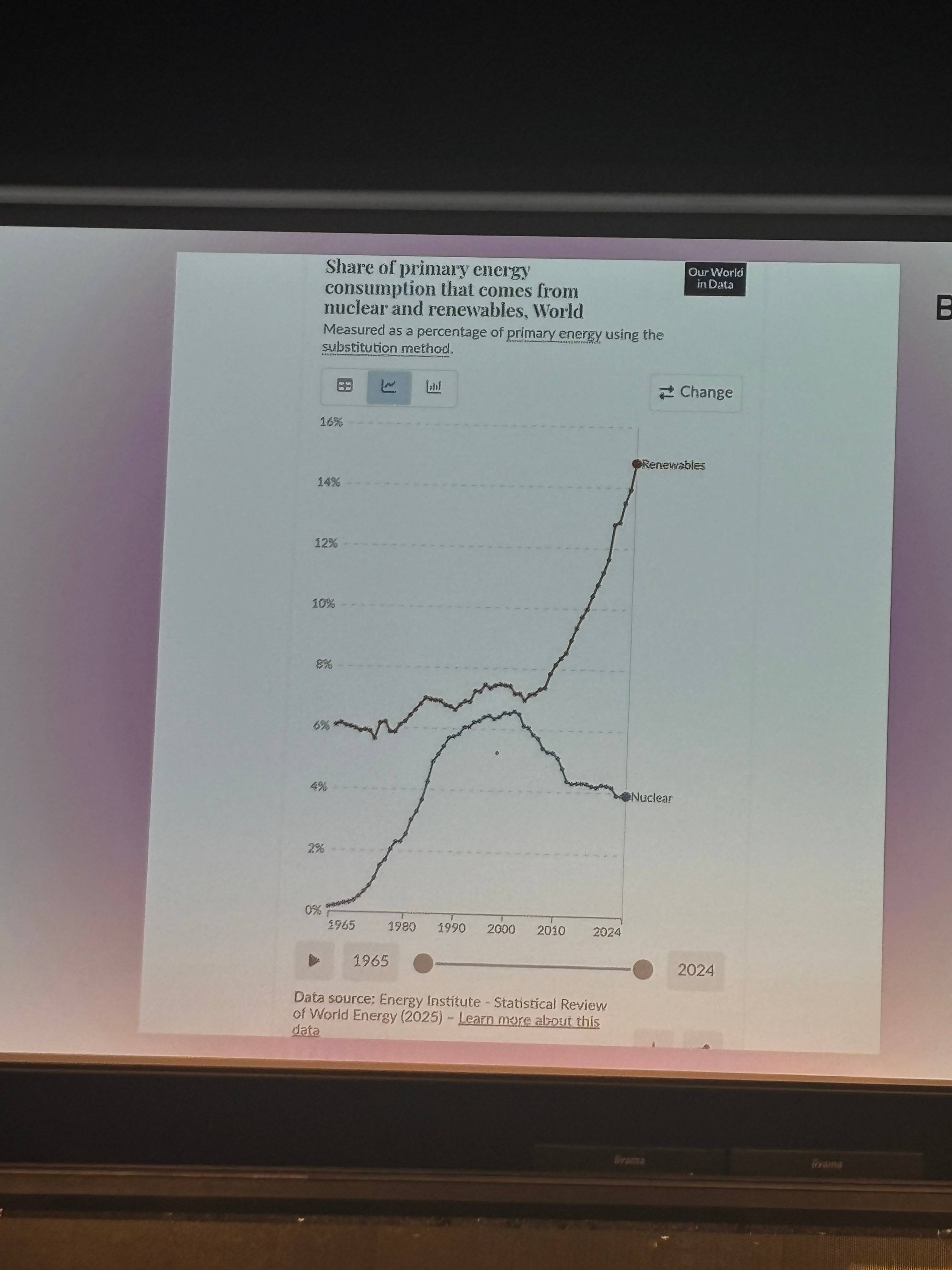
Perhaps the most striking image was a long historical chart: nuclear power, which dominated low-carbon generation in the 1990s, has steadily declined, while wind and solar have climbed from almost zero to overtake it globally in 2024. The share of primary energy consumption from renewables has risen sharply, while nuclear has lost ground. The implication was clear: the global energy landscape is no longer “in transition”; it has transitioned. What remains is for societies to catch up institutionally and culturally with that fact.
Luxembourg reflects many of these dynamics. The laureates on stage were not a monolithic bloc but a mosaic: municipal projects working hand in hand with citizens + industrial players testing new models + schools integrating solar into their pedagogy . . . and citizens experimenting with cooperative ownership. The projects in Beckerich and Schwebach were not glamorous, but they were systemic: using intelligent energy management and storage to create genuinely localized energy ecosystems. The Casa Dostert project showed what one household can become when design, technology, and open-source energy management converge. For Youth4Planet, receiving this prize is both a recognition and a challenge. The CreatiVelo project was never designed as an award-winning initiative: it was born in garages, on streets, and in workshops, trying to make climate action lived + tangible and joyful. Our young makers have built solar-charged cargo bikes, equipped them with storytelling panels, and ridden them across Luxembourg to collect voices, ideas, and commitments. They’ve done this not as one-off . . . or even occasional campaign, but as a practice of year-round, year-in, year-out civic agency. Standing on that stage, I thought about the people in the audience . . . municipal leaders, engineers, teachers, policy makers . . . and about how their efforts intersect. The energy transition is not the work of isolated heroes but of interlocking communities. Eurosolar’s prize doesn’t just celebrate projects; it makes visible a distributed movement that rarely gets the analytical attention it deserves.
Timo’s presentation added a layer of urgency to this celebration. Luxembourg’s future energy story will be written against the backdrop of a rapidly shifting global market. The numbers he showed . . . especially on declining industrial electricity prices after the 2022 shock . . . reminded the audience that the economics of renewables are no longer “fragile”. The question is no longer whether solar can compete. The question is whether societies can reorganize fast enough to integrate renewable + battery storage energy intelligently. The ceremony (on stage) ended with a tribute to Henri Kox and Guy Weiler, two pioneers of Luxembourg’s solar movement. Their decades of work predated the charts and the investment curves. They started when the notion of a solar Luxembourg was utopian. Seeing them stand there, next to young educators, municipal representatives, and cooperative founders, gave the evening its quiet weight.
Leaving the venue, trophy in hand, I thought less about the prize itself and more about the solidarity . . . and the trajectory . . . it represents. Luxembourg has the ingredients to make our energy transition real: engaged communes, inventive citizens, committed educators, pioneering entrepreneurs, and increasingly favorable market dynamics. The challenge is not inspiration; it’s integration. Youth4Planet is proud to play a part in this mosaic . . . not as a loud voice . . . as a persistent, creative one. The energy transition is here. Our job now is to make it livable, local, and shared.
Further reading:
- EuroSolar Lëtzebuerg Press Release: https://www.eurosolar.lu/2025/10/17/communique-de-presse-les-laureats-du-prix-solaire-luxembourgeois-2025/