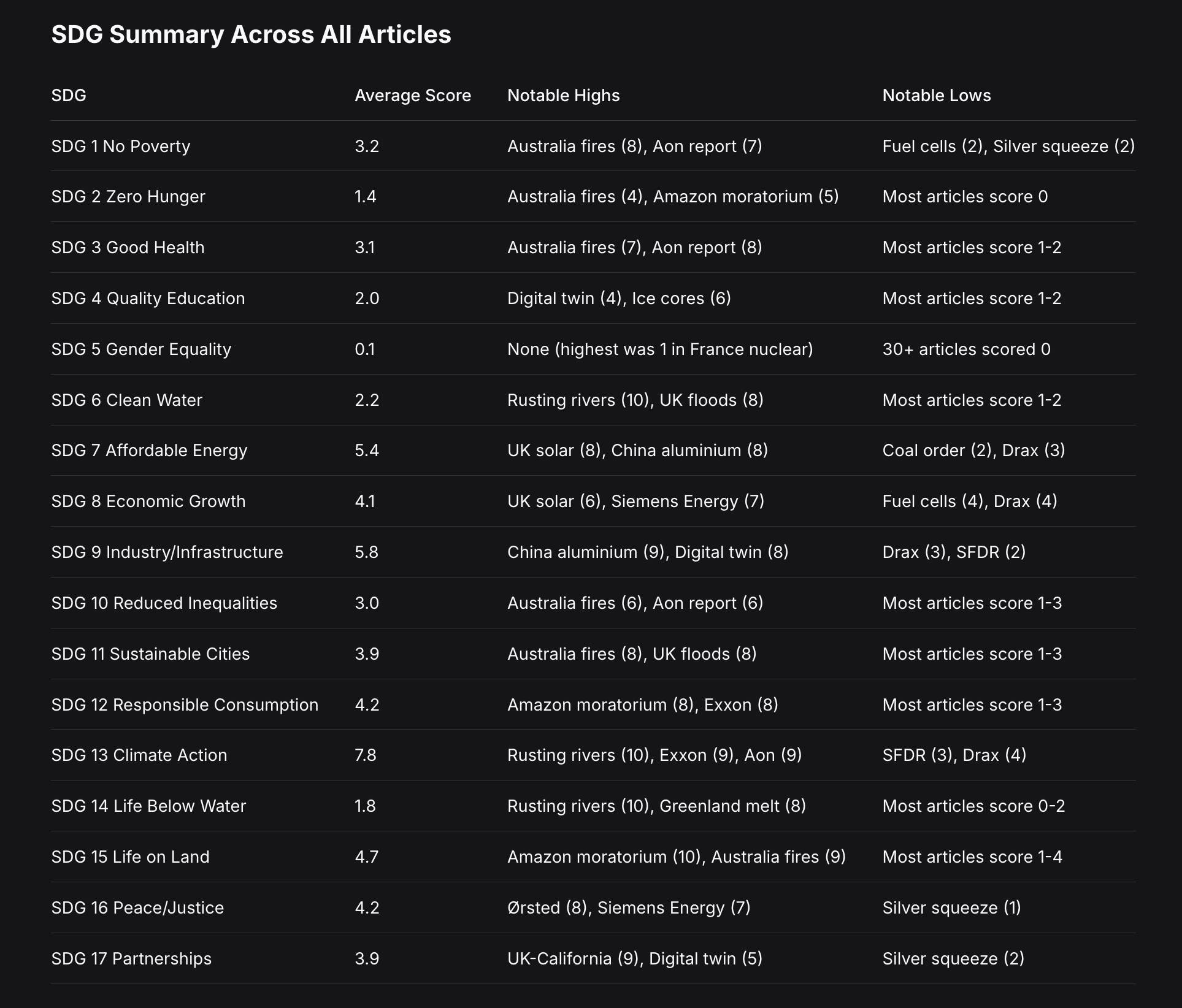
The US withdrawal from the UNFCCC and the assault on offshore wind are met with court interventions, subnational alliances, and a strategic European pivot toward energy independence. The climate system itself is sending ever-louder warnings. . . rusting Arctic rivers, record-breaking storms, and a $127bn insured loss bill. . . while the political economy of transition reveals new fault lines: the silver squeeze threatening solar deployment, the SFDR’s failure to move capital, and the quiet retreat of corporate sustainability under political pressure. The consistent weakness across nearly all reporting remains the near-total neglect of gender equality (SDG 5), with scores of 0 or 1 the norm. This is not a failure of individual journalists but a systemic blind spot in how climate and economic stories are framed.
Thematic Analysis:
1. The Policy Volatility Trap
Multiple articles document the cost of political instability. The Trump administration’s suspension of offshore wind leases cost Ørsted a DKr600mn impairment. Siemens Energy’s CEO publicly pleaded for “stability” while committing $1bn to the US. The EV industry took a $65bn writedown as policy reversed. The message is clear: climate investment requires predictable rules, and volatility has a price.
2. The Resistance is Real
Against the rollback, resistance is visible. Courts lifted the offshore wind suspensions. California and the UK signed a clean energy deal. Europe is accelerating its offshore wind build-out in response to Greenland threats. Bloomberg stepped into the funding gap left by US withdrawal from the UNFCCC. Subnational and non-state actors are not waiting for Washington.
3. The Climate System is Waking Up
The science is becoming impossible to ignore. Arctic rivers are turning orange as permafrost thaws. The polar vortex is destabilizing, bringing record snow and cold even as the planet warms. LA fires caused $58bn in losses. European heatwaves killed 24,400 people. Insured losses hit $127bn globally. The IPCC’s warnings are no longer future projections; they are quarterly earnings reports and death certificates.
4. The Transition is Real, but Fragile
Positive signals are visible. EV sales overtook petrol in Europe for the first time in December. The UK awarded record solar contracts. China is relocating aluminium smelters to renewable energy zones. But fragility abounds: the silver squeeze threatens solar costs, the SFDR failed to move capital, and the Drax scandal reveals the gap between sustainability claims and reality.
5. The China Factor
China is the undisputed leader in clean tech manufacturing, from EVs to solar to green aluminium. The EU’s CBAM is working, driving Chinese producers to decarbonize to maintain market access. But Chinese companies are also expanding coal-powered capacity in Indonesia, and the human rights dimension in Xinjiang remains unaddressed. China is both the solution and the problem.
6. The Persistent Blind Spot: SDG 5
Across 35 articles, SDG 5 (Gender Equality) scores are almost uniformly 0 or 1. The Australian fires article mentions a father and daughter; the LA fires article mentions losses; the overshoot day article mentions national consumption. Nowhere is the gendered nature of climate impact . . . the disproportionate burden on women in poverty, in care roles, in disaster recovery. . . analyzed or even acknowledged. This is the single greatest weakness of the period’s reporting.
Further Reading:
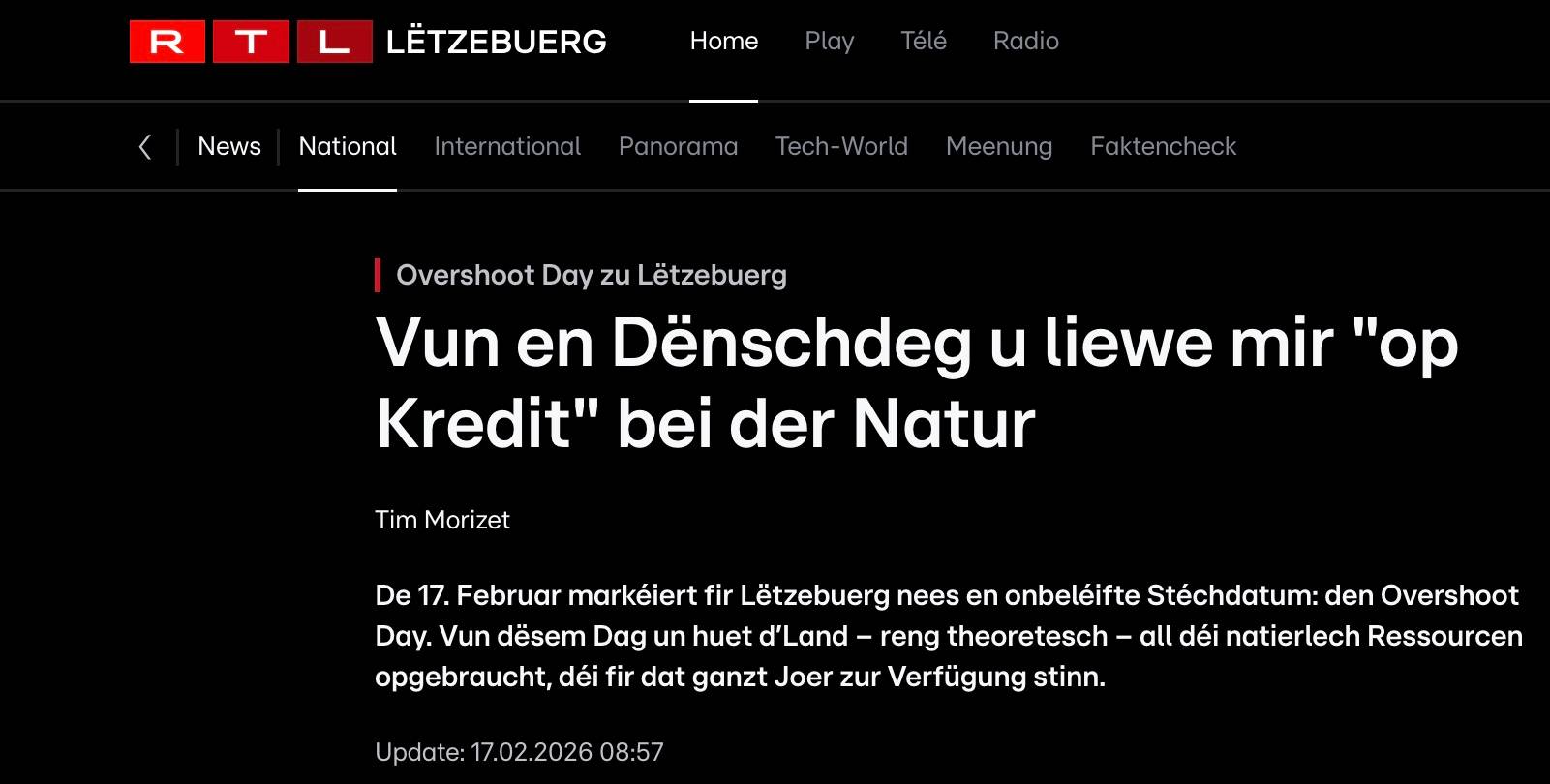
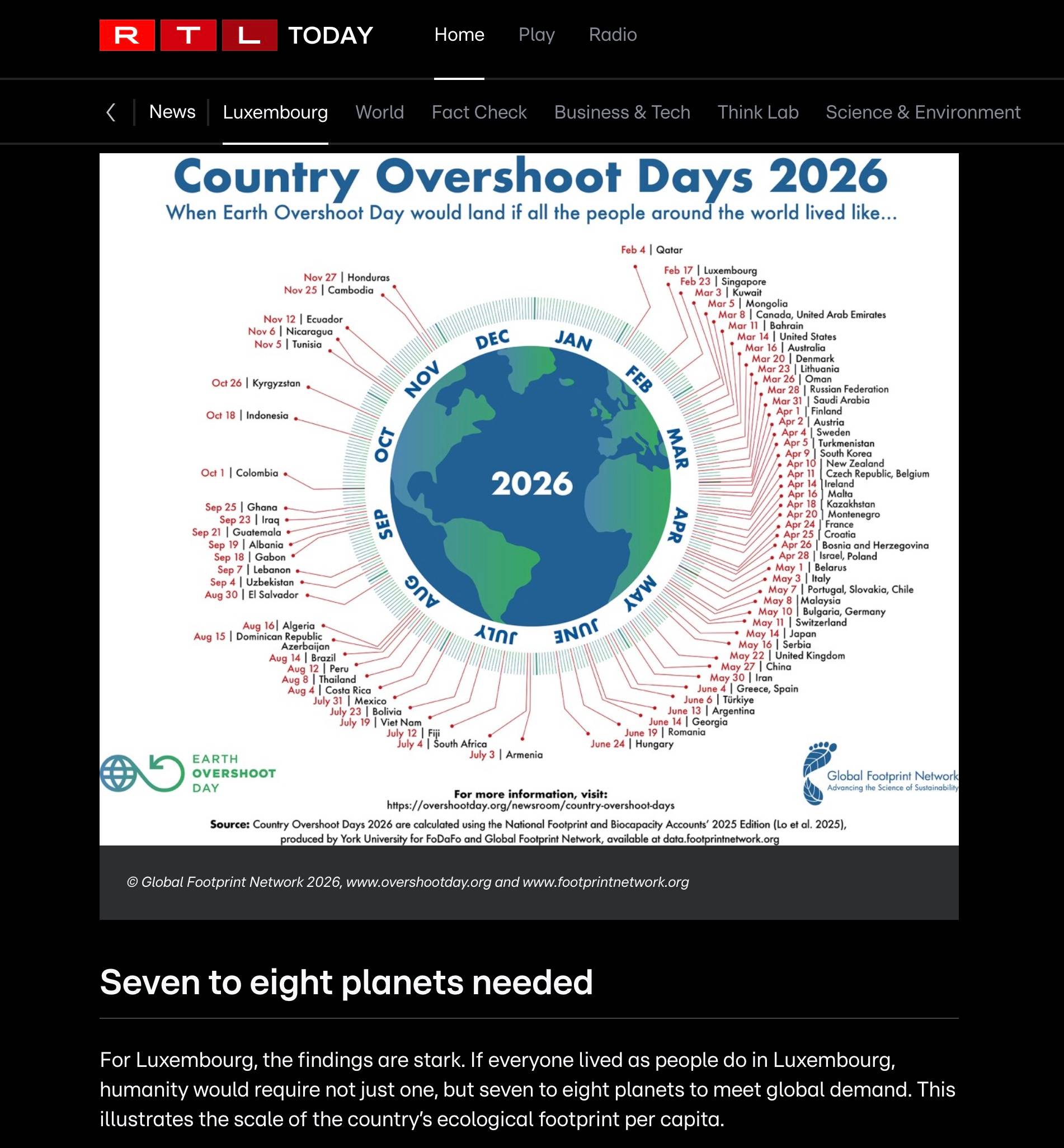
- 17th February 2026 – RTL Today Journalist Tim Morizet reviews The Grand Duchy of Luxembourg’s over-consumption lifestyle would require 7 to 8 Planet Earths if adopted globally. 17 February once again marks an unwelcome milestone for Luxembourg: Overshoot Day. From this date onwards, the country has, at least in theory, used up all the natural resources available for the entire year https://today.rtl.lu/news/luxembourg/overshoot-day-seven-to-eight-planets-needed-if-all-lived-like-luxembourg-1057340289
- Overall C.A.T. Usefulness: 6/10 ★★★★★★☆☆☆☆
- Strengths: This RTL Today article serves as a clear, data-driven, and locally relevant awareness tool, exactly as the NGOs quoted intend. It effectively communicates a complex global issue (resource consumption) through a concrete, local milestone (17th February 2026). The news articles grounds abstract concepts like the “ecological footprint” in the lived reality of a specific population, making the unsustainability of the current model tangible. The comparison to better-performing European countries (Albania, Armenia, Hungary, Romania, Greece, Spain, Serbia, Portugal, Switzerland, Bulgaria, Germany, Slovakia, Poland, Montenegro, Czech Republic, Belgium, Sweden, Denmark, and more) provides useful, hopeful contrasts . . . and a clear benchmark.
- Weaknesses: The article’s strength as a simple awareness tool is also its analytical weakness. It diagnoses the symptom (high per-capita consumption) but offers only a superficial exploration of the root causes. “High standard of living,” “population growth,” and “fuel tourism” are mentioned, but the underlying political economy . . . namely, the tax policies that incentivize fuel tourism, the land-use planning rules that shape infrastructure, the absence of binding consumption-reduction targets . . . is left unexplored. The solutions are placed almost entirely on individual choices (“purchasing and eating habits”), which directly contradicts the “systemic change, not individual guilt” lever that C.A.T. prioritizes.
- Opportunities for C.A.T.: This piece provides a perfect local “hook” to start a conversation. For a Luxembourg-based audience, this date is a powerful, annual reality check. C.A.T. can use this article to pivot from the “what” (Overshoot Day) to the “why” (systemic drivers) and “how” (policy levers like those used in Belgium, Denmark and Switzerland). It’s a prime example of the “high-resolution realism” Christian advocates for: understanding the local manifestation of a global problem.
- Threats: The article’s framing could inadvertently reinforce the very “individual guilt” narrative it partially endorses. Readers may feel morally pressured to change their consumption without seeing a parallel pathway for collective political action, leading to eco-fatigue or cynicism. The “seven to eight planets” statistic, while powerful, can also induce a sense of hopeless scale if not immediately paired with concrete, systemic solutions.
- SDG Ratings:
SDG 1 No Poverty: 3/10 ★★★☆☆☆☆☆☆☆
SDG 2 Zero Hunger: 4/10 ★★★★☆☆☆☆☆☆
SDG 3 Good Health and Well-Being: 5/10 ★★★★★☆☆☆☆☆
SDG 4 Quality Education: 6/10 ★★★★★★☆☆☆☆
SDG 5 Gender Equality: 0/10 ☆☆☆☆☆☆☆☆☆☆
SDG 6 Clean Water and Sanitation: 5/10 ★★★★★☆☆☆☆☆
SDG 7 Affordable and Clean Energy: 5/10 ★★★★★☆☆☆☆☆
SDG 8 Decent Work and Economic Growth: 4/10 ★★★★☆☆☆☆☆☆
SDG 9 Industry, Innovation and Infrastructure: 5/10 ★★★★★☆☆☆☆☆
SDG 10 Reduced Inequalities: 3/10 ★★★☆☆☆☆☆☆☆
SDG 11 Sustainable Cities and Communities: 7/10 ★★★★★★★☆☆☆
SDG 12 Responsible Consumption and Production: 8/10 ★★★★★★★★☆☆
SDG 13 Climate Action: 7/10 ★★★★★★★☆☆☆
SDG 14 Life Below Water: 2/10 ★★☆☆☆☆☆☆☆☆
SDG 15 Life on Land: 6/10 ★★★★★★☆☆☆☆
SDG 16 Peace, Justice and Strong Institutions: 2/10 ★★☆☆☆☆☆☆☆☆
SDG 17 Partnerships for the Goals: 3/10 ★★★☆☆☆☆☆☆☆
- SDG Ratings:
- Overall C.A.T. Usefulness: 6/10 ★★★★★★☆☆☆☆
- 17th February 2026 – Financial Times Journalists Jana Tauschinski, Justine Williams, and Eva Xiao report why rivers in the far north are turning orange . . . The brightly coloured waterways in the Arctic are a sign that permafrost is thawing, with potentially hazardous consequences https://www.ft.com/content/2ffab7c1-07a7-4fbb-812a-3d69dc0c2aea
- Overall C.A.T. Usefulness: 10/10 ★★★★★★★★★★
- Strengths: This is a masterclass in environmental journalism. It takes a complex, emerging, and deeply alarming scientific phenomenon . . . the “rusting” of Arctic rivers due to permafrost thaw . . . and makes it viscerally real. The piece excels by grounding the abstract in tangible evidence (orange water visible from space, undrinkable tap water, disappearing fish), weaving a multi-layered narrative that connects hard science, on-the-ground reporting, and systemic geopolitical context, and demonstrating systems thinking by perfectly illustrating a self-reinforcing climate tipping point.
- Weaknesses: The article has no significant weaknesses. Its purpose is to diagnose and reveal, which it does with exceptional clarity and power. The lack of a neatly packaged “solution” is not a weakness, but a faithful reflection of the reality it describes.
- Opportunities for C.A.T.: This article is a foundational text. It provides C.A.T. with the ultimate evidence for the reality of self-perpetuating tipping points, the concept of “committed” climate change, the blind spots in climate accounting, and the deep interconnectedness of the SDGs.
- Threats: The primary threat from this kind of reporting is the potential for “doomism” and paralysis. The bleak outlook, stated plainly by those who live it, can be overwhelming. The challenge is to use this truth to fuel a demand for radical prevention elsewhere, not to succumb to despair.
- SDG Ratings:
SDG 1 No Poverty: 8/10 ★★★★★★★★☆☆
SDG 2 Zero Hunger: 9/10 ★★★★★★★★★☆
SDG 3 Good Health and Well-Being: 9/10 ★★★★★★★★★☆
SDG 4 Quality Education: 5/10 ★★★★★☆☆☆☆☆
SDG 5 Gender Equality: 0/10 ☆☆☆☆☆☆☆☆☆☆
SDG 6 Clean Water and Sanitation: 10/10 ★★★★★★★★★★
SDG 7 Affordable and Clean Energy: 0/10 ☆☆☆☆☆☆☆☆☆☆
SDG 8 Decent Work and Economic Growth: 7/10 ★★★★★★★☆☆☆
SDG 9 Industry, Innovation and Infrastructure: 3/10 ★★★☆☆☆☆☆☆☆
SDG 10 Reduced Inequalities: 9/10 ★★★★★★★★★☆
SDG 11 Sustainable Cities and Communities: 8/10 ★★★★★★★★☆☆
SDG 12 Responsible Consumption and Production: 1/10 ★☆☆☆☆☆☆☆☆☆
SDG 13 Climate Action: 10/10 ★★★★★★★★★★
SDG 14 Life Below Water: 10/10 ★★★★★★★★★★
SDG 15 Life on Land: 10/10 ★★★★★★★★★★
SDG 16 Peace, Justice and Strong Institutions: 8/10 ★★★★★★★★☆☆
SDG 17 Partnerships for the Goals: 7/10 ★★★★★★★☆☆☆
- SDG Ratings:
- Overall C.A.T. Usefulness: 10/10 ★★★★★★★★★★
- 16th February 2026 – Financial Times Journalist Kenza Bryan reports that California has struck its first clean power deal with the UK as the US energy sector weighs the consequences of Donald Trump’s latest attacks on climate regulation. The high-level agreement signed by UK energy secretary Ed Miliband and California’s Democratic governor Gavin Newsom in London on Monday aims to boost technology sharing and mutual investment in the “global race for clean power”, the UK government said https://www.ft.com/content/9cc9a2c6-2135-4924-aa79-47ffc10eb724
- Overall C.A.T. Usefulness: 9/10 ★★★★★★★★★☆
- Strengths: This article is a sharp piece of political and economic reporting that perfectly captures the moment of “simultaneous outcomes”. Its strengths lie in:
- Demonstrating Subnational Agency: It shows how, in the face of federal rollback (Trump’s EPA repeal), state-level actors (California) can forge their own international alliances, effectively becoming foreign policy actors on climate.
- Connecting Politics and Economics: It links the political positioning of Miliband and Newsom to concrete economic flows including $1bn in investment, technology deployment, and job creation claims. It makes the case that clean energy is now a competitive race.
- Highlighting the “Resistance” Narrative: It frames the deal not just as a trade agreement, but as a deliberate act of counter-mobilization against a hostile federal government, giving it a sharp governance and democracy angle.
- Grounding in Real Assets: The mention of Octopus Energy’s specific investments (carbon removal, heat batteries, solar) moves the story from pure political symbolism to tangible capital allocation.
- Weaknesses: The article is primarily a top-down political and corporate story. The voice of communities and workers is absent. Explore the potential equity implications of these investments: who benefits from the “skilled jobs,” and the land-use implications of grassland restoration and reforestation projects in California.
- Opportunities for C.A.T.: This piece provides C.A.T. with a powerful case study of “Partnerships for the Goals” (SDG 17) in action as a direct response to institutional failure (SDG 16). It is a perfect example of how climate action can proceed through pluri-lateral and sub-national channels even when multi-lateralism is in retreat. It also offers a tangible link between high-level policy and private investment flows.
- Threats: The framing risks over-personalizing complex economic and energy systems around political figures and corporations. This obscures the deeper, systemic changes still required and creates a dangerous dependency: if these figures lose power or these corporate strategies shift, the narrative of progress collapses. It risks making subnational action look like a sufficient substitute for, rather than a pressure tactic to achieve, binding federal and international policy.
- Strengths: This article is a sharp piece of political and economic reporting that perfectly captures the moment of “simultaneous outcomes”. Its strengths lie in:
- Overall C.A.T. Usefulness: 9/10 ★★★★★★★★★☆
- 15th February 2026 – Financial Times Journalists Kana Inagaki & Harry Dempsey report that the reversal in electric vehicle ambitions has resulted in a hit of at least $65 billion for the global car industry in the past year as executives warned of more pain ahead in resetting their strategies. Carmakers were forced to overhaul their EV product and investment plans following a radical reversal in climate policy in the US, with companies that had made the biggest pivot away from petrol hit the hardest https://www.ft.com/content/2daa41c3-3721-46d1-8954-7c43d5149995
- Overall C.A.T. Usefulness: 8/10 ★★★★★★★★☆☆
- Strengths: This article provides a stark, data-rich account of how policy volatility and corporate group-think can collide to derail climate-aligned industrial strategy. Its key strengths are:
- Quantifying the Damage: The $65 billion figure is a powerful headline that translates abstract “policy risk” into concrete balance-sheet losses.
- Naming the Cause: It directly links the write-downs to the “radical reversal in climate policy in the US” under Trump, offering clear causal evidence for C.A.T.’s argument that political stability is a precondition for private investment.
- Exposing Corporate Euphoria: The Bernstein analyst quote about getting “caught up in the kind of euphoria of ‘look at the valuations Tesla was getting'” is a valuable admission that corporate strategy was driven by financial FOMO, not grounded in consumer readiness or infrastructure reality.
- Highlighting the Divergence: It notes the growing divergence between the US and Chinese markets, which will have profound geopolitical and industrial consequences.
- Weaknesses: The article’s framing is almost entirely from the perspective of the carmakers and their shareholders. The $65 billion “hit” is their loss. There is no analysis of what this means for:
- Climate goals: The emissions implications of reviving V8 and diesel engines are mentioned only in passing, not quantified or treated as the story’s central tragedy.
- Workers: The impact on employment in EV-focused factories versus retooling for combustion engines is absent.
- Consumers: The focus is on what consumers didn’t want (expensive EVs), not on what policy failed to provide (affordable models, charging infrastructure, purchase incentives).
- Competition: China’s continued EV ascent is noted but not explored as the context for the West’s retreat.
- Opportunities for C.A.T.: This article is a powerful piece of evidence for C.A.T.’s “high-resolution realism.” It demonstrates that the transition is not a smooth line but a contested, reversible political struggle. It can be used to argue that private capital, left to follow “euphoria,” will overbuild and then retreat, and that only durable, cross-party policy frameworks can provide the certainty needed for a just and rapid transition.
- Threats: The biggest threat is how this story will be weaponized. It will be used by climate delayers as proof that “the market has spoken” and the EV transition was a mistake. If the narrative focuses only on the corporate writedowns and not on the policy vandalism (US rollback) and industrial failure (inability to make affordable EVs) that caused them, it will reinforce fatalism and accelerate the very retreat it documents.
- SDG Ratings:
- SDG 1 No Poverty: 3/10 ★★★☆☆☆☆☆☆☆
- SDG 2 Zero Hunger: 0/10 ☆☆☆☆☆☆☆☆☆☆
- SDG 3 Good Health and Well-Being: 4/10 ★★★★☆☆☆☆☆☆
- SDG 4 Quality Education: 2/10 ★★☆☆☆☆☆☆☆☆
- SDG 5 Gender Equality: 0/10 ☆☆☆☆☆☆☆☆☆☆
- SDG 6 Clean Water and Sanitation: 0/10 ☆☆☆☆☆☆☆☆☆☆
- SDG 7 Affordable and Clean Energy: 7/10 ★★★★★★★☆☆☆
- SDG 8 Decent Work and Economic Growth: 6/10 ★★★★★★☆☆☆☆
- SDG 9 Industry, Innovation and Infrastructure: 8/10 ★★★★★★★★☆☆
- SDG 10 Reduced Inequalities: 3/10 ★★★☆☆☆☆☆☆☆
- SDG 11 Sustainable Cities and Communities: 4/10 ★★★★☆☆☆☆☆☆
- SDG 12 Responsible Consumption and Production: 5/10 ★★★★★☆☆☆☆☆
- SDG 13 Climate Action: 6/10 ★★★★★★☆☆☆☆
- SDG 14 Life Below Water: 0/10 ☆☆☆☆☆☆☆☆☆☆
- SDG 15 Life on Land: 1/10 ★☆☆☆☆☆☆☆☆☆
- SDG 16 Peace, Justice and Strong Institutions: 7/10 ★★★★★★★☆☆☆
- SDG 17 Partnerships for the Goals: 4/10 ★★★★☆☆☆☆☆☆
- Strengths: This article provides a stark, data-rich account of how policy volatility and corporate group-think can collide to derail climate-aligned industrial strategy. Its key strengths are:
- Overall C.A.T. Usefulness: 8/10 ★★★★★★★★☆☆
- 13th February 2026 – Financial Times Journalists Alice Hancock, Peter Foster, and Peter Campbell report that Air France-KLM has warned it will be forced to cut almost half its flights to Asia if the EU does not pare back climate policies that leave the industry at a “significant competitive disadvantage” against rivals. Benjamin Smith, chief executive, said regulations requiring EU airlines to use increasing amounts of expensive sustainable aviation fuel (SAF) would hobble EU airlines’ ability to compete on routes from Europe into Asia https://www.ft.com/content/c275cac0-3743-4b99-9a05-b58cb064882b
- Overall C.A.T. Usefulness: 7/10 ★★★★★★★☆☆☆
- Strengths: This article provides a clear and detailed account of a classic climate policy dilemma: the tension between ambitious unilateral regulation and industrial competitiveness. Its key strengths are:
- Articulating the Industry Case: It gives full voice to the airline industry’s argument that uneven Sustainable Aviation Fuel mandates create a “significant competitive disadvantage,” using concrete data (route forecasts, price comparisons) and a clear causal mechanism (the hub model allowing non-EU carriers to bypass costs).
- Quantifying the Distortion: The Deloitte modelling (15% price advantage for non-EU carriers by 2030) and the map visual effectively illustrate the competitive mechanics at play.
- Naming the Policy Response: It reports the industry’s proposed solution . . . an SAF Border Adjustment Mechanism (SAF-BAM) . . . in detail, showing how climate policy is now forcing innovation in trade mechanisms.
- Including the Counterview: The article notes that Gulf airports are expanding and that Turkey has its own SAF mandates, complicating a simple “EU good, rivals bad” narrative. The final letter from Diane Vitry, Aviation Director, Transport & Environment provides a crucial environmental counterweight: https://www.ft.com/content/854da576-7ad1-4710-9358-5531e962982f
- Weaknesses: The article’s framing is heavily shaped by the industry’s perspective. While it reports on the problem and the industry’s proposed solution, it gives less weight to critical questions:
- Is SAF the only answer? The focus is entirely on SAF costs, with almost no discussion of demand reduction (fewer flights), modal shift (trains), or the fundamental emissions problem of a growing aviation sector.
- What about the “carbon loophole”? The piece does not adequately explore the fact that the rival hubs (Dubai, Doha, Istanbul) are themselves major emitters, and that the “leakage” is not just economic but also environmental.
- Who speaks for the climate? The industry lobby (A4E) dominates the quotes. The environmental group’s view is relegated to a letter, not integrated into the main analysis.
- Opportunities for C.A.T.: This article is a perfect case study for C.A.T.’s “systems thinking” lens. It connects climate policy (SAF mandates), industrial competitiveness (airline routes), trade law (border adjustment mechanisms), and geopolitics (Gulf expansion). It demonstrates that climate action cannot be siloed from trade and industrial strategy, and that “leakage” is a real and politically potent force that must be addressed head-on.
- Threats: The biggest threat is that the article’s framing will be used to argue for weakening the SAF mandate, precisely the outcome the industry lobby seeks. If the “competitiveness” argument is accepted uncritically, it could lead to a race to the bottom on aviation fuel standards, rather than a race to the top through mechanisms like the proposed SAF-BAM that would level up, not level down.
- SDG Ratings:
- SDG 1 No Poverty: 2/10 ★★☆☆☆☆☆☆☆☆
- SDG 2 Zero Hunger: 0/10 ☆☆☆☆☆☆☆☆☆☆
- SDG 3 Good Health and Well-Being: 2/10 ★★☆☆☆☆☆☆☆☆
- SDG 4 Quality Education: 2/10 ★★☆☆☆☆☆☆☆☆
- SDG 5 Gender Equality: 0/10 ☆☆☆☆☆☆☆☆☆☆
- SDG 6 Clean Water and Sanitation: 0/10 ☆☆☆☆☆☆☆☆☆☆
- SDG 7 Affordable and Clean Energy: 5/10 ★★★★★☆☆☆☆☆
- SDG 8 Decent Work and Economic Growth: 6/10 ★★★★★★☆☆☆☆
- SDG 9 Industry, Innovation and Infrastructure: 7/10 ★★★★★★★☆☆☆
- SDG 10 Reduced Inequalities: 3/10 ★★★☆☆☆☆☆☆☆
- SDG 11 Sustainable Cities and Communities: 2/10 ★★☆☆☆☆☆☆☆☆
- SDG 12 Responsible Consumption and Production: 6/10 ★★★★★★☆☆☆☆
- SDG 13 Climate Action: 6/10 ★★★★★★☆☆☆☆
- SDG 14 Life Below Water: 0/10 ☆☆☆☆☆☆☆☆☆☆
- SDG 15 Life on Land: 1/10 ★☆☆☆☆☆☆☆☆☆
- SDG 16 Peace, Justice and Strong Institutions: 4/10 ★★★★☆☆☆☆☆☆
- SDG 17 Partnerships for the Goals: 5/10 ★★★★★☆☆☆☆☆
- Strengths: This article provides a clear and detailed account of a classic climate policy dilemma: the tension between ambitious unilateral regulation and industrial competitiveness. Its key strengths are:
- Overall C.A.T. Usefulness: 7/10 ★★★★★★★☆☆☆
- 12th February 2026 – Financial Times Journalist Attract Mooney reports that The UN is seeking to draw corporate leaders back to global climate talks, arguing that the summit process is entering a “new era” that is focused less on pledges and will bring more opportunities for investment. The approach comes as many companies have backtracked on green pledges amid a political backlash led by US President Donald Trump, who has attacked clean energy policies and withdrawn from the UN climate treaty, and as economic pressures weigh on boardroom priorities https://www.ft.com/content/4d10659b-7987-4c74-a423-5c197e392e35
- Overall C.A.T. Usefulness: 8/10 ★★★★★★★★☆☆
- Strengths: This article provides a clear-eyed assessment of the evolving COP process in a hostile geopolitical environment. Its key strengths are:
- Naming the Strategic Pivot: It captures the UN’s deliberate shift from “pledges” to “implementation” and investment as a necessary adaptation to both business retreat and political backlash. Simon Stiell’s framing of a “new era” and “new world disorder” is analytically useful.
- Grounding in Data: The IEA figures on clean energy investment ($2.2tn vs $1.1tn for fossil fuels) and China’s dominant role provide a factual counterweight to the narrative of pure retreat.
- Identifying the Tension: The article subtly highlights the gap between the UN’s investment-focused ambition and Turkey’s domestic framing (tourism, waste, individual action), which notably omitted the fossil fuel transition roadmap.
- Contextualizing Business Absence: It acknowledges the thinning corporate attendance at recent COPs and the logistical challenges, providing a realistic picture of the summit’s current standing.
- Weaknesses: The article’s primary weakness is its descriptive, rather than interrogative, stance. It reports the UN’s strategy and Turkey’s launch but does not critically examine:
- The “Investment” Assumption: Is more corporate investment in clean tech sufficient? The article does not question whether the kind of investment being courted (voluntary, profit-driven) can deliver the scale and speed required, or whether it risks repeating the failures of carbon markets.
- The Omission: Turkey’s failure to mention the fossil fuel transition roadmap is noted but not probed. What does this silence signal about its presidency? The article misses an opportunity to ask whether “concrete results” and “investment” are being used to sidestep the harder political conflict over fossil fuels.
- The “Zero Waste” Framing: The promotion of Turkey’s first lady’s “zero waste” initiative, focused on individual action, sits in direct tension with the UN’s stated need for systemic change and “big sectoral dealmaking.” This contradiction is observed but not analyzed.
- Opportunities for C.A.T.: This article provides C.A.T. with a valuable case study in institutional adaptation and the limits of multilateralism. It can be used to argue that:
- The COP process is being forced to evolve or become irrelevant.
- The focus on investment is a necessary but not sufficient condition for success.
- The absence of the fossil fuel transition from Turkey’s launch is a warning sign that must be watched.
- The tension between systemic deals and individual-action framing (Erdoğan’s initiative) is a live political battleground.
- Threats: The main threat is that the UN’s “investment” pivot could be co-opted by corporations and host countries as a substitute for, rather than a complement to, binding regulation and phase-out commitments. If “concrete results” come to mean “deals signed” rather than “emissions reduced,” the COP process could become a legitimizing veneer for business-as-usual, accelerated by friendly governments.
- SDG Ratings:
SDG 1 No Poverty: 3/10 ★★★☆☆☆☆☆☆☆
SDG 2 Zero Hunger: 2/10 ★★☆☆☆☆☆☆☆☆
SDG 3 Good Health and Well-Being: 3/10 ★★★☆☆☆☆☆☆☆
SDG 4 Quality Education: 2/10 ★★☆☆☆☆☆☆☆☆
SDG 5 Gender Equality: 1/10 ★☆☆☆☆☆☆☆☆☆
SDG 6 Clean Water and Sanitation: 2/10 ★★☆☆☆☆☆☆☆☆
SDG 7 Affordable and Clean Energy: 7/10 ★★★★★★★☆☆☆
SDG 8 Decent Work and Economic Growth: 6/10 ★★★★★★☆☆☆☆
SDG 9 Industry, Innovation and Infrastructure: 7/10 ★★★★★★★☆☆☆
SDG 10 Reduced Inequalities: 3/10 ★★★☆☆☆☆☆☆☆
SDG 11 Sustainable Cities and Communities: 4/10 ★★★★☆☆☆☆☆☆
SDG 12 Responsible Consumption and Production: 5/10 ★★★★★☆☆☆☆☆
SDG 13 Climate Action: 8/10 ★★★★★★★★☆☆
SDG 14 Life Below Water: 1/10 ★☆☆☆☆☆☆☆☆☆
SDG 15 Life on Land: 3/10 ★★★☆☆☆☆☆☆☆
SDG 16 Peace, Justice and Strong Institutions: 6/10 ★★★★★★☆☆☆☆
SDG 17 Partnerships for the Goals: 7/10 ★★★★★★★☆☆☆
- SDG Ratings:
- Strengths: This article provides a clear-eyed assessment of the evolving COP process in a hostile geopolitical environment. Its key strengths are:
- Overall C.A.T. Usefulness: 8/10 ★★★★★★★★☆☆
- 12th February 2026 – Financial Times Journalist Sarah White reports that France will boost nuclear energy and push for faster adoption of electric vehicles to cut its reliance on fossil fuels by 2035, as European countries become even more divided over the direction of climate policy. France’s long-delayed energy strategy released on Thursday counts on higher nuclear power output from its 57 reactors, the largest fleet in Europe https://www.ft.com/content/1ff2c7f1-5d12-4a42-a32d-e1ec93b67148
- Overall C.A.T. Usefulness: 9/10 ★★★★★★★★★☆
- Strengths: This article provides a sharp, on-the-ground account of how national politics, industrial identity, and climate policy collide. Its key strengths are:
- Exposing the “Fracture”: The title delivers on its promise, vividly documenting deep divisions not just between European countries, but within France.
- Grounding in Concrete Targets: It uses specific, revised numbers to show exactly how political battles have shifted the energy trajectory.
- Naming the Political Reality: The admission that the bill will be passed “by decree” rather than by parliamentary vote is a stark indicator of democracy’s weakness in energy consensus-building.
- Connecting to Continental Fractures: It links France’s internal debate to Germany’s attack on EU carbon pricing and US LNG pressure.
- Weaknesses: The article reports the political fracture without interrogating its consequences through a climate science lens. It notes delays and reduced renewables targets, but does not ask the essential question: Does this strategy actually solve the problem? From a Jacobson perspective, the article’s fatal flaw is treating nuclear and renewables as equivalent “low-carbon” options, ignoring the vast differences in deployment speed, cost, and ultimate climate impact. The 2038 timeline for new reactors is presented as a fact, not as a climate disaster—nearly 15 years during which fossil fuels will continue burning and people will continue dying from air pollution. Jacobson’s Lens Applied:
- This article is a case study in precisely the kind of energy policy that Dr. Mark Jacobson warns against. His framework for evaluating climate solutions asks: does it work? Does it work fast enough? Does it create more problems than it solves? By these measures, France’s strategy fails.
- Speed: Jacobson’s research shows wind and solar can be deployed in 2-5 years, with rooftop solar in as little as 6 months. France’s first new reactor won’t come online until 2038: a timeline that guarantees continued fossil fuel dependence and the millions of annual global air pollution deaths that Jacobson documents.
- Cost: The levelized cost of nuclear is multiple times higher than utility-scale solar or onshore wind. France is locking in expensive energy for decades.
- Distraction: Jacobson is categorical: nuclear is not just unnecessary, but a harmful distraction. Every euro spent on new reactors is a euro not spent on solar panels, wind turbines, and batteries that could be generating clean power today. The French debate treats this as “family squabbling”; Jacobson would call it a fatal misallocation of resources.
- The WWS Alternative: Jacobson’s roadmaps for 149 countries show that 100% wind-water-solar systems can keep grids stable at low cost, create millions more jobs than they displace, and require less land than the fossil fuel industry currently occupies. France’s nuclear bet delays this transition.
- Opportunities for C.A.T.: This article is a textbook case for demonstrating why technology neutrality is a trap. It allows C.A.T. to argue that not all “low-carbon” solutions are equal—some are fast, cheap, and scalable (wind, solar, storage), while others (nuclear, carbon capture) are slow, expensive, and crowd out real solutions. It provides a concrete example of Jacobson’s core thesis: “We do not need ‘miracle’ technologies. The technologies we need are already available.”
- Threats: The biggest threat is that the article’s framing normalizes nuclear’s long timelines and high costs as unavoidable realities of climate policy. In doing so, it reinforces the dangerous idea that we must accept slow solutions, when Jacobson’s research shows we have fast ones ready today. The “fracture” narrative could also be used to justify abandoning ambitious targets altogether, rather than accelerating the renewable deployment that Jacobson’s data shows is both possible and economically superior.
- SDG Ratings:
SDG 1 No Poverty: 3/10 ★★★☆☆☆☆☆☆☆
SDG 2 Zero Hunger: 0/10 ☆☆☆☆☆☆☆☆☆☆
SDG 3 Good Health and Well-Being: 2/10 ★★☆☆☆☆☆☆☆☆
SDG 4 Quality Education: 1/10 ★☆☆☆☆☆☆☆☆☆
SDG 5 Gender Equality: 0/10 ☆☆☆☆☆☆☆☆☆☆
SDG 6 Clean Water and Sanitation: 1/10 ★☆☆☆☆☆☆☆☆☆
SDG 7 Affordable and Clean Energy: 8/10 ★★★★★★★★☆☆
SDG 8 Decent Work and Economic Growth: 5/10 ★★★★★☆☆☆☆☆
SDG 9 Industry, Innovation and Infrastructure: 8/10 ★★★★★★★★☆☆
SDG 10 Reduced Inequalities: 3/10 ★★★☆☆☆☆☆☆☆
SDG 11 Sustainable Cities and Communities: 3/10 ★★★☆☆☆☆☆☆☆
SDG 12 Responsible Consumption and Production: 4/10 ★★★★☆☆☆☆☆☆
SDG 13 Climate Action: 5/10 ★★★★★☆☆☆☆☆
SDG 14 Life Below Water: 0/10 ☆☆☆☆☆☆☆☆☆☆
SDG 15 Life on Land: 1/10 ★☆☆☆☆☆☆☆☆☆
SDG 16 Peace, Justice and Strong Institutions: 6/10 ★★★★★★☆☆☆☆
SDG 17 Partnerships for the Goals: 4/10 ★★★★☆☆☆☆☆☆
- SDG Ratings:
- Strengths: This article provides a sharp, on-the-ground account of how national politics, industrial identity, and climate policy collide. Its key strengths are:
- Overall C.A.T. Usefulness: 9/10 ★★★★★★★★★☆
- 11th February 2026 – Financial Times Journalist Martha Muir reports that Donald Trump has directed the Department of Defense to buy coal-generated electricity, as part of his ongoing push to revive the flagging industry. In an executive order announced on Wednesday, the US president ordered defence secretary Pete Hegseth to strike agreements with coal power plants selected by the departments of defence and energy https://www.ft.com/content/af62f1fd-c409-4f33-8cd5-329146eb4222
- Overall C.A.T. Usefulness: 9/10 ★★★★★★★★★☆
- Strengths: This article is a sharp, factual account of a deliberate policy move to reverse energy transition progress. Its key strengths are:
- Clarity of Action: It clearly documents the executive order, the legal mechanism (Cold War-era law), the financial commitment ($175 million), and the intended beneficiaries (coal executives, mine workers).
- Quantifying the Scale: The energy data (0.60 quadrillion Btu for Defense vs 7.9 quadrillion total US coal consumption) provides essential context for understanding the order’s actual impact versus its symbolic weight.
- Naming the Rationale and Its Flaws: It presents the administration’s arguments (national security, AI race, grid resilience) and immediately counters them with expert testimony on cost, reliability, and environmental damage.
- Including the Opposition: The legal challenges from states, plant owners, and environmental groups are noted, showing that this order will not go unchallenged.
- Weaknesses: The article’s primary weakness is its descriptive, almost clinical tone. While it reports the facts and includes expert critique, it does not fully explore the systemic implications:
- The Emissions Math: What does burning an additional 0.60 quadrillion Btu of coal mean for US emissions targets? The article does not calculate or contextualize this.
- The Opportunity Cost: It notes the $175 million for upgrades but does not ask what that same money could have bought in solar, wind, or storage capacity.
- The “Resilience” Myth: The Winter Storm Fern data is presented, but not interrogated. Was coal truly “resilient,” or did it simply run because it was already online? The article misses the chance to explore how storage and distributed renewables offer a very different kind of resilience.
- Opportunities for C.A.T.: This article is a gift for C.A.T.’s “high-resolution realism.” It provides a concrete, undeniable example of climate policy being actively reversed, not just delayed. It can be used to argue that:
- The energy transition is a political fight, not a technological inevitability.
- “National security” can be weaponized to lock in fossil fuels.
- The battle is now being fought in courts and agencies, not just at climate summits.
- The gap between climate science and policy action is widening into a chasm.
- Threats: The biggest threat is normalization. If stories like this become routine, the cumulative effect is a slow erosion of the sense of crisis. The article’s measured tone, while journalistically responsible, risks making a catastrophic policy seem like just another news item. The framing of coal as a “relic of the past” (Union of Concerned Scientists quote) is accurate, but the story is that the past is being forcibly resurrected by state power.
- SDG Ratings:
SDG 1 No Poverty: 4/10 ★★★★☆☆☆☆☆☆
SDG 2 Zero Hunger: 0/10 ☆☆☆☆☆☆☆☆☆☆
SDG 3 Good Health and Well-Being: 8/10 ★★★★★★★★☆☆
SDG 4 Quality Education: 2/10 ★★☆☆☆☆☆☆☆☆
SDG 5 Gender Equality: 0/10 ☆☆☆☆☆☆☆☆☆☆
SDG 6 Clean Water and Sanitation: 4/10 ★★★★☆☆☆☆☆☆
SDG 7 Affordable and Clean Energy: 2/10 ★★☆☆☆☆☆☆☆☆
SDG 8 Decent Work and Economic Growth: 5/10 ★★★★★☆☆☆☆☆
SDG 9 Industry, Innovation and Infrastructure: 3/10 ★★★☆☆☆☆☆☆☆
SDG 10 Reduced Inequalities: 5/10 ★★★★★☆☆☆☆☆
SDG 11 Sustainable Cities and Communities: 3/10 ★★★☆☆☆☆☆☆☆
SDG 12 Responsible Consumption and Production: 2/10 ★★☆☆☆☆☆☆☆☆
SDG 13 Climate Action: 2/10 ★★☆☆☆☆☆☆☆☆
SDG 14 Life Below Water: 2/10 ★★☆☆☆☆☆☆☆☆
SDG 15 Life on Land: 4/10 ★★★★☆☆☆☆☆☆
SDG 16 Peace, Justice and Strong Institutions: 6/10 ★★★★★★☆☆☆☆
SDG 17 Partnerships for the Goals: 2/10 ★★☆☆☆☆☆☆☆☆
- SDG Ratings:
- Strengths: This article is a sharp, factual account of a deliberate policy move to reverse energy transition progress. Its key strengths are:
- Overall C.A.T. Usefulness: 9/10 ★★★★★★★★★☆
- 11th February 2026 – Financial Times “Moral Money” Columnist Simon Mundy explores that while modern economic growth has brought innumerable benefits for humanity . . . it’s also gone hand-in-hand with a steady degradation of the natural world that ultimately underpins it. He asks: is there a realistic solution to the conundrum? Let us know your view at moralmoneyreply@ft.com https://www.ft.com/content/441cebdd-17c9-45bb-a8b4-0b228aa021d9
- Overall C.A.T. Usefulness: 9/10 ★★★★★★★★★☆
- Strengths: This article performs an essential service: it brings a radical, long-marginalized idea . . . degrowth . . . into the pages of the Financial Times and reports that it has been formally endorsed by more than 150 governments. Its key strengths are:
- Naming the Unnameable: It reports, without mockery or dismissal, that the IPBES report explicitly cites “degrowth” and “post-growth” as models that “can enable transformational action.” This breaks a long-standing taboo in mainstream economic discourse.
- Quantifying the Distortion: The $7.3 trillion in financial flows with “direct negative impacts on nature” versus $220 billion for conservation is a devastating statistic that reveals the true scale of the problem.
- Exposing the Gap: The article is clear-eyed about the difference between signing a report and acting on it. The line “governments are happy to approve documents like this without feeling pressure to act” is a necessary dose of realism.
- Connecting Data to Power: It links the need for better biodiversity data (ISSB framework) to the larger question of whether voluntary action can ever be sufficient. The answer from the report’s co-chair is a clear “no.”
- Weaknesses: The article’s primary weakness is that it remains largely within the frame of “reporting on a report.” While it expertly summarizes the IPBES findings and their significance, it does not fully explore the implications of its own central tension:
- The Growth Question: If “transformative change” requires moving beyond GDP growth as the primary measure of success, what does that mean in practice for the businesses the FT covers? The article gestures at this but does not grapple with the political economy of actually implementing degrowth.
- The Agency Question: Who drives this transformation? The report says profit-driven business models are a barrier, but the article does not explore where the counter-pressure will come from . . . social movements, labor, the Global South?
- The US Absence: The US withdrawal from IPBES is noted in passing. What does it mean that the world’s largest economy is not even in the room for these discussions?
- Opportunities for C.A.T.: This article is a gift for C.A.T.’s “vocabulary of agency” toolkit. It introduces concepts like “degrowth,” “post-growth,” and “transformative change” in a credible, non-crank context. It can be used to argue that:
- The debate is shifting. What was unthinkable is now officially on the table.
- The scale of the problem ($7.3 trillion vs $220 billion) demands systemic, not individual, solutions.
- Data disclosure (ISSB) is necessary but not sufficient; it must be paired with policy.
- The US withdrawal from international bodies is a strategic error that cedes leadership on the next wave of economic thinking.
- Threats: The biggest threat is co-option. The term “degrowth” could be hollowed out, stripped of its radical implications, and used to sell another version of the same system. The article’s even-handed tone, while appropriate, could allow readers to conclude that “all options are on the table” without grasping the scale of change required. The fact that 153 governments signed the report while continuing business as usual is itself a threat . . . it normalizes the gap between rhetoric and reality.
- SDG Ratings:
SDG 1 No Poverty: 6/10 ★★★★★★☆☆☆☆
SDG 2 Zero Hunger: 5/10 ★★★★★☆☆☆☆☆
SDG 3 Good Health and Well-Being: 5/10 ★★★★★☆☆☆☆☆
SDG 4 Quality Education: 6/10 ★★★★★★☆☆☆☆
SDG 5 Gender Equality: 2/10 ★★☆☆☆☆☆☆☆☆
SDG 6 Clean Water and Sanitation: 4/10 ★★★★☆☆☆☆☆☆
SDG 7 Affordable and Clean Energy: 4/10 ★★★★☆☆☆☆☆☆
SDG 8 Decent Work and Economic Growth: 7/10 ★★★★★★★☆☆☆
SDG 9 Industry, Innovation and Infrastructure: 4/10 ★★★★☆☆☆☆☆☆
SDG 10 Reduced Inequalities: 6/10 ★★★★★★☆☆☆☆
SDG 11 Sustainable Cities and Communities: 4/10 ★★★★☆☆☆☆☆☆
SDG 12 Responsible Consumption and Production: 8/10 ★★★★★★★★☆☆
SDG 13 Climate Action: 7/10 ★★★★★★★☆☆☆
SDG 14 Life Below Water: 5/10 ★★★★★☆☆☆☆☆
SDG 15 Life on Land: 9/10 ★★★★★★★★★☆
SDG 16 Peace, Justice and Strong Institutions: 7/10 ★★★★★★★☆☆☆
SDG 17 Partnerships for the Goals: 8/10 ★★★★★★★★☆☆
- SDG Ratings:
- Strengths: This article performs an essential service: it brings a radical, long-marginalized idea . . . degrowth . . . into the pages of the Financial Times and reports that it has been formally endorsed by more than 150 governments. Its key strengths are:
- Overall C.A.T. Usefulness: 9/10 ★★★★★★★★★☆
- 11th February 2026 – Financial Times Journalist Lee Harris reports that Insurers are set to pay out £1.6 billion for weather-related property claims made last year as homeowners in the UK faced storms, flooding and higher rebuilding costs after catastrophes. Analysis of industry data by Deloitte predicts the total for claims linked to weather for 2025 will be higher than the £1.3 billion paid out in 2024 and more than double the annual amounts between 2017 and 2021 https://www.ft.com/content/8801345f-bd82-4e7b-9be5-d8465dded451
- Overall C.A.T. Usefulness: 9/10 ★★★★★★★★★☆
- Strengths: This article translates the abstract threat of climate change into hard numbers that hit balance sheets and household budgets. Its key strengths are:
- Quantifying the Trend: The £1.6 billion payout figure, the comparison to previous years (more than double 2017-2021 annual averages), and the record £6.12 billion total claims provide irrefutable evidence that climate impacts are escalating in measurable, financial terms.
- Connecting Climate to Costs: It explicitly links the rise in claims to climate drivers . . . “precipitation whiplash” . . . the abrupt transition between drought and flood, and the clustering of extreme weather. The expert quote from Oliver Wing is a model of clear science communication.
- Exposing the Squeeze: The article notes that premiums are falling even as claims rise, squeezing insurers. This reveals a temporary and unstable market dynamic—one that cannot last. It hints at the coming wave of uninsurability without using the word.
- Grounding in Lived Experience: The 1 million homes without power from Storm Éowyn and the 97 flood warnings still in place make the story visceral, not abstract.
- Weaknesses: The article’s primary weakness is its narrow focus on the insurance industry’s immediate concerns. It reports the data and the market dynamics but does not fully explore the systemic implications:
- The Uninsurability Question: It notes the squeeze on insurers but does not ask: what happens when this becomes untenable? The article misses the opportunity to name the tipping point where insurance retreat becomes a crisis for homeowners and the housing market.
- The Inequality Dimension: Who is most affected by rising claims and potential withdrawal of coverage? The article does not explore how flood risk and insurance costs are distributed unevenly: poorer communities often face higher risks and fewer resources to adapt.
- The Policy Response: What are the implications for government? If private insurance retreats, the state becomes the insurer of last resort. The article does not touch on this looming fiscal liability.
- Opportunities for C.A.T.: This article is a perfect example of C.A.T.’s “financial tipping points” lens. It shows that climate risk is no longer a future projection: it is being priced into markets today. It can be used to argue that:
- The insurance industry is the canary in the coal mine. When insurers start pulling back, the economic reality of climate change becomes undeniable.
- “Precipitation whiplash” is a useful term for describing the lived experience of climate instability.
- The gap between falling premiums and rising claims is temporary and unstable. The correction will be painful.
- Climate adaptation is not just about flood walls; it’s about the fundamental economics of where and how we build.
- Threats: The biggest threat is that this story will be read as a narrow business story about the insurance sector, rather than a warning about the broader economic and social fabric. If insurers manage to pass costs to policyholders or withdraw from high-risk areas, the burden shifts to individuals and the state—often the least able to bear it. The article’s focus on “stabilising” premiums and “disciplined” insurers could be misread as reassurance, when the underlying trend points toward crisis.
- SDG Ratings:
SDG 1 No Poverty: 7/10 ★★★★★★★☆☆☆
SDG 2 Zero Hunger: 2/10 ★★☆☆☆☆☆☆☆☆
SDG 3 Good Health and Well-Being: 6/10 ★★★★★★☆☆☆☆
SDG 4 Quality Education: 2/10 ★★☆☆☆☆☆☆☆☆
SDG 5 Gender Equality: 0/10 ☆☆☆☆☆☆☆☆☆☆
SDG 6 Clean Water and Sanitation: 8/10 ★★★★★★★★☆☆
SDG 7 Affordable and Clean Energy: 1/10 ★☆☆☆☆☆☆☆☆☆
SDG 8 Decent Work and Economic Growth: 5/10 ★★★★★☆☆☆☆☆
SDG 9 Industry, Innovation and Infrastructure: 6/10 ★★★★★★☆☆☆☆
SDG 10 Reduced Inequalities: 4/10 ★★★★☆☆☆☆☆☆
SDG 11 Sustainable Cities and Communities: 8/10 ★★★★★★★★☆☆
SDG 12 Responsible Consumption and Production: 2/10 ★★☆☆☆☆☆☆☆☆
SDG 13 Climate Action: 9/10 ★★★★★★★★★☆
SDG 14 Life Below Water: 3/10 ★★★☆☆☆☆☆☆☆
SDG 15 Life on Land: 6/10 ★★★★★★☆☆☆☆
SDG 16 Peace, Justice and Strong Institutions: 3/10 ★★★☆☆☆☆☆☆☆
SDG 17 Partnerships for the Goals: 2/10 ★★☆☆☆☆☆☆☆☆
- SDG Ratings:
- Strengths: This article translates the abstract threat of climate change into hard numbers that hit balance sheets and household budgets. Its key strengths are:
- Overall C.A.T. Usefulness: 9/10 ★★★★★★★★★☆
- 10th February 2026 – Financial Times Journalist Rachel Millard reports that The UK government has awarded subsidy contracts for a record amount of new solar power capacity as it pushes towards its goal of decarbonising the power system by 2030. Officials said on Tuesday they had awarded “contracts-for-difference” to 4.9 gigawatts of planned new solar farms, marking the “largest ever” procurement of the technology, as well as 1.3GW of onshore wind and about 21 megawatts of tidal https://www.ft.com/content/930ec54a-aaf9-4d2a-8cab-9af7dbc24632
- Overall C.A.T. Usefulness: 8/10 ★★★★★★★★☆☆
- Strengths: This article provides a clear, data-rich account of a concrete policy success in accelerating renewable deployment. Its key strengths are:
- Quantifying Progress: The 4.9GW of new solar capacity, combined with 8.4GW of offshore wind from the previous month, provides hard numbers for what “implementation” looks like. The 16 million homes figure is a useful communicator of scale.
- Naming the “New Normal”: The KPMG expert quote about rising costs (22% higher for onshore wind, 1.8% for solar) is a valuable reality check. It shows that the era of ever-falling renewable prices may be pausing, but that these technologies remain the cheapest option.
- Explaining the Mechanism: The explanation of contracts-for-difference—how they work, how they’re funded, and the rationale (insulating from gas price shocks) . . . is clear and accessible.
- Acknowledging Delivery Risks: The Cornwall Insight quote about grid connection backlogs and planning delays is a necessary dose of realism. It prevents the story from becoming pure boosterism.
- Weaknesses: The article’s primary weakness is its narrow focus on the auction itself, without sufficient interrogation of the system it sits within:
- The Grid Question: It notes “grid connection backlogs” in one sentence but does not explore the scale of the problem. What is the current queue? How many years are projects waiting? The article misses the chance to connect renewable generation to transmission infrastructure.
- The Cost to Billpayers: The government declined to publish its full analysis on household bill impacts between 2031-2035. The article reports this but does not press on what the withheld analysis might show.
- The Levy Mechanism: The £310 million annual budget for solar/onshore wind/tidal and £1.8 billion for offshore wind is reported, but there is no discussion of who bears this cost and whether it is regressive.
- The Fossil Fuel Context: The article mentions insulating from “gas price shocks” but does not state the obvious: the UK is still heavily dependent on gas, and this dependency is the source of the volatility.
- Opportunities for C.A.T.: This article provides C.A.T. with a useful “positive tipping point” case study. It shows that government policy (subsidy mechanisms, targets) can drive real deployment at scale. It can be used to argue that:
- The technology is ready. The barrier is now political and infrastructural, not technical or economic.
- Contracts-for-difference are a proven mechanism for derisking investment and driving deployment.
- The “new normal” of higher costs still leaves renewables as the cheapest option . . . meaning the economic case for transition is intact.
- Delivery is the next frontier. Winning auctions is not the same as building projects.
- Threats: The biggest threat is that the delivery challenges (grid, planning) become the new bottleneck, and the gap between awarded contracts and operational capacity grows. If projects stall, the narrative could shift from “record awards” to “broken promises.” The article’s focus on the auction could also allow readers to mistake policy announcements for emissions reductions.
- SDG Ratings:
SDG 1 No Poverty: 3/10 ★★★☆☆☆☆☆☆☆
SDG 2 Zero Hunger: 0/10 ☆☆☆☆☆☆☆☆☆☆
SDG 3 Good Health and Well-Being: 2/10 ★★☆☆☆☆☆☆☆☆
SDG 4 Quality Education: 2/10 ★★☆☆☆☆☆☆☆☆
SDG 5 Gender Equality: 0/10 ☆☆☆☆☆☆☆☆☆☆
SDG 6 Clean Water and Sanitation: 1/10 ★☆☆☆☆☆☆☆☆☆
SDG 7 Affordable and Clean Energy: 8/10 ★★★★★★★★☆☆
SDG 8 Decent Work and Economic Growth: 6/10 ★★★★★★☆☆☆☆
SDG 9 Industry, Innovation and Infrastructure: 8/10 ★★★★★★★★☆☆
SDG 10 Reduced Inequalities: 2/10 ★★☆☆☆☆☆☆☆☆
SDG 11 Sustainable Cities and Communities: 4/10 ★★★★☆☆☆☆☆☆
SDG 12 Responsible Consumption and Production: 3/10 ★★★☆☆☆☆☆☆☆
SDG 13 Climate Action: 7/10 ★★★★★★★☆☆☆
SDG 14 Life Below Water: 0/10 ☆☆☆☆☆☆☆☆☆☆
SDG 15 Life on Land: 2/10 ★★☆☆☆☆☆☆☆☆
SDG 16 Peace, Justice and Strong Institutions: 4/10 ★★★★☆☆☆☆☆☆
SDG 17 Partnerships for the Goals: 5/10 ★★★★★☆☆☆☆☆
- SDG Ratings:
- Strengths: This article provides a clear, data-rich account of a concrete policy success in accelerating renewable deployment. Its key strengths are:
- Overall C.A.T. Usefulness: 8/10 ★★★★★★★★☆☆
- 10th February 2026 – Financial Times Journalist Attracta Mooney reports that Record sea temperatures and sea ice lows near Greenland in January followed Arctic air temperatures soaring up to 15°C above average in parts of the region, with experts warning of security implications. US President Donald Trump said last month that the US wanted to seize control of mineral-rich Greenland for “national security reasons”. The threat comes as reduced ice cover opens the potential for more sea routes in the Arctic region, giving easier access to its critical minerals https://www.ft.com/content/e3b8c6fd-e55c-49d5-b727-59d7e4104174
- Overall C.A.T. Usefulness: 9/10 ★★★★★★★★★☆
- Strengths: This article masterfully connects climate science to geopolitics and resource competition, showing that melting ice is not just an environmental story but a security story. Its key strengths are:
- Connecting the Dots: It links three critical elements in a single narrative: record Arctic warming (15°C above average), the physical consequence (melting ice, open sea routes), and the geopolitical reaction (Trump’s stated desire to “seize control” of Greenland for national security).
- Grounding in Data: The Copernicus figures (5.5% below normal sea ice extent, 1°C above average sea surface temperatures in the Norwegian Sea) provide scientific rigor. The 15°C temperature anomaly is a visceral number that communicates the scale of change.
- Naming the Strategic Shift: The expert quote from John Methven about submarines being harder to “hide” as ice thins is a powerful illustration of how physical changes alter military calculations. This is not abstract: it’s about the fundamental architecture of Arctic defense.
- Balancing Short and Long Term: François Gemenne’s distinction between short-term invasion risk and long-term resource accessibility provides necessary nuance. The article does not overclaim.
- Weaknesses: The article’s primary weakness is that it reports the geopolitical implications without fully exploring the paradox at its heart:
- The Extraction Paradox: The article notes that melting ice makes “drilling for oil, gas, rare earth and critical minerals easier.” But if the ice is melting because we burned those very resources, what does it mean to then extract more? The article does not interrogate this feedback loop.
- The Security Paradox: Who is securing what, and against whom? The framing is largely from a Western/US perspective. What does this mean for Greenland’s Indigenous communities, or for Russia’s view of its own Arctic security? The article gestures at this (“both the Canadian and Russian sides”) but does not develop it.
- The Climate Omission: The emissions implications of new Arctic shipping routes and mineral extraction are not quantified or discussed. Opening the Arctic to more industrial activity will accelerate the very warming that opened it.
- Opportunities for C.A.T.: This article is a gift for C.A.T.’s “systems thinking” lens. It shows that climate change is not a single-issue problem but a threat multiplier that reshapes geopolitics, security doctrine, and resource competition. It can be used to argue that:
- The Arctic is becoming a flashpoint, and climate change is the driver.
- “National security” arguments for fossil fuel extraction are now colliding with the physical reality that made that extraction possible.
- The feedback loops are vicious: warming → melting → more extraction → more warming.
- Indigenous and local communities in Greenland are caught in the middle of a great power competition they did not create.
- Threats: The biggest threat is that this article’s framing could be used to justify militarization and a race for resources, rather than a race for climate action. If the takeaway is “we need to secure these resources before our rivals do,” rather than “we need to stop the melting,” then the story becomes part of the problem, not part of the solution. Trump’s quote about “seizing control” is reported, but the article does not explicitly condemn or contextualize it as a symptom of climate-driven resource conflict.
- SDG Ratings:
SDG 1 No Poverty: 2/10 ★★☆☆☆☆☆☆☆☆
SDG 2 Zero Hunger: 0/10 ☆☆☆☆☆☆☆☆☆☆
SDG 3 Good Health and Well-Being: 2/10 ★★☆☆☆☆☆☆☆☆
SDG 4 Quality Education: 1/10 ★☆☆☆☆☆☆☆☆☆
SDG 5 Gender Equality: 0/10 ☆☆☆☆☆☆☆☆☆☆
SDG 6 Clean Water and Sanitation: 1/10 ★☆☆☆☆☆☆☆☆☆
SDG 7 Affordable and Clean Energy: 2/10 ★★☆☆☆☆☆☆☆☆
SDG 8 Decent Work and Economic Growth: 3/10 ★★★☆☆☆☆☆☆☆
SDG 9 Industry, Innovation and Infrastructure: 5/10 ★★★★★☆☆☆☆☆
SDG 10 Reduced Inequalities: 2/10 ★★☆☆☆☆☆☆☆☆
SDG 11 Sustainable Cities and Communities: 1/10 ★☆☆☆☆☆☆☆☆☆
SDG 12 Responsible Consumption and Production: 2/10 ★★☆☆☆☆☆☆☆☆
SDG 13 Climate Action: 9/10 ★★★★★★★★★☆
SDG 14 Life Below Water: 8/10 ★★★★★★★★☆☆
SDG 15 Life on Land: 4/10 ★★★★☆☆☆☆☆☆
SDG 16 Peace, Justice and Strong Institutions: 7/10 ★★★★★★★☆☆☆
SDG 17 Partnerships for the Goals: 3/10 ★★★☆☆☆☆☆☆☆
- SDG Ratings:
- Strengths: This article masterfully connects climate science to geopolitics and resource competition, showing that melting ice is not just an environmental story but a security story. Its key strengths are:
- Overall C.A.T. Usefulness: 9/10 ★★★★★★★★★☆
- 10th February 2026 – Financial Times Journalist Alice Hancock reports that The head of the world’s biggest chemical company has hit out at the EU’s “obsolete” emissions trading system, warning that the flagship climate policy was hurting the sector already suffering from high energy costs, aggressively priced Chinese products and myriad environmental rules. Europe was the “only region in the world” where companies faced punitive fees for polluting, putting the continent’s heavy industry at a “significant competitive disadvantage”, said Markus Kamieth, chief executive of the German multinational BASF, in an interview https://www.ft.com/content/226c1883-e74b-4a9a-85d0-fde02ac79779
- Overall C.A.T. Usefulness: 8/10 ★★★★★★★★☆☆
- Strengths: This article captures a pivotal moment of political tension in European climate policy. Its key strengths are:
- Naming the Pressure Point: It documents the growing backlash against the ETS from one of Europe’s most powerful industrial actors, with concrete figures (triple-digit millions now, potentially €1 billion annually in the 2030s).
- Connecting to Broader Context: It links the ETS debate to the “competitiveness” crisis facing European industry: high energy costs, Chinese overcapacity, and regulatory burden.
- Timing and Stakes: The article is published just as EU leaders gather to discuss economic revival, giving it immediate political relevance.
- Including the Paradox: Kamieth’s warning against a “protectionism trap” adds nuance, acknowledging that local content rules are not a long-term fix.
- Weaknesses: The article reports the industry critique without sufficient interrogation or counterweight. It does not:
- Test the Claims: Are ETS costs truly the primary driver of BASF’s woes, or are energy prices (largely from fossil gas) the bigger factor? The article does not ask.
- Quantify the Alternatives: What would weakening the ETS mean for EU climate targets? There is no discussion of the emissions implications.
- Include Civil Society: The voice of environmental NGOs, climate scientists, or even the European Commission’s defense of the ETS is largely absent.
- United Nations Lens (IPCC/UNFCCC): From a UN climate governance perspective, this article is deeply alarming. The ETS is precisely the kind of carbon pricing mechanism that the UNFCCC process has long encouraged nations to adopt. Weakening it sends a signal that the world’s third-largest economy is retreating from its commitment to put a price on carbon. The article’s framing—that Europe is the “only region” with punitive carbon costs—implicitly argues for a race to the bottom, when the UN framework calls for a race to the top. The 1.5°C target requires emissions to fall by 45% by 2030; dismantling the ETS makes that impossible.
- EU Green New Deal Lens: The ETS is the “cornerstone” of the European Green Deal. This article documents a direct assault on that cornerstone. Kamieth’s characterization of the ETS as “obsolete” is a bid to reframe the Green Deal not as Europe’s growth strategy, but as a burden to be shed. If the ETS is weakened, the entire architecture of the Green Deal—the CBAM, the 2030 targets, the net-zero by 2050 goal—is placed at risk. The market reaction (carbon price dropping) shows that rhetoric alone can inflict real damage.
- Draghi Report Lens: The Draghi Report calls for €800bn in annual investment to close Europe’s innovation gap and fund decarbonization. It explicitly states that Europe cannot be a climate leader without massive, coordinated investment. This article reveals the political obstacle to that vision: incumbent industries are using the “competitiveness” argument to demand protection from the very carbon price that would drive the transition. Draghi warned that without action, Europe would have to scale back its ambitions. Kamieth’s demands suggest that scaling back is exactly what industry wants.
- Mark Jacobson Lens: Through Jacobson’s framework, this article is a case study in delay disguised as pragmatism. Jacobson’s research shows that:
- Speed Matters: Wind and solar can be deployed in 2-5 years. Weakening the ETS slows the price signal that makes those investments competitive.
- Fossil Fuels Are the Real Cost: Jacobson’s work emphasizes that the true cost is not carbon pricing, but continued dependence on volatile fossil fuels. The article reports high energy costs but does not name their source: fossil gas.
- The “Competitiveness” Trap: Jacobson argues that fighting over carbon pricing while ignoring the underlying fossil fuel dependency is a distraction. The solution is not to weaken the ETS, but to accelerate the deployment of wind-water-solar that will permanently lower energy costs.
- Health Costs: Every year of delay costs millions of lives from air pollution. The ETS, by putting a price on emissions, drives the transition that saves those lives. Weakening it prolongs the death toll.
- Opportunities for C.A.T.: This article provides C.A.T. with a live case study of the political battle at the heart of European climate policy. It can be used to argue that:
- The ETS is under direct assault, and its defense is now a frontline issue.
- The “competitiveness” frame is being weaponized to justify delay; advocates must offer a counter-frame that names fossil fuel dependency as the real cost.
- The Draghi Report’s investment agenda cannot be realized if carbon pricing is gutted.
- Jacobson’s framework provides the evidence base for why weakening the ETS is self-defeating: it locks in the very fossil fuel costs that industry claims it cannot bear.
- Threats: The biggest threat is that this article’s framing will be used to legitimize ETS reform that amounts to weakening. If the takeaway is “the ETS is hurting industry, so we must weaken it,” rather than “industry is hurting because of fossil fuel dependency, so we must accelerate the transition,” then the story becomes part of the delay apparatus. The fact that Kamieth’s critique is reported without significant counterweight means the article itself could be weaponized by those seeking to dismantle Europe’s climate architecture.
- SDG Ratings:
SDG 1 No Poverty: 3/10 ★★★☆☆☆☆☆☆☆
SDG 2 Zero Hunger: 0/10 ☆☆☆☆☆☆☆☆☆☆
SDG 3 Good Health and Well-Being: 2/10 ★★☆☆☆☆☆☆☆☆
SDG 4 Quality Education: 1/10 ★☆☆☆☆☆☆☆☆☆
SDG 5 Gender Equality: 0/10 ☆☆☆☆☆☆☆☆☆☆
SDG 6 Clean Water and Sanitation: 1/10 ★☆☆☆☆☆☆☆☆☆
SDG 7 Affordable and Clean Energy: 4/10 ★★★★☆☆☆☆☆☆
SDG 8 Decent Work and Economic Growth: 5/10 ★★★★★☆☆☆☆☆
SDG 9 Industry, Innovation and Infrastructure: 6/10 ★★★★★★☆☆☆☆
SDG 10 Reduced Inequalities: 2/10 ★★☆☆☆☆☆☆☆☆
SDG 11 Sustainable Cities and Communities: 1/10 ★☆☆☆☆☆☆☆☆☆
SDG 12 Responsible Consumption and Production: 3/10 ★★★☆☆☆☆☆☆☆
SDG 13 Climate Action: 4/10 ★★★★☆☆☆☆☆☆
SDG 14 Life Below Water: 0/10 ☆☆☆☆☆☆☆☆☆☆
SDG 15 Life on Land: 1/10 ★☆☆☆☆☆☆☆☆☆
SDG 16 Peace, Justice and Strong Institutions: 4/10 ★★★★☆☆☆☆☆☆
SDG 17 Partnerships for the Goals: 3/10 ★★★☆☆☆☆☆☆☆
- SDG Ratings:
- Strengths: This article captures a pivotal moment of political tension in European climate policy. Its key strengths are:
- Overall C.A.T. Usefulness: 8/10 ★★★★★★★★☆☆
- 8th February 2026 – Financial Times Journalist Edward White reports that China’s aluminium industry has embarked on a green long march, moving millions of tonnes of production from the northern coal country, its stronghold for seven decades, to pockets of the south and west rich in renewable energy. The country’s output of electrolytic aluminium, the sector’s main product, reached 43.8mn tonnes in 2024, accounting for about 60 per cent of the world’s total production, according to local industry data. However, following a spree of relocations in recent years, 13mn tonnes of that capacity . . . about 30% . . . now comes from new smelters in areas with clean energy and low-development costs in Yunnan, Sichuan, Xinjiang and Inner Mongolia https://www.ft.com/content/1e6e531f-b383-4404-9acf-79db8d9c6c00
- Overall C.A.T. Usefulness: 10/10 ★★★★★★★★★★
- Strengths: This article is an exceptional piece of industrial and environmental reporting. Its key strengths are:
- Quantifying Systemic Change: The 13mn tonnes of relocated capacity (30% of total) and the $6.5bn investment from Hongqiao alone provide hard evidence of a massive industrial transformation underway.
- Connecting Policy to Reality: It traces the causal chain from Beijing’s 2017 production cap, through Xi’s 2020 climate targets, to the physical reality of new smelters in Yunnan powered by hydro, solar, and wind.
- Naming the Trade-Offs: The article does not shy away from complexity. It notes the stranded asset risk for northern “rust-belt” regions, the concerns about Indonesian coal-fired expansion, and the human rights issues in Xinjiang.
- Global Context: The EU’s CBAM is correctly identified as a driver. The comparison to the US, Europe, and the Middle East (none have a “complete” aluminium ecosystem) frames this as a competitive industrial strategy, not just environmental policy.
- Ground-Level Reporting: The on-the-ground description of Wenshan . . . the industrial park, the transmission lines, the solar panels on hillsides . . .makes the story vivid and real.
- Weaknesses: The article has no significant weaknesses. It is comprehensive, balanced, and deeply reported. If pressed, one could note that:
- The emissions math is presented through industry sources (Fan Shunke’s claim that emissions peaked in 2024) without independent verification.
- The human rights section on Xinjiang is brief and could be seen as tacked on, though it is an essential caveat.
- Analysis Through Lenses of :
- United Nations Lens (IPCC/UNFCCC): From a UN climate governance perspective, this article is both hopeful and challenging. The hopeful part: the world’s largest emitter is undertaking a massive, state-directed decarbonization of one of its dirtiest industries. The 45mn-tonne production cap and the capacity-swapping mechanism are precisely the kind of supply-side policies that complement the demand-side focus of the Paris Agreement. The challenging part: the UN framework relies on collective, transparent action. China’s industrial transformation is real, but it is also opaque, state-directed, and driven by competitive advantage as much as climate concern. The article notes that emissions may have peaked in 2024, and when verified, this is a milestone for global climate action.
- EU Green New Deal Lens: This article should be required reading in Brussels. It shows that the CBAM is working as intended: it is creating a price signal that is reshaping production decisions in third countries. Chinese aluminium producers are relocating to renewable energy sources in part to maintain access to the EU market. However, the article also reveals the scale of the challenge. China now has the world’s only “complete” aluminium ecosystem, with 20 industry clusters. The EU’s CBAM protects against carbon leakage, but it does not create a domestic aluminium industry to rival China’s. The Green Deal’s industrial strategy must be about building capacity, not just defending borders.
- Draghi Report Lens: The Draghi Report calls for Europe to close the innovation and investment gap with China and the US. This article shows what Europe is up against. China is not just waiting for markets to deliver decarbonization; it is using state capacity, production caps, and relocation mandates to systematically green an entire industry. The $6.5bn investment in Yunnan alone dwarfs much of Europe’s industrial spending. Draghi’s call for €800bn in annual investment is not an exaggeration: it is the minimum required to compete with this kind of state-directed transformation. The article also illustrates Draghi’s warning about fragmentation: Chinese provinces are competing aggressively for investment, but within a national framework. Europe’s internal divisions put it at a disadvantage.
- Mark Jacobson Lens: Through Jacobson’s framework, this article is a vindication. It shows that a 100% renewable energy system for industry is not a utopian fantasy: it is happening, at scale, in China. The Yunnan smelters are powered by hydro, solar, and wind. The surrounding hills are “clad with solar panels” and “topped with wind turbines.” This is exactly the transition Jacobson’s models describe. The Hongqiao claim of a two-thirds emissions reduction from relocation plus renewable investment aligns with Jacobson’s findings that wind-water-solar can eliminate most emissions from industry. However, Jacobson would also note the caveats: the continued reliance on coal in Indonesia for feedstock processing, and the risk that “green” aluminium still enables continued consumption. The real test is whether this transition happens fast enough to meet the 1.5°C target and whether it displaces, rather than complements, fossil fuel use elsewhere.
- Opportunities for C.A.T.: This article is a gift for C.A.T.’s toolkit. It provides:
- A Blueprint: The capacity-swap model (close coal-dependent capacity, open renewable-powered capacity) is a template that could be applied to other sectors and other countries.
- Evidence of CBAM’s Impact: The EU’s carbon border tax is named as a driver: proof that well-designed climate policy can shape global production.
- A Reality Check on “Green Growth”: China is demonstrating that industrial output and emissions can be decoupled through state-directed investment. This challenges both the “degrowth” left and the “markets will fix it” right.
- A Warning on Justice: The stranded communities in the north and the human rights issues in Xinjiang are reminders that the transition must be just, or it will generate its own crises.
- Threats: The biggest threat is that this story will be read as “China is solving it, so we don’t need to.” In fact, China’s transformation is driven in part by EU policy (CBAM) and by global competition. If Europe and the US retreat from climate policy, the incentive for China to continue this transition weakens. The article also notes that Chinese companies are expanding coal-powered capacity in Indonesia: a reminder that decarbonization in one place can mean displacement, not reduction, unless it is paired with global policy. Finally, the human rights dimension in Xinjiang is a reminder that “green” is not synonymous with “just.”
- Strengths: This article is an exceptional piece of industrial and environmental reporting. Its key strengths are:
- Overall C.A.T. Usefulness: 10/10 ★★★★★★★★★★
- 6th February 2026 – Financial Times Journalist Michael Pooler reports how under the Amazon Soy Moratorium, leading agricultural commodity traders freely committed not to buy the crop from land deforested after July 2008. The pact was credited with reconciling preservation of the world’s largest rainforest with rising soyabean production. But following a co-ordinated offensive against the ban, its days now appear numbered. The death knell sounded when Abiove, a sector association representing soyabean traders, last month announced that it was quitting. Its members include the “ABCD” agribusiness giants — Archer Daniels Midland, Bunge, Cargill and Louis Dreyfus — that dominate global grain trade https://www.ft.com/content/7156234b-236a-4a75-b609-fdad7e9575f3
- Overall C.A.T. Usefulness: 9/10 ★★★★★★★★★☆
- Strengths: This article is a masterclass in tracing the lifecycle of a corporate sustainability initiative . . . from its origins in consumer pressure, through its measurable success, to its current unraveling under political and economic counter-pressure. Its key strengths are:
- Quantifying Success: The 18,000 sq km of forest loss avoided, the 69% deforestation reduction in monitored municipalities, and the fourfold expansion of soy planting on existing pasture provide hard evidence that the moratorium worked.
- Naming the Reversal Mechanism: It clearly documents the coordinated offensive . . . Mato Grosso’s tax penalty, the antitrust regulator’s investigation, Abiove’s withdrawal . . . showing that the moratorium’s death is not accidental but engineered.
- Connecting to Broader Trends: The article situates this collapse within the “wider rollback of environmental pledges by big business,” linking the Amazon story to the global pattern Christian documented in his January takeaways.
- Including the Counter-Moves: The European supermarkets’ letter and the incoming EU deforestation law are noted as potential counterweights, preventing the story from being purely fatalistic.
- The Lula Context: The final paragraph connects the moratorium’s fate to Lula’s zero-deforestation goal, raising the political stakes.
- Weaknesses: The article’s primary weakness is that it reports the unraveling without fully exploring the implications of the “China factor.” It notes that 75% of Brazil’s soy now goes to China, and that the moratorium was “designed for the European market.”
- This is the elephant in the room: China’s purchasing power and its lack of equivalent deforestation restrictions fundamentally alter the incentive structure for Brazilian producers.
- The article could have probed deeper into whether Chinese buyers are engaging with the issue, or whether their absence from the pressure coalition makes the moratorium’s collapse inevitable.
- Opportunities for C.A.T.: This article is a gift for C.A.T.’s “high-resolution realism” and “systems thinking” toolkits. It provides:
- A Case Study in Success and Failure: The moratorium worked. This proves that market pressure can drive conservation. Its collapse proves that such gains are reversible without sustained pressure and supportive policy.
- Evidence of Policy vs. Voluntary Action: The article implicitly argues that voluntary corporate pledges, no matter how successful, are vulnerable to political attack and market shifts. The EU’s incoming deforestation law (hard law) is now the more durable mechanism.
- The China Question: It forces a confrontation with the reality that European market power is declining relative to China’s. If Chinese buyers do not impose equivalent standards, the “Brussels Effect” has limits.
- The Lula Dilemma: It shows that even a friendly government cannot fully protect environmental gains if the political economy of agriculture and the antitrust framework are aligned against them.
- Threats: The biggest threat is normalization. If the moratorium’s collapse is accepted as inevitable . . . “China buys the soy, so what can we do?” . . . then the lesson learned is that market-based conservation is always temporary. The article’s even-handed tone could inadvertently reinforce this fatalism. A second threat is that the EU’s deforestation law becomes the next target. If agribusiness can kill a successful voluntary mechanism, they will certainly try to weaken or delay the mandatory one.
- SDG Ratings:
SDG 1 No Poverty: 4/10 ★★★★☆☆☆☆☆☆
SDG 2 Zero Hunger: 5/10 ★★★★★☆☆☆☆☆
SDG 3 Good Health and Well-Being: 2/10 ★★☆☆☆☆☆☆☆☆
SDG 4 Quality Education: 2/10 ★★☆☆☆☆☆☆☆☆
SDG 5 Gender Equality: 0/10 ☆☆☆☆☆☆☆☆☆☆
SDG 6 Clean Water and Sanitation: 3/10 ★★★☆☆☆☆☆☆☆
SDG 7 Affordable and Clean Energy: 0/10 ☆☆☆☆☆☆☆☆☆☆
SDG 8 Decent Work and Economic Growth: 5/10 ★★★★★☆☆☆☆☆
SDG 9 Industry, Innovation and Infrastructure: 3/10 ★★★☆☆☆☆☆☆☆
SDG 10 Reduced Inequalities: 4/10 ★★★★☆☆☆☆☆☆
SDG 11 Sustainable Cities and Communities: 2/10 ★★☆☆☆☆☆☆☆☆
SDG 12 Responsible Consumption and Production: 8/10 ★★★★★★★★☆☆
SDG 13 Climate Action: 9/10 ★★★★★★★★★☆
SDG 14 Life Below Water: 1/10 ★☆☆☆☆☆☆☆☆☆
SDG 15 Life on Land: 10/10 ★★★★★★★★★★
SDG 16 Peace, Justice and Strong Institutions: 5/10 ★★★★★☆☆☆☆☆
SDG 17 Partnerships for the Goals: 4/10 ★★★★☆☆☆☆☆☆
- SDG Ratings:
- Strengths: This article is a masterclass in tracing the lifecycle of a corporate sustainability initiative . . . from its origins in consumer pressure, through its measurable success, to its current unraveling under political and economic counter-pressure. Its key strengths are:
- Overall C.A.T. Usefulness: 9/10 ★★★★★★★★★☆
- 6th February 2026 – Financial Times Journalist Rachel Millard reports that Ørsted’s two major US offshore wind projects are back on track to complete as scheduled, its chief executive said, after a court lifted a suspension imposed by the Trump administration on national security grounds. The Danish company’s projects off the north-east US coast are among five major US offshore wind developments that had their leases suspended by Washington in late December https://www.ft.com/content/3e220182-2906-4164-8322-42134da7759b
- Overall C.A.T. Usefulness: 8/10 ★★★★★★★★☆☆
- Strengths: This article provides a clear, concrete example of “simultaneous outcomes”: policy vandalism colliding with institutional resistance. Its key strengths are:
- Quantifying the Damage: The DKr600mn impairment due to the interruption gives a hard number to the cost of political volatility. This is not abstract; it is money lost.
- Naming the Mechanism: It clearly documents the sequence: Trump administration suspends leases on “national security grounds”. . . court lifts suspension. . . projects resume. This shows that the rule of law can push back against executive overreach.
- Connecting to Broader Context: The article situates Ørsted’s current woes within its longer history of US offshore wind problems (interest rates, cost inflation, the 2023 rights issue). The Trump suspensions are the latest blow, not the first.
- Including Market Reaction: The share price rise and analyst quotes (“solid set of results,” “no big surprises”) show that investors value predictability and the rule of law.
- Strategic Pivot: Errboe’s stated focus on Europe and select Asia-Pacific markets signals that the US is now seen as a high-risk jurisdiction. This is a tangible consequence of the policy volatility.
- Weaknesses: The article’s primary weakness is its narrow focus on the corporate and shareholder perspective. It does not explore:
- The Climate Implications: The 8.1GW of offshore wind capacity is mentioned, but there is no discussion of what this means for US emissions targets or clean energy goals. The story is about Ørsted’s recovery, not about the planet’s.
- The Workers: What does this interruption and resumption mean for the workers on these projects? Were they laid off and rehired? The human cost is invisible.
- The Precedent: The court’s lifting of the suspension is a win, but the fact that a president could impose such a suspension at all is a warning. The article does not explore the vulnerability this reveals.
- Analysis Through Lenses of:
- United Nations Lens (IPCC/UNFCCC): From a UN climate governance perspective, this article illustrates a central challenge documented by the IPCC: the critical role of political commitment and policy credibility in enabling climate investment. Political commitment to policies is a prerequisite for mitigating climate change, as credible and clear signalling by governments reduces uncertainty and helps redirect financial flows. The Trump administration’s suspension, imposed on dubious national security grounds, represents precisely the kind of policy volatility that undermines investor confidence and slows the low-carbon transition. Delayed climate investments and financing result in significant carbon lock-ins, stranded assets, and other additional costs. The DKr600mn impairment is a direct, measurable example of such costs. The fact that a court overturned the suspension is a win for the rule of law, but the very need for judicial intervention reveals the fragility of the policy framework that the UNFCCC process depends upon.
- EU Green New Deal Lens: This article should be read in Brussels as both a warning and a vindication. The warning: the US market, once seen as a growth frontier for European clean tech, is now a political minefield. Ørsted’s pivot back to Europe signals that the Green Deal’s success in creating a stable, predictable policy environment is itself a competitive advantage. The vindication: the EU’s offshore wind targets are ambitious but backed by institutional mechanisms designed to prevent exactly this kind of political disruption. European governments are moving toward tripartite contracts (developers, industrial off-takers, governments) to provide regulatory certainties and financial incentives that de-risk investment. Errboe’s statement that he is encouraged by recent commitments by several European governments and the UK to support the development of around 15GW of offshore wind annually confirms that policy stability matters.
- Draghi Report Lens: Mario Draghi’s landmark report on European competitiveness called for exactly the kind of stable, long-term policy framework that Ørsted is now seeking in Europe. Draghi warned that Europe faces an innovation gap and a competitiveness gap that require massive, coordinated investment. This article shows what is at stake. Ørsted’s decision to focus future projects on Europe is a vote of confidence, but it is also a challenge: can Europe deliver the regulatory certainties and financial incentives at the scale required? Industrial power prices remain more expensive and volatile than in other regions, and demand is still low for sustainable products. Ørsted’s shift toward Europe puts pressure on EU member states to close the gap between ambition and execution.
- Mark Jacobson Lens: Through Jacobson’s framework, this article is a case study in the political obstacles to a 100% wind-water-solar transition. Jacobson’s research consistently shows that the technology for a fully renewable system exists today, that it can be deployed rapidly (2-5 years for wind and solar), and that it requires far less land than the current fossil fuel infrastructure. The Ørsted projects, with 8.1GW of offshore wind capacity, are precisely the kind of large-scale renewable deployment that Jacobson’s roadmaps depend upon. The Trump administration’s suspension, based on spurious national security grounds, is exactly the kind of political delay that Jacobson warns against. Every year of delay means continued air pollution deaths and continued carbon emissions. Jacobson has debunked the myth that renewables require vast new land areas, noting that offshore wind does not need any new land and that onshore wind turbines allow for multi-purpose land use like farming and ranching. The fact that a single executive order could threaten billions in investment and years of progress illustrates why Jacobson emphasizes that the transition is not just technical but political. The court’s intervention restored the rule of law, but the episode reveals the vulnerability of even the most advanced renewable projects to political whim.
- Opportunities for C.A.T.: This article provides C.A.T. with a powerful case study in several of its core themes:
- Rule of Law Matters: The court’s intervention shows that institutions can push back, but the very need for intervention shows how fragile the rules are.
- Policy Volatility Has a Cost: The DKr600mn impairment is a direct transfer from climate progress to waste, caused by political theater.
- Capital is Skittish: Ørsted’s pivot away from the US is a signal to other developers. The “risk premium” for investing in US clean energy just went up.
- Europe’s Advantage: The Green Deal and Draghi’s competitiveness agenda are not just policy frameworks; they are attracting real capital.
- Jacobson’s Vindication: The technology works, and the projects are viable. The only obstacle is political.
- Threats: The biggest threat is that this story will be read as “problem solved” when it is actually “problem paused.” The court lifted this suspension, but the Trump administration or a future one could find new ways to attack. The article’s upbeat tone (“back on track,” share price up) could mask the deeper lesson: the US is now an unreliable partner for long-term clean energy investment. If other developers draw the same conclusion as Ørsted, the US will fall further behind in the global race. The IPCC warns that the relatively slow implementation of commitments by countries and stakeholders in the financial system to scale up climate finance reflects neither the urgent need for ambitious climate action nor the economic rationale for ambitious climate action. This article is a perfect illustration of that warning.
- SDG Ratings:
SDG 1 No Poverty: 2/10 ★★☆☆☆☆☆☆☆☆
SDG 2 Zero Hunger: 0/10 ☆☆☆☆☆☆☆☆☆☆
SDG 3 Good Health and Well-Being: 1/10 ★☆☆☆☆☆☆☆☆☆
SDG 4 Quality Education: 1/10 ★☆☆☆☆☆☆☆☆☆
SDG 5 Gender Equality: 0/10 ☆☆☆☆☆☆☆☆☆☆
SDG 6 Clean Water and Sanitation: 0/10 ☆☆☆☆☆☆☆☆☆☆
SDG 7 Affordable and Clean Energy: 8/10 ★★★★★★★★☆☆
SDG 8 Decent Work and Economic Growth: 6/10 ★★★★★★☆☆☆☆
SDG 9 Industry, Innovation and Infrastructure: 7/10 ★★★★★★★☆☆☆
SDG 10 Reduced Inequalities: 1/10 ★☆☆☆☆☆☆☆☆☆
SDG 11 Sustainable Cities and Communities: 2/10 ★★☆☆☆☆☆☆☆☆
SDG 12 Responsible Consumption and Production: 1/10 ★☆☆☆☆☆☆☆☆☆
SDG 13 Climate Action: 6/10 ★★★★★★☆☆☆☆
SDG 14 Life Below Water: 2/10 ★★☆☆☆☆☆☆☆☆
SDG 15 Life on Land: 1/10 ★☆☆☆☆☆☆☆☆☆
SDG 16 Peace, Justice and Strong Institutions: 8/10 ★★★★★★★★☆☆
SDG 17 Partnerships for the Goals: 4/10 ★★★★☆☆☆☆☆☆
- SDG Ratings:
- Strengths: This article provides a clear, concrete example of “simultaneous outcomes”: policy vandalism colliding with institutional resistance. Its key strengths are:
- Overall C.A.T. Usefulness: 8/10 ★★★★★★★★☆☆
- 3rd February 2026 – Financial Times Journalist Jamie Smyth reports that the chief executive of Siemens Energy called on the Trump administration to deliver more policy “stability” as the German maker of gas turbines and power grid equipment unveiled a $1bn investment in its US operations. Christian Bruch told the FT on Tuesday that the group would create 1,500 jobs in a big US expansion, tapping into surging demand for its products from the boom in AI data centres https://www.ft.com/content/437097ff-eef6-48ae-a36b-af8aae0ecf01
- Overall C.A.T. Usefulness: 9/10 ★★★★★★★★★☆
- Strengths: This article is a remarkable document of corporate diplomacy in an age of political volatility. Its key strengths are:
- The CEO’s Own Words: Christian Bruch’s repeated plea for “stability” is the heart of the story. When the head of a major global industrial group says “it’s probably my major request,” that is a data point worth more than any policy paper.
- Quantifying the Contradiction: The $1bn investment and 1,500 jobs sit alongside the “painful” stop-work orders and tariff uncertainty. Bruch is forced to hold both realities in his hands: the US is an “excellent market” and a source of “challenging” policy whiplash.
- Naming the Mechanism: The article clearly explains the sequence: stop-work orders on fully permitted projects. . . courts intervene. . . projects resume. . . but the damage (cost exposure, planning complexity) is already done. This is policy volatility made visible.
- The AI Context: The boom in AI data centres is driving demand for Siemens Energy’s core products (gas turbines, grid equipment). This is the “real economy” motor that Trump’s policies are disrupting.
- The Davos Detail: Bruch’s attendance at the Trump reception, and his comment that Davos was “over-influenced by politics,” adds a layer of corporate realism. He is not a partisan; he is a business leader trying to navigate a fractured world.
- Weaknesses: The article’s primary weakness is that it reports Bruch’s critique without fully interrogating the deeper implications:
- The Gas Question: Siemens Energy makes gas turbines. The AI boom is driving demand for gas-fired power. The article does not ask whether this locks in fossil fuel infrastructure at precisely the moment it should be phased out.
- The Offshore Wind Contradiction: Bruch calls for stability while his company supplies turbines to wind projects that the administration is actively trying to kill. The article does not explore how Siemens Energy navigates this contradiction internally.
- The “Super Approachable” Line: Bruch says the Trump administration is “super approachable” for Siemens Energy because it provides critical infrastructure. This is a revealing statement about corporate access, but the article does not press on what that access buys or what it costs.
- Analysis Through Lenses of:
- United Nations Lens (IPCC/UNFCCC): From a UN climate governance perspective, this article illustrates a central challenge identified in the IPCC’s Sixth Assessment Report: the critical importance of policy credibility for enabling climate investment. The IPCC notes that “political commitment to policies as a prerequisite for mitigating climate change” and that “credible and clear signalling by governments reduces uncertainty and helps redirect financial flows.” The Trump administration’s stop-work orders, issued after permits were already granted, represent the opposite of credible signalling. Bruch’s plea for “stability” is a plea for the predictability that the UNFCCC process depends upon. The fact that courts have restored some predictability is a win for the rule of law, but the very need for judicial intervention reveals the fragility of the policy environment.
- EU Green New Deal Lens: This article should be read in Brussels as both validation and warning. Validation: the EU’s approach to energy transition, however imperfect, offers a degree of policy predictability that the US cannot currently match. Warning: European capital is flowing to the US despite the volatility. The $1bn investment and 1,500 jobs are going to Mississippi, North Carolina, Alabama. . . states that are not exactly Green Deal champions. The EU’s industrial strategy must compete with the raw market pull of the US economy, even when that market is politically erratic. Bruch’s comment that the US is a “stronghold” that will continue to attract investment is a challenge to Europe: can you offer the same scale of opportunity with greater stability?
- Draghi Report Lens: Mario Draghi’s report on European competitiveness warned that Europe faces an existential choice: close the investment and innovation gap with the US and China, or accept relative decline. This article shows one vector of that gap. A German company, rescued by a German government-backed package in 2023, is now investing $1bn in the US to serve the AI boom. The jobs and capacity are not going to Europe. Draghi called for €800bn in annual investment to fund the transition and close the competitiveness gap. This article suggests that without such investment, European capital will continue to flow to the US market, even with all its policy volatility. Bruch’s comment that “the world will have AI in the years to come” and that he is “not concerned about a bubble” suggests that Siemens Energy sees its future growth tied to the US-led AI revolution, not to Europe’s green transition.
- Mark Jacobson Lens: Through Jacobson’s framework, this article is deeply ambivalent. On one hand, Siemens Energy’s grid equipment business is essential for integrating the wind and solar that Jacobson’s 100% renewable models depend upon. On the other hand, the company’s gas turbine business is part of the fossil fuel infrastructure that Jacobson argues must be phased out, not expanded. Bruch’s focus on serving AI data centres, which are massively energy-intensive, raises the question Jacobson constantly asks: are we building renewables to displace fossil fuels, or are we building them to enable continued growth in energy consumption? The offshore wind projects that Trump blocked and courts restored are exactly the kind of renewable deployment Jacobson’s roadmaps require. But the gas turbines that Siemens Energy is also selling, powered by fracked gas, lock in emissions for decades. Jacobson would argue that the only path to climate safety is to stop building new gas infrastructure entirely and accelerate wind, solar, and storage. This article shows a company doing both, in response to market demand, and pleading for stability to do either.
- Opportunities for C.A.T.: This article provides C.A.T. with a rich case study in several core themes:
- The Cost of Volatility: Bruch’s plea for stability is a direct line into the argument that policy predictability is not a nice-to-have but a prerequisite for investment.
- Corporate Realism: The article shows how a major company navigates a hostile policy environment—by investing anyway, by seeking access, by publicly asking for stability while privately adapting.
- The AI-Energy Nexus: The AI boom is reshaping energy demand and investment. This is a new front in the climate battle, and Siemens Energy is on the front lines.
- The Rule of Law: The court interventions that restored the wind projects are a reminder that institutions matter. But the fact that they were needed is a warning.
- Jacobson’s Dilemma: The article embodies the tension at the heart of the transition: the same company that enables renewables also enables fossil gas. The path to 100% renewables requires breaking that link.
- Threats: The biggest threat is normalization. Bruch’s request for “stability” could be read as a modest, reasonable ask, when in fact it is a damning indictment of the current policy environment. The article’s even-handed tone could allow readers to miss the scandal: a US administration is actively sabotaging fully permitted, multi-billion-dollar clean energy projects, and the best a global industrial giant can do is ask nicely for it to stop. A second threat is that the AI boom becomes a new justification for fossil fuel lock-in. If data centre demand is met with new gas plants, and Siemens Energy is supplying them, then the $1bn investment is part of the problem, not the solution. Jacobson’s framework forces that question; the article does not.
- SDG Ratings:
SDG 1 No Poverty: 2/10 ★★☆☆☆☆☆☆☆☆
SDG 2 Zero Hunger: 0/10 ☆☆☆☆☆☆☆☆☆☆
SDG 3 Good Health and Well-Being: 1/10 ★☆☆☆☆☆☆☆☆☆
SDG 4 Quality Education: 1/10 ★☆☆☆☆☆☆☆☆☆
SDG 5 Gender Equality: 0/10 ☆☆☆☆☆☆☆☆☆☆
SDG 6 Clean Water and Sanitation: 0/10 ☆☆☆☆☆☆☆☆☆☆
SDG 7 Affordable and Clean Energy: 7/10 ★★★★★★★☆☆☆
SDG 8 Decent Work and Economic Growth: 7/10 ★★★★★★★☆☆☆
SDG 9 Industry, Innovation and Infrastructure: 8/10 ★★★★★★★★☆☆
SDG 10 Reduced Inequalities: 1/10 ★☆☆☆☆☆☆☆☆☆
SDG 11 Sustainable Cities and Communities: 2/10 ★★☆☆☆☆☆☆☆☆
SDG 12 Responsible Consumption and Production: 3/10 ★★★☆☆☆☆☆☆☆
SDG 13 Climate Action: 5/10 ★★★★★☆☆☆☆☆
SDG 14 Life Below Water: 0/10 ☆☆☆☆☆☆☆☆☆☆
SDG 15 Life on Land: 1/10 ★☆☆☆☆☆☆☆☆☆
SDG 16 Peace, Justice and Strong Institutions: 7/10 ★★★★★★★☆☆☆
SDG 17 Partnerships for the Goals: 4/10 ★★★★☆☆☆☆☆☆
- SDG Ratings:
- Strengths: This article is a remarkable document of corporate diplomacy in an age of political volatility. Its key strengths are:
- Overall C.A.T. Usefulness: 9/10 ★★★★★★★★★☆
- 3rd February 2026 – Financial Times Journalists Martha Muir and Alexandra White report that The rise of AI data centres has already stoked share price booms for chipmakers, electricity companies and network equipment groups. Now fuel cell companies led by California-based Bloom Energy are joining the rally, underscoring the willingness of investors and tech groups to gamble on niche energy providers in the rush to secure power for the sites https://www.ft.com/content/c818cb50-60ee-4439-9ce0-7f36ecc37ced
- Overall C.A.T. Usefulness: 9/10 ★★★★★★★★★☆
- Strengths: This article’s financial and technological analysis snapshots a moment of transition. Its key strengths are:
- Quantifying the Boom: The 400% stock rise for Bloom, the 50%+ gains for peers, and the 215x forward earnings multiple provide hard numbers for the scale of investor enthusiasm.
- Naming the Driver: The core problem is clearly identified: “grid queues are ridiculous.” Data centre developers cannot wait for grid connections or gas turbines, so they are turning to on-site power.
- Explaining the Technology: The explanation of how Bloom’s fuel cells work (natural gas over ceramic sheets, no combustion, low on-site emissions) is clear and accessible.
- Including the Caveats: The article is rich with analyst skepticism. . . “the million dollar question,” “a little exaggerated,” “shaky ground,” “I don’t know how anyone can honestly and intellectually model Bloom.” This prevents the story from becoming hype.
- Historical Depth: The background on Bloom’s founder (NASA Mars technology) and its lobbying battles (IRA exemptions, Trump’s “One Big Beautiful Bill”) adds texture and shows that this is not an overnight success.
- The Nuclear Shadow: The mention of small modular reactors as a “looming threat” situates fuel cells within a broader competitive landscape.
- Weaknesses: The article’s primary weakness is that it treats the fuel cell boom as a financial and technological story, with almost no attention to the climate implications:
- The Gas Question: Bloom’s fuel cells run on natural gas. The article mentions this but does not explore what it means for emissions. Low on-site emissions are not the same as zero lifecycle emissions. Methane leakage, fracking impacts, and the fundamental reality of burning fossil fuels are invisible.
- The Lock-In Risk: If data centres build out gas-powered fuel cells now, will those assets be stranded in a decade when the grid decarbonizes? The article does not ask.
- The Scale Question: 1.5GW supplied total, 400MW to data centres, a 1GW deal with AEP. Compared to the scale of the AI boom, this is a rounding error. The article notes this but does not explore whether fuel cells can ever scale to meet the demand.
- The Hydrogen Mirage: The article does not distinguish between current fuel cells (gas-powered) and the hydrogen-powered future that some advocates promise. This elision matters.
- Analysis Through Lenses of:
- United Nations Lens (IPCC/UNFCCC): From a UN climate governance perspective, this article is deeply ambivalent. On one hand, it shows that the private sector is responding to a genuine energy crisis (grid strain) with technological innovation. On the other hand, the technology in question runs on natural gas, a fossil fuel. The IPCC’s Sixth Assessment Report is clear: to meet the 1.5°C target, methane emissions must be slashed by 34% by 2030 and 44% by 2050 relative to 2019 levels, and “fossil fuel demand must be reduced by 75% by 2050.” Gas-powered fuel cells, even if efficient, are still part of the problem. The IPCC emphasizes that “CO₂ emission reductions from fossil fuels are the dominant driver of the global total CO₂ emission reductions.” Building new gas infrastructure, even for AI, locks in emissions that the UNFCCC process requires to be eliminated. The fact that data centres are turning to on-site gas because the grid cannot keep up is a symptom of policy failure, not a solution.
- EU Green New Deal Lens: This article should trouble Brussels. The EU’s Green Deal aims to decarbonize the power grid while also building out digital infrastructure. The article suggests that in the US, at least, those two goals are in tension: data centres are going off-grid with gas because the grid cannot serve them. The EU’s response has been to push for “energy efficiency first” and to mandate that data centres report their energy consumption and emissions. But if European data centres face the same grid bottlenecks, will they also turn to on-site gas? The Green Deal’s answer is to accelerate grid investment, not to accept gas as a stopgap. The article also raises the question of industrial strategy: if fuel cells are a growth market, where are the European champions? Ceres Power (UK) is mentioned, but Bloom (US) and Doosan (South Korea) dominate the story. The EU’s Net-Zero Industry Act aims to scale domestic manufacturing of clean tech; fuel cells are conspicuously absent from the narrative.
- Draghi Report Lens: Mario Draghi’s report on European competitiveness warned that Europe risks falling behind in precisely the kind of high-tech, high-growth industries that the AI boom represents. This article suggests that the US is pulling ahead, not just in AI chips but in the energy infrastructure that supports them. Draghi called for €800bn in annual investment to close the innovation and competitiveness gap. Where is the European equivalent of Bloom Energy? Where is the European data centre boom driving demand for European energy tech? The article notes that Ceres Power is up 50%, but its market cap and scale are dwarfed by Bloom’s. Draghi’s diagnosis was that Europe lacks the risk capital, the integrated markets, and the policy coherence to nurture home-grown champions. This article is a case study in what that gap looks like in practice.
- Mark Jacobson Lens: Through Jacobson’s framework, this article is a case study in the wrong solution to the right problem. Jacobson’s research is unequivocal: a 100% wind-water-solar system can power the entire economy, including data centres, with zero emissions. The problem is not technological; it is political and infrastructural. The “grid queues” that drive data centres to on-site gas are a symptom of policy failure, not a justification for new fossil fuel infrastructure. Jacobson has repeatedly shown that the land footprint of renewables is tiny compared to the fossil fuel industry, that offshore wind requires no new land, and that rooftop solar can be deployed in months. The fact that data centres are turning to gas-powered fuel cells, rather than demanding that grids be fixed and renewables built, is a market failure. Jacobson would argue that every dollar invested in gas fuel cells is a dollar not invested in the storage, transmission, and renewable generation that would actually solve the problem. The fuel cell boom, from his perspective, is not a climate solution; it is a climate delay disguised as innovation.
- Opportunities for C.A.T.: This article provides C.A.T. with a rich case study in several core themes:
- The AI-Energy Nexus: The AI boom is reshaping energy demand. This is a new front in the climate battle, and C.A.T. must track it.
- The Grid Crisis: The “ridiculous” grid queues are a policy failure with real consequences. They are driving investment in gas infrastructure that will last for decades.
- The Valuation Question: The 215x earnings multiple and analyst skepticism raise the question of whether this is a bubble. C.A.T. can use this to ask: what happens when the hype fades?
- The Technology Trap: Fuel cells are presented as a solution, but they run on gas. C.A.T. can use Jacobson’s lens to ask: is this a bridge or a dead end?
- The Industrial Competition Angle: The US is pulling ahead in the AI-energy complex. Where is Europe? Where is the Green Deal’s answer?
- Threats: The biggest threat is that this article will be read as a bullish case for fuel cells, when the climate implications are deeply problematic. The analyst skepticism is healthy, but the underlying narrative . . . “fuel cells are the answer to AI’s energy needs” . . . could become self-fulfilling. If data centres build out gas-powered fuel cells at scale, they will lock in emissions for decades and create a powerful new constituency for continued gas use. The article’s focus on stock prices and deal sizes could obscure the fundamental climate question: is this transition or delay? Jacobson’s framework forces that question; the article does not.
- SDG Ratings:
SDG 1 No Poverty: 2/10 ★★☆☆☆☆☆☆☆☆
SDG 2 Zero Hunger: 0/10 ☆☆☆☆☆☆☆☆☆☆
SDG 3 Good Health and Well-Being: 2/10 ★★☆☆☆☆☆☆☆☆
SDG 4 Quality Education: 1/10 ★☆☆☆☆☆☆☆☆☆
SDG 5 Gender Equality: 0/10 ☆☆☆☆☆☆☆☆☆☆
SDG 6 Clean Water and Sanitation: 1/10 ★☆☆☆☆☆☆☆☆☆
SDG 7 Affordable and Clean Energy: 5/10 ★★★★★☆☆☆☆☆
SDG 8 Decent Work and Economic Growth: 4/10 ★★★★☆☆☆☆☆☆
SDG 9 Industry, Innovation and Infrastructure: 8/10 ★★★★★★★★☆☆
SDG 10 Reduced Inequalities: 1/10 ★☆☆☆☆☆☆☆☆☆
SDG 11 Sustainable Cities and Communities: 2/10 ★★☆☆☆☆☆☆☆☆
SDG 12 Responsible Consumption and Production: 3/10 ★★★☆☆☆☆☆☆☆
SDG 13 Climate Action: 3/10 ★★★☆☆☆☆☆☆☆
SDG 14 Life Below Water: 0/10 ☆☆☆☆☆☆☆☆☆☆
SDG 15 Life on Land: 1/10 ★☆☆☆☆☆☆☆☆☆
SDG 16 Peace, Justice and Strong Institutions: 2/10 ★★☆☆☆☆☆☆☆☆
SDG 17 Partnerships for the Goals: 3/10 ★★★☆☆☆☆☆☆☆
- SDG Ratings:
- Strengths: This article’s financial and technological analysis snapshots a moment of transition. Its key strengths are:
- Overall C.A.T. Usefulness: 9/10 ★★★★★★★★★☆
- 1st February 2026 – Financial Times Journalist Clive Cookson reports that Scientists in Europe are creating an unprecedented computer simulation of the planet’s atmosphere, oceans and land to improve weather forecasting and potentially model biodiversity or pandemics. The EU-funded project to create Earth’s “digital twin” has developed digital models of climate change and extreme weather at a higher resolution than current forecasting systems, using AI and supercomputers. The programme, called Destination Earth or DestinE, will move into its next phase in June, widening its user base for practical applications. It has already been used in pilot projects including high-resolution urban heat maps for European cities, air pollution monitoring, and wildfire, flood and drought warnings https://www.ft.com/content/da46666f-718f-49b5-8eca-11d3408b6f77
- Overall C.A.T. Usefulness: 8/10 ★★★★★★★★☆☆
- Strengths: This article provides a clear, accessible introduction to a significant technological development in climate science. Its key strengths are:
- Explaining the Concept: The “digital twin” idea. . . a dynamic replica of a physical system. . . is well explained, with helpful analogies (blood circulation, immune system) that make the abstract tangible.
- Quantifying the Resolution: The 5km grid spacing (compared to current models’ coarser resolution) gives a concrete sense of the leap in capability. The claim that “the differences are amazing when you see them side by side” invites the reader to imagine the improvement.
- Naming the Applications: The pilot projects. . . urban heat maps, air pollution monitoring, wildfire/flood/drought warnings, renewable energy optimisation. . . show that this is not abstract research but practical tool-building.
- Connecting to Policy: The EU funding (€500mn) and the involvement of ECMWF ground the story in real institutional commitment. Roberto Viola’s vision of a “dashboard” for modelling and preventing crucial events is a powerful framing.
- Including the Caveat: The letter in response (“models are tools and not oracles”) is a necessary reminder of limits, even if it is relegated to the end.
- Weaknesses: The article’s primary weakness is its largely celebratory tone. It reports the technology’s potential without sufficient critical interrogation:
- The Gap Between Model and Reality: The article notes that DestinE can model climate and extreme weather, but does not ask: will this actually improve decision-making? The history of climate modeling is littered with accurate predictions that were ignored. Better models do not automatically mean better policy.
- The Energy Sector Question: The mention of “optimising production of renewables and ensuring grid stability” is intriguing but unexplored. How exactly will DestinE improve grid management? Who will have access to these tools? Will they be shared with developing countries that lack supercomputing capacity?
- The Governance Question: Who controls the digital twin? Who decides what questions it is used to answer? The EU is funding it, but climate is global. The article does not address the geopolitics of this technology.
- The “Prevention” Claim: Viola’s vision of modelling events so they “can be understood better or even prevented” is ambitious. The article does not probe what “prevention” means in practice, or whether the model will be used to allocate blame or to allocate resources.
- Analysis Through Lenses of:
- United Nations Lens (IPCC/UNFCCC): From a UN climate governance perspective, this article is genuinely hopeful. The IPCC’s assessments have always been limited by the resolution of available models and the speed of computing. DestinE’s 5km grid represents a leap in capability that could feed directly into future IPCC reports, providing higher-confidence projections for regional impacts. The “digital twin” concept also aligns with the UNFCCC’s push for transparency and measurement: better data means better verification of national pledges. However, the UN framework also raises equity questions. Will DestinE’s outputs be available to developing countries that lack their own supercomputing capacity? The IPCC’s legitimacy depends on global participation; a tool concentrated in European hands could exacerbate the North-South knowledge divide. The UN’s Technology Mechanism exists to address precisely this kind of transfer; the article does not mention it.
- EU Green New Deal Lens: This article is a showcase for the Green Deal’s investment in “twin transitions”. . . digital and green. The €500mn funding is a concrete example of the EU putting money behind its rhetoric. The applications mentioned. . . renewable energy optimisation, grid stability, urban heat maps. . . are directly relevant to Green Deal implementation. The “digital twin” could become a critical tool for managing the complex, distributed energy system that the Green Deal envisions. However, the Green Deal also requires social acceptance and political will. A better model does not automatically create the consensus needed to act on its warnings. The article’s focus on technology risks obscuring the political economy of implementation.
- Draghi Report Lens: Mario Draghi’s report called for Europe to close the innovation gap with the US and China. This article shows Europe leading in an important area of computational climate science. The €500mn investment, the ECMWF consortium, and the ambition to model not just climate but biodiversity, oceans, and human migration all suggest a strategic bet on “deep tech” that could pay dividends in both economic competitiveness and climate resilience. Draghi emphasized that Europe must invest in “public goods” that markets underprovide; climate modeling is a textbook example. The challenge, as Draghi noted, is turning research leadership into commercial and industrial advantage. Will DestinE’s tools be commercialized by European companies, or will they become open-source infrastructure that others exploit?
- Mark Jacobson Lens: Through Jacobson’s framework, this article is welcome but not sufficient. Jacobson’s work emphasizes that the technology for a 100% renewable system already exists; the barriers are political, not informational. A better digital twin can help optimize grid operations, forecast renewable output, and plan for extreme weather. . . all valuable. But it does not solve the core problem Jacobson identifies: the continued political power of the fossil fuel industry and the lack of will to phase out combustion. The “digital twin” could become a tool for more efficient management of a fossil-fueled grid, or it could accelerate the transition to 100% renewables. The outcome depends on the questions we ask it and the policies we pair it with. Jacobson would likely welcome the improved forecasting for wind and solar, but warn that better models are no substitute for shutting down coal and gas plants.
- Opportunities for C.A.T.: This article provides C.A.T. with a valuable example of technological progress that aligns with several core themes:
- The Power of Investment: The €500mn EU funding shows what public investment in climate infrastructure can achieve.
- The Digital-Green Nexus: DestinE is a concrete example of how digital tools enable green transitions.
- The Equity Question: C.A.T. can use this story to ask: who gets access to these tools? Will they be a global public good or a European advantage?
- The Implementation Gap: Better models are necessary but not sufficient. C.A.T. can use this to argue that political will must match technological capability.
- The Optimism Angle: In a sea of bad news, this is a genuinely hopeful story. C.A.T. can use it to show that progress is possible.
- Threats: The biggest threat is that this technology becomes a substitute for action. If policymakers say “we have a digital twin, so we understand the problem,” but do not act on that understanding, the investment is wasted. The article’s celebratory tone could reinforce the illusion that better models equal better outcomes. The letter in response (“models are tools and not oracles”) is a necessary corrective, but it is buried at the end. A second threat is that the digital twin becomes a European enclave, inaccessible to the Global South countries that need it most. The UNFCCC principle of “common but differentiated responsibilities” suggests that this tool should be a global public good. The article does not address whether it will be.
- SDG Ratings:
SDG 1 No Poverty: 2/10 ★★☆☆☆☆☆☆☆☆
SDG 2 Zero Hunger: 1/10 ★☆☆☆☆☆☆☆☆☆
SDG 3 Good Health and Well-Being: 3/10 ★★★☆☆☆☆☆☆☆
SDG 4 Quality Education: 4/10 ★★★★☆☆☆☆☆☆
SDG 5 Gender Equality: 0/10 ☆☆☆☆☆☆☆☆☆☆
SDG 6 Clean Water and Sanitation: 3/10 ★★★☆☆☆☆☆☆☆
SDG 7 Affordable and Clean Energy: 6/10 ★★★★★★☆☆☆☆
SDG 8 Decent Work and Economic Growth: 3/10 ★★★☆☆☆☆☆☆☆
SDG 9 Industry, Innovation and Infrastructure: 8/10 ★★★★★★★★☆☆
SDG 10 Reduced Inequalities: 2/10 ★★☆☆☆☆☆☆☆☆
SDG 11 Sustainable Cities and Communities: 5/10 ★★★★★☆☆☆☆☆
SDG 12 Responsible Consumption and Production: 2/10 ★★☆☆☆☆☆☆☆☆
SDG 13 Climate Action: 8/10 ★★★★★★★★☆☆
SDG 14 Life Below Water: 4/10 ★★★★☆☆☆☆☆☆
SDG 15 Life on Land: 4/10 ★★★★☆☆☆☆☆☆
SDG 16 Peace, Justice and Strong Institutions: 3/10 ★★★☆☆☆☆☆☆☆
SDG 17 Partnerships for the Goals: 5/10 ★★★★★☆☆☆☆☆
- SDG Ratings:
- Strengths: This article provides a clear, accessible introduction to a significant technological development in climate science. Its key strengths are:
- Overall C.A.T. Usefulness: 8/10 ★★★★★★★★☆☆
- 30th January 2026 – Financial Times Journalist Rachel Millard. reports that a senior policy specialist at the UK’s flagship biomass power station owner Drax raised concerns about the accuracy of its public statements on its wood pellet sourcing as it sought to defend itself from criticism, an employment tribunal heard. Tanisha Beebee, then senior government policy manager at the FTSE 250 company, told an internal probe that she was concerned about statements made in 2022 by the company’s chief executive, Will Gardiner, following an investigation into the sustainability of Drax’s biomass by the BBC https://www.ft.com/content/6913f97d-9065-42dd-b01f-d75f084e5278
- Overall C.A.T. Usefulness: 9/10 ★★★★★★★★★☆
- Strengths: This investigative journalism exposes the gap between corporate sustainability claims and internal reality. Its key strengths are:
- The Smoking Gun: The direct quotes from Beebee are devastating. “Do think this was misrepresented.” . . . “some areas we dig a hole for some reason.” . . . “it would be very difficult to explain.” This is internal doubt about public statements, documented and on the record.
- Connecting the Dots: The article links the internal concerns (Beebee’s questioning), the external scrutiny (BBC Panorama), the regulatory response (Ofgem probe), and the ongoing investigation (FCA). This shows a system under pressure from multiple angles.
- Quantifying the Stakes: The mention of “billions of pounds in subsidies” and the fact that Drax’s emissions are not counted in UK totals under international accounting rules raises the fundamental question: is this actually helping, or is it accounting tricks?
- Naming the Contradiction: The core tension is exposed: burning biomass emits CO2, but it is treated as carbon-neutral under the rules. The article does not resolve this, but it lays it bare.
- Including the Defense: Drax’s responses are included throughout, and the final statement is given space. This is fair reporting, not polemic.
- Weaknesses: The article’s primary weakness is that it reports the controversy without fully resolving the underlying science and policy questions:
- The Carbon Accounting Question: The article notes that biomass emissions are “not counted in the UK’s total under international carbon accounting rules, although this treatment is controversial.” This is the heart of the matter, but it is dispatched in one sentence. For readers unfamiliar with the debate, this is insufficient.
- The “Sustainable” Definition: The UK requires 70% of biomass to come from “sustainable sources.” What does that mean? The article does not explain the criteria or how they are verified.
- The Forest Impact: The BBC alleged that Drax cut down “environmentally important primary forests.” The article does not provide independent verification of this claim, nor does it explore what “primary forest” means in this context.
- The Resolution: The tribunal was settled, the Ofgem probe found no deliberate breach, and the FCA investigation is ongoing. The article leaves the reader with uncertainty. . . which is accurate, but unsatisfying.
- Analysis Through Lenses of:
- United Nations Lens (IPCC/UNFCCC): From a UN climate governance perspective, this article exposes a fundamental flaw in international carbon accounting. Under UNFCCC rules, biomass emissions are counted in the land-use sector, not the energy sector. This creates an accounting loophole that allows countries like the UK to claim emissions reductions while burning wood that may take decades or centuries to regrow. The IPCC has been clear: the climate impact of biomass depends on the source, the time horizon, and what would have happened to the wood otherwise. Burning primary forest wood is not carbon-neutral; it is a carbon debt that takes generations to repay. The UNFCCC’s accounting rules were designed for a simpler world; this article shows how they are being gamed. The fact that Drax’s emissions are invisible in UK totals is a failure of the system, not a vindication of the technology.
- EU Green New Deal Lens: This article should alarm Brussels. The EU’s Renewable Energy Directive classifies biomass as renewable, and member states have built it into their Green Deal plans. But the scientific consensus is shifting. A 2023 study in Nature found that biomass power can be worse for the climate than coal over relevant time horizons. The EU is currently revising its biomass rules, tightening sustainability criteria and requiring that biomass be used in “cascading” systems (waste first, then residues, then purpose-grown). This article suggests that even basic claims about sourcing are difficult to verify. If Drax’s statements were “misrepresented” internally, what confidence can regulators have in any company’s biomass claims? The Green Deal’s credibility depends on robust verification; this article suggests it is lacking.
- Draghi Report Lens: Mario Draghi’s report called for Europe to secure access to critical raw materials and to invest in technologies that reduce dependence on imports. Biomass is presented as a domestic, renewable alternative to fossil fuels. But this article raises the question: is biomass actually sustainable, or is it a way to keep power plants running while counting emissions elsewhere? Draghi emphasized the need for “evidence-based policy” and “regulatory certainty.” The Drax case suggests that the evidence base for biomass is weaker than advertised, and that regulatory certainty is undermined by controversies like this. If biomass is not actually low-carbon, then Europe is locking in a technology that will need to be phased out later. . . at great cost.
- Mark Jacobson Lens: Through Jacobson’s framework, this article is a case study in exactly the kind of false solution he warns against. Jacobson has been unequivocal: burning biomass for electricity is not carbon-neutral, it is a disaster for forests and climate. His research shows that biomass power produces more CO2 per unit of energy than coal, and that the “payback period” for forest regrowth can be decades to centuries. The fact that Drax’s emissions are not counted in UK totals is, for Jacobson, a scandal. He would argue that the subsidies paid to Drax should have been spent on wind, solar, and storage instead. The internal doubts expressed by Beebee. . . “I don’t think we should take from Primary Forests, even if they’re dead”. . . echo Jacobson’s warnings that the biomass industry inevitably pressures primary forests, no matter what the marketing says. The “complex area” Beebee refers to is, for Jacobson, simple: burning wood for electricity is bad for the climate, and accounting tricks do not change that.
- Opportunities for C.A.T.: This article provides C.A.T. with a rich case study in several core themes:
- The Gap Between Rhetoric and Reality: Beebee’s internal doubts are a gift for C.A.T.’s “high-resolution realism.” They show that even inside companies, people know when statements are misleading.
- The Accounting Trick: The fact that biomass emissions are not counted in UK totals is a perfect example of why C.A.T. must look beyond headline numbers.
- The Whistleblower Dynamic: The employment tribunal context adds a layer of workplace justice to the environmental story. This is not just about trees; it is about workers who speak up.
- The Regulatory Lag: Ofgem found no deliberate breach, but the FCA is still investigating. The system is slow, and the truth is hard to find.
- Jacobson’s Vindication: The article provides empirical support for Jacobson’s argument that biomass is a false solution.
- Threats: The biggest threat is that this story will be read as a one-off corporate scandal, rather than a systemic indictment of biomass accounting. The focus on Drax’s specific statements could obscure the larger truth: the entire framework that treats biomass as carbon-neutral is flawed. A second threat is that the ongoing investigations will conclude with no finding of wrongdoing, allowing Drax and the industry to claim vindication. The Ofgem finding of “no deliberate misreporting” is already being used that way. The deeper question. . . is biomass actually sustainable?. . . remains unanswered.
- SDG Ratings:
SDG 1 No Poverty: 2/10 ★★☆☆☆☆☆☆☆☆
SDG 2 Zero Hunger: 1/10 ★☆☆☆☆☆☆☆☆☆
SDG 3 Good Health and Well-Being: 2/10 ★★☆☆☆☆☆☆☆☆
SDG 4 Quality Education: 2/10 ★★☆☆☆☆☆☆☆☆
SDG 5 Gender Equality: 0/10 ☆☆☆☆☆☆☆☆☆☆
SDG 6 Clean Water and Sanitation: 3/10 ★★★☆☆☆☆☆☆☆
SDG 7 Affordable and Clean Energy: 3/10 ★★★☆☆☆☆☆☆☆
SDG 8 Decent Work and Economic Growth: 4/10 ★★★★☆☆☆☆☆☆
SDG 9 Industry, Innovation and Infrastructure: 3/10 ★★★☆☆☆☆☆☆☆
SDG 10 Reduced Inequalities: 2/10 ★★☆☆☆☆☆☆☆☆
SDG 11 Sustainable Cities and Communities: 2/10 ★★☆☆☆☆☆☆☆☆
SDG 12 Responsible Consumption and Production: 7/10 ★★★★★★★☆☆☆
SDG 13 Climate Action: 4/10 ★★★★☆☆☆☆☆☆
SDG 14 Life Below Water: 2/10 ★★☆☆☆☆☆☆☆☆
SDG 15 Life on Land: 8/10 ★★★★★★★★☆☆
SDG 16 Peace, Justice and Strong Institutions: 6/10 ★★★★★★☆☆☆☆
SDG 17 Partnerships for the Goals: 3/10 ★★★☆☆☆☆☆☆☆
- SDG Ratings:
- Strengths: This investigative journalism exposes the gap between corporate sustainability claims and internal reality. Its key strengths are:
- Overall C.A.T. Usefulness: 9/10 ★★★★★★★★★☆
- 30th January 2026 – Financial Times “Moral Money” columnist Simon Mundy explores a new initiative (backed by ExxonMobil and other big corporations) proposing new government policies around product-level emissions intensity standards and a new carbon accounting framework. The US oil company is currently suing California over a law that requires Exxon, and any other big business operating in the state, to disclose carbon emissions “in terms the company fundamentally disagrees with”. The terms in question are those developed by the Greenhouse Gas Protocol. The 28-year-old non-profit initiative is behind the world’s most widely used carbon accounting framework, incorporated into mandatory disclosure rules from the EU to Australia, and used voluntarily by most big US-listed companies https://www.ft.com/content/37ad36c2-2efe-40a2-a288-2516f986ce67
- Overall C.A.T. Usefulness: 10/10 ★★★★★★★★★★
- Strengths: This article is a masterclass in unpacking a complex, technical debate and revealing its profound political and economic stakes. Its key strengths are:
- Naming the Battle: The article frames carbon accounting not as a boring technical sideshow, but as a fundamental struggle over who bears responsibility for emissions. Exxon’s lawsuit against California is not a legal quibble; it is an attack on the entire framework of corporate climate accountability.
- Explaining the Alternatives: The GHG Protocol vs. E-liability debate is explained clearly and fairly. The reader comes away understanding what “Scope 3” means, why it matters, and what Exxon is proposing instead.
- Including the Critics: The scepticism from Brander and the joint statement from Stern and Browne are given space. This is not a one-sided industry PR piece; it is genuine journalism.
- Quantifying the Stakes: The 39 jurisdictions (60% of global GDP) moving toward ISSB-aligned disclosure, and the 70% of top US companies voluntarily reporting Scope 3, show that the tide is moving in one direction. Exxon is on the wrong side of history, and the article knows it.
- The Underdog Framing: The final line. . . “Exxon’s fearsome reputation for international influence has been hard earned over many decades. In this carbon accounting fight, however, it looks like an underdog”. . . is a perfect conclusion. It acknowledges Exxon’s power while recognizing that the world is moving past it.
- Weaknesses: The article has no significant weaknesses. It is comprehensive, balanced, and deeply informed. If pressed, one could note that:
- The “E-liability” concept is explained sympathetically before being critiqued. Some readers might come away thinking it is a viable alternative, rather than a delay tactic.
- The article does not explore the political economy of why Exxon is fighting this fight. What is at stake for them financially? A rough estimate of the liability implicit in their Scope 3 emissions would have been powerful.
- The role of other Carbon Measures members (BASF, Vale, Santander) is noted but not explored. Are they aligned with Exxon, or are they along for the ride?
- Analysis Through Lenses of:
- United Nations Lens (IPCC/UNFCCC): From a UN climate governance perspective, this article is about the infrastructure of accountability. The Paris Agreement relies on transparency: countries must report their emissions, and progress must be tracked. But corporate emissions are not the same as national emissions, and the relationship between them is contested. The IPCC has long recognized that consumption-based accounting (which assigns emissions to the consumer) tells a different story than production-based accounting (which assigns them to the producer). The UNFCCC process has not resolved this tension. Exxon’s push for product-level accounting, which would shift responsibility to consumers, is an attempt to shape the rules in its favor. The UN’s Sustainable Development Goals include SDG 12 (responsible consumption and production), which implies a need for exactly the kind of supply-chain transparency that the GHG Protocol enables. Exxon’s alternative would obscure, not illuminate, corporate responsibility.
- EU Green New Deal Lens: This article is essential reading in Brussels. The EU’s Carbon Border Adjustment Mechanism (CBAM) and its corporate disclosure rules are built on the GHG Protocol framework. If Exxon succeeds in undermining that framework, the entire architecture of EU climate policy is threatened. The EU has staked its climate strategy on the idea that carbon can be priced and traced through value chains. Exxon’s “E-liability” approach, by shifting responsibility to consumers, would make CBAM impossible to implement. The fact that 39 jurisdictions (including the EU and China) are moving toward ISSB-aligned standards is a victory for the European approach. But the fight is not over. Exxon’s lawsuit in California is a warning shot: the fossil fuel industry will not go quietly.
- Draghi Report Lens: Mario Draghi’s report on European competitiveness called for Europe to lead in the development of global standards. Carbon accounting is a textbook example. The GHG Protocol, though a non-profit initiative, is effectively the global standard. Europe has embedded it in law. China is following. The US is the outlier. Draghi would see this as a strategic opportunity: by setting the rules of the game, Europe can shape the behavior of global corporations. Exxon’s attempt to create a rival standard is a threat to that strategy. If the world fragments into “parallel accounting systems,” as Stern and Browne warn, the cost of transition increases and the ability to compare and enforce standards declines. Draghi’s call for “regulatory certainty” is directly relevant: companies need to know what the rules are, and they need to be the same rules everywhere.
- Mark Jacobson Lens: Through Jacobson’s framework, this article is about the politics of denial. Jacobson has spent his career showing that the technology for a 100% renewable system exists today. The obstacle is not technical; it is political. Exxon’s lawsuit and its promotion of “E-liability” are textbook examples of the delay tactics Jacobson documents. By shifting the debate to product-level accounting and consumer responsibility, Exxon is trying to obscure the fundamental truth: the company’s business model is incompatible with climate safety. Jacobson would argue that no amount of accounting wizardry changes that. The only honest accounting would show that Exxon’s proven reserves, if burned, would blow the carbon budget many times over. The GHG Protocol’s Scope 3 reporting, imperfect as it is, at least points toward that truth. Exxon’s alternative is designed to hide it.
- Opportunities for C.A.T.: This article is a gift for C.A.T.’s toolkit. It provides:
- A Case Study in Regulatory Capture: Exxon is not just fighting a law; it is trying to rewrite the rules of the game.
- The Stakes of Accounting: The article shows that how we count emissions determines who is held responsible. This is not boring; it is fundamental.
- The Power of Standards: The fact that 39 jurisdictions are moving toward ISSB alignment shows that standard-setting is a form of power.
- The Limits of Corporate Influence: Exxon is losing this fight. That is a hopeful data point.
- Jacobson’s Framework: The article provides empirical support for the argument that fossil fuel companies will fight any accounting system that holds them accountable.
- Threats: The biggest threat is that the article’s even-handed tone could allow readers to miss the scandal. Exxon is suing to avoid disclosing its emissions. That is the story. But the article’s careful framing (“Exxon argues,” “Exxon insists”) could create a false equivalence between the company’s position and the climate movement’s. A second threat is fragmentation. If Carbon Measures succeeds in creating a rival standard, even if it is technically inferior, it could create confusion and delay. The joint statement from Stern and Browne warns of exactly this risk. The article does not predict whether that will happen, but it documents the attempt.
- SDG Ratings:
SDG 1 No Poverty: 2/10 ★★☆☆☆☆☆☆☆☆
SDG 2 Zero Hunger: 0/10 ☆☆☆☆☆☆☆☆☆☆
SDG 3 Good Health and Well-Being: 2/10 ★★☆☆☆☆☆☆☆☆
SDG 4 Quality Education: 4/10 ★★★★☆☆☆☆☆☆
SDG 5 Gender Equality: 0/10 ☆☆☆☆☆☆☆☆☆☆
SDG 6 Clean Water and Sanitation: 1/10 ★☆☆☆☆☆☆☆☆☆
SDG 7 Affordable and Clean Energy: 3/10 ★★★☆☆☆☆☆☆☆
SDG 8 Decent Work and Economic Growth: 3/10 ★★★☆☆☆☆☆☆☆
SDG 9 Industry, Innovation and Infrastructure: 4/10 ★★★★☆☆☆☆☆☆
SDG 10 Reduced Inequalities: 2/10 ★★☆☆☆☆☆☆☆☆
SDG 11 Sustainable Cities and Communities: 1/10 ★☆☆☆☆☆☆☆☆☆
SDG 12 Responsible Consumption and Production: 8/10 ★★★★★★★★☆☆
SDG 13 Climate Action: 9/10 ★★★★★★★★★☆
SDG 14 Life Below Water: 1/10 ★☆☆☆☆☆☆☆☆☆
SDG 15 Life on Land: 2/10 ★★☆☆☆☆☆☆☆☆
SDG 16 Peace, Justice and Strong Institutions: 6/10 ★★★★★★☆☆☆☆
SDG 17 Partnerships for the Goals: 5/10 ★★★★★☆☆☆☆☆
- SDG Ratings:
- Strengths: This article is a masterclass in unpacking a complex, technical debate and revealing its profound political and economic stakes. Its key strengths are:
- Overall C.A.T. Usefulness: 10/10 ★★★★★★★★★★
- 29th January 2026 – Financial Times Journalist Kenza Bryan reports that Norway’s $2tn wealth fund would lose almost a quarter of its equity portfolio value in the event of climate shocks and more than half would be wiped out by a correction in AI valuations, its latest modelling shows. The stress test exercise undertaken by Norges Bank Investment Management for the first time featured the hypothetical hit from a climate-related scenario, involving a food supply shock after widespread crop failures: https://www.ft.com/content/a8263c83-cc22-4ac2-9b34-0185d015eab6
- Overall C.A.T. Usefulness: 9/10 ★★★★★★★★★☆
- Strengths: This article translates abstract climate risk into concrete financial numbers that any investor or policymaker must take seriously. Its key strengths are:
- Quantifying the Unthinkable: The 24% equity hit from climate shocks, the 39% from debt crisis, the 49% from geopolitical fragmentation, and the 53% from an AI correction. . . these are not rhetorical figures; they are hard numbers from one of the world’s most sophisticated investors.
- Naming the Mechanism: The climate scenario is not vague. It specifies a food supply shock after widespread crop failures. This is grounded, plausible, and directly linked to the science of climate impacts.
- Connecting the Risks: The article notes that risks can compound. . . climate shocks triggering inflation, which reduces governments’ capacity to respond to fiscal crises. This is systems thinking at work.
- The 1.5°C Admission: The fund’s statement that it now assumes companies should target emissions cuts consistent with “below 2C” rather than 1.5C is a quiet but devastating acknowledgment that the Paris goal is slipping. The FT reports this without fanfare, but it is the story beneath the story.
- Tangen’s Quotes: The CEO’s warning that “you should worry about a fragmented world” and about debt levels and AI concentration gives the story a human voice and a sense of urgency.
- Weaknesses: The article’s primary weakness is that it reports the stress test results without fully interrogating their implications:
- The 1.5°C Question: The fund’s move from 1.5°C to “below 2°C” is noted but not explored. What does this mean for the credibility of the Paris Agreement? What does it mean for the fund’s own climate commitments? The article does not ask.
- The Portfolio Question: The fund is the world’s largest sovereign wealth fund, built on oil and gas revenues. The article does not explore the irony: the money that is now at risk from climate shocks came from the very industry causing those shocks.
- The Divestment Question: If climate risk is this large, why does the fund not divest from fossil fuels? The article does not ask.
- The Time Horizon: The stress tests map “extreme market outcomes” for the short to medium term. Climate change is a long-term risk. The article does not explore whether the fund’s modeling captures the full scale of the threat.
- Analysis Through Lenses of:
- United Nations Lens (IPCC/UNFCCC): From a UN climate governance perspective, this article is a landmark. The world’s largest sovereign wealth fund is publicly stating that its portfolio is at risk from climate shocks. This is exactly the kind of signal the IPCC has been calling for: financial institutions incorporating climate risk into their core risk management. The fact that the fund used a climate scenario involving food supply shocks after crop failures shows that the IPCC’s warnings about food system vulnerability are being taken seriously. However, the fund’s quiet shift from 1.5°C to “below 2°C” is deeply concerning. The Paris Agreement’s 1.5°C goal is not a suggestion; it is the limit beyond which impacts become catastrophic. If a $2tn fund abandons it, others will follow. The UNFCCC process depends on actors like this maintaining ambition; this article suggests that ambition is slipping.
- EU Green New Deal Lens: This article should be read in Brussels as both validation and warning. Validation: the EU’s push for climate risk disclosure (SFDR, CSRD) is based on the premise that climate change is a financial risk. The Norwegian fund’s stress tests prove that premise. Warning: if a sophisticated investor like NBIM is lowering its ambition from 1.5°C to 2°C, that suggests the transition is not happening fast enough. The EU’s Green Deal aims to keep 1.5°C alive; this article suggests that even friendly actors are losing faith. The mention of “sweeping tariffs” as a top risk also resonates: the EU’s CBAM, while essential for climate policy, is itself a form of trade friction that could contribute to the “fragmentation” the fund fears.
- Draghi Report Lens: Mario Draghi’s report called for Europe to invest massively in competitiveness and resilience. This article shows why. The Norwegian fund’s stress tests identify geopolitical fragmentation and debt crises as the top risks to its portfolio. These are exactly the risks Draghi warned about: a fragmented world order, rising debt levels, and the need for Europe to secure its own supply chains. The fund’s finding that an AI correction could wipe out 53% of its equity portfolio is a reminder of the concentration risk in today’s markets. Draghi’s call for Europe to build its own tech champions is partly about capturing upside, but it is also about reducing exposure to US-dominated sectors.
- Mark Jacobson Lens: Through Jacobson’s framework, this article is deeply ambivalent. On one hand, it shows that a major financial institution is taking climate risk seriously. That is progress. On the other hand, the fund’s shift from 1.5°C to 2°C suggests that it does not believe a full transition to renewables is possible on the required timeline. Jacobson would argue that this is a self-fulfilling prophecy. If investors assume 2°C, they will continue to fund fossil fuels, and 2°C will become inevitable. The technology for a 100% renewable system exists today. The barrier is political, not technical. The Norwegian fund, as the world’s largest investor, has the power to drive that transition by divesting from fossil fuels and investing in renewables. Its stress tests show the risk of inaction; its investment decisions show that it is not yet acting on that knowledge.
- Opportunities for C.A.T.: This article provides C.A.T. with a powerful case study in several core themes:
- Climate Risk is Financial Risk: The 24% equity hit is a number that demands attention.
- The 1.5°C Goal is Slipping: The fund’s quiet shift to 2°C is a warning that must be amplified.
- Risks Compound: The article’s acknowledgment that climate shocks could trigger inflation and fiscal crises is a model of systems thinking.
- The Irony of Oil Money: The fund’s wealth comes from the very industry causing the risk. C.A.T. can use this to highlight the contradiction at the heart of fossil-fueled prosperity.
- The Power of Stress Tests: This is a template for how other funds and companies should be thinking about climate risk.
- Threats: The biggest threat is that the fund’s stress tests become a substitute for action. NBIM can model climate risk while continuing to invest in fossil fuels. The tests show the risk; the portfolio still contains it. A second threat is that the shift to 2°C becomes normalized. If the world’s largest fund abandons 1.5°C, others will follow, and the goal will be officially dead. The article reports this shift without alarm, which risks making it seem routine.
- SDG Ratings:
SDG 1 No Poverty: 4/10 ★★★★☆☆☆☆☆☆
SDG 2 Zero Hunger: 7/10 ★★★★★★★☆☆☆
SDG 3 Good Health and Well-Being: 3/10 ★★★☆☆☆☆☆☆☆
SDG 4 Quality Education: 2/10 ★★☆☆☆☆☆☆☆☆
SDG 5 Gender Equality: 0/10 ☆☆☆☆☆☆☆☆☆☆
SDG 6 Clean Water and Sanitation: 2/10 ★★☆☆☆☆☆☆☆☆
SDG 7 Affordable and Clean Energy: 3/10 ★★★☆☆☆☆☆☆☆
SDG 8 Decent Work and Economic Growth: 4/10 ★★★★☆☆☆☆☆☆
SDG 9 Industry, Innovation and Infrastructure: 3/10 ★★★☆☆☆☆☆☆☆
SDG 10 Reduced Inequalities: 3/10 ★★★☆☆☆☆☆☆☆
SDG 11 Sustainable Cities and Communities: 2/10 ★★☆☆☆☆☆☆☆☆
SDG 12 Responsible Consumption and Production: 4/10 ★★★★☆☆☆☆☆☆
SDG 13 Climate Action: 8/10 ★★★★★★★★☆☆
SDG 14 Life Below Water: 2/10 ★★☆☆☆☆☆☆☆☆
SDG 15 Life on Land: 5/10 ★★★★★☆☆☆☆☆
SDG 16 Peace, Justice and Strong Institutions: 4/10 ★★★★☆☆☆☆☆☆
SDG 17 Partnerships for the Goals: 3/10 ★★★☆☆☆☆☆☆☆
- SDG Ratings:
- Strengths: This article translates abstract climate risk into concrete financial numbers that any investor or policymaker must take seriously. Its key strengths are:
- Overall C.A.T. Usefulness: 9/10 ★★★★★★★★★☆
- 29th January 2026 – Financial Times Journalist Elettra Ardissino reports that Hedge funds and other speculative investors are piling into EU carbon markets ahead of a looming supply squeeze, helping fuel a surge in the price of emissions permits that is raising costs for some of the bloc’s heavy industries. Investment funds’ net bets on rising prices of European carbon allowances (EUAs) have been climbing sharply since August and this month hit their highest level on record in data going back to 2018, according to figures from Intercontinental Exchange https://www.ft.com/content/df3a098e-7c59-452d-a9dc-9543ea2dc317
- Overall C.A.T. Usefulness: 9/10 ★★★★★★★★★☆
- Strengths: This article provides a clear, data-rich account of a crucial but often opaque corner of climate policy: the carbon market. Its key strengths are:
- Quantifying the Trend: The record-high net long positions, the 15% supply reduction in 2026, and the price surge from €70 to €92 (now €86) give hard numbers to the story. This is not speculation about speculation; it is documented market behavior.
- Explaining the Mechanics: The article clearly explains why supply is tightening. . . the regular annual decline, the additional reduction this year, the cancellation of maritime permits, and the end of the REPowerEU sales. This is policy made legible.
- Naming the Tension: The core conflict is exposed: higher carbon prices are good for the climate (they incentivize decarbonization) but painful for industry (they raise costs). The article gives voice to both sides. . . Lewis warning of political backlash, Ferdinand arguing that industry must “get used to the new reality.”
- Including the Political Response: The mentions of Merz’s call for continued free allowances and Fico’s proposal to suspend the ETS for four to five years show that the political fight over carbon pricing is real and ongoing.
- The Speculator Defense: Dwyer’s argument that speculators “add liquidity” and “help solve this imbalance” is given space, preventing the article from becoming a simple “speculators are bad” narrative.
- Weaknesses: The article’s primary weakness is that it treats the carbon market as a closed system, without fully exploring its external implications:
- The Industry Impact: The article notes that higher prices raise costs for industry, but it does not quantify what this means for jobs, production, or competitiveness. Are factories at risk? The article does not say.
- The Pass-Through Question: Who ultimately bears the cost of higher permits? Is it passed to consumers? Absorbed by shareholders? The article does not explore.
- The Windfall Question: Some industries receive free allowances. The article mentions this but does not ask whether the current price surge creates windfall profits for those industries.
- The 1.5°C Alignment: The article assumes that higher carbon prices are good. But are they high enough? Jacobson’s framework would ask: is €86/tCO2 sufficient to drive the rapid phase-out of fossil fuels that 1.5°C requires? The article does not ask.
- Analysis Through Lenses of:
- United Nations Lens (IPCC/UNFCCC): From a UN climate governance perspective, this article is about the real-world implementation of carbon pricing, a key tool in the IPCC’s policy toolbox. The IPCC’s Sixth Assessment Report is clear: carbon pricing, if well-designed, can drive cost-effective emissions reductions. The EU ETS is the world’s largest carbon market, and its success or failure matters for global climate ambition. The fact that prices are rising toward €100/tCO2 is, from an IPCC perspective, a good thing. The IPCC’s scenarios that limit warming to 1.5°C typically require carbon prices in this range by 2030. However, the IPCC also warns that carbon pricing must be accompanied by social protections and industrial policy to ensure a just transition. The political backlash that Lewis warns of. . . industry pressuring politicians to “do something”. . . is exactly the kind of political economy challenge the IPCC recognizes. Fico’s proposal to suspend the ETS is a reminder that carbon markets are politically fragile.
- EU Green New Deal Lens: This article is at the heart of the Green Deal’s central mechanism. The ETS is designed to do exactly what this article describes: create a rising carbon price that incentivizes decarbonization. The fact that speculators are piling in, anticipating future scarcity, means the market believes the EU will stick to its tightening schedule. That is a vote of confidence. But the political pushback from Merz and Fico is a warning. The Green Deal’s credibility depends on the ETS being seen as fair and effective. If industrial lobbies succeed in weakening it, the entire architecture is at risk. The Commission’s upcoming review is a moment of maximum danger. The article captures that tension well.
- Draghi Report Lens: Mario Draghi’s report called for Europe to invest massively in competitiveness while pursuing decarbonization. This article shows the tension between those goals. Higher carbon prices make decarbonization happen, but they also increase costs for energy-intensive industries at a time when they are already struggling with high energy prices and Chinese competition. Draghi’s solution was not to weaken carbon pricing, but to use the revenues to support industry and to invest in clean tech. The ETS generates revenue (€20bn from the REPowerEU sales alone). The question is whether that revenue is being used strategically. The article does not address this, but it is the logical next question.
- Mark Jacobson Lens: Through Jacobson’s framework, this article is a case study in market-based climate policy. Jacobson is skeptical of carbon pricing as a primary tool, arguing that it is too slow and too politically vulnerable. He prefers direct regulation: bans on new fossil fuel infrastructure, mandates for renewables, and public investment. From his perspective, the ETS is a useful complement, but it is not sufficient. The fact that prices are rising toward €100/tCO2 is good, but it is still far below the social cost of carbon, and it is still subject to political reversal. Fico’s proposal to suspend the ETS is exactly the kind of political risk Jacobson warns about. The speculators are betting that the policy will hold; Jacobson would bet that the fossil fuel industry will fight it every step of the way.
- Opportunities for C.A.T.: This article provides C.A.T. with a rich case study in several core themes:
- Carbon Pricing Works: The rising price shows that the ETS is having its intended effect.
- But It Is Politically Fragile: The Merz and Fico interventions are warnings.
- Speculators Are Not the Enemy: Dwyer’s argument that speculators add liquidity and anticipate future scarcity is worth taking seriously.
- The Cost Question: Higher carbon prices hurt industry. C.A.T. can use this to ask: who bears the cost, and what is being done with the revenue?
- The 1.5°C Test: Is €86/tCO2 enough? Jacobson would say no. C.A.T. can use this to push for higher ambition.
- Threats: The biggest threat is political backlash. If industrial lobbies succeed in weakening the ETS, the price will fall, the signal to investors will weaken, and decarbonization will slow. Fico’s proposal is a shot across the bow. A second threat is that the speculators themselves become a target. If prices rise too fast, politicians may blame “greedy speculators” rather than the underlying policy, leading to ill-considered interventions. The article’s even-handed treatment of speculators is helpful, but the political narrative could easily turn against them.
- SDG Ratings:
SDG 1 No Poverty: 3/10 ★★★☆☆☆☆☆☆☆
SDG 2 Zero Hunger: 1/10 ★☆☆☆☆☆☆☆☆☆
SDG 3 Good Health and Well-Being: 2/10 ★★☆☆☆☆☆☆☆☆
SDG 4 Quality Education: 1/10 ★☆☆☆☆☆☆☆☆☆
SDG 5 Gender Equality: 0/10 ☆☆☆☆☆☆☆☆☆☆
SDG 6 Clean Water and Sanitation: 1/10 ★☆☆☆☆☆☆☆☆☆
SDG 7 Affordable and Clean Energy: 4/10 ★★★★☆☆☆☆☆☆
SDG 8 Decent Work and Economic Growth: 3/10 ★★★☆☆☆☆☆☆☆
SDG 9 Industry, Innovation and Infrastructure: 4/10 ★★★★☆☆☆☆☆☆
SDG 10 Reduced Inequalities: 2/10 ★★☆☆☆☆☆☆☆☆
SDG 11 Sustainable Cities and Communities: 1/10 ★☆☆☆☆☆☆☆☆☆
SDG 12 Responsible Consumption and Production: 5/10 ★★★★★☆☆☆☆☆
SDG 13 Climate Action: 8/10 ★★★★★★★★☆☆
SDG 14 Life Below Water: 1/10 ★☆☆☆☆☆☆☆☆☆
SDG 15 Life on Land: 2/10 ★★☆☆☆☆☆☆☆☆
SDG 16 Peace, Justice and Strong Institutions: 4/10 ★★★★☆☆☆☆☆☆
SDG 17 Partnerships for the Goals: 3/10 ★★★☆☆☆☆☆☆☆
- SDG Ratings:
- Strengths: This article provides a clear, data-rich account of a crucial but often opaque corner of climate policy: the carbon market. Its key strengths are:
- Overall C.A.T. Usefulness: 9/10 ★★★★★★★★★☆
- 28th January 2026 – Financial Times Journalists Kana Inagaki, Leslie Hook, Jamie John, and Rachel Millard report that Solar panel makers are racing to cut silver from their products, as a 300% surge in prices over the past year has created shortages across the supply chain for the industrial metal. The photovoltaic industry, which accounts for more than a quarter of industrial silver use, has been frantically hunting for substitutions for the metal, which is prized for its reflectivity and conductivity, and widely used in solar panels https://www.ft.com/content/2c210e5a-d0fb-44be-87cc-8a9ded55baf6
- Overall C.A.T. Usefulness: 9/10 ★★★★★★★★★☆
- Strengths: This article is an excellent piece of industrial reporting that connects a commodity price surge to the real-world challenges of the energy transition. Its key strengths are:
- Quantifying the Pain: The 300% price surge over the past year, the 60% rise in 2026 alone, the $112 per ounce price, and the leap from 3% to 26% of solar module costs. . . these numbers make the crisis tangible.
- Explaining the Mechanism: The concept of “thrifting” (reducing silver use) is clearly explained, and the estimates of a 20% reduction in silver use in PV panels this year give a sense of the industry’s response.
- Connecting to Broader Trends: The article links the silver squeeze to geopolitics (US military intervention fears), retail investor behavior (the “silver squeeze”), and industrial competition (Chinese manufacturers more silver-intensive than European rivals).
- Naming the Innovators: The specific examples of Longi, Trina Solar, and Aiko Solar developing silver-free or silver-reduced technologies show that the industry is not passive; it is adapting.
- The EV Angle: The mention that EVs use 80% more silver than petrol vehicles, and the estimate of $200+ in extra costs per EV if prices stay high, connects the solar story to the broader energy transition.
- Weaknesses: The article’s primary weakness is that it treats the silver squeeze as a problem for solar and EV makers without fully exploring the systemic implications:
- The Demand Destruction Question: The article notes that Metals Focus is “concerned about” demand destruction in the longer term, but it does not explore what that means for climate goals. If solar becomes more expensive, does deployment slow?
- The Geopolitics of Substitution: The shift to copper contacts (Trina Solar) or silver-free cells (Aiko) may reduce silver dependence, but it creates new dependencies. Where does copper come from? What are the environmental and labor conditions there? The article does not ask.
- The Chinese Advantage: The article notes that Chinese manufacturers are more silver-intensive, which makes them more vulnerable. But it does not explore whether this creates an opening for European manufacturers, or whether Chinese firms will simply innovate faster.
- The Recycling Question: The article does not mention silver recycling. As solar panels reach end-of-life, can silver be recovered? This is a crucial question for long-term supply security.
- Analysis Through Lenses of:
- United Nations Lens (IPCC/UNFCCC): From a UN climate governance perspective, this article highlights a critical vulnerability in the energy transition: material dependence. The IPCC’s scenarios for limiting warming to 1.5°C require massive deployment of solar PV. If silver prices remain high, that deployment becomes more expensive, potentially slowing the transition. The UNFCCC process has focused on technology transfer and finance, but it has paid less attention to the raw material supply chains that underpin clean tech. This article is a reminder that climate policy cannot ignore geology and commodity markets. The fact that silver prices are being driven partly by geopolitical fears (US military intervention) and retail speculation adds another layer of complexity. The UN’s work on critical minerals is still in its infancy; this article shows why it matters.
- EU Green New Deal Lens: This article should worry Brussels. The EU’s solar manufacturing ambitions (part of the Net-Zero Industry Act) depend on access to affordable materials. If Chinese manufacturers are more silver-intensive and therefore more vulnerable to price spikes, that could create an opportunity for European manufacturers using silver-free or silver-light technologies. But the article also notes that Chinese firms are racing to innovate. The EU’s industrial strategy must support exactly this kind of innovation. The mention that Chinese manufacturers are “generally more silver-intensive than European rivals” is a glimmer of hope, but it is not quantified. The EU’s Green Deal industrial policy should be funding research into silver-free solar cells and supporting companies that develop them.
- Draghi Report Lens: Mario Draghi’s report called for Europe to secure its supply chains for critical raw materials. Silver is not typically classified as a “critical raw material” by the EU (the list focuses on lithium, cobalt, rare earths, etc.), but this article shows that it should be. Solar is central to the energy transition, and silver is central to solar. The price surge and the threat of demand destruction are exactly the kind of supply chain vulnerabilities Draghi warned about. His report emphasized the need for strategic autonomy and diversification of supply. The EU’s response should include support for thrifting and substitution technologies, as well as diplomatic efforts to ensure stable silver supplies.
- Mark Jacobson Lens: Through Jacobson’s framework, this article is a reminder that the transition to 100% renewables is not just about wind, water, and solar; it is also about the materials that go into them. Jacobson’s roadmaps typically assume continued improvements in technology and reductions in material intensity. This article shows that those improvements are happening. . . Longi, Trina, and Aiko are all developing silver-free or silver-reduced cells. But it also shows that the transition is vulnerable to commodity price shocks. Jacobson would likely argue that the solution is not to panic, but to accelerate innovation and ensure that policies support the rapid deployment of the best available technologies. The fact that a typical solar panel today uses 10 times less silver than one made 20 years ago is a testament to human ingenuity. Jacobson would bet on that ingenuity continuing.
- Opportunities for C.A.T.: This article provides C.A.T. with a valuable case study in several core themes:
- Material Dependence: The energy transition is not just about carbon; it is about copper, lithium, silver, and a host of other materials.
- Innovation Under Pressure: The thrifting response shows that industry can adapt when prices rise.
- The Cost Question: If solar becomes more expensive, deployment slows. C.A.T. must track these dynamics.
- The China Angle: Chinese manufacturers are both more vulnerable and faster to innovate. C.A.T. can use this to explore the complexity of the China story.
- The EV Connection: The silver squeeze affects not just solar but also EVs. This is a reminder that the energy transition is a system, not a set of silos.
- Threats: The biggest threat is that higher solar costs slow deployment. If solar becomes less competitive with fossil fuels, the transition stalls. A second threat is that the silver squeeze exacerbates the financial losses of Chinese solar manufacturers, leading to consolidation and reduced competition. A third threat is that the focus on silver distracts from the bigger picture: solar is still one of the cheapest sources of electricity, even with higher silver prices. The article notes that solar manufacturers are “having a horrible time anyway” due to overcapacity and competition. The silver squeeze is adding to their pain, but it is not the only factor.
- SDG Ratings:
SDG 1 No Poverty: 2/10 ★★☆☆☆☆☆☆☆☆
SDG 2 Zero Hunger: 0/10 ☆☆☆☆☆☆☆☆☆☆
SDG 3 Good Health and Well-Being: 1/10 ★☆☆☆☆☆☆☆☆☆
SDG 4 Quality Education: 1/10 ★☆☆☆☆☆☆☆☆☆
SDG 5 Gender Equality: 0/10 ☆☆☆☆☆☆☆☆☆☆
SDG 6 Clean Water and Sanitation: 1/10 ★☆☆☆☆☆☆☆☆☆
SDG 7 Affordable and Clean Energy: 7/10 ★★★★★★★☆☆☆
SDG 8 Decent Work and Economic Growth: 3/10 ★★★☆☆☆☆☆☆☆
SDG 9 Industry, Innovation and Infrastructure: 8/10 ★★★★★★★★☆☆
SDG 10 Reduced Inequalities: 1/10 ★☆☆☆☆☆☆☆☆☆
SDG 11 Sustainable Cities and Communities: 2/10 ★★☆☆☆☆☆☆☆☆
SDG 12 Responsible Consumption and Production: 5/10 ★★★★★☆☆☆☆☆
SDG 13 Climate Action: 6/10 ★★★★★★☆☆☆☆
SDG 14 Life Below Water: 1/10 ★☆☆☆☆☆☆☆☆☆
SDG 15 Life on Land: 2/10 ★★☆☆☆☆☆☆☆☆
SDG 16 Peace, Justice and Strong Institutions: 1/10 ★☆☆☆☆☆☆☆☆☆
SDG 17 Partnerships for the Goals: 2/10 ★★☆☆☆☆☆☆☆☆
- SDG Ratings:
- Strengths: This article is an excellent piece of industrial reporting that connects a commodity price surge to the real-world challenges of the energy transition. Its key strengths are:
- Overall C.A.T. Usefulness: 9/10 ★★★★★★★★★☆
- 27th January 2026 – Financial Times Journalist Kana Inagaki reports that Sales of electric vehicles in Europe rose 30 per cent to a record high in 2025, with battery-powered models outselling petrol cars for the first time in December. The rise came despite a 38 per cent drop in Tesla’s annual sales across the continent, with Elon Musk’s group losing its crown as the world’s largest EV maker to Chinese rival BYD. Electric vehicles accounted for 17 per cent of EU car sales in 2025, compared with 14 per cent a year earlier https://www.ft.com/content/1d3b0b16-7f05-4853-94ae-34fa0d633e1e
- Overall C.A.T. Usefulness: 8/10 ★★★★★★★★☆☆
- Strengths: This article provides a data-rich snapshot of a genuine milestone in the energy transition. Its key strengths are:
- Quantifying the Milestone: The 30% annual sales growth, the 22.6% market share in December (just above petrol’s 22.5%), and the 17% full-year share (up from 14%) give hard numbers to the story. This is not hype; it is data.
- Naming the Paradox: The article captures the tension between the positive sales data and the political pressure to weaken the 2035 ban. EV sales are growing, yet carmakers are still lobbying for delay. This is a perfect illustration of the “simultaneous outcomes” Christian describes.
- Including the Tesla Angle: The 38% drop in Tesla’s sales and BYD’s rise adds a competitive dimension. The EV transition is not just about EV vs. petrol; it is also about who makes the EVs.
- Giving Voice to Both Sides: Samuelsson (Volvo) argues that demand is now driven by better products, not just subsidies. Heron (E-Mobility Europe) warns against further regulatory easing. The industry lobby’s position is implicit in the reported lobbying, but the article gives space to those who say the transition is working.
- The China Context: The 1.4% market share for BYD and 2.3% for MG shows that Chinese manufacturers are now a visible presence in Europe. This is a story that will only grow.
- Weaknesses: The article’s primary weakness is that it reports the good news without fully interrogating the challenges ahead:
- The 2035 Loophole: The article notes that Brussels has proposed allowing 10% of new cars to be non-zero-emission after 2035, with conditions (low-carbon steel, sustainable fuels). This is a significant weakening of the target, but the article does not explore what it means in practice. Will “sustainable fuels” become a loophole for continued petrol use?
- The Subsidy Dependence Question: Samuelsson says demand is no longer “primarily” driven by incentives, but Germany just launched a €3bn subsidy scheme. The article does not reconcile these statements.
- The Charging Infrastructure Question: The article mentions “better products with longer ranges and faster charging times” but does not ask whether charging infrastructure is keeping pace. This is a known barrier that deserves attention.
- The Affordability Question: The influx of “new affordable models” from China is noted, but the article does not explore whether European manufacturers are competing on price, or whether the EV market remains skewed toward premium models.
- Analysis Through Lenses of:
- United Nations Lens (IPCC/UNFCCC): From a UN climate governance perspective, this article is genuinely hopeful. The transport sector is one of the hardest to decarbonize, and the fact that EVs outsold petrol in December in Europe is a milestone. The IPCC’s scenarios for 1.5°C require rapid electrification of road transport. This data suggests that it is happening. However, the UNFCCC process also requires that transitions be just and equitable. The article does not explore whether the benefits of the EV transition are shared broadly, or whether they are concentrated among wealthier consumers who can afford new cars. The mention of “affordable models” from China is a start, but the question of EV affordability for lower-income households remains.
- EU Green New Deal Lens: This article is a vindication of the Green Deal’s core strategy. The 2035 ban on new petrol and diesel cars was always the centerpiece of the EU’s transport decarbonization plan. The fact that EV sales are growing, and that they have now overtaken petrol in a single month, suggests that the policy is working. However, the proposed weakening of the ban (allowing 10% non-zero-emission vehicles) and the continued lobbying from carmakers are warnings. The Green Deal’s credibility depends on holding the line. The article also raises the question of industrial competitiveness: Chinese manufacturers are gaining market share. The Green Deal’s industrial strategy (Net-Zero Industry Act, Battery Alliance) must ensure that European manufacturers can compete.
- Draghi Report Lens: Mario Draghi’s report called for Europe to invest in competitiveness and innovation. This article shows both the promise and the challenge. The promise: European manufacturers (Renault, VW, BMW) are bringing new EV models to market, and sales are growing. The challenge: Chinese competitors (BYD, MG) are gaining share with affordable models. Draghi warned that Europe risks falling behind in key technologies. The EV market is a test case. The article does not provide data on European vs. Chinese market share trends, but the 1.4% and 2.3% figures for BYD and MG are the beginning of a trend that bears watching.
- Mark Jacobson Lens: Through Jacobson’s framework, this article is good news, but not good enough. Jacobson’s roadmaps for 100% renewable energy require a complete phase-out of internal combustion engines. The fact that EV sales are growing and that they outsold petrol in December is a step in the right direction. But the full-year market share is still only 17%. Jacobson would say: accelerate. He would also note that EVs are only part of the solution; the electricity that powers them must come from renewables. The article does not mention the grid mix. Jacobson would also be concerned about the proposed 10% loophole. Any continued use of petrol after 2035, even with “sustainable fuels,” is a delay tactic. Sustainable fuels are not zero-carbon, and they are far more expensive than direct electrification.
- Opportunities for C.A.T.: This article provides C.A.T. with a valuable data point and a set of questions:
- The Milestone: December 2025 may be remembered as the month EVs overtook petrol in Europe. C.A.T. can use this to argue that the transition is real and measurable.
- The Political Fight: The 2035 ban is under pressure. C.A.T. must track whether the proposed 10% loophole becomes law.
- The China Challenge: Chinese manufacturers are gaining share. This is both a competitive threat and a source of affordable EVs.
- The Affordability Question: Who can afford an EV? C.A.T. should track price trends and subsidy impacts.
- The Grid Question: EVs are only as clean as the grid that powers them. C.A.T. must connect EV sales to grid decarbonization.
- Threats: The biggest threat is that the political momentum stalls. If the 2035 ban is weakened, and if subsidies are cut, the growth trend could reverse. A second threat is that Chinese manufacturers capture so much market share that European manufacturers retreat, leading to job losses and political backlash. A third threat is that the focus on EVs distracts from other necessary changes: reducing car dependence, investing in public transit, and building walkable cities.
- SDG Ratings:
SDG 1 No Poverty: 2/10 ★★☆☆☆☆☆☆☆☆
SDG 2 Zero Hunger: 0/10 ☆☆☆☆☆☆☆☆☆☆
SDG 3 Good Health and Well-Being: 3/10 ★★★☆☆☆☆☆☆☆
SDG 4 Quality Education: 1/10 ★☆☆☆☆☆☆☆☆☆
SDG 5 Gender Equality: 0/10 ☆☆☆☆☆☆☆☆☆☆
SDG 6 Clean Water and Sanitation: 1/10 ★☆☆☆☆☆☆☆☆☆
SDG 7 Affordable and Clean Energy: 7/10 ★★★★★★★☆☆☆
SDG 8 Decent Work and Economic Growth: 4/10 ★★★★☆☆☆☆☆☆
SDG 9 Industry, Innovation and Infrastructure: 7/10 ★★★★★★★☆☆☆
SDG 10 Reduced Inequalities: 2/10 ★★☆☆☆☆☆☆☆☆
SDG 11 Sustainable Cities and Communities: 4/10 ★★★★☆☆☆☆☆☆
SDG 12 Responsible Consumption and Production: 3/10 ★★★☆☆☆☆☆☆☆
SDG 13 Climate Action: 7/10 ★★★★★★★☆☆☆
SDG 14 Life Below Water: 0/10 ☆☆☆☆☆☆☆☆☆☆
SDG 15 Life on Land: 1/10 ★☆☆☆☆☆☆☆☆☆
SDG 16 Peace, Justice and Strong Institutions: 2/10 ★★☆☆☆☆☆☆☆☆
SDG 17 Partnerships for the Goals: 3/10 ★★★☆☆☆☆☆☆☆
- SDG Ratings:
- Strengths: This article provides a data-rich snapshot of a genuine milestone in the energy transition. Its key strengths are:
- Overall C.A.T. Usefulness: 8/10 ★★★★★★★★☆☆
- 27th January 2026 – Financial Times Journalists Martha Muir and Ilya Gridneff report that a severe winter storm ripping across the south and east of the US and parts of Canada has caused mass power outages and the cancellation of thousands of flights. More than half a million people across the US were without power early on Tuesday morning eastern time, according to tracking website Poweroutage.com, after as many as 870,000 lost connection at the peak of the storm on Sunday night The hardest hit were the states of Mississippi, Tennessee and Louisiana, with power in Texas gradually being restored after its mass outage. At least 22 people have been reported killed in the US due to the storm https://www.ft.com/content/875708c1-a682-48b1-a000-d327d0b05362
- Overall C.A.T. Usefulness: 8/10 ★★★★★★★★☆☆
- Strengths: This article is a classic piece of disaster reporting that grounds the abstract threat of climate change in immediate, visceral impacts. Its key strengths are:
- Quantifying the Impact: The numbers are stark. . . 870,000 without power at the peak, 22 deaths, nearly 18,000 flights cancelled, 56cm of snow in Toronto, 88.2cm for the month (making it the snowiest since records began in 1937). These are not projections; they are body counts and service disruptions.
- Connecting to Context: The comparison to Winter Storm Uri (2021) and the mention of work done since then to “winterise the grid” shows that this is part of a pattern, not a one-off.
- Naming the Vulnerability: The article notes that “the buffers in the system are much more constrained” by rising power demand from data centres and electrification. This is a crucial point: the grid is under stress from multiple directions.
- Including the Economic Cost: The $44bn figure from last year’s outages puts a price tag on fragility.
- The Climate Connection: The brief mention that “warm Arctic waters and cold continental land combine to stretch the polar vortex farther south” is the article’s only explicit link to climate science. It is understated but present.
- Weaknesses: The article’s primary weakness is that it treats the storm as a weather event rather than a climate signal. The climate link is one sentence, buried. For readers who do not already know that a destabilized polar vortex is linked to Arctic warming, the article could be read as just another winter storm. The deeper story. . . that warming in the Arctic is causing more extreme winter weather farther south. . . is barely explored. The article also does not ask whether the grid modernization efforts since Uri have been sufficient, or whether they were designed for a climate that no longer exists.
- Analysis Through Lenses of:
- United Nations Lens (IPCC/UNFCCC): From a UN climate governance perspective, this article is a case study in the impacts the IPCC has been warning about for decades. The IPCC’s Sixth Assessment Report is clear: climate change is increasing the frequency and intensity of extreme weather events, including winter storms. The connection between Arctic amplification (the Arctic warming faster than the global average) and a more unstable polar vortex is well established in the scientific literature. The fact that Toronto just had its snowiest month on record is not a contradiction of global warming; it is a symptom. The UNFCCC process exists to prevent these impacts from getting worse. The article does not make that link, but C.A.T. can.
- EU Green New Deal Lens: This article is primarily a US and Canada story, but it has implications for Europe. The vulnerability of grids to extreme weather is a global problem. The EU’s Green Deal includes significant investments in grid resilience and interconnectivity. The fact that US grid operators are scrambling to secure backup generation (35GW) and that natural gas prices spiked (though not to Uri levels) is a warning: Europe’s grids face similar risks. The EU’s push for electrification (heat pumps, EVs) must be paired with investment in grid resilience and weatherization. The article’s mention of “rising power demand from data centres” is also relevant: Europe is facing the same AI-driven demand surge.
- Draghi Report Lens: Mario Draghi’s report called for Europe to invest in resilience and strategic autonomy. The US experience with Winter Storm Fern is a case study in what happens when resilience is underinvested. The fact that Texas is “better prepared” than in 2021 is a small comfort; the fact that “buffers are much more constrained” due to demand growth is a warning. Draghi emphasized the need for Europe to secure its energy infrastructure against shocks. This article shows what those shocks look like.
- Mark Jacobson Lens: Through Jacobson’s framework, this article is a case study in the fragility of a fossil-fueled grid. The natural gas price spikes, the reliance on gas-fired generation, and the vulnerability of gas wells to freezing are all symptoms of a system built around a fuel that is neither reliable nor resilient. Jacobson’s 100% renewable vision includes a grid powered by wind, water, and solar, with storage and demand response providing resilience. Such a grid would not be vulnerable to gas well freeze-offs. The fact that “work has been done since 2021 to winterise the grid” is an admission that the current system is inherently vulnerable. Jacobson would argue that the solution is not to winterize gas infrastructure, but to replace it.
- Opportunities for C.A.T.: This article provides C.A.T. with a powerful example of several core themes:
- Climate is Here: The 22 deaths, the 870,000 without power, the 18,000 cancelled flights. . . these are not future projections.
- The Polar Vortex Link: The one-sentence explanation of the climate connection is a starting point. C.A.T. can amplify it.
- Grid Vulnerability: The article shows that the grid is not ready for the climate we now have.
- The Cost of Inaction: $44bn last year. This is a number that resonates.
- Jacobson’s Vindication: The gas price spikes and freeze-offs are exactly the kind of failure Jacobson predicts for fossil-fueled systems.
- Threats: The biggest threat is that this story will be read as a weather story, not a climate story. The headline and much of the reporting focus on the immediate disruption. The climate link is too easy to miss. A second threat is that the response focuses on weatherizing the existing system (more gas, more backup) rather than transforming it. The article notes that Texas is “better prepared” due to grid modernization, but does not ask whether that modernization is aligned with a zero-carbon future.
- SDG Ratings:
SDG 1 No Poverty: 6/10 ★★★★★★☆☆☆☆
SDG 2 Zero Hunger: 3/10 ★★★☆☆☆☆☆☆☆
SDG 3 Good Health and Well-Being: 8/10 ★★★★★★★★☆☆
SDG 4 Quality Education: 2/10 ★★☆☆☆☆☆☆☆☆
SDG 5 Gender Equality: 0/10 ☆☆☆☆☆☆☆☆☆☆
SDG 6 Clean Water and Sanitation: 3/10 ★★★☆☆☆☆☆☆☆
SDG 7 Affordable and Clean Energy: 4/10 ★★★★☆☆☆☆☆☆
SDG 8 Decent Work and Economic Growth: 5/10 ★★★★★☆☆☆☆☆
SDG 9 Industry, Innovation and Infrastructure: 4/10 ★★★★☆☆☆☆☆☆
SDG 10 Reduced Inequalities: 4/10 ★★★★☆☆☆☆☆☆
SDG 11 Sustainable Cities and Communities: 7/10 ★★★★★★★☆☆☆
SDG 12 Responsible Consumption and Production: 2/10 ★★☆☆☆☆☆☆☆☆
SDG 13 Climate Action: 6/10 ★★★★★★☆☆☆☆
SDG 14 Life Below Water: 1/10 ★☆☆☆☆☆☆☆☆☆
SDG 15 Life on Land: 3/10 ★★★☆☆☆☆☆☆☆
SDG 16 Peace, Justice and Strong Institutions: 4/10 ★★★★☆☆☆☆☆☆
SDG 17 Partnerships for the Goals: 2/10 ★★☆☆☆☆☆☆☆☆
- SDG Ratings:
- Strengths: This article is a classic piece of disaster reporting that grounds the abstract threat of climate change in immediate, visceral impacts. Its key strengths are:
- Overall C.A.T. Usefulness: 8/10 ★★★★★★★★☆☆
- 27th January 2026 – Financial Times Journalist Attracta Mooney reports that Michael Bloomberg’s spending on the “global climate fight” has topped $3bn over a decade, including a recent boost to contributions to the UN’s climate body, as broader financial support slides in the Trump era. The 83-year-old pledged nearly $270mn to two climate initiatives around the UN COP30 summit late last year through his Bloomberg Philanthropies organisation, according to FT analysis, with the funding coming from his family foundation and donations as an individual https://www.ft.com/content/69d6bf8a-bfc7-490d-8529-27301ffc17de
- Overall C.A.T. Usefulness: 9/10 ★★★★★★★★★☆
- Strengths: This article is a sharp piece of reporting on the shifting landscape of climate finance in the Trump era. Its key strengths are:
- Quantifying the Commitment: The $3bn figure over a decade, the $270mn in recent pledges, the $5mn to the UNFCCC, the $168mn for cities, and the $100mn for methane tracking. . . these numbers give scale to Bloomberg’s role.
- Naming the Context: The article makes clear that Bloomberg’s spending is happening against a backdrop of retreat. . . other philanthropies pulling back, the US withdrawing from the Paris Agreement, and Trump’s attacks on climate science. This is not a story about a rich man’s hobby; it is about a strategic intervention in a moment of crisis.
- Connecting to the UN: The specific mention of Bloomberg covering the US funding gap at the UNFCCC, and the fact that he has done this twice, shows that his philanthropy is filling a governance void.
- Including the Comparison: The mention of Rockefeller ($1bn over five years), Gates (calling for a “rethink” on climate spending), Bezos (ending SBTi support), and Hohn (stopping US grants) provides essential context. Bloomberg is not alone, but he is increasingly dominant.
- The Figueres Quote: “Michael Bloomberg doesn’t let himself be bullied.” This is a perfect closing line. It frames Bloomberg’s spending as an act of defiance, not just charity.
- Weaknesses: The article’s primary weakness is that it treats Bloomberg’s spending as unambiguously positive, without critical interrogation:
- The Accountability Question: Bloomberg is now a major funder of the UNFCCC. What influence does that buy? The article does not ask.
- The Strategy Question: Is Bloomberg’s money going to the most effective interventions? The article lists coal, methane, oceans, and air pollution, but does not evaluate whether these are the right priorities.
- The Sustainability Question: What happens when Bloomberg is no longer here? His philanthropy is vast, but it is not permanent. The article does not explore the dependence his giving creates.
- The Gates Comparison: Gates’s call for a “rethink” on climate spending is noted, but the article does not explore the tension between Gates’s view (climate is serious but not existential) and the scientific consensus.
- Analysis Through Lenses of:
- United Nations Lens (IPCC/UNFCCC): From a UN climate governance perspective, this article is both hopeful and troubling. The hopeful part: a private citizen is stepping up to fund the UNFCCC when the world’s largest economy will not. The $5mn for “supplementary activities” and the $31mn since 2016 are real contributions. The troubling part: the UNFCCC is a intergovernmental body. Its legitimacy depends on governments, not billionaires, funding it. When the US withdraws and a billionaire fills the gap, it creates a dangerous precedent. What happens when Bloomberg’s priorities diverge from the UN’s? The article does not ask, but the question hangs in the air.
- EU Green New Deal Lens: This article should be read in Brussels with mixed feelings. On one hand, Bloomberg’s spending on coal phase-out, methane tracking, and cities aligns with EU priorities. His support for the UNFCCC helps maintain the multilateral framework that the EU values. On the other hand, the retreat of US government and philanthropic support for climate action increases the burden on the EU to lead. The Green Deal’s success depends on global cooperation; this article shows that cooperation is fraying.
- Draghi Report Lens: Mario Draghi’s report called for massive investment in Europe’s green transition. This article is a reminder that the investment landscape is changing. US philanthropic retreat creates an opening for European foundations and governments to step up. But it also means that the US is ceding leadership. Draghi warned that Europe must become more self-reliant. This article suggests that self-reliance is no longer a choice; it is a necessity.
- Mark Jacobson Lens: Through Jacobson’s framework, this article is about the politics of transition. Bloomberg’s spending on coal phase-out and methane tracking is directly aligned with Jacobson’s priorities: coal is the dirtiest fuel, and methane is a super-potent greenhouse gas. The $168mn for cities could support the kind of distributed renewable energy systems Jacobson advocates. But Jacobson would also ask: is Bloomberg’s money accelerating the transition to 100% renewables, or is it supporting incremental improvements to a fossil-fueled system? The article does not say.
- Opportunities for C.A.T.: This article provides C.A.T. with a powerful case study in several core themes:
- Philanthropy as Power: Bloomberg is now a major actor in global climate governance. C.A.T. should track what his money buys.
- The US Retreat: The withdrawal of US government and philanthropic support is a vacuum. Bloomberg is filling it, but vacuums are dangerous.
- The UNFCCC’s Vulnerability: The fact that a billionaire is funding the UN climate body is a sign of institutional weakness.
- The Comparison Question: Why are some philanthropists (Bloomberg) stepping up while others (Bezos, Gates, Hohn) are stepping back? C.A.T. can explore this.
- The Defiance Angle: Figueres’s quote is a gift. It frames climate action as a fight, not a technocratic exercise.
- Threats: The biggest threat is that Bloomberg’s spending creates dependency and then ends. His philanthropy is vast, but it is not eternal. A second threat is that his influence becomes disproportionate. The UNFCCC should be accountable to its member states, not to a billionaire donor. A third threat is that other philanthropists use Bloomberg’s giving as an excuse to do less. The article notes that others are retreating; Bloomberg’s prominence could accelerate that trend.
- SDG Ratings:
SDG 1 No Poverty: 2/10 ★★☆☆☆☆☆☆☆☆
SDG 2 Zero Hunger: 1/10 ★☆☆☆☆☆☆☆☆☆
SDG 3 Good Health and Well-Being: 4/10 ★★★★☆☆☆☆☆☆
SDG 4 Quality Education: 2/10 ★★☆☆☆☆☆☆☆☆
SDG 5 Gender Equality: 0/10 ☆☆☆☆☆☆☆☆☆☆
SDG 6 Clean Water and Sanitation: 2/10 ★★☆☆☆☆☆☆☆☆
SDG 7 Affordable and Clean Energy: 6/10 ★★★★★★☆☆☆☆
SDG 8 Decent Work and Economic Growth: 2/10 ★★☆☆☆☆☆☆☆☆
SDG 9 Industry, Innovation and Infrastructure: 3/10 ★★★☆☆☆☆☆☆☆
SDG 10 Reduced Inequalities: 2/10 ★★☆☆☆☆☆☆☆☆
SDG 11 Sustainable Cities and Communities: 5/10 ★★★★★☆☆☆☆☆
SDG 12 Responsible Consumption and Production: 3/10 ★★★☆☆☆☆☆☆☆
SDG 13 Climate Action: 9/10 ★★★★★★★★★☆
SDG 14 Life Below Water: 3/10 ★★★☆☆☆☆☆☆☆
SDG 15 Life on Land: 3/10 ★★★☆☆☆☆☆☆☆
SDG 16 Peace, Justice and Strong Institutions: 4/10 ★★★★☆☆☆☆☆☆
SDG 17 Partnerships for the Goals: 6/10 ★★★★★★☆☆☆☆
- SDG Ratings:
- Strengths: This article is a sharp piece of reporting on the shifting landscape of climate finance in the Trump era. Its key strengths are:
- Overall C.A.T. Usefulness: 9/10 ★★★★★★★★★☆
- 26th January 2026 – Financial Times Journalists Alice Hancock and Rachel Millard report that US President Donald Trump’s threats over Greenland have accelerated Europe’s push for energy independence, officials suggested, as European and UK ministers agreed to build a vast offshore wind grid in the North Sea. EU energy commissioner Dan Jørgensen said the continent did not want to “swap one dependency with a new dependency”, as it tries to move away from Russian gas but becomes increasingly dependent on fuel shipped from the US https://www.ft.com/content/e9c90df9-ee03-4c51-bbd3-dad45e212961
- Overall C.A.T. Usefulness: 9/10 ★★★★★★★★★☆
- Strengths: This article masterfully connects geopolitical tension, energy security, and industrial strategy into a single coherent narrative. Its key strengths are:
- Connecting the Dots: The article links Trump’s threats over Greenland to Europe’s accelerating push for offshore wind. This is not a coincidence; it is causation. The message is clear: when your ally threatens to seize your territory, you rethink your dependencies.
- Quantifying the Shift: The numbers tell the story. . . Russian gas fell from 40% to near zero. US LNG rose from 21bn cubic metres (2021) to 81bn (2025), now 57% of supply. The EU’s 300GW offshore wind target by 2050 (up from 37GW now). The 15GW per year target between 2031 and 2040. This is not rhetoric; it is industrial planning.
- Naming the Dilemma: Jørgensen’s quote is the heart of the article: “We are not aiming at replacing one dependency with a new dependency.” Europe knows it has swapped Russian gas for US gas, and it is not comfortable with that.
- The Grid Innovation: The announcement of a dual-country offshore wind cable (Germany and UK) is a concrete example of the kind of integrated infrastructure the energy transition requires.
- The Industry Reality Check: The mention of Denmark and Germany’s failed subsidy-free auctions, and the shift back to revenue guarantees, shows that the article is not naive about the challenges.
- Weaknesses: The article’s primary weakness is that it reports the ambition without fully interrogating the obstacles:
- The Timeline Question: 300GW by 2050 is a long way off. The article does not ask whether this is fast enough to meet climate goals or to address the immediate dependency on US gas.
- The Cost Question: The industry promises a 30% cost reduction by 2040, but the article does not explore whether that is credible or what happens if it is not achieved.
- The Grid Question: The dual-country cable is a step forward, but the article notes that “delays accessing the electricity grid” have been a problem. It does not explore the scale of the grid investment needed.
- The US LNG Contradiction: The EU has committed to buy $250bn of US energy imports annually as part of a trade deal. The article notes this but does not explore the tension between that deal and the goal of energy independence.
- Analysis Through Lenses of:
- United Nations Lens (IPCC/UNFCCC): From a UN climate governance perspective, this article is a case study in the co-benefits of climate action. Europe’s push for offshore wind is driven by energy security concerns, but it also advances climate goals. The IPCC has long argued that climate policy can be aligned with other priorities. This article shows that alignment in action. However, the UNFCCC process also requires that emissions reductions be sufficient to meet the Paris goals. The article does not ask whether 300GW by 2050 is enough. The IPCC’s 1.5°C scenarios require far faster deployment.
- EU Green New Deal Lens: This article is at the heart of the Green Deal’s logic: decarbonization as a strategy for security and competitiveness. The move away from Russian gas, the discomfort with US LNG dependence, and the push for domestic renewables. . . this is exactly what the Green Deal was designed to achieve. The specific targets (15GW per year, 300GW by 2050) give the policy teeth. The mention of revenue guarantees for offshore wind shows that the EU is learning from past mistakes (subsidy-free auctions that failed). The Green Deal is not static; it is evolving.
- Draghi Report Lens: Mario Draghi’s report called for Europe to invest in strategic autonomy and competitiveness. This article shows why. The dependence on US LNG is a vulnerability, as Trump’s Greenland threats make clear. The push for offshore wind is a direct response. Draghi’s call for €800bn in annual investment is the scale required to make this vision real. The 300GW target and the 15GW per year build-out are ambitious, but they will require massive capital. The article does not mention the investment gap, but Draghi’s report makes it clear.
- Mark Jacobson Lens: Through Jacobson’s framework, this article is good news, but not good enough. The push for offshore wind is exactly what Jacobson’s 100% renewable roadmaps require. The 300GW target is significant. But Jacobson would ask: why 2050? His models show that a full transition can be achieved much faster. The continued reliance on US LNG, even as a bridge, is a problem. Every LNG terminal built, every long-term contract signed, locks in fossil fuel infrastructure that will need to be retired early or will blow the carbon budget. Jacobson would also welcome the grid integration innovation (dual-country cables) as a step toward the kind of interconnected, flexible grid his models require.
- Opportunities for C.A.T.: This article provides C.A.T. with a powerful case study in several core themes:
- Geopolitics Drives Climate Action: Trump’s threats are accelerating Europe’s transition. C.A.T. can use this to argue that climate action is not just about morality; it is about security.
- Dependency is Dangerous: The shift from Russian gas to US gas is not freedom; it is a new dependency. C.A.T. can amplify Jørgensen’s quote.
- Offshore Wind is Scaling: The 15GW per year target is a benchmark to watch.
- Grid Innovation Matters: The dual-country cable is a model for the future.
- The Investment Gap: Draghi’s lens reminds us that ambition without capital is just words.
- Threats: The biggest threat is that the targets are not met. Grid delays, cost overruns, and political opposition could slow deployment. A second threat is that the EU’s continued reliance on US LNG undermines the logic of the entire project. If US LNG remains cheap and abundant, the political will for rapid renewables deployment could weaken. A third threat is that the Greenland tensions escalate further, making cooperation on energy even harder.
- SDG Ratings:
SDG 1 No Poverty: 2/10 ★★☆☆☆☆☆☆☆☆
SDG 2 Zero Hunger: 0/10 ☆☆☆☆☆☆☆☆☆☆
SDG 3 Good Health and Well-Being: 2/10 ★★☆☆☆☆☆☆☆☆
SDG 4 Quality Education: 1/10 ★☆☆☆☆☆☆☆☆☆
SDG 5 Gender Equality: 0/10 ☆☆☆☆☆☆☆☆☆☆
SDG 6 Clean Water and Sanitation: 1/10 ★☆☆☆☆☆☆☆☆☆
SDG 7 Affordable and Clean Energy: 8/10 ★★★★★★★★☆☆
SDG 8 Decent Work and Economic Growth: 5/10 ★★★★★☆☆☆☆☆
SDG 9 Industry, Innovation and Infrastructure: 8/10 ★★★★★★★★☆☆
SDG 10 Reduced Inequalities: 1/10 ★☆☆☆☆☆☆☆☆☆
SDG 11 Sustainable Cities and Communities: 3/10 ★★★☆☆☆☆☆☆☆
SDG 12 Responsible Consumption and Production: 3/10 ★★★☆☆☆☆☆☆☆
SDG 13 Climate Action: 8/10 ★★★★★★★★☆☆
SDG 14 Life Below Water: 2/10 ★★☆☆☆☆☆☆☆☆
SDG 15 Life on Land: 2/10 ★★☆☆☆☆☆☆☆☆
SDG 16 Peace, Justice and Strong Institutions: 5/10 ★★★★★☆☆☆☆☆
SDG 17 Partnerships for the Goals: 6/10 ★★★★★★☆☆☆☆
- SDG Ratings:
- Strengths: This article masterfully connects geopolitical tension, energy security, and industrial strategy into a single coherent narrative. Its key strengths are:
- Overall C.A.T. Usefulness: 9/10 ★★★★★★★★★☆
- 23rd January 2026 – Financial Times Journalist Steve Johnson reports that Europe’s flagship green investing framework has failed to increase investment in “sustainable” funds or encourage fund managers to construct more environmentally friendly portfolios, new research has found. Academics from Stanford, Harvard and Amsterdam universities and London Business School found the EU legislation, introduced in 2021 to encourage sustainable investment, had not meaningfully improved funds’ green credentials in terms of carbon emissions or on other measures, nor had it boosted fund flows to green funds. The findings are likely to strengthen the view of some critics that the investment industry is unable to significantly help combat climate change and is instead engaging in so-called greenwashing to present itself as more environmentally friendly than it really is https://www.ft.com/content/75355371-12a7-4063-9e41-cdd305d2abfe
- Overall C.A.T. Usefulness: 9/10 ★★★★★★★★★☆
- Strengths: This article is a bracing dose of empirical reality about the limits of financial regulation to drive real-world change. Its key strengths are:
- Grounding in Research: The study from Stanford, Harvard, Amsterdam, and London Business School gives the story academic heft. This is not opinion; it is peer-reviewed evidence.
- Quantifying the Failure: The key findings are stark: no increase in flows to green funds, no material change in portfolio sustainability, no meaningful impact on carbon emissions or environmental ratings. The SFDR, for all its cost and complexity, appears to have achieved nothing.
- Naming the Cost: The €500mn one-off implementation cost and €246mn annual recurring cost put a price tag on this failure. That is money that could have been spent on actual decarbonization.
- Including the Industry Voice: Bioy (Morningstar) and Clare (Bayes Business School) confirm the findings and add context. “Regulatory fatigue,” “too complex,” “awareness is close to zero.” . . . these are damning quotes from within the system.
- The Timing: The article appears just as the EU is preparing to overhaul the SFDR. This is not an academic exercise; it is a live policy debate.
- Weaknesses: The article’s primary weakness is that it reports the failure without fully exploring the implications:
- The Greenwashing Question: The article notes that critics will see this as evidence of greenwashing, but it does not explore whether the SFDR’s failure is a result of deliberate gaming by the industry or simply poor design.
- The Alternatives Question: If SFDR didn’t work, what would? The article does not explore alternative approaches.
- The Classification Question: The Article 8/9/6 categories are confusing, but the article does not ask whether they were designed to be confusing, or whether that was an unintended consequence.
- The Investor Question: The paper found that investors “struggle to understand SFDR disclosures.” The article does not explore whether this is a failure of education or a failure of design.
- Analysis Through Lenses of:
- United Nations Lens (IPCC/UNFCCC): From a UN climate governance perspective, this article is a sobering reminder that financial regulation is not a substitute for real-economy action. The IPCC has long called for the alignment of financial flows with climate goals (Article 2.1c of the Paris Agreement). The SFDR was supposed to be a step toward that alignment. This research suggests it has failed. The UNFCCC process depends on the assumption that transparency and disclosure will drive change. This article challenges that assumption. If investors cannot understand the disclosures, and if funds do not change their behavior, then the whole theory of change is broken.
- EU Green New Deal Lens: This article is an indictment of a key pillar of the EU’s sustainable finance strategy. The SFDR was supposed to be a global model. Instead, it has become a case study in regulatory failure. The EU’s own acknowledgment of “shortcomings” and its plan to overhaul the rules is an admission of defeat. The Green Deal’s credibility depends on all its parts working together. If the sustainable finance rules are broken, the whole architecture is weakened. The €500mn in implementation costs and €246mn in annual costs are not just wasted money; they are a drain on resources that could have been used for real investment.
- Draghi Report Lens: Mario Draghi’s report called for Europe to simplify regulation and reduce the burden on business. This article is a perfect example of the kind of regulatory complexity Draghi warned against. The SFDR has created massive compliance costs with zero measurable impact. That is the opposite of smart regulation. Draghi’s call for “regulatory certainty” and “simplification” is directly relevant. The SFDR has created confusion, not certainty. The overhaul the EU is planning should be informed by exactly this kind of research.
- Mark Jacobson Lens: Through Jacobson’s framework, this article is a case study in the limits of market-based approaches to climate action. Jacobson has always been skeptical that financial engineering can substitute for physical deployment of renewables. The SFDR was supposed to channel capital toward green funds, which would then invest in green companies. This research suggests it hasn’t worked. Jacobson would argue that the only thing that works is direct action: building wind turbines, solar farms, and storage; shutting down coal plants; and electrifying everything. Financial regulations are a sideshow. The €746mn in compliance costs (one-off plus annual) could have built a lot of solar panels.
- Opportunities for C.A.T.: This article provides C.A.T. with a powerful case study in several core themes:
- Regulation is Not Enough: The SFDR shows that well-intentioned rules can fail if they are too complex and if investors do not understand them.
- Greenwashing is Real: The fact that funds adopted Article 8 and 9 labels without changing their portfolios is a form of greenwashing. C.A.T. can use this to argue for stronger enforcement.
- Costs Matter: The €746mn in compliance costs is money that could have been spent on actual climate action.
- Simplicity Wins: The research suggests that simpler, clearer categories might have worked better. C.A.T. can advocate for regulatory humility.
- Jacobson’s Vindication: The failure of financial regulation to drive change reinforces Jacobson’s argument that direct investment in physical infrastructure is what matters.
- Threats: The biggest threat is that this research will be used to argue that all climate regulation is useless, and that we should abandon the effort. That would be a mistake. The SFDR failed, but that does not mean all regulation fails. A second threat is that the EU’s overhaul will be captured by industry lobbyists who want even weaker rules. The fact that the research shows the current rules are ineffective could be used to argue for scrapping them entirely, rather than fixing them.
- SDG Ratings:
SDG 1 No Poverty: 2/10 ★★☆☆☆☆☆☆☆☆
SDG 2 Zero Hunger: 0/10 ☆☆☆☆☆☆☆☆☆☆
SDG 3 Good Health and Well-Being: 1/10 ★☆☆☆☆☆☆☆☆☆
SDG 4 Quality Education: 3/10 ★★★☆☆☆☆☆☆☆
SDG 5 Gender Equality: 0/10 ☆☆☆☆☆☆☆☆☆☆
SDG 6 Clean Water and Sanitation: 1/10 ★☆☆☆☆☆☆☆☆☆
SDG 7 Affordable and Clean Energy: 2/10 ★★☆☆☆☆☆☆☆☆
SDG 8 Decent Work and Economic Growth: 3/10 ★★★☆☆☆☆☆☆☆
SDG 9 Industry, Innovation and Infrastructure: 2/10 ★★☆☆☆☆☆☆☆☆
SDG 10 Reduced Inequalities: 1/10 ★☆☆☆☆☆☆☆☆☆
SDG 11 Sustainable Cities and Communities: 1/10 ★☆☆☆☆☆☆☆☆☆
SDG 12 Responsible Consumption and Production: 4/10 ★★★★☆☆☆☆☆☆
SDG 13 Climate Action: 3/10 ★★★☆☆☆☆☆☆☆
SDG 14 Life Below Water: 1/10 ★☆☆☆☆☆☆☆☆☆
SDG 15 Life on Land: 1/10 ★☆☆☆☆☆☆☆☆☆
SDG 16 Peace, Justice and Strong Institutions: 4/10 ★★★★☆☆☆☆☆☆
SDG 17 Partnerships for the Goals: 2/10 ★★☆☆☆☆☆☆☆☆
- SDG Ratings:
- Strengths: This article is a bracing dose of empirical reality about the limits of financial regulation to drive real-world change. Its key strengths are:
- Overall C.A.T. Usefulness: 9/10 ★★★★★★★★★☆
- 23rd January 2026 – Financial Times Journalists Jana Tauschinski, Eva Xiao and Alexandra White report that Airborne sensors and satellites captured more than 20 large methane plumes emitted last year by EQT Corp and Expand Energy, two of the biggest gas producers in the Appalachian Basin, as well as one-off events involving Berkshire Hathaway Energy, according to environmental groups. Gas Leaks and Earthworks analysed data provided by Carbon Mapper’s satellites of more than 80 large methane releases observed at oil and gas facilities in West Virginia and Pennsylvania from November 2024 to October 2025. The FT verified the data by matching the coordinates where the release was detected with public records to identify the operator https://www.ft.com/content/200995c4-3d34-464a-8685-a9aac4d2bb4f
- Overall C.A.T. Usefulness: 10/10 ★★★★★★★★★★
- Strengths: This article is a masterclass in investigative environmental journalism. Its key strengths are:
- The Smoking Gun: The combination of satellite data, coordinate matching, and public records creates an undeniable evidentiary chain. This is not allegation; it is documentation. The 20+ large plumes from EQT and Expand, the 2,000kg/hour event at Berkshire Hathaway, the repeated observations over the same sites. . . these are facts.
- Quantifying the Problem: The definition of “super emitter” (100kg/hour) and the 80x warming potential of methane (over 20 years) give the story scientific heft. This is not just pollution; it is a climate bomb.
- Naming the Denial: The article includes the companies’ responses. . . EQT disputes, says alerts come too late, questions “false positives”. . . but the data undercuts them. The Berkshire Hathaway spokesman’s claim that “other operators” could be responsible is a classic deflection.
- Connecting to Policy: The mention of the EU’s focus on methane and the expectation that US producers will need to tackle emissions to maintain exports links this local story to global markets.
- The Industry Voice: Henderson’s quote (“No one is sitting on their laurels. . . there will continue to be a focus on doing better next year”) is a masterpiece of weasel words. The article lets him speak, but the data speaks louder.
- Weaknesses: The article has no significant weaknesses. It is comprehensive, data-driven, and fair. If pressed, one could note that:
- The companies’ responses are included but not aggressively fact-checked in real time. The reader is left to judge.
- The article does not estimate the total climate impact of these emissions in CO2-equivalent terms, which might have made the story even more powerful.
- The policy implications (e.g., potential EU tariffs on high-methane LNG) are hinted at but not explored in depth.
- Analysis Through Lenses of:
- United Nations Lens (IPCC/UNFCCC): From a UN climate governance perspective, this article is about the gap between pledges and reality. Methane is a central focus of the Global Methane Pledge, launched at COP26, which commits signatories to reduce methane emissions by 30% by 2030. The US is a signatory. This article shows that major US gas producers are emitting methane at super-emitter levels, and that the regulatory and monitoring systems are not catching it. Satellite data is revealing what self-reporting hides. The UNFCCC’s transparency framework depends on accurate data; this article shows that satellite monitoring is becoming an essential tool for accountability. The fact that the EU is paying attention to methane in LNG exports is a direct result of the UNFCCC process.
- EU Green New Deal Lens: This article should terrify Brussels. The EU has committed to buying $250bn of US energy imports annually, including LNG. But the EU is also tightening its methane regulations, including requirements for importers to certify the methane intensity of their supplies. This article suggests that US LNG may be far dirtier than advertised. If the EU enforces its rules, it could disrupt a major trade relationship. The EU’s Methane Regulation, which entered into force in 2024, requires importers to meet equivalent standards to EU producers. This article provides the evidence that many US producers are not meeting those standards.
- Draghi Report Lens: Mario Draghi’s report called for Europe to secure its energy supplies and reduce dependencies. The EU’s turn to US LNG was a response to the loss of Russian gas. But this article raises a new dependency: not just on US gas, but on US claims about the cleanliness of that gas. If those claims are false, Europe is not only dependent on an unreliable ally; it is also importing a product that undermines its climate goals. Draghi’s call for “strategic autonomy” applies to data as well as energy. Europe needs its own monitoring capacity.
- Mark Jacobson Lens: Through Jacobson’s framework, this article is a case study in the inherent dirtiness of fossil fuels. Even “cleaner” natural gas, marketed as a bridge fuel, is leaking methane at rates that make it as bad as or worse than coal. Jacobson has long argued that natural gas is not a bridge; it is a dead end. This article provides empirical support. The fact that EQT and Expand Energy report low “methane intensity” while satellites catch super-emitter events shows that the industry’s self-reporting is worthless. Jacobson would say: the only solution is to stop using natural gas entirely. Every LNG terminal, every pipeline, every well is a source of leakage. The only way to stop the leaks is to stop the flow.
- Opportunities for C.A.T.: This article provides C.A.T. with a powerful case study in several core themes:
- Satellites as Accountability: The Carbon Mapper data is a game-changer. C.A.T. can track the development of this monitoring capacity.
- The Pledge Gap: The US signed the Global Methane Pledge. This article shows the gap between signing and acting.
- The EU Leverage: The EU’s methane regulations give it leverage over US LNG exporters. C.A.T. can track whether the EU uses it.
- Jacobson’s Vindication: The article provides empirical support for Jacobson’s argument that natural gas is not clean.
- The Industry Response: The companies’ denials and deflections are a case study in how the fossil fuel industry responds to bad news.
- Threats: The biggest threat is that this data is ignored. The companies will dispute it, the regulators will move slowly, and the exports will continue. A second threat is that the EU’s methane regulations are weakened under pressure from the US. The $250bn trade deal is a huge incentive to look the other way. A third threat is that the focus on super-emitters obscures the larger problem: the entire natural gas system leaks, and even small leaks add up.
- SDG Ratings:
SDG 1 No Poverty: 2/10 ★★☆☆☆☆☆☆☆☆
SDG 2 Zero Hunger: 0/10 ☆☆☆☆☆☆☆☆☆☆
SDG 3 Good Health and Well-Being: 4/10 ★★★★☆☆☆☆☆☆
SDG 4 Quality Education: 2/10 ★★☆☆☆☆☆☆☆☆
SDG 5 Gender Equality: 0/10 ☆☆☆☆☆☆☆☆☆☆
SDG 6 Clean Water and Sanitation: 2/10 ★★☆☆☆☆☆☆☆☆
SDG 7 Affordable and Clean Energy: 2/10 ★★☆☆☆☆☆☆☆☆
SDG 8 Decent Work and Economic Growth: 3/10 ★★★☆☆☆☆☆☆☆
SDG 9 Industry, Innovation and Infrastructure: 3/10 ★★★☆☆☆☆☆☆☆
SDG 10 Reduced Inequalities: 1/10 ★☆☆☆☆☆☆☆☆☆
SDG 11 Sustainable Cities and Communities: 2/10 ★★☆☆☆☆☆☆☆☆
SDG 12 Responsible Consumption and Production: 4/10 ★★★★☆☆☆☆☆☆
SDG 13 Climate Action: 9/10 ★★★★★★★★★☆
SDG 14 Life Below Water: 1/10 ★☆☆☆☆☆☆☆☆☆
SDG 15 Life on Land: 3/10 ★★★☆☆☆☆☆☆☆
SDG 16 Peace, Justice and Strong Institutions: 4/10 ★★★★☆☆☆☆☆☆
SDG 17 Partnerships for the Goals: 3/10 ★★★☆☆☆☆☆☆☆
- SDG Ratings:
- Strengths: This article is a masterclass in investigative environmental journalism. Its key strengths are:
- Overall C.A.T. Usefulness: 10/10 ★★★★★★★★★★
- 21st January 2026 – Financial Times Science Commentator Anjana Ahuja reflects that ancient ice is the closest thing that nature has to the perfect reference book. Its layers comprise centuries upon centuries of snowfall, compressing the powder beneath so heavily that it turns to ice. That compacted ice captures information on atmosphere and climate, trapping air bubbles, pollutants, aerosols and dust in its layers. But these records are melting as the world warms, risking the loss of valuable information. Now scientists have opened a purpose-built cave in Antarctica to preserve samples of mountain glaciers. Last Wednesday, the first ice cores, drilled from Mont Blanc in France and Grand Combin in Switzerland, were archived in a 35-metre subterranean tunnel called the Ice Memory Sanctuary https://www.ft.com/content/b60ad85c-d65c-4e75-826c-e82faefa95d5
- Overall C.A.T. Usefulness: 8/10 ★★★★★★★★☆☆
- Strengths: This article is a beautifully written piece of science journalism that connects past, present, and future in a single narrative. Its key strengths are:
- The Central Metaphor: “Ancient ice is the closest thing that nature has to the perfect reference book.” This framing is elegant and accessible. It makes the science legible to any reader.
- Quantifying the Loss: The article makes clear that these records are melting as the world warms. The Ice Memory Sanctuary is a response to that loss. The stakes are tangible.
- Explaining the Science: The explanation of how ice cores are dated (isotopes, tie points, wiggle matching, krypton-81) is clear and fascinating. The 6mn-year-old ice in Antarctica and the 1.2mn-year Beyond Epica core give a sense of the scale.
- Connecting to the Future: The article’s central claim is that “peering into the past could help us to see into the future.” The shift from 41,000-year cycles to 100,000-year cycles is offered as an example of the kind of knowledge at risk.
- The Political Context: The mention that this project provides “hope for the future even as the political consensus around climate change wobbles” grounds the story in the present moment.
- Weaknesses: The article’s primary weakness is that it gestures toward the political context without fully engaging it:
- The “Wobbling” Consensus: The article notes that political consensus is wobbling, but it does not say how or why. The US withdrawal from the Paris Agreement, Trump’s attacks on climate science, and the broader rollback of climate policy are absent.
- The Funding Question: The Ice Memory Sanctuary involves 13 countries, including the US, Russia, and China. The article does not explore whether this collaboration is threatened by geopolitical tensions.
- The “So What” Question: The article argues that ancient ice can help us see the future, but it does not give a concrete example of how. What specific policy-relevant insight has ice core science provided? The reader is left to infer.
- The Urgency Gap: The quote “We are the last generation who can act” is powerful, but the article does not connect it to any specific action. What should be done with this knowledge?
- Analysis Through Lenses of:
- United Nations Lens (IPCC/UNFCCC): From a UN climate governance perspective, this article is about the infrastructure of knowledge. The IPCC’s assessments depend on paleoclimate data to understand how the climate system behaves under different conditions. Ice cores are a primary source of that data. The Ice Memory Sanctuary is a form of climate adaptation: preserving the evidence so that future scientists can study it. The UN Decade of Action for Cryospheric Sciences, mentioned in the article, is a recognition that the cryosphere is changing faster than we can study it. The fact that 13 countries, including the US, Russia, and China, are collaborating on this project is a reminder that science can transcend politics. But the article’s mention of “wobbling” political consensus is a warning that this collaboration is fragile.
- EU Green New Deal Lens: This article should resonate in Brussels. The EU is a major funder of climate science, and the Ice Memory Foundation is a European-led initiative. The Green Deal’s focus on science-based policy depends on the quality of the underlying data. The Beyond Epica project, mentioned in the article, is a European consortium. The EU’s investment in cryospheric science is an investment in the knowledge base for climate action. The article does not mention funding, but the implication is clear: this work requires sustained support.
- Draghi Report Lens: Mario Draghi’s report called for Europe to invest in research and innovation. This article is a case study in why. The Ice Memory Sanctuary and the Beyond Epica project are examples of Europe leading in a field of strategic importance. Understanding past climate shifts is essential for predicting future ones. That knowledge has economic value: it informs infrastructure planning, insurance pricing, and adaptation investment. Draghi’s call for Europe to “lead in the technologies of the future” should include the technologies of knowing the past.
- Mark Jacobson Lens: Through Jacobson’s framework, this article is a reminder that the climate system is complex and that human understanding is incomplete. Jacobson’s roadmaps for 100% renewables are based on current climate models and historical data. Ice core science provides the long-term context for those models. The fact that the climate has shifted between 41,000-year and 100,000-year cycles suggests that the system has tipping points. Jacobson’s work assumes that we can avoid those tipping points by transitioning to renewables quickly. This article is a reminder of what is at stake.
- Opportunities for C.A.T.: This article provides C.A.T. with a valuable example of several core themes:
- Science as Infrastructure: Ice cores are not just interesting; they are essential for understanding the future.
- Preservation as Action: The Ice Memory Sanctuary is a form of adaptation. It acknowledges that loss is happening and tries to salvage what can be saved.
- Collaboration Across Conflict: The fact that the US, Russia, and China are participating in this project is a rare example of cooperation. C.A.T. can use it to argue that science can bridge divides.
- The Urgency Gap: The quote “We are the last generation who can act” is a gift. C.A.T. can amplify it.
- The “So What” Question: C.A.T. can use this article to ask: what specific policies should follow from this knowledge?
- Threats: The biggest threat is that the knowledge preserved in the Ice Memory Sanctuary is never used. If political will collapses, the data will sit in the cave unanalyzed. A second threat is that the collaboration fractures. The US, Russia, and China are not exactly reliable partners. A third threat is that the focus on preserving ice cores distracts from the need to stop the melting. The sanctuary is a backup; it is not a solution.
- SDG Ratings:
SDG 1 No Poverty: 1/10 ★☆☆☆☆☆☆☆☆☆
SDG 2 Zero Hunger: 1/10 ★☆☆☆☆☆☆☆☆☆
SDG 3 Good Health and Well-Being: 1/10 ★☆☆☆☆☆☆☆☆☆
SDG 4 Quality Education: 6/10 ★★★★★★☆☆☆☆
SDG 5 Gender Equality: 0/10 ☆☆☆☆☆☆☆☆☆☆
SDG 6 Clean Water and Sanitation: 3/10 ★★★☆☆☆☆☆☆☆
SDG 7 Affordable and Clean Energy: 1/10 ★☆☆☆☆☆☆☆☆☆
SDG 8 Decent Work and Economic Growth: 1/10 ★☆☆☆☆☆☆☆☆☆
SDG 9 Industry, Innovation and Infrastructure: 5/10 ★★★★★☆☆☆☆☆
SDG 10 Reduced Inequalities: 1/10 ★☆☆☆☆☆☆☆☆☆
SDG 11 Sustainable Cities and Communities: 1/10 ★☆☆☆☆☆☆☆☆☆
SDG 12 Responsible Consumption and Production: 1/10 ★☆☆☆☆☆☆☆☆☆
SDG 13 Climate Action: 8/10 ★★★★★★★★☆☆
SDG 14 Life Below Water: 3/10 ★★★☆☆☆☆☆☆☆
SDG 15 Life on Land: 4/10 ★★★★☆☆☆☆☆☆
SDG 16 Peace, Justice and Strong Institutions: 4/10 ★★★★☆☆☆☆☆☆
SDG 17 Partnerships for the Goals: 7/10 ★★★★★★★☆☆☆
- SDG Ratings:
- Strengths: This article is a beautifully written piece of science journalism that connects past, present, and future in a single narrative. Its key strengths are:
- Overall C.A.T. Usefulness: 8/10 ★★★★★★★★☆☆
- 21st January 2026 – Financial Times Journalist Madeleine Speed reports that Nestlé chief executive Philipp Navratil has partly blamed Donald Trump for the company’s failure to talk enough about sustainability, as the US president dismantles the country’s environmental regulations and labels climate change “a hoax”. At an event for Nestlé employees in December, Navratil said “it’s a bit [of] a pity” that the world’s largest food company isn’t more vocal on sustainability issues. Nestlé’s chief said that while he should bear some of the blame it was “also President Trump’s fault”, according to video footage of the event seen by the FT https://www.ft.com/content/0e0972b3-8059-4fe5-b949-08dffd412112
- Overall C.A.T. Usefulness: 9/10 ★★★★★★★★★☆
- Strengths: This article is a sharp piece of corporate and political reporting that captures a moment of profound shift in the business environment. Its key strengths are:
- The Smoking Gun: The video footage of Navratil’s comments is a gift. “It’s also President Trump’s fault” . . . “nobody asks, not one has asked” . . . “it’s a huge mistake not to be focused on it.” This is a CEO speaking candidly, and it reveals the pressure corporate leaders feel.
- Quantifying the Stakes: The $38bn in annual US revenue and 36,000 US employees make clear why Nestlé is sensitive to the political climate. Trump is not just a nuisance; he is a threat to the bottom line.
- Naming the Phenomenon: The article introduces “greenhushing” as a term of art. This is useful for C.A.T.’s vocabulary of agency.
- Connecting to Broader Trends: The mention of BP, Coca-Cola, and others scaling back or diluting targets shows that Nestlé is not alone. The comparison to the Dairy Methane Action Alliance withdrawal adds specific evidence.
- The Scientist’s Coda: The final paragraph about 1.5°C being breached earlier than expected is a necessary reality check. It reminds the reader what is at stake while corporations go quiet.
- Weaknesses: The article’s primary weakness is that it reports Navratil’s comments and the broader trend without fully interrogating the implications:
- The Accountability Question: Navratil blames Trump, but he also says “I should bear some of the blame.” The article does not press on what that means. Is Nestlé actively scaling back, or just staying quiet?
- The “Greenhushing” Question: The article notes that Nestlé has withdrawn from the Dairy Methane Action Alliance. Is that greenhushing, or is it green retreat? The line is blurry.
- The Investor Question: Navratil says investors no longer ask about sustainability. The article does not ask why. Is it because they don’t care, or because they assume it’s a lost cause?
- The Trump Effect: The article blames Trump, but it does not explore whether the retreat would be happening anyway. The ESG backlash predates Trump’s second term.
- Analysis Through Lenses of:
- United Nations Lens (IPCC/UNFCCC): From a UN climate governance perspective, this article is a case study in the fragility of corporate climate commitment. The Paris Agreement depends on non-state actors (companies, cities, investors) to complement government action. If companies go quiet or retreat, that pillar weakens. Navratil’s comments suggest that corporate climate action is not driven by intrinsic commitment but by external pressure. When the pressure lifts (because investors stop asking, because the US president calls climate a hoax), the action stalls. The UNFCCC’s Race to Zero campaign and other initiatives try to create that pressure. This article shows how easily it can be deflated.
- EU Green New Deal Lens: This article should worry Brussels. The EU’s Green Deal relies on companies like Nestlé to deliver on sustainability goals. If the US market is pulling in the opposite direction, European companies face a dilemma. Do they maintain their commitments and risk losing US market share, or do they follow Navratil’s apparent path and go quiet? The EU’s Corporate Sustainability Reporting Directive and other regulations are designed to prevent exactly this kind of retreat. But if the largest economy in the world is hostile to sustainability reporting, the EU’s rules become a competitive disadvantage.
- Draghi Report Lens: Mario Draghi’s report called for Europe to invest in its own competitiveness and reduce dependencies. This article suggests that European companies are still deeply dependent on the US market. Nestlé’s $38bn in US revenue is not something it can walk away from. Draghi’s call for “strategic autonomy” applies to corporate strategy as well as geopolitics. European companies need to decide whether they will align with EU values or US politics. Navratil’s comments suggest that, for now, the US is winning.
- Mark Jacobson Lens: Through Jacobson’s framework, this article is a case study in the political economy of delay. Jacobson has long argued that the technology for a 100% renewable system exists; the barrier is political. Navratil’s comments are a perfect illustration. Nestlé has a net zero target (50% reduction by 2030, 2050 net zero). It has achieved a 20% reduction. But when the political winds shift, the CEO goes quiet. Jacobson would say: this is why we need regulation, not voluntary targets. If Nestlé’s commitment depends on whether investors ask about it, it is not a commitment at all.
- Opportunities for C.A.T.: This article provides C.A.T. with a rich case study in several core themes:
- Greenhushing: The term itself is a tool. C.A.T. can use it to name what is happening.
- The Trump Effect: Navratil’s comments are a rare candid admission of how political pressure shapes corporate behavior.
- The Investor Vacuum: If investors stop asking, companies stop acting. C.A.T. can track whether this changes.
- The Commitment Gap: Nestlé has targets, but are they real? The withdrawal from the Dairy Methane Action Alliance is a data point.
- Jacobson’s Vindication: The article shows why voluntary corporate targets are not enough.
- Threats: The biggest threat is that greenhushing becomes the new normal. If companies stop talking about sustainability, the pressure to act diminishes. A second threat is that Nestlé’s retreat is followed by others. The mention of BP and Coca-Cola suggests a trend. A third threat is that the 1.5°C target is breached while companies go quiet. The final paragraph is a warning that the clock is ticking, and silence is not neutrality.
- SDG Ratings:
SDG 1 No Poverty: 2/10 ★★☆☆☆☆☆☆☆☆
SDG 2 Zero Hunger: 3/10 ★★★☆☆☆☆☆☆☆
SDG 3 Good Health and Well-Being: 2/10 ★★☆☆☆☆☆☆☆☆
SDG 4 Quality Education: 2/10 ★★☆☆☆☆☆☆☆☆
SDG 5 Gender Equality: 0/10 ☆☆☆☆☆☆☆☆☆☆
SDG 6 Clean Water and Sanitation: 2/10 ★★☆☆☆☆☆☆☆☆
SDG 7 Affordable and Clean Energy: 1/10 ★☆☆☆☆☆☆☆☆☆
SDG 8 Decent Work and Economic Growth: 2/10 ★★☆☆☆☆☆☆☆☆
SDG 9 Industry, Innovation and Infrastructure: 2/10 ★★☆☆☆☆☆☆☆☆
SDG 10 Reduced Inequalities: 1/10 ★☆☆☆☆☆☆☆☆☆
SDG 11 Sustainable Cities and Communities: 1/10 ★☆☆☆☆☆☆☆☆☆
SDG 12 Responsible Consumption and Production: 4/10 ★★★★☆☆☆☆☆☆
SDG 13 Climate Action: 5/10 ★★★★★☆☆☆☆☆
SDG 14 Life Below Water: 1/10 ★☆☆☆☆☆☆☆☆☆
SDG 15 Life on Land: 3/10 ★★★☆☆☆☆☆☆☆
SDG 16 Peace, Justice and Strong Institutions: 3/10 ★★★☆☆☆☆☆☆☆
SDG 17 Partnerships for the Goals: 2/10 ★★☆☆☆☆☆☆☆☆
- SDG Ratings:
- Strengths: This article is a sharp piece of corporate and political reporting that captures a moment of profound shift in the business environment. Its key strengths are:
- Overall C.A.T. Usefulness: 9/10 ★★★★★★★★★☆
- 21st January 2026 – Financial Times Journalist Nic Fildes reports that Australian fire officials have warned that temperatures could rise significantly in the coming weeks, with Victoria and New South Wales, the country’s two largest state economies, among the hardest hit by blazes. Some fear that 2026 could prove to be one of the worst seasons since the “Black Summer” blazes of 2019 that killed 33 people and cost farmers A$5bn ($3.4bn) in lost crops and damage to property and equipment and A$2.4bn of insured losses, according to Moody’s https://www.ft.com/content/9b868fa8-50c9-45cb-9249-3e951b97151e
- Overall C.A.T. Usefulness: 10/10 ★★★★★★★★★★
- Strengths: This article is a masterclass in climate journalism. It weaves together personal tragedy, scientific context, economic data, and policy questions into a single, devastating narrative. Its key strengths are:
- The Human Story: David Jeffries is not a statistic. He is a 69-year-old retired graphic designer who lost his life’s possessions. . . his vinyl collection, his stamps, his career’s work, his inherited furniture. His daughter’s crowdfunding campaign and his final line (“I want my coin collection but I need a shovel and that burnt too”) are haunting.
- Quantifying the Scale: The numbers are stark. . . 400,000 hectares scorched, 220 homes destroyed, A$5bn in lost crops and damage, A$2.4bn in insured losses, A$100mn in government assistance. But the article also notes that Jeffries couldn’t afford A$4,000/year insurance, which is its own kind of number.
- Naming the Shift: The article makes clear that the old rules no longer apply. Harcourt was considered “at lower risk” because it is not heavily forested. Now it is ash. The quote from Sharples about fires moving in ways that are “hard to predict and respond to” is the science of climate change made visceral.
- Connecting to Policy: The controlled burning window has narrowed. The fire services are volunteers. The telecoms towers went down. The government assistance is A$100mn, but the losses are in the billions. The article does not editorialize, but the gaps are visible.
- The Sound of Fire: Gleeson’s description of helicopters “bombing water” and the fire sounding “like a war zone” is immersive journalism.
- Weaknesses: The article has no significant weaknesses. It is comprehensive, humane, and scientifically literate. If pressed, one could note that:
- The climate link is present (“scientists have warned that climate change is making extreme weather events more intense”) but understated. The reader who does not already know that Australia’s fires are climate-driven might miss it.
- The policy response is described but not evaluated. Is A$100mn enough? The article does not say.
- The insurance question is raised (Jeffries couldn’t afford it) but not explored systemically. Is uninsurability now the norm in fire-prone areas?
- Analysis Through Lenses of:
- United Nations Lens (IPCC/UNFCCC): From a UN climate governance perspective, this article is a case study in the impacts the IPCC has been warning about for decades. Australia is a canary in the coal mine. The Black Summer fires of 2019 were a wake-up call. The fact that 2026 may be worse is evidence that the wake-up call was ignored. The IPCC’s Sixth Assessment Report is clear: every fraction of a degree of warming increases the intensity of fire weather. Australia is living that science. The UNFCCC process exists to prevent these impacts from getting worse. This article is a reminder of what is at stake.
- EU Green New Deal Lens: This article should be read in Brussels as a warning. Europe is not immune. The Mediterranean basin is fire-prone, and climate change is making it more so. The EU’s Forest Fire Prevention strategy and its Civil Protection Mechanism are the European equivalents of the rural fire services described here. The article’s description of volunteers fighting fires, of telecoms towers going down, of insurance unaffordability. . . these are all warnings for Europe. The Green Deal’s adaptation agenda must take them seriously.
- Draghi Report Lens: Mario Draghi’s report called for Europe to invest in resilience. This article shows what resilience looks like when it fails. The A$5bn in losses, the A$2.4bn in insured losses, the A$100mn in government assistance. . . these are the costs of not investing enough in prevention. Draghi’s call for investment is not abstract; it is about avoiding exactly these kinds of losses. The fact that Jeffries couldn’t afford insurance is a reminder that resilience is not just about infrastructure; it is about social protection.
- Mark Jacobson Lens: Through Jacobson’s framework, this article is a case study in the consequences of delay. Jacobson has spent his career arguing that a rapid transition to renewables is essential to avoid the worst impacts of climate change. Australia is experiencing those impacts now. The fires are not a future projection; they are a present reality. Jacobson would say: every year of delay, every ton of CO2 emitted, makes fires like these more likely and more intense. The solution is not better firefighting; it is stopping the burning of fossil fuels.
- Opportunities for C.A.T.: This article provides C.A.T. with a powerful case study in several core themes:
- Climate is Here: The 220 destroyed homes, the 400,000 hectares scorched, the one casualty (so far). . . these are not projections.
- The New Normal: The fact that a “lower risk” town like Harcourt burned is a warning that nowhere is safe.
- The Insurance Gap: Jeffries couldn’t afford insurance. This is a growing crisis. C.A.T. can track it.
- The Volunteer Firefighters: The reliance on volunteers is a reminder that the state cannot do everything. Communities matter.
- The Sound of Fire: Gleeson’s description is a gift. It makes the story unforgettable.
- Threats: The biggest threat is normalization. If fires like these become routine, they stop being news. The fact that 2026 may be one of the worst seasons since Black Summer is a headline, but if every year is worse than the last, the headlines blur. A second threat is that the policy response remains inadequate. A$100mn is a fraction of the losses. A third threat is that the insurance crisis deepens. If more people cannot afford insurance, the social safety net will fray.
- SDG Ratings:
SDG 1 No Poverty: 8/10 ★★★★★★★★☆☆
SDG 2 Zero Hunger: 4/10 ★★★★☆☆☆☆☆☆
SDG 3 Good Health and Well-Being: 7/10 ★★★★★★★☆☆☆
SDG 4 Quality Education: 2/10 ★★☆☆☆☆☆☆☆☆
SDG 5 Gender Equality: 0/10 ☆☆☆☆☆☆☆☆☆☆
SDG 6 Clean Water and Sanitation: 2/10 ★★☆☆☆☆☆☆☆☆
SDG 7 Affordable and Clean Energy: 1/10 ★☆☆☆☆☆☆☆☆☆
SDG 8 Decent Work and Economic Growth: 5/10 ★★★★★☆☆☆☆☆
SDG 9 Industry, Innovation and Infrastructure: 3/10 ★★★☆☆☆☆☆☆☆
SDG 10 Reduced Inequalities: 6/10 ★★★★★★☆☆☆☆
SDG 11 Sustainable Cities and Communities: 8/10 ★★★★★★★★☆☆
SDG 12 Responsible Consumption and Production: 2/10 ★★☆☆☆☆☆☆☆☆
SDG 13 Climate Action: 9/10 ★★★★★★★★★☆
SDG 14 Life Below Water: 1/10 ★☆☆☆☆☆☆☆☆☆
SDG 15 Life on Land: 9/10 ★★★★★★★★★☆
SDG 16 Peace, Justice and Strong Institutions: 4/10 ★★★★☆☆☆☆☆☆
SDG 17 Partnerships for the Goals: 3/10 ★★★☆☆☆☆☆☆☆
- SDG Ratings:
- Strengths: This article is a masterclass in climate journalism. It weaves together personal tragedy, scientific context, economic data, and policy questions into a single, devastating narrative. Its key strengths are:
- Overall C.A.T. Usefulness: 10/10 ★★★★★★★★★★
- 20th January 2026 – Financial Times Journalist Jim Pickard reports that ministers are tilting Britain’s “homes upgrade” spending away from insulation and towards technologies such as solar panels, batteries and heat pumps as they seek to lift 1mn families out of fuel poverty. Ed Miliband, energy secretary, said a package of £15bn of spending over five years would help lower-income households install clean energy products to reduce their bills. “With this investment we embark on a national project to turn the tide, waging war on fuel poverty and taking another step forward in tackling the affordability crisis for families throughout Britain” https://www.ft.com/content/ee646243-a332-4eb6-ba86-003a7054e52f
- Overall C.A.T. Usefulness: 8/10 ★★★★★★★★☆☆
- Strengths: This article provides a clear, data-rich account of a major shift in UK climate policy. Its key strengths are:
- Quantifying the Spending: The £15bn over five years, the comparison to £10bn under the previous government, the 1mn families lifted out of fuel poverty, the 4.5mn homes with solar by 2030, and the 450,000 heat pump target give the story concrete scale.
- Naming the Shift: The title gets it right: the policy is tilting away from insulation and toward solar panels, batteries, and heat pumps. This is a strategic choice, and the article explains it.
- The Fuel Poverty Frame: Miliband’s language (“waging war on fuel poverty”) connects climate policy to cost-of-living concerns. This is politically smart and morally necessary.
- Including the Critics: Moore’s quote about insulation and draught-proofing often making “the biggest difference to comfort and to damp and mould” is a necessary corrective. The tilt toward tech should not mean abandoning the basics.
- The Delivery Question: The mention of the Warm Homes Agency and the quote from Moore (“what matters now is delivery”) acknowledge that policy is not the same as results.
- Weaknesses: The article’s primary weakness is that it reports the policy without fully interrogating its assumptions or challenges:
- The Insulation Trade-Off: The article notes the tilt away from insulation but does not ask whether this is wise. Moore’s quote hints at the issue, but the article does not explore whether solar panels without insulation are the best use of funds.
- The Heat Pump Gap: The target of 450,000 heat pumps per year is noted, but current installations are “in the tens of thousands.” The article does not ask how the gap will be closed.
- The £300 Pledge: Miliband’s promise of a £300 reduction in energy bills by 2030 is mentioned, but the article does not interrogate whether the math works. Critics are sceptical, but their scepticism is not explored.
- The Delivery Risk: The Warm Homes Agency is mentioned, but the article does not ask whether it has the capacity to deliver. The history of UK retrofit programs is not encouraging.
- Analysis Through Lenses of:
- United Nations Lens (IPCC/UNFCCC): From a UN climate governance perspective, this article is about the intersection of climate mitigation and social policy. The IPCC has long argued that well-designed climate policy can deliver co-benefits, including reduced fuel poverty. The UK’s approach, targeting lower-income households for clean energy installations, is exactly the kind of just transition policy the UNFCCC encourages. However, the tilt away from insulation raises a question: is this the most cost-effective way to reduce emissions? The IPCC’s emphasis on energy efficiency as the “first fuel” suggests that insulation should not be an afterthought.
- EU Green New Deal Lens: This article should be read in Brussels as a case study in national implementation. The EU’s Green Deal includes a major focus on building renovation (the “Renovation Wave”). The UK is no longer in the EU, but its policies are still shaped by European norms. The tilt toward solar and heat pumps, and away from insulation, is a strategic choice that other European countries will watch. The 450,000 heat pump target is lower than the previous government’s 600,000 target, which may raise eyebrows in Brussels.
- Draghi Report Lens: Mario Draghi’s report called for Europe to invest in competitiveness and resilience. This article is about both. The £15bn investment in home energy upgrades is a form of resilience: it reduces dependence on volatile energy markets and lowers bills for vulnerable households. It is also a form of industrial policy: it creates demand for solar panels, batteries, and heat pumps. Draghi’s call for investment in clean tech is directly relevant. The question is whether the UK’s supply chain can meet that demand.
- Mark Jacobson Lens: Through Jacobson’s framework, this article is good news, but with caveats. Jacobson’s 100% renewable vision includes rooftop solar on every suitable building, backed by battery storage and heat pumps for heating. The UK’s policy is moving in that direction. The tilt toward solar and batteries is exactly what Jacobson would recommend. The tilt away from insulation is more concerning. Jacobson’s models assume high levels of energy efficiency; without it, the scale of renewable generation needed is larger. The focus on fuel poverty is welcome, but Jacobson would argue that the cheapest energy is the energy you don’t use. Insulation delivers that.
- Opportunities for C.A.T.: This article provides C.A.T. with a valuable case study in several core themes:
- Policy as Signal: The £15bn sends a signal to industry and households. C.A.T. can track whether it translates into deployment.
- The Fuel Poverty Link: Connecting climate policy to cost-of-living concerns is politically essential. C.A.T. can amplify this frame.
- The Insulation Question: The tilt away from insulation is a choice. C.A.T. can ask whether it is the right one.
- The Delivery Challenge: The gap between targets and current installations (heat pumps) is a warning. C.A.T. can track progress.
- Jacobson’s Lens: The article provides a test case for Jacobson’s framework. Is the UK building the right mix of efficiency and generation?
- Threats: The biggest threat is delivery failure. The UK has a poor record of implementing retrofit programs. If the money is spent but installations do not happen, the policy fails. A second threat is that the tilt away from insulation creates a new problem: homes that generate their own energy but leak it through poor fabric. A third threat is that the £300 pledge becomes an albatross. If bills do not fall by 2030, the political backlash could be severe.
- SDG Ratings:
SDG 1 No Poverty: 8/10 ★★★★★★★★☆☆
SDG 2 Zero Hunger: 0/10 ☆☆☆☆☆☆☆☆☆☆
SDG 3 Good Health and Well-Being: 5/10 ★★★★★☆☆☆☆☆
SDG 4 Quality Education: 1/10 ★☆☆☆☆☆☆☆☆☆
SDG 5 Gender Equality: 0/10 ☆☆☆☆☆☆☆☆☆☆
SDG 6 Clean Water and Sanitation: 1/10 ★☆☆☆☆☆☆☆☆☆
SDG 7 Affordable and Clean Energy: 8/10 ★★★★★★★★☆☆
SDG 8 Decent Work and Economic Growth: 4/10 ★★★★☆☆☆☆☆☆
SDG 9 Industry, Innovation and Infrastructure: 6/10 ★★★★★★☆☆☆☆
SDG 10 Reduced Inequalities: 7/10 ★★★★★★★☆☆☆
SDG 11 Sustainable Cities and Communities: 6/10 ★★★★★★☆☆☆☆
SDG 12 Responsible Consumption and Production: 3/10 ★★★☆☆☆☆☆☆☆
SDG 13 Climate Action: 7/10 ★★★★★★★☆☆☆
SDG 14 Life Below Water: 0/10 ☆☆☆☆☆☆☆☆☆☆
SDG 15 Life on Land: 1/10 ★☆☆☆☆☆☆☆☆☆
SDG 16 Peace, Justice and Strong Institutions: 3/10 ★★★☆☆☆☆☆☆☆
SDG 17 Partnerships for the Goals: 3/10 ★★★☆☆☆☆☆☆☆
- SDG Ratings:
- Strengths: This article provides a clear, data-rich account of a major shift in UK climate policy. Its key strengths are:
- Overall C.A.T. Usefulness: 8/10 ★★★★★★★★☆☆
- 20th January 2026 – Financial Times Journalists Lee Harris and Eva Xiao report that global insured losses of more than $127bn from natural disasters were dominated by more than $100bn occurring in the US in 2025 after the Los Angeles fires, according to a new industry report on climate and other extreme events. Overall global economic losses stemming from disasters, including thunderstorms and earthquakes, totalled about $260bn, according to the review by insurance broker Aon. But more than half of those losses remain not covered by insurance, highlighting the persistence of inadequate coverage in emerging markets https://www.ft.com/content/bc5fa1ea-c11f-47bb-a085-ec85cc6a4448
- Overall C.A.T. Usefulness: 9/10 ★★★★★★★★★☆
- Strengths: This article is a masterclass in translating climate risk into financial language that investors, insurers, and policymakers cannot ignore. Its key strengths are:
- Quantifying the Unthinkable: The numbers are staggering. . . $127bn in insured losses globally, over $100bn in the US alone, $58bn from the LA fires, $260bn in total economic losses. These are not abstractions; they are dollars.
- Naming the Gap: The fact that “more than half of those losses remain not covered by insurance” is a quiet bombshell. It means that the costs are being borne by households, businesses, and governments, not by the insurance industry. This is a subsidy from the vulnerable to the resilient.
- Connecting to Trends: The article notes that insured losses are 27% higher than the long-term average since 2000. This is not a blip; it is a trend. The mention of “severe convective storms” driving $61bn in losses (third highest on record) adds another layer.
- The US Concentration: The explanation for why the US dominates global insured losses. . . more extensive coverage, higher property values, assets in high-risk places, migration to Texas. . . is clear and contextual.
- The Death Toll: The 42,000 deaths, with more than half (24,400) from European heatwaves, is a reminder that climate disasters are not just about money. The comparison to the 21st-century average (45% lower) is a cold comfort.
- Weaknesses: The article’s primary weakness is that it reports the data without fully exploring the implications:
- The Uninsurability Question: The article notes the insurance gap but does not ask what happens when it widens. If half of losses are already uninsured, and losses are growing, at what point does the system break?
- The Adaptation Question: Aon’s CEO calls for “investment in resilience.” The article does not ask what that means or who will pay for it.
- The Heatwave Question: The 24,400 deaths from European heatwaves are noted but not explored. Why are heatwaves so deadly in Europe? What could be done differently?
- The Litigation Angle: The mention that lawsuits have “more than doubled over the past decade” is intriguing but unexplored. Who is suing whom, and with what effect?
- Analysis Through Lenses of:
- United Nations Lens (IPCC/UNFCCC): From a UN climate governance perspective, this article is a case study in the economic impacts of climate change. The IPCC’s Sixth Assessment Report is clear: climate change is increasing the frequency and intensity of extreme weather events, and those events have economic costs. The $260bn in global economic losses is a down payment on a much larger bill. The fact that more than half of those losses are uninsured is a failure of the global financial system to protect the vulnerable. The UNFCCC’s Loss and Damage fund was created to address exactly this gap. This article is a reminder of why that fund is needed.
- EU Green New Deal Lens: This article should be read in Brussels with alarm. The 24,400 deaths from European heatwaves is a scandal. The EU has heatwave early warning systems, but they are not enough. The Green Deal’s adaptation agenda must include heat resilience: cooling centers, green infrastructure, building retrofits. The insurance gap is also a concern. If European insurers start to pull back from high-risk areas, the state will become the insurer of last resort. The EU’s Solvency II framework needs to account for this.
- Draghi Report Lens: Mario Draghi’s report called for Europe to invest in resilience and competitiveness. The Aon report is a case study in why. The $260bn in global economic losses is a drag on growth. The $127bn in insured losses is a cost to the financial system. Draghi’s call for investment in adaptation is not just about saving lives; it is about saving money. Every euro spent on resilience is a euro not spent on recovery.
- Mark Jacobson Lens: Through Jacobson’s framework, this article is a case study in the costs of delay. The $58bn from the LA fires, the 24,400 European heatwave deaths, the $61bn from severe storms. . . these are the consequences of a fossil-fueled economy. Jacobson would argue that every dollar of these losses is a dollar that could have been spent on the transition to renewables. The fact that half of the losses are uninsured is a reminder that the costs are not evenly distributed. The vulnerable pay the highest price.
- Opportunities for C.A.T.: This article provides C.A.T. with a powerful case study in several core themes:
- Climate is Here: The $127bn in insured losses is a number that demands attention.
- The Insurance Gap: The fact that half of losses are uninsured is a crisis in waiting. C.A.T. can track it.
- The US Concentration: The US is the big story, but Europe’s heatwave deaths are a warning.
- The Litigation Angle: The doubling of climate lawsuits is a trend worth watching.
- Jacobson’s Vindication: The costs of delay are now visible in quarterly reports.
- Threats: The biggest threat is normalization. If $127bn in insured losses becomes routine, it stops being news. A second threat is that the insurance gap widens. If more losses are uninsured, the burden shifts to households and governments. A third threat is that the adaptation investment never comes. Aon’s CEO calls for it, but who will pay?
- SDG Ratings:
SDG 1 No Poverty: 7/10 ★★★★★★★☆☆☆
SDG 2 Zero Hunger: 2/10 ★★☆☆☆☆☆☆☆☆
SDG 3 Good Health and Well-Being: 8/10 ★★★★★★★★☆☆
SDG 4 Quality Education: 1/10 ★☆☆☆☆☆☆☆☆☆
SDG 5 Gender Equality: 0/10 ☆☆☆☆☆☆☆☆☆☆
SDG 6 Clean Water and Sanitation: 2/10 ★★☆☆☆☆☆☆☆☆
SDG 7 Affordable and Clean Energy: 1/10 ★☆☆☆☆☆☆☆☆☆
SDG 8 Decent Work and Economic Growth: 4/10 ★★★★☆☆☆☆☆☆
SDG 9 Industry, Innovation and Infrastructure: 3/10 ★★★☆☆☆☆☆☆☆
SDG 10 Reduced Inequalities: 6/10 ★★★★★★☆☆☆☆
SDG 11 Sustainable Cities and Communities: 6/10 ★★★★★★☆☆☆☆
SDG 12 Responsible Consumption and Production: 2/10 ★★☆☆☆☆☆☆☆☆
SDG 13 Climate Action: 9/10 ★★★★★★★★★☆
SDG 14 Life Below Water: 1/10 ★☆☆☆☆☆☆☆☆☆
SDG 15 Life on Land: 4/10 ★★★★☆☆☆☆☆☆
SDG 16 Peace, Justice and Strong Institutions: 3/10 ★★★☆☆☆☆☆☆☆
SDG 17 Partnerships for the Goals: 2/10 ★★☆☆☆☆☆☆☆☆
- SDG Ratings:
- Strengths: This article is a masterclass in translating climate risk into financial language that investors, insurers, and policymakers cannot ignore. Its key strengths are:
- Overall C.A.T. Usefulness: 9/10 ★★★★★★★★★☆