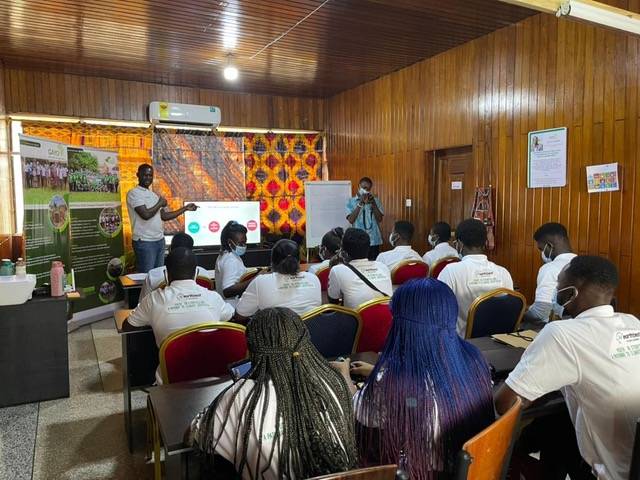
Yesterday in Luxembourg, something happened that most summaries will fail to capture because articles do not always translate easily into bullet points or conclusions. It was not the content of the Vision Zero workshops that mattered most. It was the moment when people who normally operate in parallel systems were thinking in the same direction. Health, labour, mobility, insurance, safety, environment, education . . . different mandates, different incentives, different vocabularies . . . and yet for a day we were not negotiating with each other: we were describing the same reality. That is rarer than we admit, and more fragile than we tend to realise.
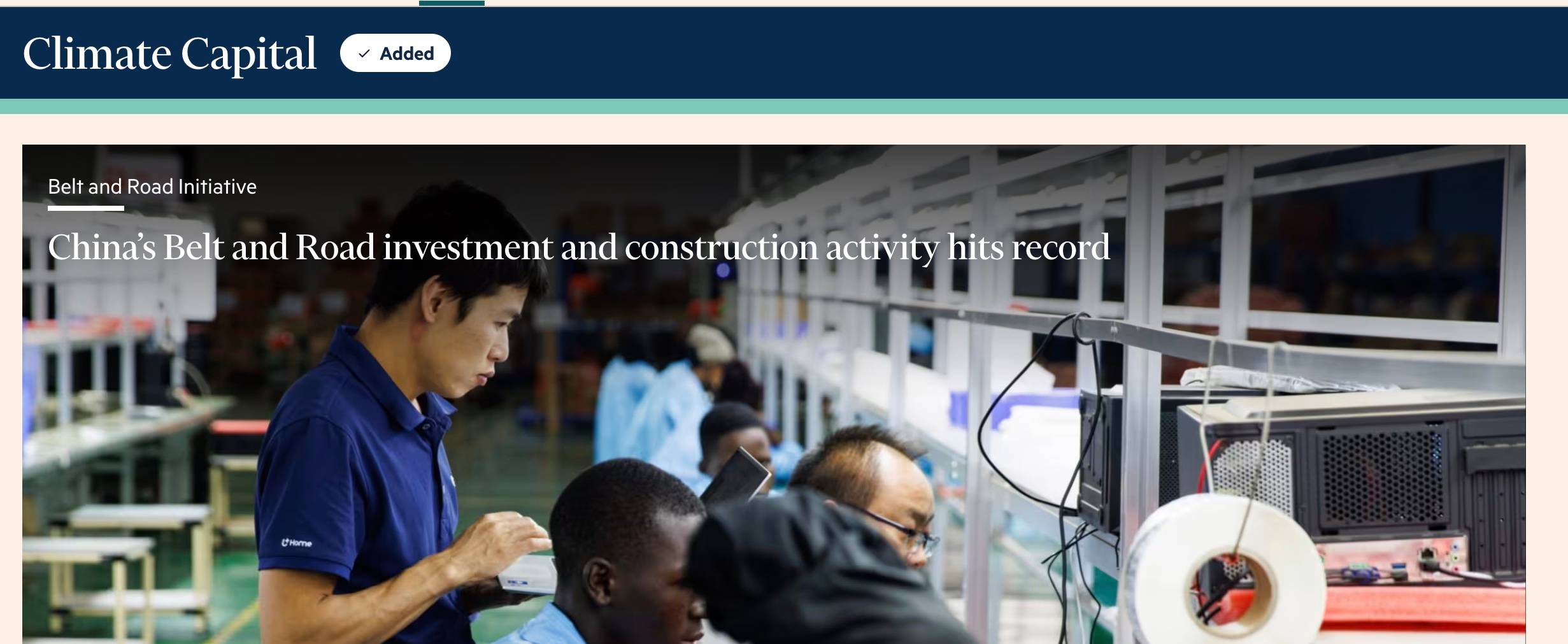
Outside the LuxExpo Vision Zero convention, the world is not aligning. As the C.A.T. monthly round-up below charts: the world is diverging, and doing so at a scale that is becoming impossible to ignore. China is building something that increasingly resembles a full-system transition: not because it is ideologically committed to climate action, but because it has recognised the industrial logic of it. Clean electricity has surged from marginal levels a generation ago to more than 40% of the mix, with solar now overtaking wind. Emissions are beginning to flatten even as energy demand continues to rise. It is not complete, it is not clean, and coal still lingers like an unresolved sentence . . . but the direction is unmistakable. At the same time, parts of the United States are moving in the opposite direction, not slowly or ambiguously, but deliberately. Climate Finance is retreating under political pressure. Regulatory foundations are being contested. The very idea that emissions should be governed is no longer treated as settled. These are not policy adjustments. They are structural signals. The physical reality is stark:
- the Earth’s energy imbalance has doubled in twenty years
- oceans are storing heat for millennia
- sea levels are already 30 centimeters higher than previously understood
- three to four metres of eventual rise are locked in
- atmospheric rivers flood Europe’s agricultural winter pantries
- homes fall into the sea in the zone adjacent to the UK’s Sizewell-C nuclear power construction-area
- the Global South faces coastal exposure 50–70% greater than previously estimated.
- we in Europe remain stubbornly vulnerable: importing 90% of our fossil fuels, and fighting over carbon allowances
- China is bending its emissions curve, with 40% clean power, solar overtaking wind, and CATL’s profits surging 42% on the strength of AI-driven storage demand.

The strategic case for the transition is crystallizing in real time: Microsoft buys renewables for price stability while security analysts warn that “fossil fuels have to constantly flow or else all hell breaks loose.” The question is whether this crisis will lock in the resilient infrastructure of the future . . . or entrench the brittle dependencies of the past. Europe, as so often, finds itself in between. Committed to the transition, but not yet moving at the pace that the moment demands. Structured, but not yet adaptive enough. And Luxembourg sits within that condition, with all of its advantages and all of its risks . . . small enough to move quickly, connected enough to matter, but also comfortable enough to delay.
Which is why yesterday mattered more than it might appear. Because for a few hours, Luxembourg was not in that in-between space. It was ahead of it. Not in scale, not in infrastructure, but in something more fundamental . . . alignment without coercion. The kind of alignment that does not come from hierarchy or regulation. The kind of alignment that does come from a shared recognition that the system itself is responsible for the outcomes it produces. Vision Zero is often described as a road safety strategy. That framing is too small. It is a philosophy of governance. It asserts that death is not an acceptable side-effect of mobility, that systems must be designed for human fallibility, and that responsibility does not sit with the individual at the point of failure but with the system that made that failure possible.
Once seen that way, Vision Zero does not remain confined to transport. It Venn Diagrams public health + labour conditions + urban planning + energy systems. And for a brief moment, that spillover was visible in Luxembourg not as a theory, but as a shared instinct. The danger now is not that Luxembourg will reject that instinct. It is that it will admire it . . . and then move on.
Because this is where Luxembourg tends to struggle: not in generating insight, but in repeating it often enough for it to become muscle-memory. Decency, when discussed, feels obvious. When operationalised, it becomes difficult. And when not reinforced, it fades, not because people disagree with it, but because systems revert to their defaults. And defaults are powerful. They are built over years, sometimes decades, sometimes centuries . . . and they do not change because of a single workshop, however successful.

This is where Copenhagen enters the picture, not as a model to copy, but as a process to understand. Denmark has moved from less than 15% renewable electricity a few decades ago to more than 80% today . . . not through slogans but through consistent, system-wide decisions that align policy, infrastructure, and behaviour. In Copenhagen itself, more than half of all trips to work and school are made by bicycle. Not because Danes are uniquely virtuous, but because the infrastructure makes the safe choice the easy choice. Protected bicycle paths + continuous People Walking-priority public spaces + and human-scaled design are not aesthetic features. They are economic infrastructure.
This is the point that is still too often missed in Luxembourg. Decency is not a cost centre. Decency is a profit centre. The work of Jan Gehl, from New York to Paris to Beijing, has demonstrated repeatedly that cities designed for people outperform cities designed for cars. Retail activity increases. Property values grow. Health costs decline. Productivity improves. Insurance risk decreases. The return on investment is not theoretical. It is measurable, and it compounds over time. Designing for human beings is not a moral luxury. It is a holistic economic strategy.
Which brings us back to something that might appear, at first glance, to be a simple logistical note . . . the Bikeable City Masterclass in Copenhagen this May. As an alumni, I support BCM each year . . . not as a favour, but as a recognition of what Luxembourg actually needs next. Not more ideas. Not more reports. But shared experience at the level where systems change. When you cycle through a city where safety is embedded, you stop debating whether it is possible. When you observe children navigating public spaces independently, you stop asking whether it is realistic. When you engage with practitioners for whom these outcomes are routine, your own baseline for what is acceptable begins to shift.
But there is a critical distinction. If you go alone, you come back inspired. If you go as a team, you come back aligned. And alignment is what turns insight into implementation. When colleagues from health, labour, mobility, insurance, and safety share the same reference point, they do not need to convince each other afterwards. They begin from the same understanding of what works. That is how culture changes, and culture, more than policy, determines outcomes.
The question for Luxembourg now is whether active mobility remains treated as a marginal add-on . . . the One Percent afterthought . . . or becomes what it already is in leading cities . . . the dominant framework through which mobility is organised. Not ideology, not aspiration, but simply the most efficient allocation of space, capital, and human energy.
Yesterday showed that Luxembourg is capable of that shift. The intelligence is there. The willingness is there. The Decency is already there. What remains uncertain is whether Luxembourg will build on that moment or allow it to dissolve into the long list of well-executed, well-documented, and ultimately isolated successes that define so many institutional efforts.
Because the real competition is no longer about who has the best ideas. It is about who can embed them fastest. China is embedding at scale. Parts of the United States are unravelling what they had begun to embed. Europe is deciding, perhaps more slowly than it realises, whether it will convert its commitments into lived systems or remain in a state of permanent transition.
Luxembourg, for a brief moment yesterday, stepped out of that uncertainty. It behaved like a place where alignment is not forced, but understood. The challenge now is not to replicate the workshops. It is to repeat the conditions that made them possible, often enough that they stop feeling exceptional.
Because that is when Decency stops being something we talk about.
And becomes something we do without thinking.
Bicycle City Master 18th runs from 18th through 22nd May 2026 = Register tomorrow on the Cycling Embassy of Denmark‘s website: https://cyclingsolutions.info/embassy/bikeable-city-masterclass/

– – – – – –
Further Reading:
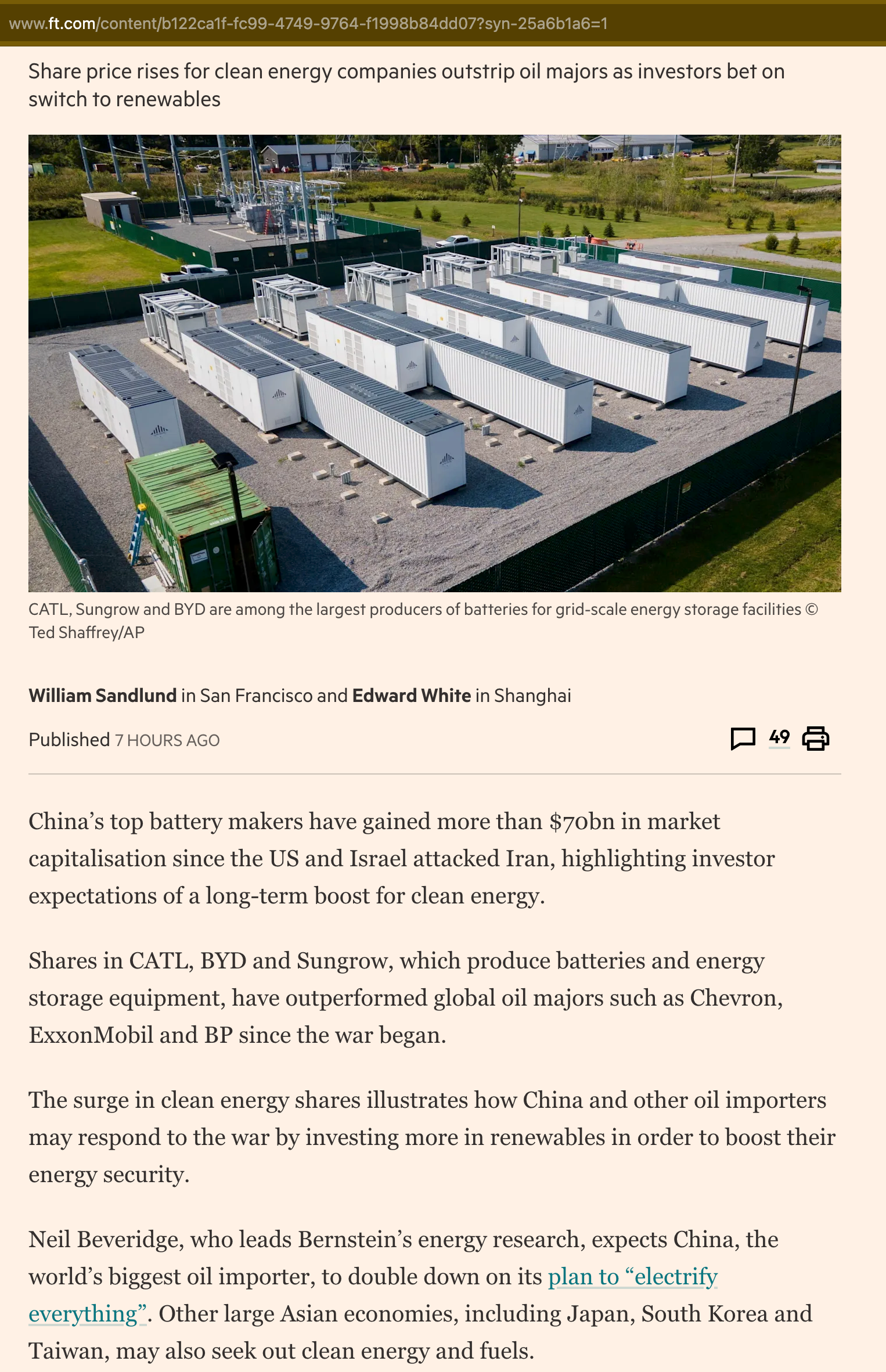
23rd March 2026: Financial Times Journalists William Sandlund and Edward White report that China’s top battery makers (including CATL, BYD, and Sungrow) have gained more than $70 Billion in market capitalisation since the US and Israel attacked Iran . . . outperforming global oil majors such as Chevron, ExxonMobil, and BP despite a 47% rise in oil prices. CATL shares are up 19%, Sungrow 19.4%, and BYD 21.9% since the strikes began. Neil Beveridge of Bernstein said the war “totally changes the whole energy paradigm” and that “even if the war ends next month, there is no going back.” The domestic Chinese market for grid-scale battery storage is forecast to surge from $48 Billion last year to $199 Billion by 2032. Li Shuo of the Asia Society Policy Institute noted that attacks on LNG infrastructure highlight the “inherent risks of fossil fuel dependency,” and that countries “would be wise” to invest heavily in clean energy to shield themselves from geopolitical shocks
Overall C.A.T. Usefulness: 10/10 ★★★★★★★★★★
Strengths:
This article masterfully connects the geopolitical crisis, financial markets, and industrial strategy into a single coherent narrative. Its key strengths are:
- The $70 Billion Signal: The numbers tell the story. $70 Billion in market capitalisation gained by three Chinese battery makers. CATL up 19%, BYD up 21.9%, Sungrow up 19.4%. Oil majors, despite a 47% rise in oil prices, have seen only modest gains: BP up 15.2%, Chevron 8%, Shell 8.3%, ExxonMobil 4.7%. This is not a marginal shift: it is a market verdict. Investors are betting that the war accelerates the transition, not the fossil fuel incumbency.
- The “Paradigm Shift” Framing: Neil Beveridge’s quote (“this totally changes the whole energy paradigm”) is the heart of the article. He adds: “Even if the war ends next month, there is no going back.” This is a rare moment of clarity from an analyst who understands that crises create path dependencies. The war is not just a short-term shock; it is a catalyst for structural change.
- The China Advantage: The article documents China’s position as the undisputed leader in the technologies of the transition. CATL, BYD, Sungrow . . . these are not speculative startups; they are established giants. The $199 Billion forecast for China’s grid-scale battery storage market by 2032 (up from $48 Billion in 2025) shows the scale of the domestic market that underpins their global competitiveness.
- The Oil Price Paradox: The article notes that oil majors have benefited from a 47% rise in oil prices, yet their share price gains are modest compared to the battery makers. This is a striking illustration of the market’s forward-looking logic. Investors see high oil prices as a temporary windfall for incumbents, but a permanent tailwind for the transition.
- The LNG Vulnerability: Li Shuo’s observation that attacks on LNG infrastructure highlight the “inherent risks of fossil fuel dependency” is a crucial framing. He explicitly connects the war to the strategic logic of the transition: East Asian countries most reliant on imported LNG “will soon face an immeasurable economic shock, despite their distance from the conflict.”
- The Developing World Prescription: Li’s conclusion that developing countries “would be wise” to invest heavily in clean energy and transport to shield themselves from geopolitical shocks is a powerful argument. It reframes climate action not as a luxury that rich countries can afford, but as a strategic necessity for all nations.
Weaknesses:
The article has no significant weaknesses. It is comprehensive, data-driven, and conceptually precise. If pressed, one could note that:
- The Human Dimension: The article focuses on market capitalisation, forecasts, and strategic logic. The human dimension (workers, communities, the just transition) is absent. Who benefits from the $70 Billion gain? Are the jobs created in battery manufacturing good jobs? What happens to workers in fossil fuel industries as the transition accelerates? The article does not ask.
- The Gender Dimension (SDG 5): As with almost all financial and industrial reporting, the article is silent on gender. The battery industry, like the fossil fuel industry, has a gender profile. Women are underrepresented in manufacturing, underrepresented in executive suites, and overrepresented in the care economies that are disrupted by energy transitions. This dimension is invisible.
- The Geopolitical Risk: The article celebrates China’s battery dominance but does not explore the risks that come with it. What happens if US-China tensions escalate? Are European and American policymakers comfortable with their energy transition depending on Chinese supply chains? The article notes the $199 Billion forecast for China’s domestic market, but does not ask what it means for the rest of the world.
- The Speed Question: The article documents the market’s bet on the transition. It does not ask whether the transition is happening fast enough. The Earth’s energy imbalance has more than doubled in 20 years. Ocean heat is at record levels. The market’s $70 Billion bet is a signal, but is it a signal of sufficient scale? The article does not say.
Opportunities for C.A.T.:
This article provides C.A.T. with a powerful case study and a set of strategic arguments:
- The Market as an Ally: The $70 Billion gain is a market verdict. Investors are betting that the transition accelerates, not that fossil fuels rebound. C.A.T. can use this to counter the narrative that the transition is a costly burden. The market is voting with its capital, and it is voting for batteries over barrels.
- The “No Going Back” Framing: Beveridge’s quote is a gift. “Even if the war ends next month, there is no going back.” This is the language of irreversible tipping points, but applied to policy and markets, not just the climate system. C.A.T. can use it to argue that the transition has reached a point of self-reinforcing momentum.
- The China Factor, Revisited: This article updates the “China Factor” theme. China is both the solution and the problem. Here, China is unequivocally the solution: the manufacturer of the technologies the world needs. C.A.T. can use this to argue that the transition is not waiting for the US to lead; it is being driven by Chinese industrial capacity.
- The LNG Vulnerability: Li Shuo’s framing of LNG as an “inherent risk” should be central to C.A.T.’s vocabulary. It connects energy security to climate action in a way that resonates with policymakers who may not be moved by environmental arguments alone.
- The Developing World Prescription: Li’s argument that developing countries “would be wise” to invest in clean energy to shield themselves from geopolitical shocks is a powerful reframing. It turns climate finance from aid into strategic investment. C.A.T. can amplify this frame.
Threats:
The biggest threat is that the $70 Billion gain is read as a purely financial story, rather than a strategic signal about the direction of the global economy. A second threat is that the concentration of battery manufacturing in China creates new dependencies. If the transition becomes dependent on Chinese supply chains, the geopolitical risks documented in the Sharma article (US resilience) are simply transferred to a different set of actors. A third threat is that the market’s bet proves over-optimistic. The $199 Billion forecast is a projection, not a certainty. If the war ends quickly and oil prices stabilize, the momentum for the transition could slow. Beveridge’s “no going back” is a conviction, but it is not a guarantee.
Analysis Through Lenses:
United Nations Lens (IPCC/UNFCCC): From a UN climate governance perspective, this article is both hopeful and challenging. Hopeful because it shows that the market is moving toward the technologies the IPCC says are necessary. The $70 Billion gain is a vote of confidence in the transition. Challenging because the transition is being driven by Chinese industrial policy, not by the multilateral framework of the Paris Agreement. The UNFCCC process has spent decades trying to build consensus on emissions reductions. Meanwhile, China has built the factories. The question for the UN system is whether it can adapt to a world where the transition is being driven by industrial strategy rather than diplomatic consensus.
EU Green New Deal Lens: For Brussels, this article should be a wake-up call. The $70 Billion gain is going to Chinese companies. The $199 Billion forecast for China’s grid-scale battery market is a measure of the gap Europe faces. The Green Deal includes battery manufacturing targets (the European Battery Alliance, the Net-Zero Industry Act) but Europe is not yet competing at this scale. The article does not mention European companies, because there are no European companies in this league. The strategic question for Brussels is whether the Green Deal can create champions that can compete with CATL and BYD, or whether Europe will remain dependent on Chinese supply chains for the technologies of the transition.
Draghi Report Lens: Mario Draghi’s report called for Europe to close the investment and innovation gap with China and the US. This article shows the scale of that gap in one sector. CATL, BYD, Sungrow: these are the kind of industrial champions Draghi wants Europe to create. The $199 Billion forecast for China’s domestic market is the kind of scale Draghi’s €800 Billion annual investment is meant to achieve. The article does not mention Draghi, but it is the empirical proof of his diagnosis.
Mark Jacobson Lens: Through Jacobson’s framework, this article is a vindication. Jacobson’s 100% wind-water-solar roadmaps require massive deployment of battery storage. The $199 Billion forecast for China’s grid-scale battery market is exactly the kind of investment Jacobson’s models demand. The market’s $70 Billion bet on battery makers is a sign that the financial system is beginning to align with the physics of the transition. Jacobson would note, however, that the transition is not just about batteries; it is about wind, hydro, solar, and storage working together. The article focuses on batteries, which are necessary but not sufficient. The real test is whether the battery gains are accompanied by similar gains in solar and wind manufacturing.
SDG Ratings:
| SDG | Rating | Rationale |
|---|---|---|
| SDG 1 No Poverty | 2/10 ★★☆☆☆☆☆☆☆☆ | Not addressed; poverty impacts of transition not explored |
| SDG 2 Zero Hunger | 0/10 ☆☆☆☆☆☆☆☆☆☆ | Not addressed |
| SDG 3 Good Health and Well-Being | 2/10 ★★☆☆☆☆☆☆☆☆ | Air pollution benefits of transition implicit, not explored |
| SDG 4 Quality Education | 1/10 ★☆☆☆☆☆☆☆☆☆ | Not addressed |
| SDG 5 Gender Equality | 0/10 ☆☆☆☆☆☆☆☆☆☆ | Complete absence. No mention of women, gender, or differential impacts of the battery industry and energy transition |
| SDG 6 Clean Water and Sanitation | 0/10 ☆☆☆☆☆☆☆☆☆☆ | Not addressed |
| SDG 7 Affordable and Clean Energy | 9/10 ★★★★★★★★★☆ | Central focus; battery storage, renewables, energy security |
| SDG 8 Decent Work and Economic Growth | 6/10 ★★★★★★☆☆☆☆ | Market capitalisation, industrial growth; job quality not addressed |
| SDG 9 Industry, Innovation and Infrastructure | 10/10 ★★★★★★★★★★ | Core focus; battery manufacturing, grid storage, industrial strategy |
| SDG 10 Reduced Inequalities | 2/10 ★★☆☆☆☆☆☆☆☆ | Not addressed; global distribution of battery manufacturing not analyzed |
| SDG 11 Sustainable Cities and Communities | 3/10 ★★★☆☆☆☆☆☆☆ | Grid storage supports urban renewables; not explored |
| SDG 12 Responsible Consumption and Production | 5/10 ★★★★★☆☆☆☆☆ | Battery production and recycling not addressed |
| SDG 13 Climate Action | 9/10 ★★★★★★★★★☆ | Core focus; transition acceleration, fossil fuel dependency risks |
| SDG 14 Life Below Water | 0/10 ☆☆☆☆☆☆☆☆☆☆ | Not addressed |
| SDG 15 Life on Land | 1/10 ★☆☆☆☆☆☆☆☆☆ | Not addressed |
| SDG 16 Peace, Justice and Strong Institutions | 5/10 ★★★★★☆☆☆☆☆ | Geopolitical shocks, energy security, war as driver |
| SDG 17 Partnerships for the Goals | 4/10 ★★★★☆☆☆☆☆☆ | China’s industrial strategy; global implications not explored |
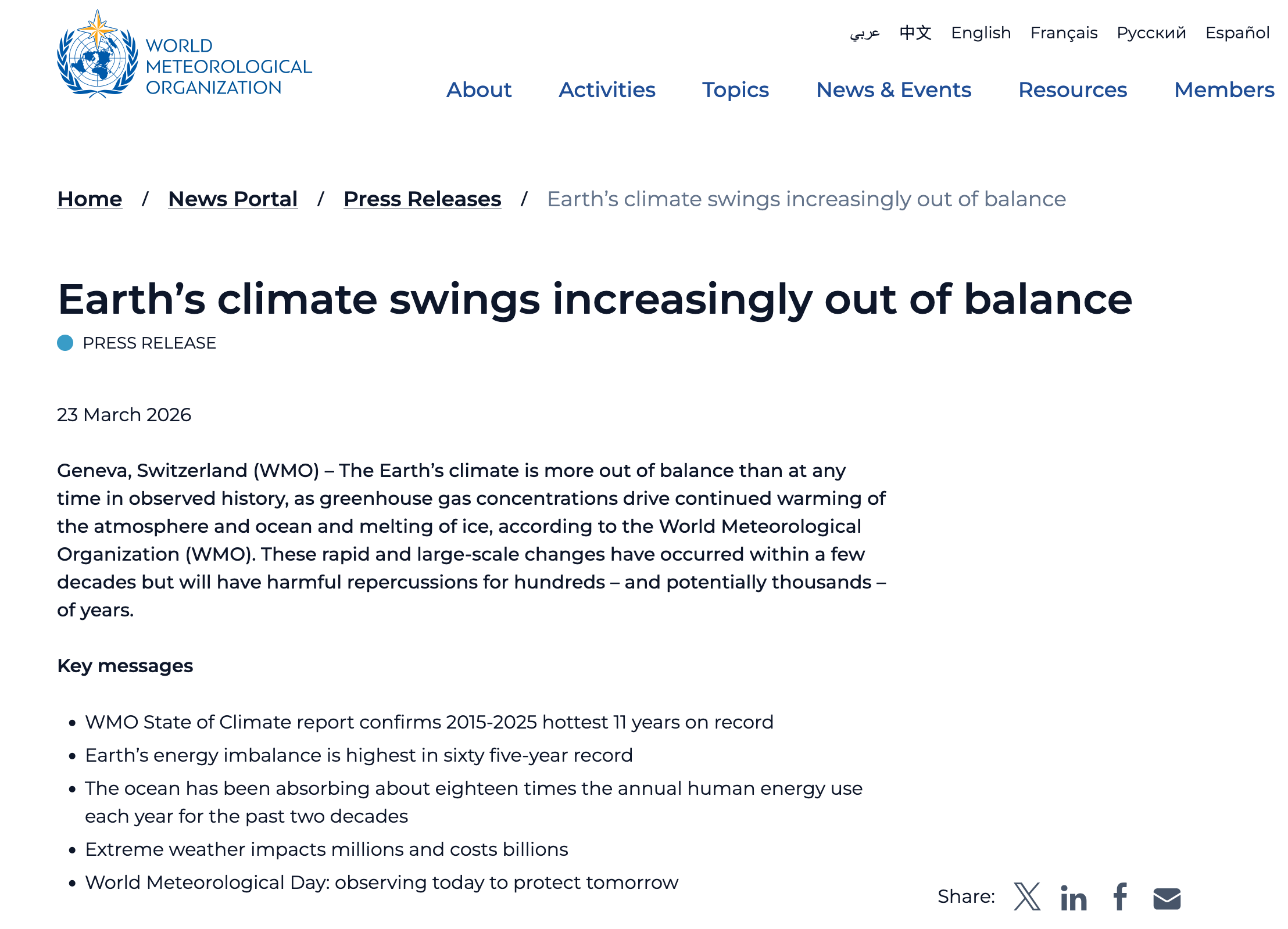
23rd March 2026: Financial Times Journalist Emiliya Mychasuk reports that the Earth’s energy imbalance reached record levels in 2025: the rate of solar radiation entering the planet exceeding outgoing energy at an accelerated pace. The measure, included for the first time in the World Meteorological Organization’s State of the Climate annual report, has more than doubled in the past 20 years as greenhouse gases continue to accumulate. The oceans absorbed 91% of the excess heat, with the 2025 increase alone equivalent to 39 times total annual human energy use. Ocean heat reached the highest level in the observational record, and scientists warn that heat now stored in deeper ocean layers is likely to be “captured” for hundreds or thousands of years. The 2015-2025 period was the warmest 11 years since observations began. Despite concerns about cuts in climate science funding, the WMO’s deputy secretary-general reported that demand for credible climate information remains strong https://www.ft.com/content/e8390d64-63d3-4d27-9c73-6a59dda2045b?syn-25a6b1a6=1
Overall C.A.T. Usefulness: 10/10 ★★★★★★★★★★
Strengths:
This article is a landmark piece of climate science reporting: precise, authoritative, and devastating in its implications. Its key strengths are:
- Introducing a New Vital Sign: The Earth’s energy imbalance is not a metric that appears often in public discourse, but it is perhaps the most fundamental measure of the climate crisis. The article explains it clearly: the difference between incoming solar radiation and outgoing energy. That this measure has “more than doubled in the past 20 years” is not a detail . . . it is the headline. The WMO’s decision to include it for the first time in its annual report signals that scientists believe this metric has become too important to ignore.
- Quantifying the Unimaginable: The numbers in this article are staggering, and the journalists present them with exemplary clarity. Eleven zettajoules added annually since 2005: 18 times total annual human energy use. The 2025 increase alone: 39 times annual human energy use. These numbers are almost impossible to comprehend, but the article makes them legible by comparing them to something readers can grasp: the total energy humanity uses in a year.
- The Ocean Storage Story: The fact that the oceans have absorbed 91% of the excess heat is not new to climate scientists, but it is crucial context for public understanding. The article explains that the heat is now reaching deeper ocean layers, where it will be “captured” for hundreds or thousands of years. This is not a temporary buffer; it is a long-term commitment. The oceans are not saving us. The oceans are storing up trouble.
- The 2015-2025 Decade: The report’s finding that 2015-2025 was the warmest 11-year period since observations began is a stark marker. This period encompasses the Paris Agreement (2015), the IPCC’s 1.5°C special report (2018), and now the acceleration documented in the Rahmstorf paper. The pattern is consistent and undeniable.
- The Funding Counter-Narrative: Ko Barrett’s observation that demand for climate information remains strong despite Trump-era funding cuts is a valuable piece of context. It suggests that the political attacks on climate science have not succeeded in diminishing the appetite for credible data. This is a small note of hope in an otherwise bleak report.
- Scientific Authority, Journalistic Restraint: The article lets the science speak for itself. There is no editorializing, no political grandstanding. The WMO’s findings are presented with the calm authority of a UN agency reporting on the state of the planet. This restraint makes the findings more powerful, not less.
Weaknesses:
The article has no significant weaknesses. It is a model of climate science journalism. If pressed, one could note that:
- The Policy Connection: The article documents the physical reality but does not connect it to the policy debates documented in previous C.A.T. analyses: the ETS battle, the IEA demand reduction call, the US resilience argument. The reader is left to make those connections themselves. This is not a weakness of the reporting, but it is an opportunity for C.A.T. to provide synthesis.
- The Gender Dimension (SDG 5): As with almost all climate science reporting, the article is silent on gender. The impacts of ocean warming, sea level rise, and glacier retreat are not gender-neutral. Women in coastal communities, in small island states, in subsistence fishing economies will bear disproportionate burdens. This dimension is invisible.
- The “So What” Question: The article does not explicitly answer the question that readers will ask: what does this mean for me? The connection between ocean heat content and extreme weather events (atmospheric rivers, hurricanes, flooding) is implicit but not spelled out. The previous C.A.T. article on February’s climate extremes provided that connection; this article does not.
Opportunities for C.A.T.:
This article provides C.A.T. with foundational evidence for multiple core themes:
- The Energy Imbalance as a North Star Metric: we have been tracking policy volatility, corporate retreat, and political fragmentation. This article provides the physical context that makes those stories matter. The Earth’s energy imbalance is not an abstraction; it is the fundamental driver of every climate impact documented in these pages. C.A.T. can adopt this metric as a north star: the single most important number to watch.
- The 39x Figure: The statistic that the 2025 increase alone was 39 times annual human energy use is a devastating communications tool. It translates the abstract physics of the climate system into a comparison that anyone can understand. The planet absorbed 39 years’ worth of human energy use in a single year. This is NOT sustainable.
- The Ocean Debt: The fact that ocean heat has reached record levels and that deeper layers are now storing heat for “hundreds or thousands of years” is a powerful argument against delay. The carbon we emit today will be stored in the ocean for millennia. This is not a problem that future technology can solve: it is a problem we are locking in now.
- The Decadal Context: The finding that 2015-2025 was the warmest 11-year period since observations began provides a clean temporal frame. This is the Paris decade. It is the decade in which the world promised to act. And it is the decade in which the climate system accelerated.
- The Funding Resilience: Barrett’s observation that demand for climate information remains strong is a useful counterpoint to the “greenhushing” and corporate retreat documented in previous articles. While some actors are going quiet, the demand for credible data is not diminishing. C.A.T. can use this to argue that the information infrastructure for climate action remains robust, even when the political will falters.
Threats:
The biggest threat is that this article’s findings are normalized. The Earth’s energy imbalance has more than doubled in 20 years. Ocean heat is at record levels. The 2015-2025 period was the warmest on record. If these become “just another report,” the urgency is lost. A second threat is that the 39x figure, staggering as it is, becomes a source of despair rather than action. The scale of the problem can induce paralysis. The challenge for communicators is to use this data to fuel demand for action, not resignation. A third threat is that the funding resilience Barrett reports is temporary. If the Trump administration or other governments succeed in cutting climate science funding over the long term, the data stream that makes reports like this possible could be compromised. The WMO’s ability to track the energy imbalance depends on satellite data, land monitors, and ocean sensors . . . all of which require sustained investment.
Analysis Through Lenses:
United Nations Lens (IPCC/UNFCCC): From a UN climate governance perspective, this article is a status report on the failure of the Paris Agreement. The Earth’s energy imbalance has more than doubled in the 20 years since the IPCC began its most recent assessment cycle. The 2015-2025 period (the first decade of the Paris Agreement) was the warmest on record. The oceans are storing heat that will remain for millennia. These are not signs of progress; they are signs of accelerating failure. The UNFCCC process was designed to bend the curve. The curve is bending the wrong way. Barrett’s comment about funding resilience is a small comfort, but it does not change the underlying physics. The WMO’s decision to include the energy imbalance in its annual report is an implicit acknowledgment that the traditional metrics (temperature, sea level, ice extent) are no longer sufficient. The system is sending a new signal, and the UN is trying to amplify it.
EU Green New Deal Lens: For Brussels, this article should be a reality check. The Green Deal is the EU’s answer to the climate crisis. BUT the crisis is accelerating faster than the policy. The energy imbalance has doubled in 20 years. The EU’s 2030 targets, ambitious as they are, were set against a baseline that is already outdated. The article does not mention policy, but its implications are clear: the current pace of action is not matching the pace of change. The Green Deal’s emphasis on emissions reduction is necessary, but this article suggests that even if emissions were to fall dramatically tomorrow, the ocean heat already stored will continue to drive climate impacts for centuries. Adaptation is not a secondary concern; it is a primary necessity.
Draghi Report Lens: Mario Draghi’s report called for Europe to invest in competitiveness and innovation. This article suggests a different kind of investment: in resilience. The oceans have absorbed 91% of the excess heat. That heat will not disappear. Sea level rise, ocean acidification, and the destabilization of marine ecosystems are now locked in for generations. Europe’s coastal cities, its fisheries, its ports, its Mediterranean tourism industry . . . all are now living with a new baseline. Draghi’s call for investment must include adaptation at scale. The energy imbalance is not a problem that can be solved by better industrial policy; it is a problem that must be managed.
Mark Jacobson Lens: Through Jacobson’s framework, this article is a vindication of everything he has been saying about the urgency of the transition. The Earth’s energy imbalance has more than doubled in 20 years. The oceans are storing heat for millennia. Every year of delay adds to that store. Jacobson’s 100% wind-hydro-solar roadmaps are designed to stop the accumulation as fast as possible. This article shows why speed matters. The 39x figure is a measure of the gap between the pace of the transition and the pace of the crisis. Jacobson would say: the technology exists to close that gap. The question is whether the political will can be incarnated.
SDG Ratings:
| SDG | Rating | Rationale |
|---|---|---|
| SDG 1 No Poverty | 2/10 ★★☆☆☆☆☆☆☆☆ | Not addressed; poverty impacts of ocean warming implicit |
| SDG 2 Zero Hunger | 3/10 ★★★☆☆☆☆☆☆☆ | Fisheries and marine ecosystems affected; not explored |
| SDG 3 Good Health and Well-Being | 2/10 ★★☆☆☆☆☆☆☆☆ | Not addressed |
| SDG 4 Quality Education | 1/10 ★☆☆☆☆☆☆☆☆☆ | Not addressed |
| SDG 5 Gender Equality | 0/10 ☆☆☆☆☆☆☆☆☆☆ | Complete absence. No mention of women, gender, or differential impacts of ocean warming and sea level rise |
| SDG 6 Clean Water and Sanitation | 2/10 ★★☆☆☆☆☆☆☆☆ | Not addressed |
| SDG 7 Affordable and Clean Energy | 3/10 ★★★☆☆☆☆☆☆☆ | Energy imbalance compared to human energy use; policy implications not explored |
| SDG 8 Decent Work and Economic Growth | 2/10 ★★☆☆☆☆☆☆☆☆ | Not addressed |
| SDG 9 Industry, Innovation and Infrastructure | 2/10 ★★☆☆☆☆☆☆☆☆ | Not addressed |
| SDG 10 Reduced Inequalities | 3/10 ★★★☆☆☆☆☆☆☆ | Global impacts of ocean warming uneven; not analyzed |
| SDG 11 Sustainable Cities and Communities | 3/10 ★★★☆☆☆☆☆☆☆ | Sea level rise and coastal cities; not explored |
| SDG 12 Responsible Consumption and Production | 1/10 ★☆☆☆☆☆☆☆☆☆ | Not addressed |
| SDG 13 Climate Action | 10/10 ★★★★★★★★★★ | Core focus; energy imbalance, ocean heat, warming decade |
| SDG 14 Life Below Water | 10/10 ★★★★★★★★★★ | Central focus; ocean heat, acidification, marine systems |
| SDG 15 Life on Land | 3/10 ★★★☆☆☆☆☆☆☆ | Glacier retreat mentioned; land warming noted (5 per cent) |
| SDG 16 Peace, Justice and Strong Institutions | 3/10 ★★★☆☆☆☆☆☆☆ | WMO report, UN institution; funding resilience noted |
| SDG 17 Partnerships for the Goals | 4/10 ★★★★☆☆☆☆☆☆ | WMO coordinating global data; demand for information remains strong |
23rd March 2026: Financial Times columnist Ruchir Sharma argues that America’s underlying economic strengths (energy independence + deep pools of investors + the dollar’s safe-haven status) are bailing out President Trump from the worst effects of his Iran war. While petrol prices have risen more than 20% in the US, the increases have been steeper elsewhere, and natural gas prices have barely budged in America while surging globally. Ruchir notes that retail investors have been net buyers “virtually every day” since the war began, and the dollar has appreciated against every other major currency. Sharma warns that US hubris is being reinforced by this “resilience”, and that other nations “need to do a lot more” to reduce their dependence on America by: forming bargaining coalitions + building energy independence + strengthening their own financial markets. “The law of the jungle prevails,” he concludes, “and the best way for smaller powers to survive when might makes right is to work in a pack” https://www.ft.com/content/a6d0083d-ef46-4940-965e-2dfaeecd5bc4?syn-25a6b1a6=1
Overall C.A.T. Usefulness: 9/10 ★★★★★★★★★☆
Strengths:
This opinion piece contributes to a clear-eyed, unsentimental analysis of how the structural asymmetries of the global economy are enabling US-led planetary cannibalism. The article’s key strengths are:
- Naming the Asymmetry: Sharma does something that most political and economic reporting avoids: he names the power imbalance directly. The US is being “bailed out” by its pre-existing strengths. Other nations are suffering more because they have become “too dependent on America: militarily, technologically and, above all, financially.” This is essential reading for European voters, investors, policymakers and leaders.
- Quantifying the Divergence: The article grounds its argument in concrete data points: petrol prices up 20% in the US but more steeply elsewhere; natural gas prices barely budged in America while surging globally; the dollar appreciating against every other major currency; retail investors net buyers “virtually every day” since the war began. These numbers give the argument weight.
- The Hubris Diagnosis: Sharma’s identification of “superpowerdom” and its natural breeding of “hubris” is a crucial framing. He notes that this arrogance “long predates Trump and permeates the establishment”: the Biden administration weaponized the dollar with sanctions on Russia, and Silicon Valley and Wall Street leaders shrug off threats to the US economy with a “where else will the money go?” mentality. This is not a partisan critique; it is a structural one.
- The Call to Action: Unlike many opinion pieces that diagnose problems without proposing solutions, Sharma offers a clear set of prescriptions: European nations should form bargaining coalitions to respond to tariff threats, focus on creating a unified military structure, prioritize energy independence, and strengthen their own financial markets by encouraging domestic investment. This is a “vocabulary of agency” for the audience he is addressing.
- The “No Domestic Blowback” Reality: Sharma’s observation that 90% of MAGA Republicans back the Iran campaign is a crucial reality check. Other nations “can’t just hope for his base to revolt.” This forecloses the comfortable fantasy that domestic politics will constrain Trump. If other nations want to be protected from US junk-bond trajectory, they must act themselves.
Weaknesses:
The article has a few important dimensions it leaves unexplored:
- The Climate Silence: For an article about energy markets, the climate dimension is almost entirely absent. Sharma discusses natural gas and petrol prices but does not ask what the Iran war means for the energy transition: is the crisis accelerating the shift to renewables (as the IEA demand reduction call suggests) or entrenching fossil fuel dependence? The article does not say. This is a significant omission given the climate context of the C.A.T. analysis.
- The Gender Dimension (SDG 5): As with almost all economic and political analysis, the article is silent on gender. The impacts of energy shocks (factory shutdowns, school closures, corporate insolvencies) are not gender-neutral. Women are disproportionately affected by care burdens when schools close, by job losses in affected sectors, and by the regressive impacts of energy price inflation. This dimension is invisible.
- The Europe-as-Victim Framing: Sharma’s prescriptions for Europe are sensible, but he does not acknowledge the steps Europe has already taken: the Green Deal, the push for offshore wind, the CBAM, the REPowerEU strategy to reduce Russian gas dependence. The article treats Europe as passive when in fact it has been actively trying to decouple from US energy dependence. The Iran war may accelerate that process, but the foundation has already been laid.
- The Retail Investor Question: Sharma celebrates the “endless army of retail investors” who have been net buyers “virtually every day” since the war began. He does not ask whether this is a sign of resilience or a sign of irrational exuberance. Are retail investors making informed decisions, or are they the same “euphoria” that drove the EV writedowns documented in CAT’s previous analysis? The article does not probe this.
Opportunities for C.A.T.:
This article provides C.A.T. with a powerful framework for understanding the geopolitical context in which climate policy is being made:
- The Asymmetry Argument: Sharma’s analysis of US resilience versus European vulnerability is essential context for understanding why the EU is pushing so hard on energy independence. The Iran war is more than a humanitarian crisis: it is a structural reminder that Europe remains dangerously dependent on policies it cannot control. C.A.T. can use this to argue that energy independence is not just about climate; it is about sovereignty.
- The IEA Connection: This article should be read alongside the IEA demand reduction call. The IEA is asking citizens to work from home, drive slower, fly less. Sharma is explaining why the US does not feel the same pressure: it is being “bailed out” by its structural advantages. The contrast is stark. C.A.T. can use it to argue that Europe cannot rely on US-style resilience; it must build its own.
- The “Where Else Will the Money Go?” Trap: Sharma’s observation that Silicon Valley and Wall Street leaders shrug off US policy unpredictability with “where else will the money go?” is a warning. US dominance is so entrenched that it can absorb policy errors that would cripple other nations. For Europe, the lesson is that building alternative financial markets, encouraging domestic investment, and reducing dependence on US capital markets is a strategic imperative.
- The Coalition-Building Prescription: Sharma’s call for smaller powers to “work in a pack” and form “bargaining coalitions” is directly relevant to climate policy. The EU’s CBAM, the California-UK deal, the subnational alliances are exactly the kind of pack-forming behavior Sharma recommends. C.A.T. can use this analysis to validate these strategies and argue for their expansion.
Threats:
The biggest threat is that Sharma’s analysis is read as a celebration of US resilience rather than a warning about its consequences. The headline (“America keeps bailing out Trump”) could be interpreted as a story about US strength when it is actually a story about dangerous asymmetry. A second threat is that the prescriptions are ignored. Sharma’s call for Europe to form coalitions, build energy independence, and strengthen financial markets is urgent and strategic. But European leaders have long ignored such calls. The question is whether this crisis will produce action or just more summits and statements. A third threat is that the climate dimension remains absent: if the energy transition is not accelerated in response to this crisis, then the next crisis will be worse.
Analysis Through Lenses:
United Nations Lens (IPCC/UNFCCC): From a UN climate governance perspective, this article is deeply unsettling. The UN system is built on the premise of multilateral cooperation and the rule of law. Sharma describes a world in which “the law of the jungle prevails” and “might makes right.” The US, the world’s largest economy and second-largest emitter, is pursuing a unilateral war with no apparent constraint from international institutions. The UNFCCC process, already weakened by US withdrawal, becomes even more irrelevant when the US can act with impunity. Sharma’s prescription that other nations must strengthen themselves collectively . . . is a recognition that the multilateral system cannot protect them. This is a retreat from the UN vision.
EU Green New Deal Lens: For Brussels, this article should be required reading. Sharma’s diagnosis of European dependence (on US military protection + US energy supplies + US financial markets) is a direct challenge to the Green Deal’s ambition of strategic autonomy. The Green Deal is not just about climate; it is about building the economic and energy infrastructure that would allow Europe to weather shocks like the Iran war without being “the bigger loser.” Sharma’s call for energy independence, a unified military structure, and stronger domestic financial markets is a roadmap that aligns with the Green Deal’s logic. The question is whether European leaders have the moral courage . . . at this hinge-moment in History.
Draghi Report Lens: Mario Draghi’s report called for Europe to close the investment and innovation gap with the US and China. Sharma’s article explains why that gap matters. The US can absorb policy errors (tariff wars, military wars, budget deficits) because its structural advantages (AI dominance, the dollar, retail investors) create a cushion. Europe must build that cushion. Draghi’s call for €800 Billion in annual investment is not just about competitiveness: it is about thriving with Decency in a world where other nations act with shamelessness. Sharma’s article is the strategic rationale for Draghi’s numbers.
Mark Jacobson Lens: Through Jacobson’s framework, this article is a case study in the fossil fuel trap. Sharma notes that US natural gas prices have “barely budged” while surging globally. This is not a sign of US strength; it is a sign of US fossil fuel dependence. The US is not immune to energy shocks; it is simply better positioned to exploit them because it is a net energy exporter. Jacobson would argue that this is a trap. The US is locking in fossil fuel infrastructure that will need to be stranded later. The “resilience” Sharma celebrates is actually a delay in the transition. The real resilience . . . the kind that comes from wind, solar, hydro and storage, which cannot be targeted by a war in the Middle East . . . is being postponed.
SDG Ratings:
| SDG | Rating | Rationale |
|---|---|---|
| SDG 1 No Poverty | 4/10 ★★★★☆☆☆☆☆☆ | Energy prices affect households; distributional impacts not explored |
| SDG 2 Zero Hunger | 0/10 ☆☆☆☆☆☆☆☆☆☆ | Not addressed |
| SDG 3 Good Health and Well-Being | 2/10 ★★☆☆☆☆☆☆☆☆ | War impacts on health not addressed |
| SDG 4 Quality Education | 1/10 ★☆☆☆☆☆☆☆☆☆ | Not addressed |
| SDG 5 Gender Equality | 0/10 ☆☆☆☆☆☆☆☆☆☆ | Complete absence. No mention of women, gender, or differential impacts of war and energy shocks |
| SDG 6 Clean Water and Sanitation | 0/10 ☆☆☆☆☆☆☆☆☆☆ | Not addressed |
| SDG 7 Affordable and Clean Energy | 8/10 ★★★★★★★★☆☆ | Central focus; energy prices, US vs global divergence |
| SDG 8 Decent Work and Economic Growth | 6/10 ★★★★★★☆☆☆☆ | Factory shutdowns, corporate insolvencies, retail investor behavior |
| SDG 9 Industry, Innovation and Infrastructure | 5/10 ★★★★★☆☆☆☆☆ | US AI dominance mentioned; European energy infrastructure as gap |
| SDG 10 Reduced Inequalities | 5/10 ★★★★★☆☆☆☆☆ | Asymmetry between US and other nations central to the argument |
| SDG 11 Sustainable Cities and Communities | 2/10 ★★☆☆☆☆☆☆☆☆ | Not addressed |
| SDG 12 Responsible Consumption and Production | 3/10 ★★★☆☆☆☆☆☆☆ | Energy consumption patterns implicit |
| SDG 13 Climate Action | 3/10 ★★★☆☆☆☆☆☆☆ | Climate almost entirely absent; energy discussion without climate framing |
| SDG 14 Life Below Water | 0/10 ☆☆☆☆☆☆☆☆☆☆ | Not addressed |
| SDG 15 Life on Land | 0/10 ☆☆☆☆☆☆☆☆☆☆ | Not addressed |
| SDG 16 Peace, Justice and Strong Institutions | 9/10 ★★★★★★★★★☆ | Core focus; war, US power, international relations, coalition-building |
| SDG 17 Partnerships for the Goals | 7/10 ★★★★★★★☆☆☆ | Call for coalitions, bargaining blocs, European unity |
20th March 2026: Financial Times Journalist Rachel Millard reports that the International Energy Agency is calling for people to cut oil demand by working from home more, flying less, and driving slower, as the Iran war rocks global energy markets. The agency says these measures, alongside steps such as sharing cars and switching to electric cookers, are needed to help with the “largest supply disruption in the history of the oil market,” which has pushed the price of a barrel of oil above $100. The IEA’s members have agreed to release a record 400 Million barrels of oil into the market, but the agency said “supply-side measures alone cannot fully offset the scale of the disruption.” The call has echoes of the 1970s oil embargo, when the US and UK lowered speed limits. Italy, meanwhile, has temporarily cut fuel taxes by 20 per cent . . . a move energy economists have criticized for promoting consumption rather than conservation https://www.ft.com/content/f6ebd241-b2a6-4d56-ac8a-ef186203c1af?syn-25a6b1a6=1
Overall C.A.T. Usefulness: 10/10 ★★★★★★★★★★
Strengths:
This article captures a profound shift in the discourse around energy security and climate action. Its key strengths are:
- The Return of Demand-Side Logic: The IEA . . . an institution historically focused on supply security . . . is explicitly calling for demand reduction measures. Working from home, driving slower, flying less. This is not an environmentalist manifesto; it is the world’s most authoritative energy agency responding to a geopolitical crisis with a logic that climate advocates have been pushing for decades. The fact that this is now IEA policy is a seismic shift.
- Quantifying the Unprecedented: The 20% of global oil supplies typically shipped through the Strait of Hormuz, the record 400 Million barrel release, the price above $100. These numbers ground the story in a scale that demands attention. This is not a marginal disruption; it is a systemic shock.
- The 1970s Echo: The framing of the IEA’s call as having “echoes of the 1970s” is historically resonant and politically potent. It reminds readers that demand-side responses to energy crises are not radical innovations but proven strategies from a previous era of disruption. The US and UK lowered speed limits then; they can do so again.
- The Italy Contradiction: The inclusion of Italy’s fuel tax cut . . . and the explicit criticism from energy economists that it “will promote consumption rather than conservation” . . . is a mature journalistic balance. It shows that not all governments are responding rationally, and it names the policy failure without editorializing.
- Naming the Tension: The article captures the central tension of the moment: supply-side measures (releasing reserves, lifting sanctions) are necessary but insufficient. The IEA’s admission that “supply-side measures alone cannot fully offset the scale of the disruption” is a quiet but devastating acknowledgment that the old toolkit is broken.
Weaknesses:
The article has no significant weaknesses. It is concise, data-driven, and conceptually precise. If pressed, one could note that:
- The Implementation Gap: The article reports the IEA’s recommendations but does not explore the political economy of implementation. Which governments are likely to adopt these measures? Which are likely to resist? The Pakistan and Philippines examples are noted, but there is no analysis of why they acted or what lessons might be drawn.
- The Equity Question: The article does not explore how demand-side measures affect different populations. Working from home is not an option for essential workers. Driving slower and flying less affect some industries and communities more than others. The gendered dimensions of these impacts (care responsibilities, transport poverty) are invisible.
- The Climate Connection: The article frames the IEA’s call as a response to an energy security crisis, not a climate crisis. This is accurate reporting, but it leaves unexplored the deeper irony: the measures being recommended are precisely those that climate advocates have been calling for, and the crisis that finally prompted them is a war, not a climate summit.
- The Scale of Reduction: The article does not estimate how much demand reduction the IEA’s recommendations would achieve if widely adopted. Is it 1 per cent? 5 per cent? 10 per cent? The absence of numbers makes the call feel aspirational rather than operational.
Opportunities for C.A.T.:
This article provides C.A.T. with a gift of almost unparalleled strategic value:
- The IEA as an Unlikely Ally: The IEA is not a radical environmental organization. It is the establishment. Its call for demand reduction gives C.A.T. the most powerful possible cover for advocating measures that have long been dismissed as politically impossible. When the IEA says “work from home, drive slower, fly less,” the conversation shifts.
- Framing the Transition as Security: The article reinforces a theme that Climate Action Tiger has been tracking: geopolitical instability is accelerating the transition. Now the Iran war is driving the IEA to recommend demand reduction. C.A.T. can use this to argue that climate action is not a trade-off with security; it is security.
- The Italy Warning: Italy’s fuel tax cut is a case study in exactly the wrong response. It is a subsidy for consumption at a moment when consumption must fall. C.A.T. can use this as a negative example . . . a warning of what happens when governments prioritize short-term political cushioning over long-term structural adjustment.
- A Vocabulary of Agency: The article provides concrete, actionable measures: working from home, driving slower, flying less, sharing cars, switching to electric cookers. This is a “vocabulary of agency” that C.A.T. can amplify. These are not abstract targets; they are behaviors that individuals, companies, and governments can adopt immediately.
Threats:
The biggest threat is that the IEA’s call is heard but not heeded. Recommendations are not binding. Governments may follow Italy’s path (subsidizing consumption) rather than Pakistan’s path (reducing demand). A second threat is that the crisis passes and the moment is lost: if the Strait of Hormuz reopens and prices stabilize, the urgency for demand reduction may fade, and the IEA’s recommendations will be forgotten until the next crisis. A third threat is that demand reduction measures are implemented regressively. Working from home is a privilege of the professional class. Driving slower affects rural communities with no alternatives. Flying less hits tourism-dependent economies. If the burden falls unevenly, the political backlash could discredit the entire approach.
SDG Ratings:
| SDG | Rating | Rationale |
|---|---|---|
| SDG 1 No Poverty | 5/10 ★★★★★☆☆☆☆☆ | Italy’s fuel tax cut mentioned as cushion for citizens; equity of impacts not explored |
| SDG 2 Zero Hunger | 0/10 ☆☆☆☆☆☆☆☆☆☆ | Not addressed |
| SDG 3 Good Health and Well-Being | 4/10 ★★★★☆☆☆☆☆☆ | Air pollution benefits of reduced driving implicit, not explored |
| SDG 4 Quality Education | 1/10 ★☆☆☆☆☆☆☆☆☆ | Not addressed |
| SDG 5 Gender Equality | 0/10 ☆☆☆☆☆☆☆☆☆☆ | Complete absence. Working from home, care responsibilities, transport poverty: all have gendered dimensions that are invisible here |
| SDG 6 Clean Water and Sanitation | 0/10 ☆☆☆☆☆☆☆☆☆☆ | Not addressed |
| SDG 7 Affordable and Clean Energy | 9/10 ★★★★★★★★★☆ | Central focus; energy security, prices, demand reduction |
| SDG 8 Decent Work and Economic Growth | 5/10 ★★★★★☆☆☆☆☆ | Working from home mentioned; impacts on jobs and industries not explored |
| SDG 9 Industry, Innovation and Infrastructure | 4/10 ★★★★☆☆☆☆☆☆ | Heat pumps and electric cookers mentioned; broader infrastructure not discussed |
| SDG 10 Reduced Inequalities | 3/10 ★★★☆☆☆☆☆☆☆ | Italy’s tax cut noted as cushion; distributional impacts of demand measures absent |
| SDG 11 Sustainable Cities and Communities | 4/10 ★★★★☆☆☆☆☆☆ | Driving slower, sharing cars, working from home all affect urban mobility |
| SDG 12 Responsible Consumption and Production | 8/10 ★★★★★★★★☆☆ | Demand reduction, conservation, flying less: core to responsible consumption |
| SDG 13 Climate Action | 9/10 ★★★★★★★★★☆ | IEA’s call for demand reduction is a climate action milestone |
| SDG 14 Life Below Water | 0/10 ☆☆☆☆☆☆☆☆☆☆ | Not addressed |
| SDG 15 Life on Land | 0/10 ☆☆☆☆☆☆☆☆☆☆ | Not addressed |
| SDG 16 Peace, Justice and Strong Institutions | 6/10 ★★★★★★☆☆☆☆ | Iran war as driver; IEA’s institutional response; Italy’s policy choice |
| SDG 17 Partnerships for the Goals | 5/10 ★★★★★☆☆☆☆☆ | IEA member countries coordinating on supply release; demand measures left to individual governments |
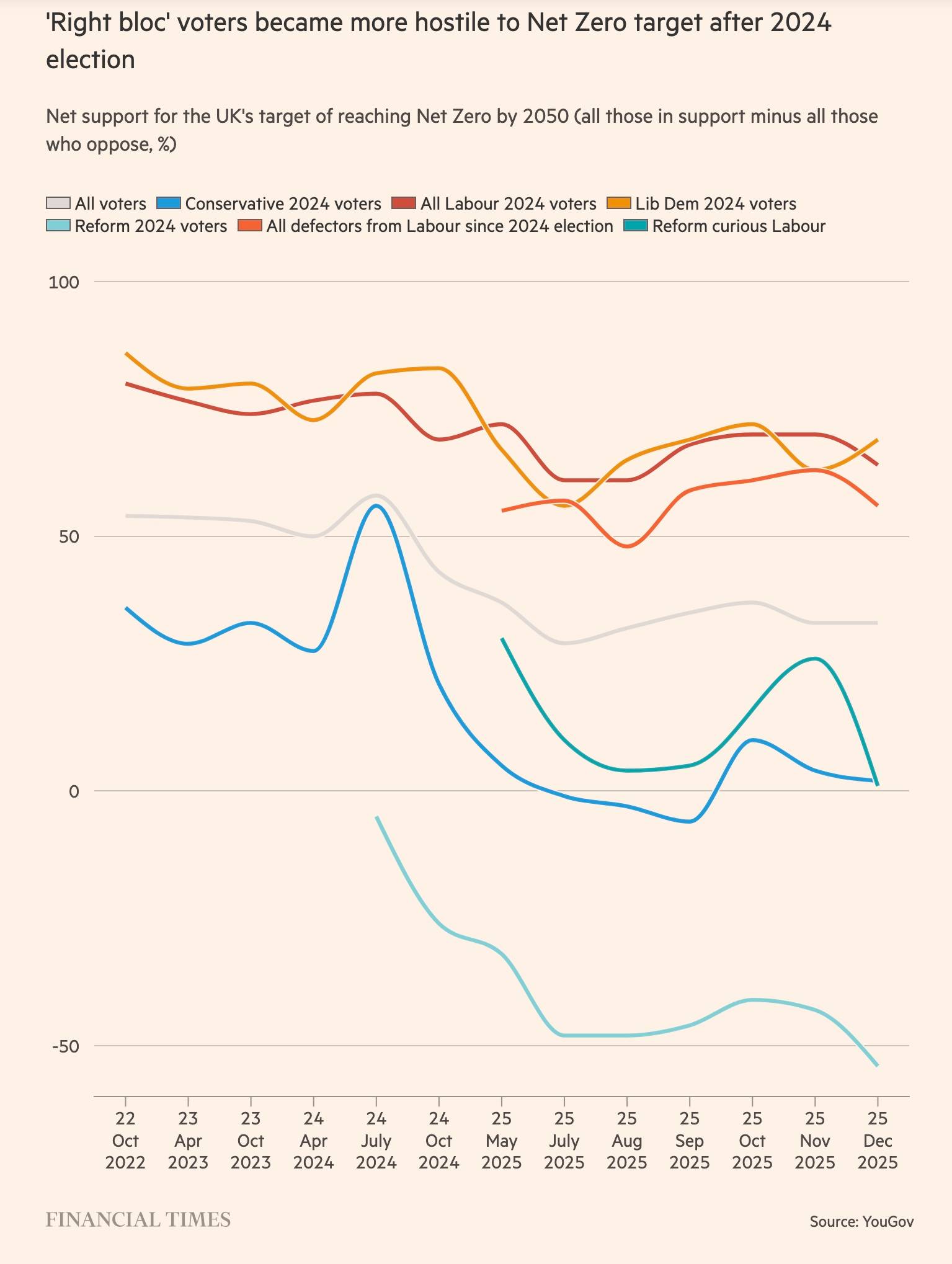
20th March 2026: Financial Times Inside Politics Columnist Miranda Green reports on new polling from Persuasion UK and IPPR revealing that Tory MPs under-estimate public support for net zero by 18% points. Support for net zero remains high among the UK public, but that the Conservative party has “sheered off” from the cross-party consensus since the 2024 election. The data shows overall net support for the 2050 target has drifted upward to 49% among all voters, but Tory support has dropped from 65% (April 2024) to 57% (December 2025), while Reform UK voters remain consistently hostile at around 24%. Notably, only 4% of Labour-to-Reform defectors cite climate or net zero as a reason for their switch https://www.ft.com/content/161a9f60-0bb8-40ad-a48d-47da8d08437b?syn-25a6b1a6=1
Overall C.A.T. Usefulness: 9/10 ★★★★★★★★★☆
Strengths:
This article performs an essential service for anyone trying to understand the political terrain of the energy transition in the UK and, by extension, in other Western democracies facing similar populist pressures. Its key strengths are:
- Grounding in Data, Not Anecdote: The polling data is granular and segmented by party allegiance, allowing us to see not just a single “public opinion” number, but the complex tectonic shifts beneath the surface. The distinction between “all voters” (49% net support, trending up) and “Conservative 2024 voters” (57% net support, trending down) is the heart of the story.
- Exposing the Elite-Public Gap: The finding that Tory MPs underestimate public support for net zero by 18 percentage points is devastating. It reveals that the retreat from climate policy on the centre-right is not being driven by voter demand, but by elite political strategy . . . an attempt to “keep the radical right on board” by abandoning the cross-party consensus that Boris Johnson once claimed.
- Reframing the Narrative: The headline and framing . . . “Net zero is not a zero-sum game” . . . directly challenge the dominant political framing that climate action is a luxury the public no longer wants. The data supports this: only 4% of Labour-to-Reform defectors cite climate as a reason. The drivers of populist realignment are elsewhere (immigration, “Britishness,” economic anxiety), and climate policy is being dragged along as a symbolic casualty.
- Naming the Mechanism: Steve Akehurst’s analysis of the “centre of gravity” being “yanked away from the centre” within the right bloc is a precise diagnosis of how minority factions can drive policy retreat. This is not a story about the public turning against climate action; it is a story about political elites misreading their own voters and chasing a radical fringe.
- The Scotland Anomaly: The note that anti-net-zero sentiment is notably higher in Scotland (31% vs mid-20s UK-wide) and the speculation about North Sea oil and gas is a valuable reminder that the politics of transition are local. What plays in Westminster does not play the same way in Aberdeen or Shetland.
Weaknesses:
The article’s primary weakness is that it remains within the frame of Westminster political reporting, without fully exploring the implications of its own findings:
- The “Why” of Elite Retreat: The article notes that the centre-right abandoned the consensus “in an attempt to keep the radical right on board.” But it does not explore the political economy of that decision. Who is funding this shift? What is the role of fossil fuel interests, media owners, and think-tanks in creating the perception that climate policy is unpopular? The article hints at a manufactured backlash but does not name the manufacturers.
- The Johnson Question: The suggestion that “maybe Johnson should speak up” is a fascinating admission that the architecture of the cross-party consensus was always fragile—built on the personality of one politician rather than institutionalized. But the article does not ask: why did that consensus not survive him? What does that say about the durability of climate policy when it is not embedded in law and institutional structure?
- The Silence on Policy Content: The polling asks about the “net zero target” in the abstract, but not about specific policies (heat pumps, insulation, EV mandates, wind farm siting). The gap between support for the goal and opposition to the means of achieving it is a known phenomenon. The article does not explore whether the same patterns hold when voters are asked about trade-offs.
- The Gender Dimension (SDG 5): As with almost all political reporting, the article is silent on gender. Are women and men diverging in their support for climate policy? Are there gendered patterns in the “Reform-curious” voter base? The data might not exist, but the article does not acknowledge this as a gap.
Opportunities for C.A.T.:
This article provides C.A.T. with a powerful case study and a set of strategic openings:
- A Strategic Argument: The finding that Tory MPs are 18 points out of step with their own voters is a political weapon. It can be used to argue that climate policy retreat is not democratic accountability, but elite capture. This is precisely the kind of “high-resolution realism” Christian advocates: understanding that the barrier is not public opinion but political strategy.
- A Rebuttal to the “Greenlash” Narrative: The article provides empirical evidence that the much-discussed “greenlash” is real only among a narrow political elite and their most radical supporters. For C.A.T., this is an opportunity to push back against defeatist narratives and argue that the political terrain is still winnable.
- A Warning on Fragility: The fact that the cross-party consensus collapsed with a change of party leadership shows that climate policy cannot rely on elite goodwill. It must be embedded in durable institutions, long-term contracts, and distributed constituencies (workers, communities, investors) who have a stake in its continuation. C.A.T. can use this to argue for institutionalization, not just advocacy.
- A Lens for Other Countries: The dynamics described . . . centre-right chasing the radical right, elite misreading of public opinion, the symbolic weaponisation of climate policy . . . are not unique to the UK. This article provides a template for analyzing similar dynamics in France, Germany, the Netherlands, and beyond.
Threats:
The biggest threat is that this article’s findings will be read as a “greenlash” confirmation, rather than a critique of elite political strategy. The headline (“Revolt on the right—again!”) could reinforce the very narrative the article complicates. A second threat is that the 18-point elite-public gap becomes a story about “out of touch MPs,” but not a call to action. The gap is a weapon; if it is not used, it becomes just another data point. A third threat is that the fragmentation documented here accelerates. If the centre-right has abandoned the consensus, and the left cannot hold it alone, then net zero becomes a partisan issue . . . and partisan issues are always one election away from reversal.
Analysis Through Lenses:
United Nations Lens (IPCC/UNFCCC): From a UN climate governance perspective, this article is deeply concerning. The Paris Agreement relies on the assumption that once countries set targets, those targets will be sustained through changes in government. The UK’s retreat from cross-party consensus suggests that this assumption is naive. If the world’s first major economy to legislate net zero cannot maintain political support for it, what hope for others? The UNFCCC process has focused on target-setting; this article suggests that the real work is in target-sustaining . . . building political durability into climate policy.
EU Green New Deal Lens: For Brussels, this article should be a warning. The UK was once the leader on climate legislation. Its political fragmentation suggests that even well-designed policy can be undone by elite realignment. The EU’s Green Deal is more institutionalized than the UK’s approach ever was, but it is not immune to similar dynamics. The rise of populist parties across Europe, many of them hostile to climate policy, mirrors the Reform UK trajectory. The lesson: institutionalize deeply, create distributed constituencies, and never assume that today’s consensus is tomorrow’s.
Draghi Report Lens: Mario Draghi’s report called for Europe to invest in competitiveness and to build political consensus around the transition. This article shows what happens when consensus fractures. The 18-point gap between MPs and voters is a failure of democratic representation. Draghi’s vision of a “clean industrial deal” requires not just investment, but political stability. The UK’s experience suggests that stability cannot be taken for granted.
Mark Jacobson Lens: Through Jacobson’s framework, this article is a case study in the political obstacles to a 100% renewable system. Jacobson’s research shows that the technology exists, the economics work, and the health benefits are enormous. The barrier is political. This article shows that barrier in action: political elites abandoning climate policy not because voters demand it, but because they have chosen to chase a radical fringe. Jacobson would say: the solution is not better polling, but direct investment that creates jobs and lowers bills . . . making the transition politically unstoppable by creating constituencies that will defend it.
SDG Ratings:
| SDG | Rating | Rationale |
|---|---|---|
| SDG 1 No Poverty | 4/10 ★★★★☆☆☆☆☆☆ | Mentions energy bills and vulnerable households, but no detailed analysis |
| SDG 2 Zero Hunger | 0/10 ☆☆☆☆☆☆☆☆☆☆ | Not addressed |
| SDG 3 Good Health and Well-Being | 2/10 ★★☆☆☆☆☆☆☆☆ | No health or air quality framing |
| SDG 4 Quality Education | 2/10 ★★☆☆☆☆☆☆☆☆ | Polling literacy, but no education angle |
| SDG 5 Gender Equality | 0/10 ☆☆☆☆☆☆☆☆☆☆ | Complete absence. No mention of women, gender, or differential impacts |
| SDG 6 Clean Water and Sanitation | 0/10 ☆☆☆☆☆☆☆☆☆☆ | Not addressed |
| SDG 7 Affordable and Clean Energy | 8/10 ★★★★★★★★☆☆ | Central focus; bills and energy costs |
| SDG 8 Decent Work and Economic Growth | 4/10 ★★★★☆☆☆☆☆☆ | Economic anxiety mentioned, but jobs and workers not discussed |
| SDG 9 Industry, Innovation and Infrastructure | 3/10 ★★★☆☆☆☆☆☆☆ | Not addressed |
| SDG 10 Reduced Inequalities | 4/10 ★★★★☆☆☆☆☆☆ | Class and political divides noted, but inequality analysis absent |
| SDG 11 Sustainable Cities and Communities | 2/10 ★★☆☆☆☆☆☆☆☆ | Not addressed |
| SDG 12 Responsible Consumption and Production | 3/10 ★★★☆☆☆☆☆☆☆ | Not addressed |
| SDG 13 Climate Action | 9/10 ★★★★★★★★★☆ | Core focus; net zero target and political support |
| SDG 14 Life Below Water | 0/10 ☆☆☆☆☆☆☆☆☆☆ | Not addressed |
| SDG 15 Life on Land | 1/10 ★☆☆☆☆☆☆☆☆☆ | Not addressed |
| SDG 16 Peace, Justice and Strong Institutions | 7/10 ★★★★★★★☆☆☆ | Democratic representation, elite accountability, MP-voter gap |
| SDG 17 Partnerships for the Goals | 4/10 ★★★★☆☆☆☆☆☆ | Cross-party consensus mentioned but now broken |
19th March 2026: Financial Times Europe Express columnist Henry Foy reports that the Middle East war has “gatecrashed” the EU leaders’ summit originally focused on economic competitiveness. The Brussels meeting, intended to address Europe’s flagging economic growth through proposals to break down internal market barriers, cut red tape, and establish a competitiveness fund, has been overtaken by the energy crisis triggered by the Iran conflict. A paragraph on the EU’s Emissions Trading System (ETS) is one of the few topics left undecided by diplomats, with ten member states led by Austria demanding more free allowances and a review of the system by the end of May. Meanwhile, DHL Express Europe’s CEO argues that Europe’s economic plight may be overstated, noting that six EU countries rank in the top ten most globally connected nations and that the German economy has begun to pick up https://www.ft.com/content/25b309cb-4ae0-411d-b2f9-3c6557fa8cea?syn-25a6b1a6=1
Overall C.A.T. Usefulness: 9/10 ★★★★★★★★★☆
Strengths:
This article captures a critical moment of simultaneity: the collision of geopolitical crisis, energy policy, and economic strategy in the EU’s central decision-making forum. Its key strengths are:
- The Gatecrash Framing: The metaphor of war “gatecrashing” the summit is precise and evocative. It communicates that the EU’s carefully planned agenda for competitiveness is being overwhelmed by events beyond its control . . . and that the response to those events will shape the competitiveness agenda for years to come.
- Exposing the ETS Battlefront: The detail that the ETS is one of the “few topics left undecided” by diplomats, and that ten member states led by Austria are demanding more free allowances and a review by the end of May, is a vital piece of reporting. It shows that the political battle over carbon pricing . . . documented in previous C.A.T. analyses (BASF’s Kamieth, the speculator surge) . . . is now playing out at the highest level of EU governance.
- The DHL Counter-Narrative: The inclusion of Mike Parra’s argument that Europe’s economic plight may be overstated is a valuable dose of data-driven optimism. The six EU countries in the top ten most globally connected, the return of companies to the Netherlands, the German economy picking up . . . these are concrete indicators that the “doom narrative” may be mis-delivered. This prevents the article from becoming pure crisis reporting.
- The Dutch _ _ _ _ _-Builder: The opening scoop on new Dutch premier Rob Jetten . . . urging EU leaders to “stop complaining” and “maybe just do a better job,” embracing an “open relationship” with Trump’s America, and positioning himself as a bridge between France and Germany . . . introduces a new political actor at a moment of fragmentation.
- The Tension Between Short and Long Term: The article captures the central dilemma facing EU leaders: the immediate need to address soaring energy prices (short-term remedies like lowering energy taxes) versus the long-term structural fixes needed for competitiveness. The diplomat’s warning that a desire for “instant solutions does not help in terms of getting the same prescription” is a perfect articulation of this tension.
Weaknesses:
The article has few weaknesses, but there are areas where deeper analysis would strengthen it:
- The ETS Detail Gap: The article notes that ten member states want more free allowances and a review by the end of May. It does not name nine of the ten (Austria is named, the others are not). It does not explain what “more free allowances” would mean for the carbon price, for emissions reductions, or for the EU’s 2030 targets. For readers following the ETS battle, this is insufficient detail.
- The Gender Dimension (SDG 5): As with almost all political reporting, the article is silent on gender. The EU summit is a gathering of (mostly male) heads of government. The energy crisis has gendered impacts (fuel poverty affects women disproportionately; care responsibilities shape transport needs). The DHL analysis of economic connectivity says nothing about gender in the workforce. This is a persistent blind spot.
- The DHL Data Gap: Parra’s optimism is welcome, but the article does not interrogate it. The purchasing managers’ index increase from 49.50 to 50.80 is marginal. The “companies that left and now have returned” are not named or quantified. The article could have pressed harder on whether the data supports the optimism.
- The Ukraine-Russia Shadow: The article mentions Russia considering armed naval patrols to protect its shadow fleet. But it does not explore how the Iran war interacts with the ongoing Russia-Ukraine war. Europe is facing multiple energy fronts simultaneously; the article treats Iran in isolation.
Opportunities for C.A.T.:
This article provides C.A.T. with a high-resolution picture of the political battlefield in Brussels:
- The ETS Defense: The battle over free allowances is the frontline of European climate policy. C.A.T. can use this article to track which member states are pushing for weakening (Austria and nine others) and which are holding the line. The end-of-May deadline is a specific date for monitoring.
- The Competitiveness Frame: The article shows that the “competitiveness” argument is now central to the ETS debate. C.A.T. can use the DHL data . . . Europe’s continued global connectivity . . . to counter the narrative that climate policy is destroying European competitiveness. The data says the opposite: Europe remains the most globally connected region.
- The Dutch Angle: Jetten’s arrival as a “bridge builder” between France and Germany is a new variable. C.A.T. can watch whether the Netherlands under liberal leadership becomes a force for holding the line on climate policy or for diluting it.
- The Short-Term/Long-Term Tension: This tension is at the heart of every climate policy debate. C.A.T. can use the article to argue that short-term fixes (tax cuts, subsidies) must be designed to reinforce, not undermine, long-term structural transition. Italy’s fuel tax cut (from the previous article) is a negative example; targeted support for vulnerable households is a positive one.
Threats:
The biggest threat is that the ten member states succeed in weakening the ETS. If more free allowances are granted, the carbon price will fall, the signal to investors will weaken, and the EU’s 2030 targets will become harder to reach. A second threat is that the short-term remedies (tax cuts, state aid) become permanent, locking in fossil fuel dependence rather than accelerating the transition. Italy’s fuel tax cut (previous article) is a warning: what starts as a temporary crisis response can become a permanent subsidy. A third threat is that the competitiveness debate becomes entirely decoupled from climate goals. If EU leaders conclude that competitiveness means weakening environmental regulation, the Green Deal will be hollowed out from within.
Analysis Through Lenses:
United Nations Lens (IPCC/UNFCCC): From a UN climate governance perspective, this article is a case study in how geopolitical crisis tests the durability of climate policy. The EU’s ETS is the world’s largest carbon market and a cornerstone of the global climate architecture. If ten member states succeed in weakening it . . . granting more free allowances, delaying reforms . . . the signal to global markets is that carbon pricing is politically fragile. The UNFCCC process has always assumed that once carbon pricing is in place, it will be sustained. This article suggests that assumption is optimistic. The fact that the ETS battle is playing out at the same time as the IEA is calling for demand reduction creates a striking contrast: one institution moving toward conservation, another potentially moving away from it.
EU Green New Deal Lens: This article is at the heart of the Green Deal’s stress test. The ETS is the “cornerstone” of the Green Deal. If it is weakened, the entire architecture . . . the CBAM, the 2030 targets, the net-zero by 2050 goal . . . is at risk. The article shows that the “competitiveness” argument, weaponized by BASF and other industrial actors, has now penetrated the highest levels of EU governance. The ten member states pushing for free allowances are essentially arguing that European industry cannot bear the cost of carbon pricing. The Green Deal’s response must be to show that the cost of inaction . . . in energy dependence, in climate impacts, in lost competitiveness . . . is far higher. The DHL data on Europe’s global connectivity is a starting point for that argument.
Draghi Report Lens: Mario Draghi’s report called for €800 Billion in annual investment to close Europe’s innovation and competitiveness gap. It also called for simplifying regulation and reducing the burden on business. This article shows the political obstacle to that vision: member states are using the crisis to demand exemptions from the very carbon price that would drive the investment Draghi called for. The tension is real: higher carbon prices make investment in clean tech more attractive, but they also raise costs for incumbent industries in the short term. Draghi’s answer was to use the revenues to support the transition. The article does not mention whether the ten member states are also demanding a share of ETS revenues for industrial support . . . but that is the logical next question.
Mark Jacobson Lens: Through Jacobson’s framework, this article is a case study in the political resistance to the transition. Jacobson’s research shows that wind and solar can be deployed in 2-5 years, that they are cheaper than fossil fuels, and that they would free Europe from the kind of energy dependence that makes it vulnerable to wars in the Middle East. The fact that EU leaders are debating free carbon allowances rather than accelerating renewable deployment is, for Jacobson, a sign of policy failure. He would argue that every euro spent on free allowances is a euro not spent on solar panels, wind turbines, and storage. The “short-term remedies” von der Leyen proposes . . . using existing state aid frameworks, lowering energy taxes . . . are, from Jacobson’s perspective, a distraction. The only real remedy is to build out renewables so fast that fossil fuel dependence becomes irrelevant.
SDG Ratings:
| SDG | Rating | Rationale |
|---|---|---|
| SDG 1 No Poverty | 4/10 ★★★★☆☆☆☆☆☆ | Energy bills mentioned; distributional impacts of ETS and tax cuts not explored |
| SDG 2 Zero Hunger | 0/10 ☆☆☆☆☆☆☆☆☆☆ | Not addressed |
| SDG 3 Good Health and Well-Being | 2/10 ★★☆☆☆☆☆☆☆☆ | No health or air quality framing |
| SDG 4 Quality Education | 1/10 ★☆☆☆☆☆☆☆☆☆ | Not addressed |
| SDG 5 Gender Equality | 0/10 ☆☆☆☆☆☆☆☆☆☆ | Complete absence. No mention of women, gender, or differential impacts of energy crisis |
| SDG 6 Clean Water and Sanitation | 0/10 ☆☆☆☆☆☆☆☆☆☆ | Not addressed |
| SDG 7 Affordable and Clean Energy | 9/10 ★★★★★★★★★☆ | Central focus; energy prices, ETS, short-term remedies |
| SDG 8 Decent Work and Economic Growth | 7/10 ★★★★★★★☆☆☆ | Competitiveness, economic growth, DHL data on connectivity |
| SDG 9 Industry, Innovation and Infrastructure | 6/10 ★★★★★★☆☆☆☆ | Competitiveness fund, internal market barriers, industrial policy |
| SDG 10 Reduced Inequalities | 3/10 ★★★☆☆☆☆☆☆☆ | ETS free allowances benefit incumbents; distributional impacts not analyzed |
| SDG 11 Sustainable Cities and Communities | 1/10 ★☆☆☆☆☆☆☆☆☆ | Not addressed |
| SDG 12 Responsible Consumption and Production | 4/10 ★★★★☆☆☆☆☆☆ | Implicit in ETS and competitiveness discussion |
| SDG 13 Climate Action | 8/10 ★★★★★★★★☆☆ | ETS central; tension between short-term fixes and long-term transition |
| SDG 14 Life Below Water | 0/10 ☆☆☆☆☆☆☆☆☆☆ | Not addressed |
| SDG 15 Life on Land | 0/10 ☆☆☆☆☆☆☆☆☆☆ | Not addressed |
| SDG 16 Peace, Justice and Strong Institutions | 6/10 ★★★★★★☆☆☆☆ | EU governance, diplomatic negotiations, war as driver |
| SDG 17 Partnerships for the Goals | 7/10 ★★★★★★★☆☆☆ | EU member state coordination (and tension); Netherlands as bridge builder |
17th March 2026: Financial Times Journalist Ian Johnston reports that Spain warns EU against suspending carbon market to try to lower energy prices amid Iran war shock https://www.ft.com/content/2fc4615a-c9bb-4b9e-be29-2c9c6ec44b5f?syn-25a6b1a6=1
Overall C.A.T. Usefulness: 9/10 ★★★★★★★★★☆
Strengths:
This article is masterful real-time climate policy journalism, capturing a pivotal moment of pressure on Europe’s core climate mechanism. Its key strengths are:
- Naming the Battle Lines: It clearly delineates the factions . . . Italy and Germany (wavering) pushing for suspension vs Spain, Portugal, and Scandinavia defending the ETS. This is not abstract; it is a live political fight with immediate consequences.
- Quantifying the Stakes: The 11% of energy costs attributable to ETS, the 7% carbon price drop after Merz’s comments (to €71.40/t), and Spain’s 57% renewable electricity mix give hard numbers to the debate.
- Historical Depth: The reference to the 2022 Ukraine crisis and the decision not to suspend the ETS then provides essential context. The lesson: the system held before; it can hold again.
- Giving Voice to Defense: Aagesen’s quotes are powerful and quotable. “Using this crisis to change a system that works is irresponsible and a big error.” “ETS needs to last.” This is the counter-argument to short-term panic.
- Connecting to Real-World Success: The article explicitly links Spain’s renewable build-out (57% mix) to its reduced exposure to gas price spikes. This is the evidence-based case, and not retreat.
- Detail on Alternatives: The mention of the stability reserve mechanism, the “Iberian exception” history, and Spain’s two-package approach (circumstantial vs structural measures) provides policy granularity.
Weaknesses:
The article’s primary weakness is its exclusive focus on the elite-level political debate, with almost no grounding in the human or equity dimensions:
- The Civil Society Voice is Absent: Where are the environmental NGOs? The climate justice movements? The youth activists? This is reported entirely through ministers and commissioners.
- The “Vulnerable Households” Question: Aagesen mentions protecting vulnerable households from disconnection and broadening subsidies. But the article does not interrogate whether these measures are adequate, or who falls through the cracks.
- The Global South Dimension: The trigger is the Iran war and the closure of the Strait of Hormuz . . . a geopolitical crisis with roots in fossil fuel dependence. The article does not explore what this means for energy-importing developing countries, who face the same price spikes with far fewer buffers.
- The 1.5°Celsius Question: The debate is about energy prices and competitiveness. The article does not ask what suspending the ETS would mean for the EU’s climate targets. The elephant in the room is unspoken.
Opportunities for C.A.T.:
This article provides C.A.T. with several powerful hooks:
- The “Success Story” Frame: Spain is living proof that the transition works. C.A.T. can use this to counter the “competitiveness” narrative. The headline could be: “Spain’s 57% Renewables Show Why We Must Defend, Not Dismantle, the ETS.”
- The Historical Lesson: The fact that the ETS survived the 2022 Ukraine crisis is a powerful precedent. C.A.T. can argue: we held the line then; we must hold it now.
- The Vulnerability Map: The article implicitly maps which countries are vulnerable (fossil-dependent) and which are resilient (renewable-rich). C.A.T. can use this to argue that energy security is climate policy.
- The Stability Reserve Angle: von der Leyen’s proposal to use the reserve to “keep prices in check” is a technical fix that C.A.T. can track and evaluate. Will it be enough? Will it be implemented?
- The Two-Package Model: Spain’s distinction between “circumstantial” measures (protecting vulnerable households) and “structural” measures (reinforcing renewables) is a useful policy template. C.A.T. can amplify this as a model for just transition policy.
Threats:
The threats are significant and immediate:
- Contagion Risk: If Italy succeeds in forcing a suspension, other countries will follow. The ETS could unravel.
- The Merz Effect: Merz softened his stance, but the 7% price drop shows how fragile market confidence is. A single politician’s comment can wipe billions in value and slow investment.
- The Short-Termism Trap: The entire debate is framed around immediate energy prices, not long-term climate survival. C.A.T. must fight this framing.
- The Missing Voice: The absence of civil society and youth voices in this article is itself a threat. It means the debate is being conducted entirely within elite circles, with the public as passive observers. C.A.T. can and must fill that gap.
Analysis Through Lenses of:
- United Nations Lens (IPCC/UNFCCC): From a UN climate governance perspective, this article is a stress test for the Paris Agreement’s Article 6 (carbon markets). The EU ETS is the world’s largest carbon market and a template for others. If it collapses under political pressure, the signal to emerging carbon markets globally is devastating. The UNFCCC process depends on demonstrating that carbon pricing can be durable. Spain’s defense is therefore a defense of the entire multilateral framework.
- EU Green New Deal Lens: This is the central nervous system of the Green Deal under direct assault. The ETS is not just a policy; it is the economic engine that funds the transition (through auction revenues) and drives industrial decarbonisation. Von der Leyen’s letter, proposing to use the stability reserve to “keep prices in check,” is a tactical concession. But the deeper question is whether the Commission will hold the line or allow the system to be gutted. Spain’s 57% renewable mix is the proof of concept: countries that transitioned are now resilient. Those that didn’t are clamoring for suspension. The lesson is not to weaken the ETS, but to Marshall Plan renewable deployment.
- Draghi Report Lens: Mario Draghi’s report called for €800 Billion in annual investment to close Europe’s competitiveness gap. The ETS revenue stream is a critical part of that financing. Suspending it would not only slow decarbonisation but also starve the very industries that need support of the funds Draghi identified as essential. The irony is acute: Italy, whose former prime minister authored the report, is now leading the charge to undermine one of its key funding mechanisms. The competitiveness argument against the ETS is, in Draghi’s framework, self-defeating.
- Mark Jacobson Lens: Through Jacobson’s framework, this article is a case study in the political economy of transition. Spain’s 57% renewable mix is exactly what Jacobson’s roadmaps prescribe. The result? Lower exposure to fossil fuel price volatility. The countries pushing for suspension are those still dependent on gas. Jacobson would argue: the solution is not to weaken the carbon price, but to accelerate the wind-water-solar deployment that makes countries immune to these shocks. Every day of delay in building renewables locks in another day of vulnerability to fossil fuel price spikes and geopolitical blackmail.
SDG Ratings:
| SDG | Rating | Rationale |
|---|---|---|
| SDG 1 No Poverty | 4/10 ★★★★☆☆☆☆☆☆ | Mentions vulnerable households and disconnection bans, but no detail on adequacy |
| SDG 2 Zero Hunger | 1/10 ★☆☆☆☆☆☆☆☆☆ | Brief mention of farming aid, no analysis |
| SDG 3 Good Health | 2/10 ★★☆☆☆☆☆☆☆☆ | Implicit link to air pollution from fossil fuels, not explored |
| SDG 4 Quality Education | 1/10 ★☆☆☆☆☆☆☆☆☆ | Not addressed |
| SDG 5 Gender Equality | 0/10 ☆☆☆☆☆☆☆☆☆☆ | Complete absence. No mention of women, gender, or differential impacts. |
| SDG 6 Clean Water | 1/10 ★☆☆☆☆☆☆☆☆☆ | Not addressed |
| SDG 7 Affordable Clean Energy | 8/10 ★★★★★★★★☆☆ | Central to the debate |
| SDG 8 Decent Work | 3/10 ★★★☆☆☆☆☆☆☆ | Implied competitiveness concerns, no worker voice |
| SDG 9 Industry Innovation | 7/10 ★★★★★★★☆☆☆ | Innovation and investment mentioned |
| SDG 10 Reduced Inequalities | 3/10 ★★★☆☆☆☆☆☆☆ | Vulnerable households mentioned, not analyzed |
| SDG 11 Sustainable Cities | 1/10 ★☆☆☆☆☆☆☆☆☆ | Not addressed |
| SDG 12 Responsible Consumption | 2/10 ★★☆☆☆☆☆☆☆☆ | Implicit in ETS logic |
| SDG 13 Climate Action | 9/10 ★★★★★★★★★☆ | Core subject |
| SDG 14 Life Below Water | 0/10 ☆☆☆☆☆☆☆☆☆☆ | Not addressed |
| SDG 15 Life on Land | 1/10 ★☆☆☆☆☆☆☆☆☆ | Not addressed |
| SDG 16 Peace Justice Institutions | 6/10 ★★★★★★☆☆☆☆ | EU governance, rule of law, institutional resilience |
| SDG 17 Partnerships | 5/10 ★★★★★☆☆☆☆☆ | EU member state coordination, Commission role |
11th March 2026: Financial Times Journalist Attracta Mooney reports that energy shocks caused by the Middle East war will force business rethink. State Street CEO Ron O’Hanley is quoted that supply-chain breaks are a “Covid moment” for companies https://www.ft.com/content/d2142fe3-7f59-4018-b25a-9003d552dfdf?syn-25a6b1a6=1
Overall C.A.T. Usefulness: 8/10 ★★★★★★★★☆☆
Strengths:
This article captures a pivotal shift in corporate consciousness, translating geopolitical crisis into strategic imperative. Its key strengths are:
- The Framing: O’Hanley’s “Covid moment” analogy is powerful and accessible. It connects the current energy shock to a lived experience every business leader understands . . . a fundamental, system-wide breakage that demands a permanent rethink, not a temporary fix.
- Quantifying the Shift in Mindset: The core thesis is not about numbers but about psychology. “No one is going to leave themselves exposed like that again” is a statement of intent that, if realized, will reshape investment flows for decades.
- Diverse Voices, Coherent Narrative: The article weaves together finance (O’Hanley, Nusseibeh), politics (Kerry), and industry (Sinha) into a single, coherent story. Each voice adds a layer: Nusseibeh’s regional variation, Kerry’s “scarcity premium,” Sinha’s short-term vs long-term caution.
- The Energy Independence Frame: Kerry’s reframing of the crisis as a catalyst for energy independence is politically potent. It moves the debate from “burden” to “security.”
- Grounded Realism: Sinha’s caution about interest rates and infrastructure costs prevents the article from becoming naive boosterism. The transition will be accelerated, but not without friction.
Weaknesses:
The article’s primary weakness is its exclusive focus on elite decision-makers in finance and policy, with the attendant blind spots:
- The Worker Question: Where are the workers? The “business rethink” is discussed entirely from the C-suite perspective. What does this mean for employment in fossil fuel industries? For retraining? For just transition?
- The Global South Reality: Sinha (India) is included, but the perspective is still that of a major economy. What does this “Covid moment” mean for energy-importing developing countries with no fiscal space to build renewables? The article does not ask.
- The Gender Dimension: Again, a complete absence. How will this energy shock and the subsequent “rethink” affect women differentially . . . as workers, as household energy managers, as caregivers in times of crisis?
- The “We” Assumption: O’Hanley speaks of “no one” leaving themselves exposed. But many countries and companies cannot afford the insurance of diversified, renewable energy. The assumption of universal agency is false.
- The Historical Amnesia: The article treats this as a new awakening. But every energy crisis since 1973 has prompted similar rhetoric, followed by relapse when prices fall. Is this truly different? The article does not interrogate this.
Opportunities for C.A.T.:
This article provides C.A.T. with powerful material for several core themes:
- The “Covid Moment” Frame: This is a gift. C.A.T. can use it to argue that the energy crisis is not a temporary inconvenience but a fundamental system shock that demands permanent restructuring. Just as companies rewired supply chains after Covid, they must now rewire energy systems.
- The Energy Independence Narrative: Kerry’s framing is politically potent across the spectrum. C.A.T. can amplify it: renewables are not just about saving the planet; they are about national security, strategic autonomy, and insulation from global blackmail.
- The Executive Voice: O’Hanley, Nusseibeh, Kerry, Sinha . . . these are not activists; they are the establishment. C.A.T. can use their words to counter the “cost of transition” narrative with “cost of inaction” realism.
- The Short-Term/Long-Term Distinction: Sinha’s caution about interest rates and infrastructure costs is a valuable reality check. C.A.T. can use it to argue for policy interventions that lower the cost of capital for renewables and protect projects from macroeconomic volatility.
Threats:
The threats are as significant as the opportunities:
- The “This Time Is Different” Fallacy: Every energy crisis produces rhetoric about permanent change, followed by relapse when prices fall. The threat is that this “Covid moment” becomes another forgotten resolution. C.A.T. must track whether words become deeds.
- The Affordability Trap: If interest rates rise and infrastructure costs spike, the transition could become the preserve of wealthy nations and corporations, leaving the Global South behind. Sinha’s warning must be taken seriously.
- The Greenwashing Risk: Companies will announce “rethink” strategies that are actually business-as-usual with a green veneer. C.A.T. must maintain its forensic skepticism.
- The Missing Justice Dimension: The article’s complete silence on workers, vulnerable households, and gender means the emerging consensus is being built on an incomplete foundation. C.A.T. must keep inserting these questions until they become unignorable.
Analysis Through Lenses of:
- United Nations Lens (IPCC/UNFCCC): From a UN climate governance perspective, this article is about the real-economy transmission of crisis into commitment. The IPCC has long argued that climate action requires a “whole-of-economy” approach. This article shows the finance sector beginning to internalize that logic . . . not from altruism, but from self-preservation. The “Covid moment” framing is useful: just as supply chains were reshored for resilience, energy systems must be rebuilt for security. The UNFCCC’s Global Stocktake process should be tracking exactly these shifts in corporate and financial sector behavior. The question is whether this translates into the 45% emissions cuts by 2030 that the IPCC says are necessary.
- EU Green New Deal Lens: This article should be read in Brussels as validation of the Green Deal’s core logic. The argument that energy independence is climate policy is now being made by former US secretaries of state and global bank CEOs. The EU’s push for renewables was always framed as both climate action and strategic autonomy. This crisis proves the thesis. The challenge is execution: Sinha’s warning about interest rates and infrastructure costs is a reminder that the macroeconomic environment is now headwinds, not tailwinds.
- Draghi Report Lens: Mario Draghi’s diagnosis was that Europe faces a competitiveness crisis requiring massive, coordinated investment. This article suggests that the private sector is waking up to the same reality . . . but in response to crisis, not foresight. Draghi called for €800 Billion in annual investment. O’Hanley’s “no one will leave themselves exposed” suggests capital is ready to move. The question is whether Europe has the bankable projects, the streamlined permitting, and the grid capacity to absorb it. Draghi warned that without action, capital would flow elsewhere. This article hints at capital’s readiness; the policy framework must now deliver.
- Mark Jacobson Lens: Through Jacobson’s framework, this article is a case study in the politics of acceleration. Jacobson has long argued that the technology for 100% renewables exists, and that the only barriers are political and perceptual. O’Hanley’s “Covid moment” is a perceptual shift. Kerry’s “renewables are the fastest and most economical source” is exactly Jacobson’s thesis spoken by a political heavyweight. But Jacobson would also sound Sinha’s caution: if interest rates rise and infrastructure costs spike, the transition could stall. The solution, in Jacobson’s view, is not to wait for markets to correct, but for governments to intervene directly . . . with public investment, streamlined permitting, and mandates . . . to ensure that the perceptual shift becomes physical reality before the window closes.
SDG Ratings:
| SDG | Rating | Rationale |
|---|---|---|
| SDG 1 No Poverty | 2/10 ★★☆☆☆☆☆☆☆☆ | Implied in energy access, not addressed |
| SDG 2 Zero Hunger | 0/10 ☆☆☆☆☆☆☆☆☆☆ | Not addressed |
| SDG 3 Good Health | 1/10 ★☆☆☆☆☆☆☆☆☆ | Not addressed |
| SDG 4 Quality Education | 0/10 ☆☆☆☆☆☆☆☆☆☆ | Not addressed |
| SDG 5 Gender Equality | 0/10 ☆☆☆☆☆☆☆☆☆☆ | Complete absence. No mention of women or gender dimensions. |
| SDG 6 Clean Water | 0/10 ☆☆☆☆☆☆☆☆☆☆ | Not addressed |
| SDG 7 Affordable Clean Energy | 8/10 ★★★★★★★★☆☆ | Central to the debate |
| SDG 8 Decent Work | 2/10 ★★☆☆☆☆☆☆☆☆ | Implied in “business rethink,” no worker voice |
| SDG 9 Industry Innovation | 7/10 ★★★★★★★☆☆☆ | Core theme . . . business strategy, infrastructure |
| SDG 10 Reduced Inequalities | 1/10 ★☆☆☆☆☆☆☆☆☆ | Not addressed |
| SDG 11 Sustainable Cities | 1/10 ★☆☆☆☆☆☆☆☆☆ | Not addressed |
| SDG 12 Responsible Consumption | 3/10 ★★★☆☆☆☆☆☆☆ | Implicit in energy efficiency logic |
| SDG 13 Climate Action | 8/10 ★★★★★★★★☆☆ | Central subject |
| SDG 14 Life Below Water | 0/10 ☆☆☆☆☆☆☆☆☆☆ | Not addressed |
| SDG 15 Life on Land | 0/10 ☆☆☆☆☆☆☆☆☆☆ | Not addressed |
| SDG 16 Peace Justice Institutions | 3/10 ★★★☆☆☆☆☆☆☆ | Geopolitical context, institutional responses |
| SDG 17 Partnerships | 4/10 ★★★★☆☆☆☆☆☆ | SMI event, multi-stakeholder dialogue |
11th March 2026: Financial Times Moral Money columnist Simon Mundy reports on China’s latest 5-year plan, revealing that Beijing’s new green targets appear modest on paper but reflect a deliberate strategy of maintaining flexibility while accelerating clean energy deployment. The plan commits to a 17% reduction in carbon intensity by 2030, avoids firm limits on coal consumption, and emphasizes continued expansion of renewables, electric vehicles, and industrial decarbonisation. At the same time, China positions its “ecological civilisation” framework as central to national development, while leveraging the geopolitical moment . . . rising fossil fuel insecurity and weakening US climate leadership . . . to strengthen its role in global climate governance https://www.ft.com/content/721cbd01-5133-4c02-a399-8cd74a241a04?syn-25a6b1a6=1
8/10 ★★★★★★★★☆☆
Strengths: This article provides a nuanced and strategically important interpretation of China’s evolving climate policy, particularly within the framework of its new five-year development blueprint. Its key strengths are:
- Strategic Context: The article situates China’s energy policy within the broader geopolitical shock created by the Middle East crisis and rising fossil fuel prices. As the world’s largest importer of oil and gas, China’s vulnerability to external supply shocks reinforces the strategic importance of its clean energy expansion. China’s push toward renewables is framed not only as climate policy but as a response to structural energy insecurity.
- Policy Interpretation Rather Than Headline Reaction: Rather than treating the modest climate targets as evidence of policy retreat, the article interprets them within the long-term logic of China’s development planning under the Five-Year Plans of China. This framing helps readers understand that the apparent caution may represent deliberate strategic flexibility rather than backsliding.
- Insight Into Chinese Political Philosophy: The article effectively explains how Chinese policy culture draws on the incrementalism associated with Deng Xiaoping’s maxim about “crossing the river by feeling the stones.” This historical framing clarifies why Beijing avoids rigid commitments while still pursuing large structural shifts.
- Integration of Xi Jinping’s Ideological Framework: The analysis highlights the role of Xi Jinping’s concept of “ecological civilisation,” which has become embedded in China’s constitutional and policy architecture. By linking climate policy to national ideology and legitimacy, the article explains why decarbonisation remains THE politically central narrative despite the published cautious targets.
- Economic Drivers of Decarbonisation: One of the most important insights is the recognition that China’s clean energy push is driven by industrial policy + economic strategy AND environmental considerations. The country’s dominance in renewable manufacturing and electric vehicles means that climate action increasingly aligns with economic growth.
- Empirical Evidence of Transition: The article includes several indicators suggesting that China’s emissions peak may already be approaching or even occurring earlier than expected . . . despite rising energy demand, falling coal utilisation rates, and electric vehicles reaching 54% of the domestic car market. Official data hints at structural shifts within the energy system.
Weaknesses: The article remains focused on policy interpretation and leaves several critical dimensions under-explored:
- Limited Discussion of Global Climate Implications: China is the world’s largest emitter of greenhouse gases, and the trajectory of its energy system will heavily influence the feasibility of global climate targets. Yet the article does not fully examine how China’s flexible targets affect the global carbon budget or the feasibility of the 1.5°Celsius pathway.
- The Coal System Question: The article acknowledges the continued expansion of coal capacity but stops short of interrogating the long-term implications of this strategy. While coal is described as a “training wheels” system, the long-term risks of maintaining such a large coal fleet are not interrogated. Backup capacity can easily become structural dependency. Maintaining a vast coal fleet as a “safety net” may provide energy security, but it also risks locking in high emissions if renewable integration falters.
- Absence of Social and Environmental Justice Perspectives: As with many Financial Times pieces, the analysis focuses heavily on state policy and economic strategy while largely excluding the health perspectives of communities affected by pollution, workers in fossil industries, or civil society’s need for environmental decency.
- The Global South Dimension: China’s clean energy manufacturing dominance has profound implications for developing economies that depend on imported energy technologies. The article touches on China’s growing influence in global climate governance but does not explore how this might reshape the political economy of energy transitions across the Global South.
- Historical Pattern Blind Spot: Energy crises have repeatedly triggered promises of transition that faded once prices stabilized. The article does not fully address whether this moment represents structural change or another cyclical response.
Opportunities for C.A.T.: This article creates several strategic communication opening and opportunities for Climate Action Tiger:
- The “Energy Security Through Clean Energy” Narrative: China’s energy transition is being driven partly by the strategic risks associated with fossil fuel imports. This reinforces the argument that renewable energy deployment is not merely environmental policy but also a national security strategy.
- The Industrial Strategy Dimension: China’s success in scaling renewable manufacturing demonstrates that climate action can also be an engine of economic growth. This narrative helps counter the persistent claim that decarbonisation undermines competitiveness.
- The Flexible Transition Model: China’s strategy of “build before breaking” offers a distinct transition model: rapidly expand renewable capacity while maintaining legacy infrastructure as a backup safety net. Whether this model accelerates or delays decarbonisation will be an important question for policymakers globally.
- The Global Leadership Vacuum: With the United States stepping back from climate leadership under Donald Trump, China may seek to position itself as a central actor in global climate governance. This shift could reshape diplomatic alliances and investment flows in clean energy.
Threats: Several risks emerge from the strategy described in the article
- Coal Lock-In Risk: Maintaining a large coal fleet as a “training wheels” backup system may reduce short-term energy insecurity but could slow the pace of absolute emissions reductions if demand for electricity continues to grow rapidly.
- Strategic Ambiguity: China’s deliberate flexibility around climate targets may create uncertainty for global climate diplomacy. Other countries could interpret the absence of strict commitments as justification for weakening their own targets.
- Industrial Dominance Tensions: China’s growing dominance in renewable manufacturing may provoke trade conflicts with Europe and the United States, potentially slowing the global diffusion of clean technologies.
- Geopolitical Energy Instability: The Middle East crisis highlighted in the article underscores how fossil fuel dependence continues to expose global energy systems to geopolitical shocks. Without rapid electrification and renewable deployment, these vulnerabilities will persist.
SDG Ratings:
| SDG | Rating | Rationale |
|---|---|---|
| SDG 1 – No Poverty | 2/10 ★★☆☆☆☆☆☆☆☆ | Implied in energy access but not addressed directly |
| SDG 2 – Zero Hunger | 0/10 ☆☆☆☆☆☆☆☆☆☆ | Not addressed |
| SDG 3 – Good Health and Well-Being | 2/10 ★★☆☆☆☆☆☆☆☆ | Indirect link through pollution reduction but not discussed |
| SDG 4 – Quality Education | 0/10 ☆☆☆☆☆☆☆☆☆☆ | Not addressed |
| SDG 5 – Gender Equality | 0/10 ☆☆☆☆☆☆☆☆☆☆ | Complete absence. No mention of women or gender impacts. |
| SDG 6 – Clean Water and Sanitation | 1/10 ★☆☆☆☆☆☆☆☆☆ | Not discussed |
| SDG 7 – Affordable and Clean Energy | 9/10 ★★★★★★★★★☆ | Core focus of the article |
| SDG 8 – Decent Work and Economic Growth | 7/10 ★★★★★★★☆☆☆ | Clean energy industries linked to economic growth |
| SDG 9 – Industry, Innovation and Infrastructure | 8/10 ★★★★★★★★☆☆ | Strong emphasis on industrial development and clean technology |
| SDG 10 – Reduced Inequalities | 2/10 ★★☆☆☆☆☆☆☆☆ | Not explored |
| SDG 11 – Sustainable Cities and Communities | 2/10 ★★☆☆☆☆☆☆☆☆ | Indirect relevance through pollution and energy transition |
| SDG 12 – Responsible Consumption and Production | 4/10 ★★★★☆☆☆☆☆☆ | Energy efficiency and industrial transformation implied |
| SDG 13 – Climate Action | 9/10 ★★★★★★★★★☆ | Central subject |
| SDG 14 – Life Below Water | 0/10 ☆☆☆☆☆☆☆☆☆☆ | Not addressed |
| SDG 15 – Life on Land | 1/10 ★☆☆☆☆☆☆☆☆☆ | Minimal relevance |
| SDG 16 – Peace, Justice and Strong Institutions | 6/10 ★★★★★★☆☆☆☆ | Geopolitical context and climate governance |
| SDG 17 – Partnerships for the Goals | 6/10 ★★★★★★☆☆☆☆ | Implications for global climate cooperation |
10th March 2026: Financial Times Journalists Kenza Bryan and Jana Tauschinski report that “exceptional” atmospheric rivers brought record rainfall and widespread flooding to western and southern Europe in February, with Copernicus warning that such events should draw more attention to the “pressing need for global action” on climate change. Global temperatures reached 1.49C above pre-industrial levels for the month . . . a fraction below the 1.5C threshold that scientists warn would lead to irreversible changes if sustained. The pattern of extremes repeated globally: wetter conditions in Australia, Mozambique, and Botswana; dry spells in the southern US, northern Mexico, eastern China, and parts of South America. February was 23% wetter than average in the UK, with England recording 70% more rain than its long-term average. A new study published in Geophysical Research Letters finds a “statistically significant” acceleration of global warming since 2015. Sea surface temperatures reached 20.88°C in February, the joint second-highest on record, while Arctic sea ice was 5% below average . . . the third-lowest level for the month https://www.ft.com/content/2049ad66-5156-406f-b765-bbe1da42b4b6?syn-25a6b1a6=1
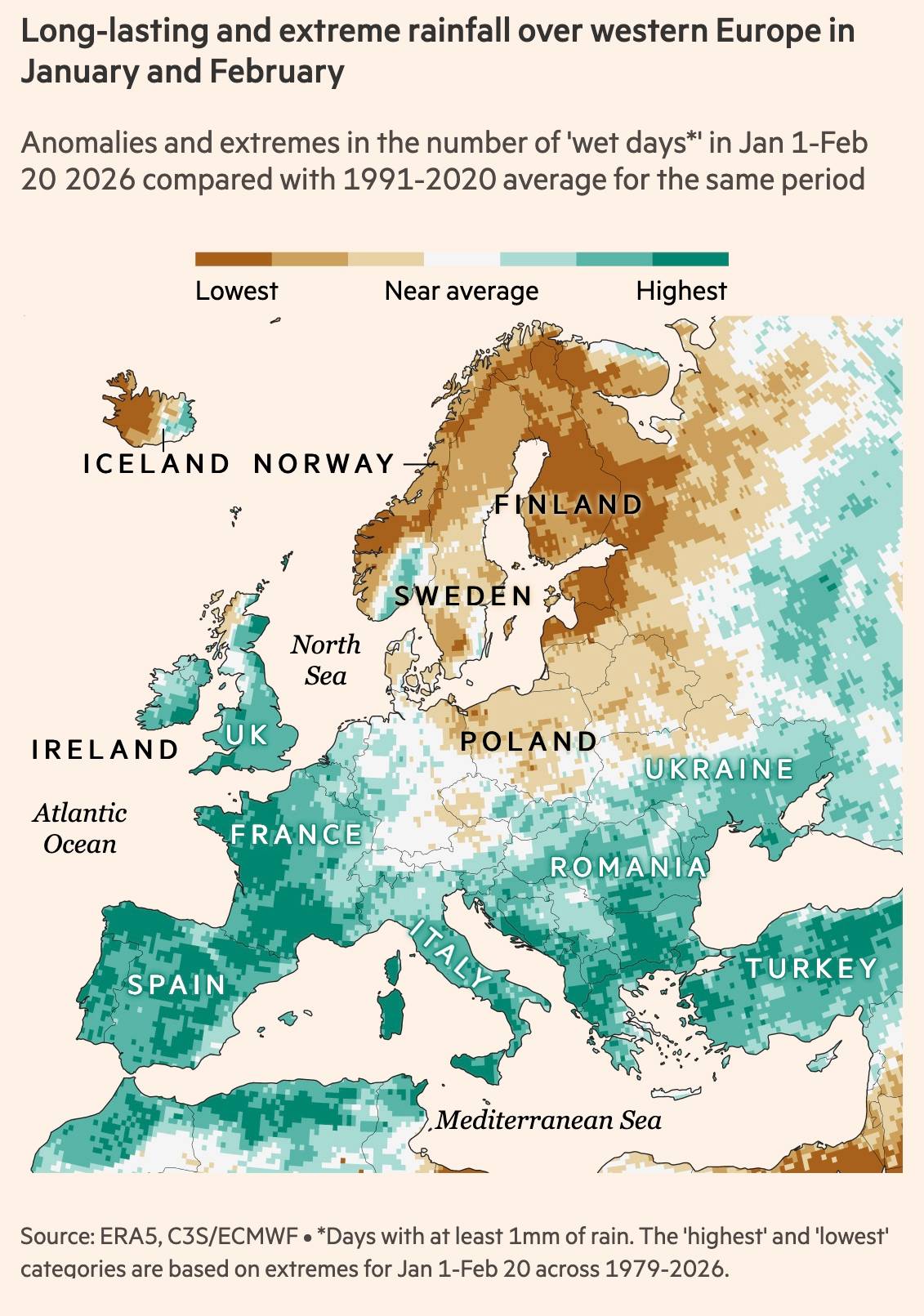
Overall C.A.T. Usefulness: 10/10 ★★★★★★★★★★
Strengths:
This article is precise, data-rich, and deeply alarming without resorting to hyperbole. Its key strengths are:
- Grounding the Abstract in the Tangible: The article takes a complex climate phenomenon . . . atmospheric rivers, the 7% moisture increase per 1°C of warming . . . and grounds it in concrete impacts: crops rotting in the ground, fruit and vegetable supplies disrupted, 70% more rain in England. This is the “high-resolution realism” Climate Action Tiger advocates: understanding the local manifestation of a global problem.
- The 1.49°C Data Point: The reporting that February 2026 reached 1.49°C above pre-industrial levels . . . a fraction below the 1.5°C threshold . . . is a quiet bombshell. The article does not sensationalize, but the number speaks for itself. We are now living at the edge of the Paris Agreement’s most ambitious guardrail.
- Connecting the Dots Across Scales: The article masterfully weaves together multiple scales of analysis: the local (crops rotting in UK fields), the regional (atmospheric rivers over western Europe), the global (wetter in Australia, drier in the US), and the systemic (the acceleration of warming since 2015, sea surface temperatures, Arctic ice). This is systems-thinking at its best.
- The Acceleration Finding: The inclusion of the Rahmstorf paper finding a “statistically significant” acceleration of global warming since 2015 is a crucial piece of scientific context. It moves the story beyond individual weather events to the underlying trend . . . and confirms what many climate scientists have suspected: the warming is not just continuing, it is speeding up.
- The La Niña Caveat: The article notes that La Niña has temporarily dampened global temperatures, and that it is expected to dissipate later this year. This is responsible science reporting. It warns readers that the current temperatures, while already alarming, are not the peak. When La Niña ends, the warming will resume its accelerated trajectory.
- The Burgess Quote: Samantha Burgess’s call for “pressing need for global action” is understated but powerful. It comes from a scientist, not an activist. It is the kind of authoritative voice that cuts through political noise.
Weaknesses:
The article has no significant weaknesses. It is comprehensive, scientifically literate, and responsibly framed. If pressed, one could note that:
- The Policy Connection: The article documents the science and the impacts but does not explicitly connect them to the policy battles documented in previous C.A.T. analyses . . . the ETS debate in Brussels, the UK net zero polling, the IEA demand reduction call. The reader is left to make those connections themselves.
- The Gender Dimension (SDG 5): As with almost all climate science reporting, the article is silent on gender. Climate impacts are not gender-neutral: women face higher risks in disasters, bear disproportionate care burdens, and have less access to recovery resources. The flooding in western Europe, the crop failures, the disrupted supply chains . . . all have gendered dimensions that are invisible here.
- The Adaptation Gap: The article documents the impacts but does not ask what is being done to adapt. Are European farmers switching to flood-resistant crops? Are cities building drainage infrastructure for the new rainfall regime? The absence of adaptation reporting leaves the reader with a sense of helplessness that the science alone does not require.
Opportunities for C.A.T.:
This article provides C.A.T. with foundational evidence for multiple core themes:
- The 1.5°C Threshold is at Our Doorstep: The 1.49°C February reading is not a future projection. It is here. C.A.T. can use this to argue that the Paris Agreement’s guardrail is not a distant target but a line we are already touching. Every fraction of a degree matters.
- The Acceleration Narrative: The Rahmstorf paper finding acceleration since 2015 is a critical piece of evidence. C.A.T. can use it to counter the narrative that warming is proceeding at a predictable, manageable pace. It is not. It is speeding up.
- The Atmospheric River Framework: The article provides a clear explanation of atmospheric rivers and the 7% moisture increase per 1°C of warming. This is a powerful framework for understanding why extreme rainfall is becoming more common . . . and why it will continue to worsen.
- The Crop Failure Angle: The mention of crops rotting in the ground and disrupted fruit and vegetable supplies connects climate change to food security in a visceral way. This is not a distant polar bear story; it is food on the table.
- The Global Pattern: The article’s documentation of simultaneous extremes . . . wet here, dry there . . . illustrates the “precipitation whiplash” that climate scientists have been warning about. C.A.T. can use this to show that climate change is not just about warming; it is about destabilization of the entire hydrological cycle.
Threats:
The biggest threat is normalization. If 1.49°C February temperatures, 70% above-average rainfall in England, and 5% below-average Arctic sea ice become routine, they stop being news. The article’s sober, scientific tone is appropriate, but it risks allowing readers to absorb these numbers as just more data points rather than as the crisis they represent. A second threat is that the acceleration finding is ignored. The Rahmstorf paper is a major scientific development, but it appears at the end of the article, almost as an afterthought. The acceleration of warming since 2015 is not a detail; it is the story. A third threat is that the adaptation gap remains unfilled. The article documents the impacts but does not ask what is being done. If policymakers read this and do nothing, the next flood will be worse.
Analysis Through Lenses:
United Nations Lens (IPCC/UNFCCC): From a UN climate governance perspective, this article is a status report on the planet. The IPCC’s Sixth Assessment Report warned that crossing 1.5°C would lead to irreversible changes. February 2026 hit 1.49°C. The Rahmstorf paper suggests that the acceleration since 2015 means we are on track to cross 1.5°C permanently sooner than models predicted. The UNFCCC process was designed to prevent this. It has failed: not because the science was wrong, but because the politics was too slow. The Loss and Damage fund, established at COP28, was meant to address the impacts documented in this article. But the fund remains underfunded, and the impacts are already here. This article is a reminder that the UNFCCC process is now playing catch-up with a climate system that is moving faster than diplomacy.
EU Green New Deal Lens: For Brussels, this article should be a wake-up call. The atmospheric rivers that flooded western Europe in February are not an anomaly; they are the new normal. The Green Deal’s adaptation agenda (the EU Adaptation Strategy, the proposed Climate Adaptation Plan) must move from planning to implementation. The 70% increase in rainfall in England, the crops rotting in the ground, the disrupted supply chains . . . these are not future risks. They are current costs. The Green Deal’s credibility depends on whether it can help European farmers, cities, and communities adapt to the climate that is already here, while simultaneously accelerating the mitigation that might prevent it from getting worse.
Draghi Report Lens: Mario Draghi’s report called for Europe to invest in competitiveness and resilience. This article shows what resilience means in practice: drainage infrastructure, flood defenses, crop diversification, supply chain redundancy. The costs of inaction are visible in the fields of England and the flooded towns of France. Draghi’s call for €800 Billion in annual investment must include adaptation. Competitiveness is not just about exports and innovation; it is about whether the economy can function when the weather no longer follows the patterns it was built for.
Mark Jacobson Lens: Through Jacobson’s framework, this article is a case study in the consequences of delay. Jacobson’s roadmaps for 100% wind-water-solar systems are designed to stop the warming that drives the atmospheric rivers, the crop failures, and the Arctic ice loss. Every year of delay means more moisture in the atmosphere, more extreme rainfall, more flooded fields, more disrupted supply chains. The 7% moisture increase per 1°C of warming is a physical law. It does not care about politics. Jacobson would say: the technology to stop this exists. The only question is whether we deploy it fast enough. The February 2026 data suggests we are not.
SDG Ratings:
| SDG | Rating | Rationale |
|---|---|---|
| SDG 1 No Poverty | 5/10 ★★★★★☆☆☆☆☆ | Flooding and crop failures affect farmers and vulnerable communities; distributional impacts not explored |
| SDG 2 Zero Hunger | 7/10 ★★★★★★★☆☆☆ | Crops rotting, disrupted fruit and vegetable supplies—direct food security impacts |
| SDG 3 Good Health and Well-Being | 4/10 ★★★★☆☆☆☆☆☆ | Flooding has health impacts; not explored |
| SDG 4 Quality Education | 1/10 ★☆☆☆☆☆☆☆☆☆ | Not addressed |
| SDG 5 Gender Equality | 0/10 ☆☆☆☆☆☆☆☆☆☆ | Complete absence. Climate impacts are not gender-neutral; women face higher disaster risks and care burdens |
| SDG 6 Clean Water and Sanitation | 6/10 ★★★★★★☆☆☆☆ | Flooding and atmospheric rivers affect water systems; not explored in depth |
| SDG 7 Affordable and Clean Energy | 1/10 ★☆☆☆☆☆☆☆☆☆ | Not addressed |
| SDG 8 Decent Work and Economic Growth | 4/10 ★★★★☆☆☆☆☆☆ | Farmers affected; supply chains disrupted; broader economic impacts not quantified |
| SDG 9 Industry, Innovation and Infrastructure | 3/10 ★★★☆☆☆☆☆☆☆ | Infrastructure stress from flooding implied, not explored |
| SDG 10 Reduced Inequalities | 4/10 ★★★★☆☆☆☆☆☆ | Vulnerability to flooding and crop failure is unevenly distributed; not analyzed |
| SDG 11 Sustainable Cities and Communities | 6/10 ★★★★★★☆☆☆☆ | Urban flooding impacts; not explored in depth |
| SDG 12 Responsible Consumption and Production | 2/10 ★★☆☆☆☆☆☆☆☆ | Food supply disruptions implied; consumption patterns not addressed |
| SDG 13 Climate Action | 10/10 ★★★★★★★★★★ | Core focus; temperature data, extremes, acceleration, Burgess’s call for action |
| SDG 14 Life Below Water | 8/10 ★★★★★★★★☆☆ | Sea surface temperatures, Arctic sea ice—both central to the story |
| SDG 15 Life on Land | 7/10 ★★★★★★★☆☆☆ | Crop failures, flooding, ecosystem stress: all central |
| SDG 16 Peace, Justice and Strong Institutions | 2/10 ★★☆☆☆☆☆☆☆☆ | Not addressed |
| SDG 17 Partnerships for the Goals | 3/10 ★★★☆☆☆☆☆☆☆ | Copernicus as EU scientific institution; global collaboration implied |
10th March 2026: Financial Times Journalists Edward White and William Sandlund report that CATL, the world’s largest battery maker, saw its shares soar as much as 9.7% in Hong Kong after reporting full-year net profit of Rmb72.2 Billion ($10.4 Billion) for 2025 . . . 42% higher than 2024 and ahead of analyst estimates. Revenue rose 17% to Rmb423.7 Billion, with energy storage system sales (including for power grids and AI data centres) up 9% and overseas sales up 18%. The company’s global market share for EV batteries has reached a record 39%. CATL plans to issue up to Rmb40 Billion in bonds to expand overseas operations, including new factories in Germany, Hungary, Indonesia and Spain. Citi forecasts CATL’s sales will grow 31% in 2026, with energy storage batteries jumping 45% and EV batteries rising 27%. Bernstein analysts noted that CATL’s upstream resource investments (including lithium mines) provide a “natural hedge” against commodity price swings, and that its technology leadership in solid-state and sodium-ion batteries “bodes well for the long-term competitive position of the company” https://www.ft.com/content/3fdcf8e8-5eb5-4403-9b26-cb8191f8b6ff?syn-25a6b1a6=1
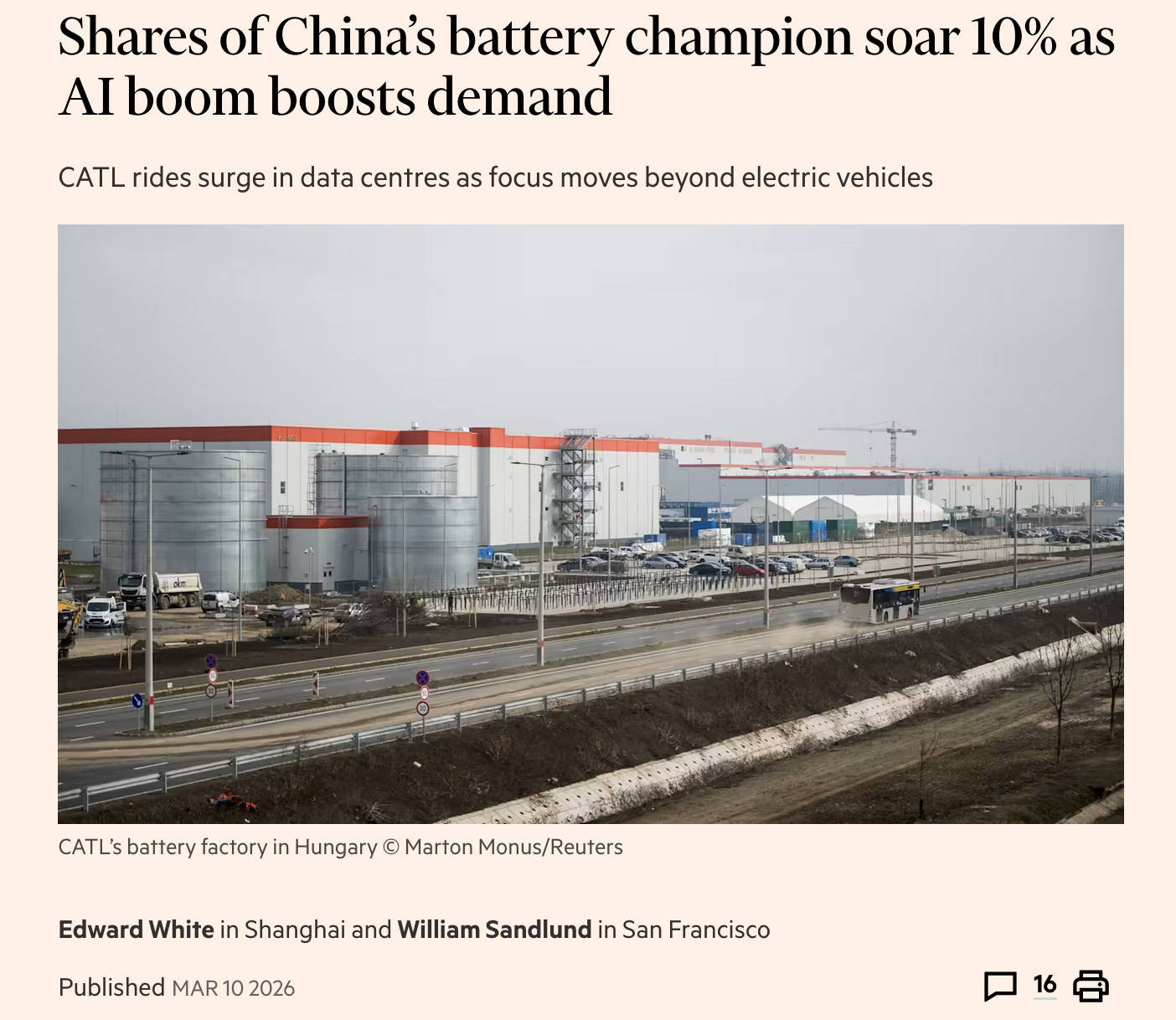
Overall C.A.T. Usefulness: 10/10 ★★★★★★★★★★
Strengths:
This article’s financial and industrial reporting captures a pivotal moment in the global energy transition. Its key strengths are:
- The Earnings Signal: Rmb72.2 Billion in net profit . . . 42% higher than 2024 . . . is not a marginal improvement. It is a statement of dominance. CATL’s earnings growth far exceeds analyst expectations, and the market responded with a near-10% share price surge. This is not speculation; it is performance.
- The AI Data Centre Connection: The article explicitly connects CATL’s growth to the AI boom. “Increased energy demand from data centres and the need for flexible resource regulation” have driven growth in energy storage system batteries. This is a crucial signal: the AI revolution, which has been criticized for its energy intensity, is also driving demand for the storage technologies that enable renewable integration.
- The 39 per cent Global Market Share: The figure . . . CATL now holds 39% of the global EV battery market . . . is a measure of concentration. One company controls nearly two-fifths of a market that is central to the energy transition. This is both a testament to CATL’s execution and a vulnerability that competitors and regulators will seek to address.
- The Overseas Expansion: CATL’s plans to issue Rmb40 Billion in bonds to expand factories in Germany, Hungary, Indonesia and Spain show that the company is not content to dominate only the Chinese market. It is building global manufacturing capacity . . . including in Europe, where the EU is developing regulatory frameworks for increased local components. This is strategic foresight.
- The Technology Pipeline: Bernstein’s note on CATL’s investments in solid-state and sodium-ion batteries, as well as larger cells for energy storage systems, is a crucial reminder that the battery industry is not static. CATL’s current dominance is built on lithium-ion technology; its future dominance will depend on whether it can lead the next generation of battery chemistry.
- The “Natural Hedge”: Bernstein’s observation that CATL’s upstream investments in lithium mines provide a “natural hedge” against commodity price swings is a sophisticated point. Vertical integration insulates the company from the volatility that has plagued other battery makers. This is a structural advantage that competitors without mining operations cannot easily replicate.
Weaknesses:
The article has no significant weaknesses. It is concise, data-driven, and strategically informed. If pressed, one could note that:
- The Gender Dimension (SDG 5): As with almost all financial and industrial reporting, the article is silent on gender. The battery industry, like the fossil fuel industry it is displacing, has a gender profile. Women are under-represented in manufacturing, in executive suites, and in the mining operations that supply critical minerals. This dimension is invisible.
- The US Market Challenge: The article notes that CATL faces “long-term challenges from US moves to block China from American supply chains.” It does not explore the scale of this challenge. With the US administration actively hostile to Chinese clean tech, CATL’s access to the American market may be severely restricted. This is a material risk that deserves more exploration.
- The European Regulatory Risk: The article notes that the EU is developing “regulatory framework for increased local components in manufacturing.” This is a threat to CATL’s margins. The company’s response . . . building factories in Germany, Hungary, and Spain . . . is noted, but the article does not evaluate whether this will be sufficient to meet local content requirements.
Opportunities for C.A.T.:
This article provides C.A.T. with a critical data point on the momentum of the transition:
- The AI-Storage Nexus: The article’s connection between AI data centre demand and battery storage growth is a new and important theme. The AI boom, often framed as an energy problem, is also driving demand for the storage technologies that enable renewable integration. C.A.T. can track this nexus as a potential accelerator of the transition.
- The CATL Earnings as a Bellwether: CATL’s 42% profit growth is not an isolated data point. It is a signal that the battery industry is not just growing but thriving. The 31% sales growth forecast for 2026, with energy storage jumping 45%, suggests that the momentum is accelerating.
- The Technology Pipeline: CATL’s investments in solid-state and sodium-ion batteries are a reminder that the transition is not waiting for political consensus. The technology is advancing, costs are falling, and performance is improving. C.A.T. can use this to counter narratives of technological stagnation.
- The Global Footprint: CATL’s expansion into Germany, Hungary, Indonesia, and Spain shows that the company is globalizing its manufacturing base. This may help it navigate the regulatory risks in Europe and beyond. C.A.T. can track whether this strategy succeeds.
- The Upstream Integration: CATL’s “natural hedge” through lithium mining is a model for the industry. Companies that control their supply chains will be more resilient to commodity price shocks. C.A.T. can use this to argue for strategic investments in critical mineral supply chains.
Threats:
The biggest threat is that CATL’s dominance creates new dependencies. The world is moving from fossil fuel dependence to battery dependence. If one company controls 39% of the global EV battery market, and if its supply chains are concentrated in China, the geopolitical risks documented in earlier articles (US resilience, IEA fracture) are simply transferred to a new set of critical materials. A second threat is that the US and EU successfully block CATL from their markets. If the administration’s “moves to block China from American supply chains” succeed, CATL’s growth could be constrained . . . but at the cost of slowing the transition in those markets. A third threat is that the technology pipeline does not deliver. Solid-state and sodium-ion batteries are promising, but they are not yet commercial at scale. If CATL’s investments do not pay off, competitors could emerge.
Analysis Through Lenses:
United Nations Lens (IPCC/UNFCCC): From a UN climate governance perspective, this article is a reminder that the energy transition is being driven by industrial strategy and market forces, not just diplomatic agreements. CATL’s 39% global market share, its 42% profit growth, its investments in next-generation batteries . . . all are evidence that the transition has its own momentum. The UNFCCC process has struggled to achieve consensus on emissions targets; meanwhile, Chinese industrial policy has built the companies that will manufacture the technologies of the transition. This is not a failure of the UN system, but it is a recognition that the UN is far from being the only driver of change.
EU Green New Deal Lens: For Brussels, this article should be both a warning and an opportunity. The warning: CATL’s 39% market share, its 45% forecast growth in energy storage, its expansion into Germany, Hungary, and Spain . . . all suggest that the EU’s battery industry is not yet competitive. The opportunity: CATL is investing in European manufacturing. The EU’s regulatory framework for local content must be calibrated to encourage this investment while also supporting the development of European champions. The Green Deal’s success depends on whether it can create a competitive battery industry . . . or whether it will become dependent on Chinese supply chains.
Draghi Report Lens: Mario Draghi’s report called for Europe to close the investment and innovation gap with China and the US. CATL’s 42% profit growth, its 39% market share, its Rmb40 Billion bond issuance for expansion . . . these are the numbers that measure the gap. Europe’s battery champions are struggling. CATL is thriving. Draghi’s call for €800 Billion in annual investment is a recognition that Europe must match this scale or fall further behind.
Mark Jacobson Lens: Through Jacobson’s framework, this article is a vindication. Jacobson’s roadmaps for 100% renewable energy require massive deployment of battery storage. CATL is building that storage. The 45% forecast growth in energy storage batteries is exactly the kind of scale Jacobson’s models demand. However, Jacobson would note that the transition is not just about batteries; it is about wind, solar, and storage working together. CATL’s dominance in batteries is necessary but not sufficient. The question is whether the deployment of wind and solar is keeping pace.
SDG Ratings:
| SDG | Rating | Rationale |
|---|---|---|
| SDG 1 No Poverty | 1/10 ★☆☆☆☆☆☆☆☆☆ | Not addressed |
| SDG 2 Zero Hunger | 0/10 ☆☆☆☆☆☆☆☆☆☆ | Not addressed |
| SDG 3 Good Health and Well-Being | 1/10 ★☆☆☆☆☆☆☆☆☆ | Not addressed |
| SDG 4 Quality Education | 1/10 ★☆☆☆☆☆☆☆☆☆ | Not addressed |
| SDG 5 Gender Equality | 0/10 ☆☆☆☆☆☆☆☆☆☆ | Complete absence. No mention of women, gender, or differential impacts of the battery industry |
| SDG 6 Clean Water and Sanitation | 1/10 ★☆☆☆☆☆☆☆☆☆ | Not addressed |
| SDG 7 Affordable and Clean Energy | 9/10 ★★★★★★★★★☆ | Core focus; batteries, energy storage, EV transition |
| SDG 8 Decent Work and Economic Growth | 6/10 ★★★★★★☆☆☆☆ | Profit growth, investment, expansion; job quality not addressed |
| SDG 9 Industry, Innovation and Infrastructure | 10/10 ★★★★★★★★★★ | Core focus; battery manufacturing, technology pipeline, global expansion |
| SDG 10 Reduced Inequalities | 2/10 ★★☆☆☆☆☆☆☆☆ | Not addressed |
| SDG 11 Sustainable Cities and Communities | 2/10 ★★☆☆☆☆☆☆☆☆ | Not addressed |
| SDG 12 Responsible Consumption and Production | 5/10 ★★★★★☆☆☆☆☆ | Battery production, supply chains, critical minerals |
| SDG 13 Climate Action | 9/10 ★★★★★★★★★☆ | Core focus; energy transition, electrification, storage |
| SDG 14 Life Below Water | 0/10 ☆☆☆☆☆☆☆☆☆☆ | Not addressed |
| SDG 15 Life on Land | 2/10 ★★☆☆☆☆☆☆☆☆ | Lithium mining impacts not addressed |
| SDG 16 Peace, Justice and Strong Institutions | 2/10 ★★☆☆☆☆☆☆☆☆ | Not addressed |
| SDG 17 Partnerships for the Goals | 4/10 ★★★★☆☆☆☆☆☆ | Global expansion, supply chain integration |
6th March 2026: Financial Times Journalists Kenza Bryan and Attracta Mooney report that the Middle East war has bolstered the case for investment in clean energy sources and battery storage, according to Microsoft’s global vice-president for energy Bobby Hollis, who said the oil and gas price surge had underscored the need for renewable energy as protection from volatile fuel costs. “Wind and solar as part of that mix is a huge benefit from the standpoint of price stability, because once you install it you have more certainty around what that actual cost profile looks like,” he said. Linda Kalcher, an adviser to European climate policymakers, noted that “Europeans are still importing 90% of their fossil fuels, so that’s an extremely high exposure to the vulnerability of global markets.” Lauri Myllyvirta of the Centre for Research on Energy and Clean Air said the energy market ructions would reinforce China’s electrification strategy to protect it from geopolitical risk. Former US intelligence official Tom Ellison of the Center for Climate and Security said the energy squeeze was a reminder that “fossil fuels have to constantly flow or else all hell breaks loose” . . . a fundamental vulnerability compared to renewable energy. However, analysts noted paradoxical effects: the war could cause supply chain disruptions for renewable infrastructure, and could also shore up the case for increased use of low-cost domestic coal in some countries https://www.ft.com/content/001a7cb8-96a9-4b6c-95ad-d609976141c9?syn-25a6b1a6=1
Overall C.A.T. Usefulness: 10/10 ★★★★★★★★★★
Strengths:
This article is a synthesis of the core themes. Its key strengths are:
- The Microsoft Voice: Bobby Hollis is not an environmental activist. He is a corporate energy buyer for one of the world’s largest technology companies. His statement . . . that wind and solar provide “price stability” and “more certainty around what that actual cost profile looks like” . . . is a pragmatic, bottom-line argument for renewables. When Microsoft says fossil fuels are too volatile, the market listens.
- The 90% Import Figure: Linda Kalcher’s observation that “Europeans are still importing 90% of their fossil fuels” is a devastating statistic. After the Russian gas crisis, after the push for energy independence, after the Green Deal . . . Europe remains almost entirely dependent on imported fossil fuels. The Iran war is not an anomaly; it is the latest reminder of a structural vulnerability.
- The “Constant Flow” Vulnerability: Tom Ellison’s framing (“fossil fuels have to constantly flow or else all hell breaks loose.”) = this is not an environmental argument; it is a strategic argument. Fossil fuel systems are brittle. Renewable systems are resilient. This is a message that should resonate with security hawks and business pragmatists alike.
- The China Validation: Myllyvirta’s observation that the Iran war validates China’s energy security approach . . . electrification, domestic renewables, strategic autonomy . . . connects the dots between the CATL earnings surge, the emissions decline, and the geopolitical logic of the transition. China is not building batteries for environmental reasons alone; it is building them because it does not want to be at the mercy of the Strait of Hormuz.
- The Paradox Acknowledged: The article does not pretend that the war is an unalloyed good for the transition. It notes the risk of supply chain disruptions for renewable infrastructure, and the paradoxical effect that the war could shore up the case for increased use of low-cost domestic coal. This is the “high-resolution realism” that C.A.T.’s framework demands: seeing the complexity, not smoothing it away.
- The Asia LNG Re-evaluation: IEEFA’s Sam Reynolds notes that following Russia’s war in Ukraine, many Asian countries began re-evaluating LNG import infrastructure. Pakistan started importing solar panels instead. The Iran war could accelerate this trend—or, if prolonged, could lock in new LNG dependencies. This is a pivotal question for the future of the transition.
Weaknesses:
The article has no significant weaknesses. It is concise, balanced, and strategically informed. If pressed, one could note that:
- The Gender Dimension (SDG 5): As with almost all energy and climate reporting, the article is silent on gender. The 90% of imported fossil fuels, the supply chains disrupted, the communities at risk from volatile prices . . . all have gendered dimensions that are invisible here.
- The Microsoft Context: Hollis’s statement is powerful, but the article does not explore Microsoft’s own energy footprint. The AI boom that is driving CATL’s storage growth is also driving massive increases in data centre electricity demand. The article could have explored whether Microsoft’s renewable investments are keeping pace with its own consumption growth.
- The Coal Paradox: The article notes that the war could “shore up the case for increased use of low-cost domestic coal.” It does not explore where this is most likely to happen, or what the emissions implications would be. Given the Earth’s energy imbalance and the acceleration of warming, this is a critical question.
Opportunities for C.A.T.:
This article provides C.A.T. with a synthesis of the core arguments for the transition:
- The Price Stability Argument: Microsoft’s Hollis makes the case: renewables provide price stability. Fossil fuels are volatile. For businesses, for households, for governments, this is a compelling argument. C.A.T. can amplify it.
- The 90% Vulnerability: Kalcher’s 90% figure is a powerful communication tool. Europe remains as dependent on imported fossil fuels as it was before the Russian gas crisis. The Iran war is a reminder that this dependence is a vulnerability. C.A.T. can use this to argue that energy independence is not a slogan; it is a strategic necessity.
- The “Constant Flow” Frame: Ellison’s language . . . “fossil fuels have to constantly flow or else all hell breaks loose”—is a gift. It reframes the transition not as a trade-off but as a resilience strategy. C.A.T. can use this to reach audiences that are unmoved by environmental arguments but responsive to security and stability arguments.
- The China Validation: Myllyvirta’s observation that the war validates China’s energy security approach is a crucial insight. The country that has invested most heavily in the transition is also the country most insulated from the current crisis. C.A.T. can use this to argue that the transition is not just about climate; it is about sovereignty.
- The Asia LNG Crossroads: Reynolds’s observation that the war could cause Asian countries to reconsider LNG plans is a pivotal question. If the transition accelerates, the LNG industry’s growth projections collapse. If the war locks in new LNG dependencies, the transition stalls. C.A.T. should track this fork in the road.
Threats:
The biggest threat is that the paradoxical effects outweigh the accelerative ones. If supply chain disruptions delay renewable infrastructure, and if the war shoring up the case for coal, the net effect could be a slowing of the transition. A second threat is that the window of opportunity closes. The war will not last forever. When it ends, oil prices may fall, and the urgency for the transition may fade. The question is whether the policy response locks in renewable investments before that happens. A third threat is that the Asia LNG crossroads is resolved in favor of LNG. If countries like Pakistan, which turned to solar after the Russian gas crisis, revert to LNG plans, the emissions locked in will be with us for decades.
Analysis Through Lenses:
United Nations Lens (IPCC/UNFCCC): From a UN climate governance perspective, this article is a case study in how geopolitical crisis can accelerate the transition . . . or delay it. The IPCC has long argued that climate action is consistent with energy security. This article shows that the logic is not just theoretical. Microsoft’s Hollis, Kalcher, Ellison, Myllyvirta . . . all are making the same argument: renewables are not just cleaner; they are more secure. The UNFCCC process has struggled to make this case compellingly. The Iran war is making it in real time.
EU Green New Deal Lens: For Brussels, this article is a reality check. Europeans are still importing 90% of their fossil fuels. The Green Deal was supposed to change that. It has not . . . yet. The Iran war is a reminder that the window for action is closing. Kalcher’s voice (an adviser to European climate policymakers) should be heard in every capital. The debate should not be about carbon allowances and free permits; it should be about strategic vulnerability.
Draghi Report Lens: Mario Draghi’s report called for Europe to invest in competitiveness and resilience. This article shows what resilience means: price stability, supply security, freedom from the whims of the Strait of Hormuz. The 90% import figure is a measure of Europe’s vulnerability. Draghi’s €800 Billion annual investment is the scale required to close that gap.
Mark Jacobson Lens: Through Jacobson’s framework, this article is a vindication of everything he has been saying for decades. Jacobson’s roadmaps for 100% renewables are not just about emissions; they are about resilience. A wind turbine does not need to flow through the Strait of Hormuz. A solar panel does not depend on pipeline politics. Ellison’s “constant flow” vulnerability is exactly what Jacobson’s systems are designed to eliminate.
SDG Ratings:
| SDG | Rating | Rationale |
|---|---|---|
| SDG 1 No Poverty | 3/10 ★★★☆☆☆☆☆☆☆ | Energy price volatility affects household budgets; not explored |
| SDG 2 Zero Hunger | 0/10 ☆☆☆☆☆☆☆☆☆☆ | Not addressed |
| SDG 3 Good Health and Well-Being | 2/10 ★★☆☆☆☆☆☆☆☆ | Not addressed |
| SDG 4 Quality Education | 1/10 ★☆☆☆☆☆☆☆☆☆ | Not addressed |
| SDG 5 Gender Equality | 0/10 ☆☆☆☆☆☆☆☆☆☆ | Complete absence. No mention of women, gender, or differential impacts of energy vulnerability |
| SDG 6 Clean Water and Sanitation | 0/10 ☆☆☆☆☆☆☆☆☆☆ | Not addressed |
| SDG 7 Affordable and Clean Energy | 10/10 ★★★★★★★★★★ | Core focus; price stability, energy security, transition acceleration |
| SDG 8 Decent Work and Economic Growth | 4/10 ★★★★☆☆☆☆☆☆ | Energy costs, economic vulnerability, Microsoft as corporate voice |
| SDG 9 Industry, Innovation and Infrastructure | 7/10 ★★★★★★★☆☆☆ | Renewable infrastructure, supply chains, grid resilience |
| SDG 10 Reduced Inequalities | 3/10 ★★★☆☆☆☆☆☆☆ | Import dependence affects all; emerging markets particularly vulnerable |
| SDG 11 Sustainable Cities and Communities | 2/10 ★★☆☆☆☆☆☆☆☆ | Not addressed |
| SDG 12 Responsible Consumption and Production | 3/10 ★★★☆☆☆☆☆☆☆ | Not addressed |
| SDG 13 Climate Action | 10/10 ★★★★★★★★★★ | Core focus; renewables as solution to crisis |
| SDG 14 Life Below Water | 0/10 ☆☆☆☆☆☆☆☆☆☆ | Not addressed |
| SDG 15 Life on Land | 1/10 ★☆☆☆☆☆☆☆☆☆ | Not addressed |
| SDG 16 Peace, Justice and Strong Institutions | 8/10 ★★★★★★★★☆☆ | Geopolitical conflict, energy security, strategic vulnerability |
| SDG 17 Partnerships for the Goals | 5/10 ★★★★★☆☆☆☆☆ | Global supply chains, international cooperation, vulnerability to conflict |
4th March 2026: Financial Times Journalist Clive Cookson reports on a new study published in Nature by researchers at Wageningen University, led by Philip Minderhoud and Katharina Seeger, finding that sea levels across the world are already “much higher” than most scientific assessments have assumed. The study reveals that more than 99% of evaluated coastal hazard impact assessments have handled sea-level and land elevation data inadequately, with 90% assuming coastal sea levels based on geoid models rather than using actual sea-level measurements. The discrepancy between modeling and reality averages about 30cm globally but reaches 1 to 1.5 metres on some coastlines in Southeast Asia and Oceania. The researchers estimate that with a 1-metre rise in sea level . . . predicted by many ocean scientists to occur by 2100 . . . between 77 million and 132 million more coastal inhabitants would live below sea level than previously predicted. Co-author Katharina Seeger noted that just 1% of existing scientific publications “combined land elevation and sea level measurements properly and refer to actual measured sea level.” Anders Levermann of the Potsdam Institute for Climate Impact Research cautioned that while the oceans respond slowly to climate change, the 1.5°C warming already observed means “we will eventually get a rise of three to four metres” https://www.ft.com/content/eb581941-9ebe-4b1e-afed-1170c9fb4e71?syn-25a6b1a6=1
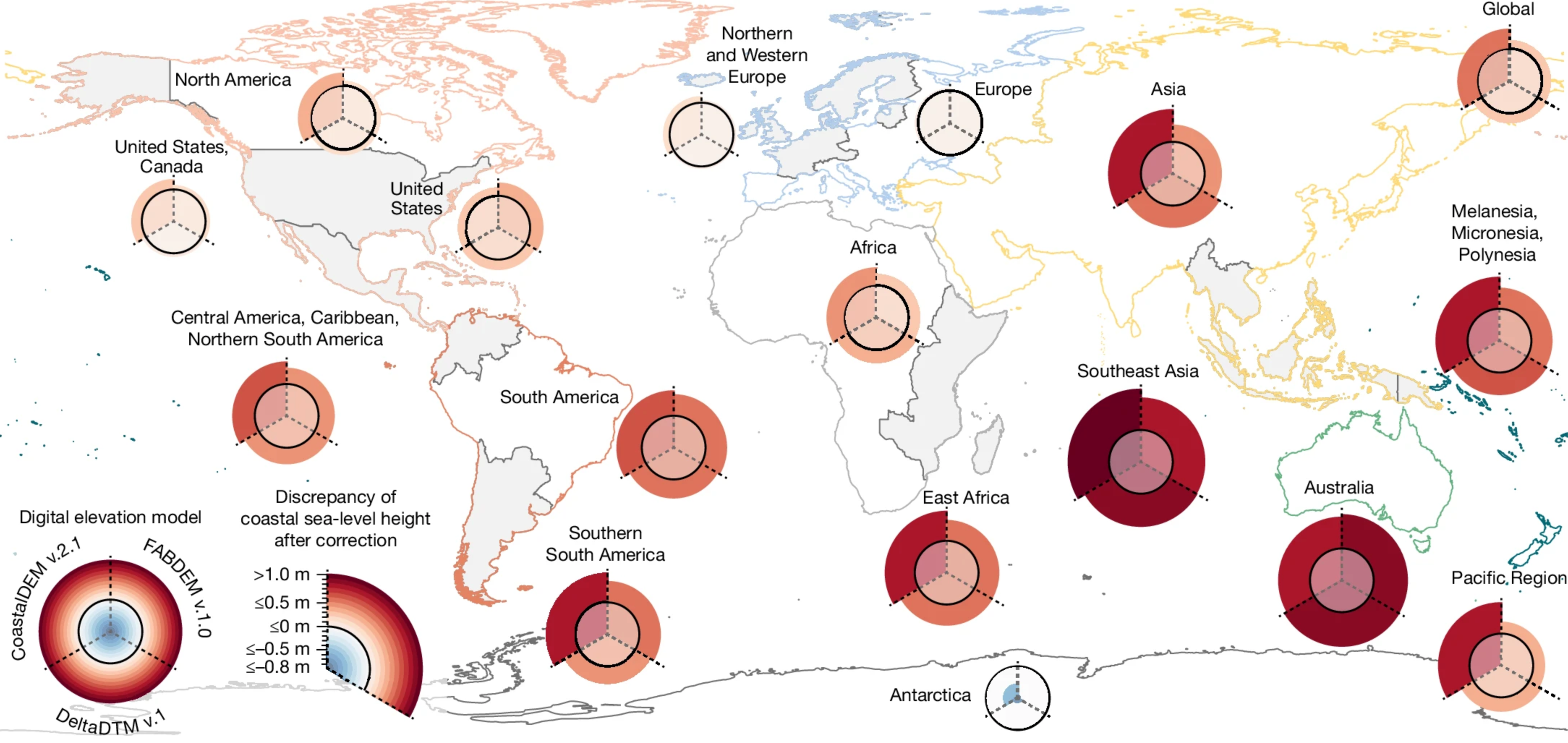
Overall C.A.T. Usefulness: 10/10 ★★★★★★★★★★
Strengths:
This article (and the underlying Nature study) represents a landmark correction to the scientific understanding of coastal climate risk. Its key strengths are:
- The Methodological Blind Spot Exposed: The study’s finding that more than 99% of evaluated impact assessments handled sea-level and land elevation data inadequately is devastating. This is not a critique of a few flawed studies; it is an indictment of the entire field. The researchers identified that 90% of hazard assessments assume coastal sea levels based on geoid models (gravity-based approximations) rather than actual sea-level measurements that account for ocean currents, winds, temperature, and salinity. This is a community-wide failure.
- Quantifying the Error: The numbers are precise and alarming. A global average underrepresentation of 0.27 metres (EGM96) and 0.24 metres (EGM2008). Regional discrepancies exceeding 1 metre in Southeast Asia and the Pacific. In some locations, the difference reaches 5.5 to 7.6 metres. The researchers estimate that proper sea-level referencing would increase estimates of exposed land area after 1 metre of sea-level rise by 31–37%, and exposed population by 48–68% . . . adding 55 to 102 million people to the number living below sea level.
- The Global South Disparity: The study highlights that the largest discrepancies occur in the Global South . . . Southeast Asia, the Pacific, Latin America, Africa, the Caribbean . . . precisely the regions with the least capacity to adapt. This is not a coincidence. Geoid models perform poorly in regions with sparse gravity data, which are predominantly in the Global South. The researchers suggest that “Global-North-based scientists” may have placed overconfidence in geoid models that perform well in their home regions but fail elsewhere. This is a methodological colonialism that has distorted risk assessments for decades.
- The IPCC Implications: The study traces how these flawed assessments have been incorporated into the IPCC reports. Forty-six of the evaluated studies are cited in the IPCC AR6, including in the Cross-Chapter Paper on coastal risks. The researchers found that datum conversion errors and sea-level reference omissions may have led to underestimated coastal exposure in the IPCC reports. The reported 896 million people in the low-elevation coastal zone may actually be 966 million to 1.07 billion: an undercount of 70 to 170 million people.
- The Levermann Warning: Anders Levermann’s observation that 1.5°C warming means “we will eventually get a rise of three to four metres” is a crucial long-term perspective. Even if emissions were cut dramatically today, the heat already stored in the oceans (documented in the Earth’s energy imbalance article) will continue to drive sea-level rise for centuries. The study’s findings mean that this rise will affect far more people than previously understood.
- The Path Forward: The study concludes with concrete recommendations: data documentation guidelines, peer-review checklists, and a call for data providers to offer readily combined products of digital terrain with sea level. The researchers have made their corrected DEMs available on Zenodo, providing a resource for re-evaluating existing assessments.
Weaknesses:
The article and study have no significant weaknesses. They are models of rigorous science and responsible journalism. If pressed, one could note that:
- The Gender Dimension (SDG 5): As with almost all coastal and climate science reporting, the study and article are silent on gender. The 77 to 132 million additional people who will live below sea level are not a homogeneous group. Women in coastal communities face higher risks in disasters, have less access to recovery resources, and bear disproportionate care burdens. The gendered dimensions of displacement, migration, and adaptation are invisible.
- The Implementation Gap: The study offers recommendations for improving research standards. It does not address how to ensure that policymakers, particularly in the Global South, have access to the corrected data and the capacity to use it. The corrected DEMs are available, but are they accessible to the governments and communities that need them most?
Opportunities for C.A.T.:
This study provides C.A.T. with a foundational correction to the scientific understanding of coastal risk:
- The 30cm Baseline Shift: The finding that actual sea levels are on average 30cm higher than previously assumed means that many coastal communities are already closer to the edge than anyone realized. C.A.T. can use this to argue that adaptation timelines must be accelerated: what was projected for 2050 may be happening now.
- The Southeast Asia Focus: The largest discrepancies (up to 1.5 metres) are in Southeast Asia, home to some of the world’s most populous coastal lowlands. This is where the China battery surge and the emissions decline intersect with the highest physical vulnerability. C.A.T. can use this to argue that climate finance must be directed to the regions most at risk.
- The IPCC Accountability: The study’s finding that the IPCC has relied on flawed assessments raises questions about the credibility of global climate risk reporting. C.A.T. can use this to argue for stronger review mechanisms and greater transparency in how assessments are conducted.
- The Methodological Colonialism Frame: The researchers’ observation about Global-North-based scientists overconfidently applying models that fail in the Global South is a powerful frame. C.A.T. can use it to argue for decolonizing climate science: ensuring that local knowledge, local data, and local capacity are centered in risk assessments.
- The Levermann Long View: The three to four metres of eventual sea-level rise locked in by 1.5°C of warming means that even the corrected exposure estimates are conservative. The children of Youth4Planet will live with these consequences for centuries. C.A.T. can use this to argue that the transition is not just about 2050 targets but about the long-term habitability of the planet.
Threats:
The biggest threat is that the study’s findings are ignored or dismissed. The researchers have documented a community-wide methodological failure affecting the most authoritative climate risk assessments. The institutional inertia of the IPCC, of funding bodies, of academic publishing may resist the kind of systemic change the study calls for. A second threat is that the corrected data does not reach the communities that need it most. The Global South regions with the highest exposure also have the least capacity to access and use advanced DEMs and MDT data. A third threat is that the adaptation gap widens. If exposure has been underestimated by 50–70%, the resources committed to adaptation are drastically insufficient. The children who will live with these consequences will bear the cost of this scientific failure.
Analysis Through Lenses:
United Nations Lens (IPCC/UNFCCC): From a UN climate governance perspective, this study is a crisis of credibility. The IPCC is the authoritative source for climate risk assessments. If its coastal hazard estimates are based on flawed methodologies, the entire edifice of climate risk communication is compromised. The study’s finding that 90% of assessments assume geoid-based sea levels rather than actual measurements suggests that the IPCC’s review processes failed to catch a fundamental error. The UNFCCC’s Loss and Damage fund, which is meant to compensate vulnerable nations for climate impacts, relies on these assessments to determine need. If the assessments underestimated exposure by 50–70%, the fund is drastically undercapitalized.
EU Green New Deal Lens: For Brussels, this study should prompt a re-evaluation of all coastal risk assessments used in EU policy. The EU’s Adaptation Strategy, its coastal management frameworks, its funding for climate resilience in former colonies—all may be based on underestimates of exposure. The study’s corrected DEMs provide a tool for re-evaluation. The EU should fund a systematic reassessment of coastal risks in its member states and in the regions where it provides climate finance.
Draghi Report Lens: Mario Draghi’s report called for Europe to invest in competitiveness and resilience. This study shows that resilience investments must be based on accurate risk assessments. If Europe is financing coastal adaptation in the Global South based on flawed data, those investments may be insufficient. The corrected exposure estimates (48 to 68% more people at risk) mean that the scale of adaptation investment needed is far larger than previously understood. Draghi’s call for investment must be calibrated to this new reality.
Mark Jacobson Lens: Through Jacobson’s framework, this study is a reminder that the impacts of climate change are already locked in. Jacobson’s roadmaps for 100% renewables focus on stopping the accumulation of heat in the system. But the heat already stored (documented in the Earth’s energy imbalance article) will continue to drive sea-level rise for centuries. The three to four metres of eventual rise that Levermann cites is a consequence of the 1.5°C warming already observed. Jacobson’s work is essential for preventing further accumulation, but this study shows that even with a rapid transition, the adaptation challenge is far larger than previously understood.
SDG Ratings:
| SDG | Rating | Rationale |
|---|---|---|
| SDG 1 No Poverty | 7/10 ★★★★★★★☆☆☆ | 77-132 million additional people at risk of displacement; poverty implications central |
| SDG 2 Zero Hunger | 3/10 ★★★☆☆☆☆☆☆☆ | Coastal agriculture, fisheries, food systems at risk |
| SDG 3 Good Health and Well-Being | 5/10 ★★★★★☆☆☆☆☆ | Displacement, disaster risk, mental health impacts |
| SDG 4 Quality Education | 2/10 ★★☆☆☆☆☆☆☆☆ | Not addressed |
| SDG 5 Gender Equality | 0/10 ☆☆☆☆☆☆☆☆☆☆ | Complete absence. Women in coastal communities face higher disaster risks, care burdens, and displacement impacts that are invisible here |
| SDG 6 Clean Water and Sanitation | 4/10 ★★★★☆☆☆☆☆☆ | Saltwater intrusion, coastal water systems |
| SDG 7 Affordable and Clean Energy | 1/10 ★☆☆☆☆☆☆☆☆☆ | Not addressed |
| SDG 8 Decent Work and Economic Growth | 4/10 ★★★★☆☆☆☆☆☆ | Coastal economies, fisheries, tourism at risk |
| SDG 9 Industry, Innovation and Infrastructure | 5/10 ★★★★★☆☆☆☆☆ | Coastal infrastructure, ports, cities at risk; corrected DEMs as innovation |
| SDG 10 Reduced Inequalities | 8/10 ★★★★★★★★☆☆ | Global South disproportionately affected; methodological colonialism |
| SDG 11 Sustainable Cities and Communities | 10/10 ★★★★★★★★★★ | Core focus; coastal cities, communities, displacement |
| SDG 12 Responsible Consumption and Production | 2/10 ★★☆☆☆☆☆☆☆☆ | Not addressed |
| SDG 13 Climate Action | 10/10 ★★★★★★★★★★ | Core focus; sea-level rise, climate impacts, adaptation needs |
| SDG 14 Life Below Water | 9/10 ★★★★★★★★★☆ | Sea-level rise, ocean dynamics, coastal marine systems |
| SDG 15 Life on Land | 6/10 ★★★★★★☆☆☆☆ | Coastal ecosystems, land loss |
| SDG 16 Peace, Justice and Strong Institutions | 6/10 ★★★★★★☆☆☆☆ | IPCC credibility, research standards, methodological accountability |
| SDG 17 Partnerships for the Goals | 5/10 ★★★★★☆☆☆☆☆ | Global scientific collaboration, data sharing, capacity building |
1st March 2026: Financial Times Journalist Emiliya Mychasuk reports that China’s emissions from energy and industry fell by 0.3% in 2025, continuing a trend begun the year before, even as total energy consumption rose by 3.5%. The share of clean power generation reached 40%, up from 37% the previous year, driven mainly by solar . . . which overtook wind generation. Elon Musk posted on X that “China is moving rapidly to a solar/electric future with very little need for oil or gas.” Despite the decline, China remains heavily reliant on coal, with total coal consumption 0.1% higher than the previous year, though its share of total energy consumption fell marginally. Lauri Myllyvirta of the Centre for Research on Energy and Clean Air noted that China has revised the definition of carbon intensity to include industrial process emissions, which “will give China space to emit a bit more CO₂ while meeting the 2030 climate commitment.” China has committed to reaching peak emissions by 2030 and net zero by 2060. Duo Chan of the University of Southampton said the figures were encouraging, adding that “the scale of China’s deployment of renewables can lead us to hope that this may be the start of a sustained decline in its emissions” https://www.ft.com/content/bf9d4b24-909d-49f2-8d3a-65e7cbd93e52?syn-25a6b1a6=1
Overall C.A.T. Usefulness: 10/10 ★★★★★★★★★★
Strengths:
This article captures a moment of potential inflection in the world’s largest emitting economy. Its key strengths are:
- The Inflection Point: A 0.3% decline in emissions against a 3.5% rise in total energy consumption is not a large number, but it is a significant signal. It suggests that China’s massive investment in renewables is beginning to decouple emissions from economic growth. This is precisely the pattern the world needs to see.
- The 40 per cent Clean Power Share: The figure 40% of power generation from clean sources, up from 37%: a concrete measure of the transition. Solar has overtaken wind. The scale of deployment is visible in the data.
- The Musk Endorsement: Elon Musk’s post that “China is moving rapidly to a solar/electric future with very little need for oil or gas”: is a notable validation from an unlikely source. It signals that even critics of China’s broader policies recognize the scale of its clean energy achievement.
- The Coal Contradiction: The article does not paper over the complexity. Coal consumption rose 0.1%, even as its share of the energy mix fell. Cement production fell due to real estate weakness, which contributed to the emissions decline. Lauri Myllyvirta’s observation that China has revised its carbon intensity definition to give itself “space to emit a bit more CO₂ while meeting the 2030 climate commitment” is a crucial caveat.
- The Scientific Caution: Duo Chan’s framing (“whilst one year of lower emissions does not mean that the climate challenge is solved, the scale of China’s deployment of renewables can lead us to hope that this may be the start of a sustained decline”) is precisely calibrated. It is hopeful but not naive.
- The Business Frame: Gareth Redmond-King’s observation (“we know net zero is the only solution to limiting increasingly dangerous climate change impacts, but we also know net zero represents exceptionally good business, something not lost on China”) connects the climate imperative to the economic logic that has driven China’s investment. This is a framing that should resonate with audiences across the political spectrum.
Weaknesses:
The article has no significant weaknesses. It is concise, data-driven, and responsibly framed. If pressed, one could note that:
- The Gender Dimension (SDG 5): As with almost all energy and climate reporting, the article is silent on gender. The clean energy transition, the coal industry, the real estate sector: all have gendered dimensions that are invisible here. Women’s participation in China’s renewable energy workforce, the gendered impacts of coal phase-out, the differential access to clean energy: all are unexplored.
- The Definitional Shift: Myllyvirta’s observation about the revised carbon intensity definition is a crucial caveat, but the article does not explore it in depth. What exactly changed? How much “space” does this give China? Is this genuine progress or accounting adjustment? The article raises the question but does not answer it.
- The Real Estate Factor: The article notes that cement production fell due to continued real estate weakness. This is a significant contributor to the emissions decline. The article does not explore whether the decline is structural (a permanent shift away from a real estate-led growth model) or cyclical (a temporary downturn). The answer matters for whether the emissions decline is sustained.
- The Peak Emissions Question: China has committed to peak emissions by 2030. The 2025 decline suggests that peak may have already occurred . . . or may be imminent. The article does not make this connection explicitly, though it is implicit in the data.
Opportunities for C.A.T.:
This article provides C.A.T. with a critical data point in the global emissions picture:
- The Inflection Narrative: The 0.3% decline, coming after a similar decline in 2024, suggests that China may have reached peak emissions. If this is sustained, it is one of the most significant climate developments of the decade. C.A.T. can track whether the decline continues in 2026 data.
- The Solar Story: Solar overtaking wind in China’s power mix is a data point that should be amplified. The scale of Chinese solar deployment is unmatched anywhere in the world. C.A.T. can use this to counter narratives that the transition is not happening fast enough.
- The Musk Validation: Musk’s high-profile endorsement of China’s clean energy trajectory from a figure who is not known for climate advocacy: C.A.T. can use it to reach audiences who might dismiss climate reporting as partisan.
- The Business Case: Redmond-King’s framing (net zero as “exceptionally good business”) should be central to C.A.T.’s vocabulary. China is not pursuing the transition for environmental reasons alone; it is pursuing it because it sees the economic opportunity. C.A.T. can use this to argue that climate action and economic competitiveness are not trade-offs but complements.
- The Coal Contradiction as Honesty: The article’s inclusion of the coal data (consumption up 0.1%) is a model of responsible reporting. It does not claim a victory where none exists. C.A.T. can use this to model the kind of “high-resolution realism”: see the complexity, do not smooth it away.
Threats:
The biggest threat is that the 0.3% decline is a one-off . . . driven by temporary factors (real estate downturn, accounting changes) rather than structural transition. A second threat is that the coal consumption rise, even as its share falls, indicates that China is not yet willing to phase out coal. The 0.1% increase is small, but the direction matters. A third threat is that the definitional shift Myllyvirta notes is a sign of “greenwashing”: adjusting the metrics to claim progress that is not real. The article does not resolve this question; it raises it.
Analysis Through Lenses:
United Nations Lens (IPCC/UNFCCC): From a UN climate governance perspective, this article is the best news in years. China is the world’s largest emitter. If its emissions have peaked and are now declining, the global emissions curve may finally be bending. The IPCC’s scenarios for 1.5°C require exactly this pattern: emissions peaking by 2025 at the latest and declining rapidly thereafter. The 40% clean power share is evidence that the investment is real. However, the UNFCCC process also requires transparency. Myllyvirta’s observation about the revised carbon intensity definition raises questions about whether the data tells the whole story. The UN’s reporting frameworks must be robust enough to distinguish genuine progress from accounting adjustments.
EU Green New Deal Lens: For Brussels, this article should be both a wake-up call and a source of hope. The wake-up call: China is moving faster than Europe on solar deployment, on clean power share, on the industrial logic of the transition. The hope: if the world’s largest emitter can begin to bend its emissions curve, then the global goal is not impossible. The EU’s Green Deal must be calibrated to compete with China: not just on emissions, but on industrial competitiveness. The $199 Billion forecast for China’s grid-scale battery market (from an earlier article) and the 40% clean power share are measures of the scale of the competition.
Draghi Report Lens: Mario Draghi’s report called for Europe to close the investment and innovation gap with China and the US. This article shows the scale of the gap in one sector. China’s solar industry is unmatched. Its clean power share is rising rapidly. Its emissions are declining while energy consumption rises. Draghi’s call for €800 Billion in annual investment is a recognition that Europe must match this scale. The alternative is to fall further behind.
Mark Jacobson Lens: Through Jacobson’s framework, this article is a vindication. Jacobson’s roadmaps for 100% renewable energy have always shown that the transition is technically feasible and economically beneficial. China is proving it at scale. The 40% clean power share, the solar overtaking wind, the emissions decline against rising energy consumption: all are consistent with Jacobson’s models. However, Jacobson would note that 40% is not 100%. The coal that remains . . . the 0.1% rise in consumption . . . is still a problem. The transition must be completed, not just begun.
SDG Ratings:
| SDG | Rating | Rationale |
|---|---|---|
| SDG 1 No Poverty | 2/10 ★★☆☆☆☆☆☆☆☆ | Not addressed |
| SDG 2 Zero Hunger | 0/10 ☆☆☆☆☆☆☆☆☆☆ | Not addressed |
| SDG 3 Good Health and Well-Being | 3/10 ★★★☆☆☆☆☆☆☆ | Air pollution benefits of transition implicit, not explored |
| SDG 4 Quality Education | 1/10 ★☆☆☆☆☆☆☆☆☆ | Not addressed |
| SDG 5 Gender Equality | 0/10 ☆☆☆☆☆☆☆☆☆☆ | Complete absence. No mention of women, gender, or differential impacts of energy transition |
| SDG 6 Clean Water and Sanitation | 1/10 ★☆☆☆☆☆☆☆☆☆ | Not addressed |
| SDG 7 Affordable and Clean Energy | 9/10 ★★★★★★★★★☆ | Core focus; clean power share, solar, wind, transition |
| SDG 8 Decent Work and Economic Growth | 5/10 ★★★★★☆☆☆☆☆ | Economic growth decoupled from emissions, industrial transition |
| SDG 9 Industry, Innovation and Infrastructure | 9/10 ★★★★★★★★★☆ | Core focus; solar deployment, clean tech manufacturing, infrastructure |
| SDG 10 Reduced Inequalities | 2/10 ★★☆☆☆☆☆☆☆☆ | Not addressed |
| SDG 11 Sustainable Cities and Communities | 2/10 ★★☆☆☆☆☆☆☆☆ | Not addressed |
| SDG 12 Responsible Consumption and Production | 5/10 ★★★★★☆☆☆☆☆ | Energy consumption, emissions intensity |
| SDG 13 Climate Action | 10/10 ★★★★★★★★★★ | Core focus; emissions decline, peak emissions, 2030 target |
| SDG 14 Life Below Water | 0/10 ☆☆☆☆☆☆☆☆☆☆ | Not addressed |
| SDG 15 Life on Land | 2/10 ★★☆☆☆☆☆☆☆☆ | Not addressed |
| SDG 16 Peace, Justice and Strong Institutions | 3/10 ★★★☆☆☆☆☆☆☆ | Data reporting, carbon intensity definition |
| SDG 17 Partnerships for the Goals | 4/10 ★★★★☆☆☆☆☆☆ | Global implications of Chinese transition |
27th February 2026: Financial Times Moral Money Columnist Simon Mundy reports that the Net Zero Asset Managers initiative (NZAM) has relaunched with an updated list of 254 members . . . down from 331 at the start of last year . . . with most top US asset managers conspicuously absent amid a Republican backlash against “woke” investing. Vanguard’s $29.5 Million settlement with Texas and other Republican-led states included a pledge to steer clear of climate alliances like NZAM. However, most of the biggest non-US asset managers remain members, including nearly all top European names (Amundi, L&G, Allianz Global Investors, BNP Paribas, UBS) and Japanese market leaders (Sumitomo Mitsui, MUFG, Nomura). The author identifies pressure from pension funds and other institutional investors as the key factor keeping non-US firms engaged: 53 asset owners with $3.7 Trillion under management signed an open letter urging asset managers to stay in NZAM. BlackRock has lost two Dutch pension fund mandates worth a combined €19 Billion ($22 Billion) due to its climate approach, and State Street lost a £28 Billion ($38 Billion) mandate from the UK’s People’s Pension. NZAM has dropped its previous pledge to achieve net zero by 2050 with interim targets, giving members more discretion over target-setting in an effort to keep remaining members on board. Some firms are attempting to have it both ways: State Street, Wellington, Columbia Threadneedle, DWS and T Rowe Price have withdrawn their US businesses from NZAM but retained membership for their European-focused units https://www.ft.com/content/8a0f9621-2175-407a-97a8-0d22eee87144?syn-25a6b1a6=1
Overall C.A.T. Usefulness: 9/10 ★★★★★★★★★☆
Strengths:
This article captures a critical moment of divergence in the global asset management industry. Its key strengths are:
- The Transatlantic Divergence: The article documents a fundamental split: US asset managers retreating from climate alliances under political pressure; European and Japanese firms remaining engaged due to client demand. This is not a marginal difference; it is a structural divergence that will shape capital flows for years.
- The Pension Fund Leverage: The article identifies the mechanism that is keeping non-US firms in the alliance: pressure from pension funds and other institutional investors. 53 asset owners with $3.7 Trillion under management signed an open letter urging asset managers to stay. BlackRock lost €19 Billion in Dutch mandates; State Street lost a £28 Billion UK mandate. This is not abstract pressure; it is money moving.
- The “Having It Both Ways” Strategy: The article notes that some firms (State Street, Wellington, Columbia Threadneedle, DWS, T Rowe Price) have withdrawn their US businesses from NZAM but retained membership for their European-focused units. The author notes the risk: “they damage their credibility with Republican politicians and European pension trustees alike. Sometimes there’s just no pleasing everyone.”
- The NZAM Revise: The article documents how NZAM has been forced to adapt: dropping the 2050 target, giving members more discretion, removing the language that had become a target for Republican attacks. The alliance is still alive, but it has been significantly weakened.
- The Vanguard Settlement Connection: The article situates Vanguard’s $29.5 Million settlement within the broader pattern of US retreat. The settlement included a pledge to steer clear of climate alliances like NZAM. This is not an isolated decision; it is a signal to the entire industry.
- The Kennedy Echo: The opening reference to John F. Kennedy’s Apollo programme framing . . . “commit to embark with determination and ambition on a journey” . . . is a poignant reminder of how far the tone has shifted. What once was framed as a moonshot is now framed as a liability.
Weaknesses:
The article has no significant weaknesses. It is concise, balanced, and deeply informed. If pressed, one could note that:
- The Gender Dimension (SDG 5): As with almost all financial reporting, the article is silent on gender. The asset management industry, the pension fund trustees, the legal teams: all are presented in gender-neutral terms. The representation of women in these institutions, the gendered dimensions of climate risk in investment portfolios, the differential impacts of capital allocation decisions: all are invisible.
- The Asset Owner Voice: The article mentions that 53 asset owners signed an open letter, but it does not quote any of them. The pension funds that are pulling mandates from BlackRock and State Street are named, but their reasoning is not explored in depth. The reader is left to infer the pressure rather than hear it directly.
- The Climate Impact: The article documents the retreat of US asset managers from climate engagement. It does not quantify what this means for emissions. If US firms are no longer pressing companies to decarbonize, what is the impact on the Earth’s energy imbalance? On coal production? On the transition? The article does not ask.
- The “Greensliding” Reference: The article includes a note about Italy’s proposal to cut power prices by reimbursing generators for carbon permits: a policy Lex describes as “greensliding.” This is a useful term, but it is not integrated into the main analysis. The connection between the NZAM story and the broader pattern of policy retreat could have been drawn more explicitly.
Opportunities for C.A.T.:
This article provides C.A.T. with a critical case study in the diverging trajectories of climate finance:
- The Transatlantic Divide: The article documents a structural divergence: US asset managers retreating; European and Japanese firms holding the line. C.A.T. can track this divide as a key indicator of whether capital flows will continue to support the transition . . . or whether the US will become a climate finance laggard.
- The Pension Fund Leverage: The article identifies a mechanism that C.A.T. can amplify: pension funds and other institutional investors have the power to hold asset managers accountable. The €19 Billion and £28 Billion mandate losses are proof that this leverage is real. C.A.T. can use this to argue that asset owners (particularly public pension funds) have a responsibility to use their power.
- The “Having It Both Ways” Risk: The article notes the credibility risk for firms trying to maintain different stances in different markets. C.A.T. can track whether this strategy is sustainable, or whether it collapses under pressure from both sides.
- The NZAM Adaptation: NZAM’s survival, albeit in weakened form, is a data point. The alliance is not dead. C.A.T. can track whether it regains momentum or continues to atrophy.
- The Vanguard Signal: Vanguard’s settlement and its pledge to avoid climate alliances is a signal that the political risk of climate engagement in the US is now higher than the market risk of retreat. C.A.T. can use this to argue that voluntary initiatives are fragile and that durable climate action requires regulation.
Analysis Through Lenses:
United Nations Lens (IPCC/UNFCCC): From a UN climate governance perspective, this article is deeply concerning. The Paris Agreement’s Article 2.1c calls for “making finance flows consistent with a pathway towards low greenhouse gas emissions.” The NZAM initiative was a voluntary effort by asset managers to align with that goal. The US retreat from NZAM (and the political assault that drove it) is a direct blow to the UN’s theory of change. The UNFCCC process has relied on voluntary action by financial institutions. This article shows that voluntary action is politically vulnerable. The remaining NZAM members are concentrated in Europe and Japan: regions where political support for climate action remains stronger. The UN’s challenge is to build on that foundation while the US retreats.
EU Green New Deal Lens: For Brussels, this article should be read as both validation and warning. Validation: European asset managers are holding the line. The pressure from European pension funds is keeping them engaged. This is proof that the EU’s regulatory framework (the SFDR, the CSRD, the broader sustainable finance agenda) is creating a constituency for climate action. Warning: the US retreat creates a two-tier system. European firms may find themselves at a competitive disadvantage if US firms can ignore climate risks and European firms cannot. The EU must ensure that its regulatory framework does not become a liability in global competition.
Draghi Report Lens: Mario Draghi’s report called for Europe to invest in competitiveness and innovation. This article suggests that European asset managers are holding the line on climate engagement, but at a cost. If US firms can ignore climate risks and still attract capital, European firms may struggle to compete. Draghi’s call for investment must include support for the sustainable finance infrastructure that keeps European firms engaged. The alternative is a race to the bottom.
Mark Jacobson Lens: Through Jacobson’s framework, this article is a case study in the limits of voluntary finance. Jacobson’s roadmaps for 100% renewables require massive capital reallocation. The NZAM initiative was a voluntary effort to achieve that reallocation. The US retreat shows that voluntary efforts are fragile. Jacobson would argue that the solution is not voluntary initiatives but direct regulation: carbon pricing, fossil fuel bans, renewable mandates. Finance will follow policy; it will not lead it.
Threats:
The biggest threat is that the US retreat spreads. If European and Japanese firms follow the US lead . . . if the pressure from pension funds is not enough to hold the line . . . the entire architecture of voluntary climate finance could collapse. A second threat is that the two-tier system becomes permanent. If US firms can ignore climate risks while European firms cannot, European firms will be at a competitive disadvantage. The risk is not just that US firms retreat; it is that they gain market share by doing so. A third threat is that the NZAM adaptation (dropping the 2050 target, giving members more discretion) weakens the initiative to the point of irrelevance. The alliance survives, but without teeth.
SDG Ratings:
| SDG | Rating | Rationale |
|---|---|---|
| SDG 1 No Poverty | 2/10 ★★☆☆☆☆☆☆☆☆ | Not addressed |
| SDG 2 Zero Hunger | 0/10 ☆☆☆☆☆☆☆☆☆☆ | Not addressed |
| SDG 3 Good Health and Well-Being | 1/10 ★☆☆☆☆☆☆☆☆☆ | Not addressed |
| SDG 4 Quality Education | 1/10 ★☆☆☆☆☆☆☆☆☆ | Not addressed |
| SDG 5 Gender Equality | 0/10 ☆☆☆☆☆☆☆☆☆☆ | Complete absence. No mention of women, gender, or differential impacts |
| SDG 6 Clean Water and Sanitation | 0/10 ☆☆☆☆☆☆☆☆☆☆ | Not addressed |
| SDG 7 Affordable and Clean Energy | 6/10 ★★★★★★☆☆☆☆ | Net zero targets, climate alignment |
| SDG 8 Decent Work and Economic Growth | 5/10 ★★★★★☆☆☆☆☆ | Asset management industry, pension fund mandates |
| SDG 9 Industry, Innovation and Infrastructure | 2/10 ★★☆☆☆☆☆☆☆☆ | Not addressed |
| SDG 10 Reduced Inequalities | 2/10 ★★☆☆☆☆☆☆☆☆ | Not addressed |
| SDG 11 Sustainable Cities and Communities | 1/10 ★☆☆☆☆☆☆☆☆☆ | Not addressed |
| SDG 12 Responsible Consumption and Production | 3/10 ★★★☆☆☆☆☆☆☆ | Investment alignment with climate goals |
| SDG 13 Climate Action | 9/10 ★★★★★★★★★☆ | Core focus; net zero, climate engagement, Paris Agreement alignment |
| SDG 14 Life Below Water | 0/10 ☆☆☆☆☆☆☆☆☆☆ | Not addressed |
| SDG 15 Life on Land | 1/10 ★☆☆☆☆☆☆☆☆☆ | Not addressed |
| SDG 16 Peace, Justice and Strong Institutions | 5/10 ★★★★★☆☆☆☆☆ | Legal challenges, institutional resilience, political pressure |
| SDG 17 Partnerships for the Goals | 8/10 ★★★★★★★★☆☆ | NZAM as partnership, asset owner collaboration, transatlantic divergence |
26th February 2026: Financial Times Journalist Amelia Pollard reports that Vanguard has reached a $29.5 Million settlement with Texas and other Republican-led states that accused the asset manager and its biggest competitors (BlackRock and State Street) of conspiring to suppress coal production in a key case about environmental, social and governance (ESG) investing. The states sued the three companies in 2024, arguing that they used their vast influence as passive fund managers to push for net zero carbon emissions through proxy votes and other forms of influence, which in turn pressed coal companies to cut production and pushed energy prices higher. Vanguard settled to avoid legal fees and “distraction,” leaving BlackRock and State Street to defend the case alone. Texas Attorney-General Ken Paxton said the settlement “sets a new standard for institutional investors that every company should follow,” adding that his office would “continue to uproot and destroy any attempt by investment giants to push a woke agenda that puts American energy at risk.” Wall Street has dramatically pulled back from environmental pledges after a Republican backlash, with all three asset managers having scaled back some of their previous commitments https://www.ft.com/content/b619bf8f-d23e-4e58-a1c9-536fd979a81a?syn-25a6b1a6=1
Overall C.A.T. Usefulness: 9/10 ★★★★★★★★★☆
Strengths:
This article captures a pivotal moment in the political assault on sustainable investment. Its key strengths are:
- The Settlement Signal: Vanguard’s decision to pay $29.5 Million to settle . . . leaving BlackRock and State Street to fight alone . . . is a signal to the entire investment industry. The largest asset manager in the world has chosen to pay rather than defend the principle of using shareholder influence for climate goals. This is a retreat, and it will be read as such across Wall Street.
- Naming the Mechanism: The article makes clear what is at stake: the states allege that the asset managers used “proxy votes and other forms of influence” to press coal companies to cut production. This is not about direct investment in coal; it is about the governance power that comes with owning shares. If the states win, that power is fundamentally constrained.
- The Paxton Language: Ken Paxton’s statement (“uproot and destroy any attempt by investment giants to push a woke agenda that puts American energy at risk”) reveals the ideological nature of the assault. This is not a technical legal dispute; it is a political crusade. The language of “woke agenda” and “American energy” frames the battle in terms that resonate with the administration’s broader narrative.
- The Wall Street Retreat Context: The article notes that “Wall Street has dramatically pulled back from environmental pledges after a backlash from Republicans,” and that all three asset managers have scaled back some of their previous commitments. This situates the lawsuit within a broader pattern of corporate retreat: the same “greenhushing” documented in the Nestlé article and the same policy volatility documented throughout the C.A.T. Take-aways.
- The Stakes for Passive Investing: The article makes clear that the case has “far-reaching implications for the broader investment industry.” If the states win, it could “dramatically shift how passive funds interact with companies, vote in annual proxy meetings and engage with industry groups.” This is not a narrow case about coal; it is a case about whether index funds have any role in corporate governance at all.
- The Diverging Strategies: Vanguard’s settlement versus BlackRock and State Street’s continued fight reveals a strategic divergence. Vanguard chose to pay and retreat. BlackRock and State Street are holding the line . . . for now. The outcome of the remaining litigation will determine whether that was a prudent choice or a doomed stand.
Weaknesses:
The article has no significant weaknesses. It is concise, balanced, and deeply informed. If pressed, one could note that:
- The Settlement Terms: The article reports that Vanguard paid $29.5 Million and did not admit wrongdoing. It does not explore whether the settlement includes any restrictions on future proxy voting or engagement with coal companies. The “reaffirms our longstanding practices and standards” language is vague. What, exactly, did Vanguard agree to?
- The Gender Dimension (SDG 5): As with almost all financial and legal reporting, the article is silent on gender. The asset management industry, the legal teams, the state attorneys-general: all are presented in gender-neutral terms. The impacts of coal policy on women, the gendered dimensions of energy poverty, the representation of women in corporate governance: all are invisible.
- The Climate Cost: The article reports on the legal battle but does not quantify what is at stake for the climate. If the states win, and passive funds cannot use their influence to press for emissions reductions, what is the impact on coal production? On emissions? On the Earth’s energy imbalance? The article does not ask.
- The “Conspiracy” Claim: The states’ allegation of “conspiring” to suppress coal production is a serious one. The article notes that the asset managers argue there is “no evidence they directly sought to limit coal output or worked together.” It does not adjudicate between these claims, but the fact that Vanguard settled rather than fight may suggest vulnerability.
Opportunities for C.A.T.:
This article provides C.A.T. with a critical case study in the political assault on sustainable finance:
- The ESG Battlefield: The lawsuit is a frontline in the broader war on ESG investing. C.A.T. can track the outcome of the remaining case against BlackRock and State Street as a critical indicator of whether passive funds will retain any ability to influence corporate behavior on climate.
- The Vanguard Signal: Vanguard’s settlement is a signal to the entire industry: the political risk of climate engagement is now higher than the legal risk of settling. C.A.T. can use this to argue that voluntary corporate commitments are fragile and that durable climate action requires regulation, not just investor pressure.
- The Paxton Language: Paxton’s “uproot and destroy” language is a window into the ideological commitment behind the assault. C.A.T. can use it to argue that this is not a good-faith debate about fiduciary duty; it is an attempt to weaponize state power against climate action.
- The SFDR Connection: This article should be read alongside the SFDR failure article. Both show that the market-based, voluntary, disclosure-driven approach to sustainable finance is failing . . . from different directions. The SFDR failed because it didn’t move capital. The Texas lawsuit is succeeding because it is actively deterring engagement.
- The Coal Context: This lawsuit is part of the broader pattern documented in previous articles: the Defense Department coal purchase, the mercury rollback, the endangerment finding repeal. The Trump administration is using every tool from executive orders, agency action, and state lawsuits . . . to prop up coal. C.A.T. can connect these dots.
Threats:
The biggest threat is that Vanguard’s settlement becomes a template. If other asset managers choose to pay rather than fight, the political assault on climate engagement will succeed. A second threat is that the remaining case against BlackRock and State Street is lost. If the states win, the precedent will constrain how all passive funds can engage on climate: not just in Texas, but across the country. A third threat is that the settlement emboldens other states to launch similar lawsuits. Texas has shown that the strategy works; others will follow.
Analysis Through Lenses:
United Nations Lens (IPCC/UNFCCC): From a UN climate governance perspective, this article is devastating. The Paris Agreement’s Article 2.1c calls for “making finance flows consistent with a pathway towards low greenhouse gas emissions.” The Texas lawsuit is doing the opposite: using state power to deter finance flows that support emissions reductions. The UNFCCC process has relied on voluntary action by financial institutions. This lawsuit shows that voluntary action is politically vulnerable. If asset managers cannot use their influence to press for decarbonization without facing lawsuits, the entire theory of change behind climate finance collapses.
EU Green New Deal Lens: For Brussels, this article should be a warning. The EU’s Sustainable Finance Disclosure Regulation (SFDR), its Corporate Sustainability Reporting Directive (CSRD), and its broader sustainable finance agenda are built on the assumption that asset managers will engage with companies on climate. The Texas lawsuit shows that in the US, that assumption is being actively undermined. European asset managers with US operations may face similar pressures. The EU’s regulatory framework must be designed to withstand political assault . . . or it will be vulnerable to the same dynamics.
Draghi Report Lens: Mario Draghi’s report called for Europe to invest in competitiveness and innovation. It did not call for Europe to abandon the governance tools that make investment effective. The Texas lawsuit is an attack on the very mechanism (shareholder engagement) that allows investors to hold companies accountable. If European asset managers follow Vanguard’s lead and retreat from climate engagement, the investment needed for the transition will not flow. Draghi’s vision requires not just capital, but the governance structures to deploy it effectively.
Mark Jacobson Lens: Through Jacobson’s framework, this article is a case study in the political obstacles to the transition. Jacobson’s roadmaps for 100% renewables require the phase-out of coal. The Texas lawsuit is designed to prevent that phase-out. The $29.5 Million settlement is a small price for Vanguard to pay, but the signal it sends is large: engaging on climate carries political risk. Jacobson would argue that the solution is not voluntary engagement by asset managers; it is direct regulation. Coal must be banned, not pressured. The Texas lawsuit shows why voluntary approaches are insufficient.
SDG Ratings:
| SDG | Rating | Rationale |
|---|---|---|
| SDG 1 No Poverty | 2/10 ★★☆☆☆☆☆☆☆☆ | Not addressed; energy prices mentioned |
| SDG 2 Zero Hunger | 0/10 ☆☆☆☆☆☆☆☆☆☆ | Not addressed |
| SDG 3 Good Health and Well-Being | 2/10 ★★☆☆☆☆☆☆☆☆ | Coal pollution impacts not addressed |
| SDG 4 Quality Education | 1/10 ★☆☆☆☆☆☆☆☆☆ | Not addressed |
| SDG 5 Gender Equality | 0/10 ☆☆☆☆☆☆☆☆☆☆ | Complete absence. No mention of women, gender, or differential impacts of coal policy or investment governance |
| SDG 6 Clean Water and Sanitation | 1/10 ★☆☆☆☆☆☆☆☆☆ | Not addressed |
| SDG 7 Affordable and Clean Energy | 6/10 ★★★★★★☆☆☆☆ | Coal production, energy prices, transition |
| SDG 8 Decent Work and Economic Growth | 4/10 ★★★★☆☆☆☆☆☆ | Asset management industry, legal costs |
| SDG 9 Industry, Innovation and Infrastructure | 3/10 ★★★☆☆☆☆☆☆☆ | Not addressed |
| SDG 10 Reduced Inequalities | 3/10 ★★★☆☆☆☆☆☆☆ | Not addressed |
| SDG 11 Sustainable Cities and Communities | 1/10 ★☆☆☆☆☆☆☆☆☆ | Not addressed |
| SDG 12 Responsible Consumption and Production | 4/10 ★★★★☆☆☆☆☆☆ | Coal production, corporate governance |
| SDG 13 Climate Action | 8/10 ★★★★★★★★☆☆ | Core focus; coal emissions, net zero, climate engagement |
| SDG 14 Life Below Water | 0/10 ☆☆☆☆☆☆☆☆☆☆ | Not addressed |
| SDG 15 Life on Land | 2/10 ★★☆☆☆☆☆☆☆☆ | Coal mining impacts not addressed |
| SDG 16 Peace, Justice and Strong Institutions | 8/10 ★★★★★★★★☆☆ | Legal system, state power, corporate governance, rule of law |
| SDG 17 Partnerships for the Goals | 3/10 ★★★☆☆☆☆☆☆☆ | Asset manager collaboration alleged; partnerships fracturing |
24th February 2026: Financial Times Journalists Attracta Mooney and Rachel Millard report that swaths of the eastern UK coastline are eroding faster than expected: forcing the demolition of homes and putting the spotlight on the risks surrounding a £40 Billion nuclear power plant being built at Sizewell. More than 27 metres of cliff at the village of Thorpeness . . . just 2km from the Sizewell C construction site . . . has been lost since December 2024, compared with an average erosion rate of 2 metres per year. Ten homes, including two flats that sold within recent years for more than £600,000, have been knocked down since October. Hilary Lightfoot, whose home was demolished, said: “I made a cup of tea at 7-7.30 in the morning, and then half an hour later I realised that a quarter of my garden had just gone.” The developer EDF plans to build a 14-metre-high row of boulders to protect the plant, bringing forward plans to raise it by an additional 2 metres. Sir David King, the UK government’s former chief scientific adviser, said Britain is “tilting into the sea on its eastern side because of erosion.” Local campaigners called the location “nuts” given its vulnerability. EDF maintains the plant is on a more stable section of coast and is designing it to withstand a 1-in-10,000-year storm and 1-in-100,000-year surge events https://www.ft.com/content/7f093296-41cd-498c-ba81-f3707204eca9?syn-25a6b1a6=1
Overall C.A.T. Usefulness: 9/10 ★★★★★★★★★☆
Strengths:
This article connects local tragedy, national infrastructure, and global climate change into a powerful narrative. Its key strengths are:
- The Human Story: Hilary Lightfoot’s words are haunting. “I made a cup of tea at 7-7.30 in the morning, and then half an hour later I realised that a quarter of my garden had just gone.” Sophie Marple’s family built a new home 11 years ago; it is now scheduled for demolition. Roo Clark, whose family has owned a beachfront home for decades, said the speed of erosion had “taken everyone aback.” These are not statistics; they are lives.
- Quantifying the Unprecedented: 27 metres of cliff lost in just over a year, compared to an average erosion rate of 2 metres per year. Ten homes demolished. 2,500 homes in Norfolk and Suffolk at direct risk. A 14-metre defence wall being raised by an additional 2 metres. The numbers tell a story of a coastline that is changing faster than anyone anticipated.
- The Sizewell Connection: The article places the £40 Billion nuclear plant . . . designed to provide 7% of Britain’s electricity for at least 60 years . . . in the context of a coastline that is eroding at accelerating rates. The juxtaposition is devastating: a plant meant to last 60 years on a coast that is losing 27 metres of cliff in 14 months.
- The Scientific Voices: Sir David King’s framing (Britain is “tilting into the sea on its eastern side because of erosion, which will amplify the effect of rising seas in future”) is a crucial piece of scientific context. Helene Burningham’s explanation of shingle decline and coastal vulnerability adds depth. The inclusion of the government’s Centre for Environment, Fisheries and Aquaculture Science, which insists the plant is “safe”, provides balance.
- The Local Opposition: Chris Wilson’s quote (“to me, it’s nuts that you would build [Sizewell C] in an [area] that is so vulnerable”) captures the lived frustration of communities watching their homes disappear while a £40 Billion plant rises nearby. Paul Dorfman’s warning that the plant could be “almost entirely surrounded by flood water once a year by the end of the 2030s” adds urgency.
- The Insurance Gap: Lightfoot’s note that she “did not have property insurance covering coastal erosion” is a quiet bombshell. It echoes the well-documented insurance crisis: when the risks become uninsurable, the costs fall on individuals, families, and communities.
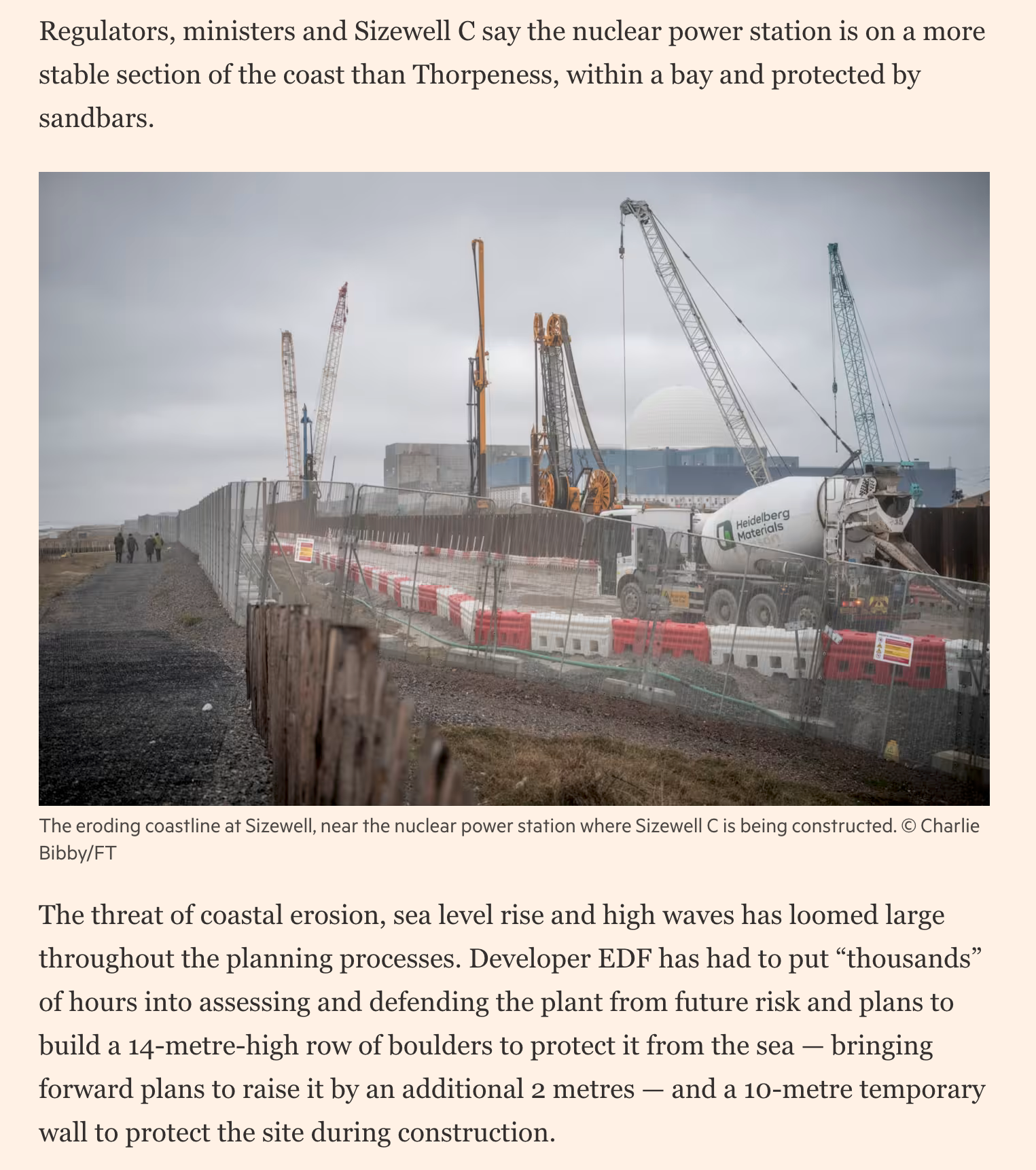
Weaknesses:
The article has no significant weaknesses. It is comprehensive, balanced, and deeply humane. If pressed, one could note that:
- The Gender Dimension (SDG 5): As with almost all infrastructure and environmental reporting, the article is silent on gender. The women quoted (Hilary Lightfoot, Sophie Marple) are present as victims of erosion, but their voices are not centered in the analysis of who is most vulnerable, who bears the care burdens, who is represented in the planning process.
- The Nuclear Debate: The article presents the nuclear industry’s defense (the plant is on a more stable section of coast, protected by sandbars, designed for extreme scenarios) alongside local opposition. It does not adjudicate between them. This is responsible journalism, but it leaves the reader uncertain about the actual risk.
- The Letters to the Editor: The two letters offer a fascinating counterpoint to the article’s framing. One, from Tom Greatrex of the Nuclear Industry Association, deflects by arguing that “it is climate change, not nuclear construction, that is accelerating coastal erosion.” The other, from Nicholas Malins-Smith, addresses broader issues. These letters reveal the ongoing debate about risk, responsibility and long-term solutions.
Opportunities for C.A.T.:
This article provides C.A.T. with a critical case study in the tensions between low-carbon infrastructure and climate vulnerability:
- The Adaptation Paradox: Sizewell C is being built to provide low-carbon power: a contribution to climate mitigation. But it is being built on a coastline that is eroding at accelerating rates: a direct consequence of climate change. This is the adaptation paradox: the infrastructure we need for the transition is itself vulnerable to the impacts of the transition’s delay.
- The 60-Year Question: The plant is designed to operate for at least 60 years. What will the coastline look like in 2086? The article suggests that erosion rates are already exceeding projections. The 1-in-10,000-year storm and 1-in-100,000-year surge event standards assume a stable climate. The climate is not stable.
- The Insurance Signal: Lightfoot’s lack of insurance coverage for coastal erosion is a signal. The insurance industry is already pulling back from high-risk areas. If Sizewell C becomes uninsurable, the liability will fall on the state. This echoes the broader uninsurability crisis documented in previous articles.
- The Local vs. National Tension: The article captures a classic tension: national energy infrastructure (Sizewell C provides 7% of Britain’s electricity) versus local communities (2,500 homes at risk, ten already demolished). C.A.T. can use this to explore questions of energy justice: who bears the risks of the transition?
- The “Tilting into the Sea” Framing: Sir David King’s metaphor (Britain tilting into the sea on its eastern side) is a powerful framing device. C.A.T. can use it to connect local erosion to global sea level rise, and both to the Earth’s energy imbalance documented in earlier articles.
Threats:
The biggest threat is that the erosion accelerates faster than the protection can be built. The 27 metres lost in 14 months at Thorpeness is a warning: the models are not keeping up with reality. A second threat is that the insurance gap widens. If coastal properties become uninsurable, the housing market in affected areas collapses, and the state becomes the insurer of last resort. A third threat is that the debate becomes polarized between nuclear advocates (who insist the plant is safe) and local opponents (who insist it is not). The reality . . . that the risks are uncertain and accelerating . . . is lost in the polarization.
Analysis Through Lenses:
United Nations Lens (IPCC/UNFCCC): From a UN climate governance perspective, this article is a case study in the adaptation imperative. The IPCC has long warned that sea level rise and coastal erosion will accelerate with warming. Sizewell C is a test case: can we build long-lived low-carbon infrastructure in a climate that is no longer stable? The UNFCCC process has focused on mitigation; this article shows that adaptation is not a secondary concern but a primary challenge. The Loss and Damage fund was designed to address exactly the kinds of losses documented here: homes demolished, gardens disappeared, communities displaced. But the fund remains underfunded, and the losses are already here.
EU Green New Deal Lens: For Brussels, this article should be a warning. The UK is no longer in the EU, but its infrastructure challenges are Europe’s challenges. The EU’s nuclear fleet . . . in France, in Finland, in other member states . . . faces similar questions: can plants built on coastlines withstand accelerating sea level rise and erosion? The Green Deal’s emphasis on low-carbon energy must be paired with rigorous climate risk assessment for all infrastructure. Sizewell C’s 1-in-10,000-year storm standard assumes a climate that no longer exists.
Draghi Report Lens: Mario Draghi’s report called for Europe to invest in competitiveness and resilience. This article shows what resilience means in practice: building infrastructure that can withstand the climate we are creating. Sizewell C’s £40 Billion price tag is a massive investment. But if the plant is vulnerable to coastal erosion, that investment is at risk. Draghi’s call for investment must include rigorous risk assessment and adaptation planning. The question is not whether to build low-carbon infrastructure; it is whether to build it in places that will be habitable and stable for its intended lifespan.
Mark Jacobson Lens: Through Jacobson’s framework, this article is a case study in the risks of betting on nuclear. Jacobson’s 100% wind-water-solar roadmaps do not include nuclear. He argues that nuclear is too slow to deploy, too expensive, and too risky. Sizewell C embodies all three critiques: it is taking decades to build (construction began years ago, and the plant is not yet operational); it costs £40 Billion; and it is located on a coastline that is eroding at accelerating rates. Jacobson would correctly argue that the same investment in wind, solar, and storage . . . distributed, modular, and less vulnerable to coastal erosion . . . would provide more resilient power with fewer risks.
SDG Ratings:
| SDG | Rating | Rationale |
|---|---|---|
| SDG 1 No Poverty | 6/10 ★★★★★★☆☆☆☆ | Homes demolished, families displaced, uninsured losses |
| SDG 2 Zero Hunger | 0/10 ☆☆☆☆☆☆☆☆☆☆ | Not addressed |
| SDG 3 Good Health and Well-Being | 3/10 ★★★☆☆☆☆☆☆☆ | Displacement, stress, community disruption |
| SDG 4 Quality Education | 1/10 ★☆☆☆☆☆☆☆☆☆ | Not addressed |
| SDG 5 Gender Equality | 0/10 ☆☆☆☆☆☆☆☆☆☆ | Complete absence. Women are quoted as victims but not centered in analysis of vulnerability, care burdens, or representation in planning |
| SDG 6 Clean Water and Sanitation | 2/10 ★★☆☆☆☆☆☆☆☆ | Coastal erosion affects water systems; not explored |
| SDG 7 Affordable and Clean Energy | 8/10 ★★★★★★★★☆☆ | Sizewell C as low-carbon power source; 7% of UK electricity |
| SDG 8 Decent Work and Economic Growth | 4/10 ★★★★☆☆☆☆☆☆ | Construction jobs; economic losses from erosion |
| SDG 9 Industry, Innovation and Infrastructure | 9/10 ★★★★★★★★★☆ | Core focus; £40 Billion infrastructure, coastal defences, nuclear plant |
| SDG 10 Reduced Inequalities | 5/10 ★★★★★☆☆☆☆☆ | Wealthy homeowners vs. vulnerable communities; insurance gap |
| SDG 11 Sustainable Cities and Communities | 9/10 ★★★★★★★★★☆ | Core focus; coastal communities, homes demolished, erosion risk |
| SDG 12 Responsible Consumption and Production | 2/10 ★★☆☆☆☆☆☆☆☆ | Not addressed |
| SDG 13 Climate Action | 9/10 ★★★★★★★★★☆ | Core focus; sea level rise, erosion acceleration, climate-driven risk |
| SDG 14 Life Below Water | 6/10 ★★★★★★☆☆☆☆ | Coastal erosion, sea level rise, marine processes (shingle movement) |
| SDG 15 Life on Land | 8/10 ★★★★★★★★☆☆ | Coastal ecosystems, cliff erosion, land loss |
| SDG 16 Peace, Justice and Strong Institutions | 5/10 ★★★★★☆☆☆☆☆ | Planning process, regulatory oversight, community consultation |
| SDG 17 Partnerships for the Goals | 4/10 ★★★★☆☆☆☆☆☆ | EDF, government agencies, local councils, community groups |
22nd February 2026: Financial Times Opinion columnist Rana Foroohar argues that the Trump administration’s energy policy is transforming the United States into a “petrostate”: a shift that will make the country “sicker and poorer.” Foroohar documents the costs: $50 Billion in writedowns for the Big Three automakers (GM, Ford, Stellantis) due to the sabotage of EV tax credits and fuel efficiency mandates + over 2 million manufacturing jobs at risk from the repeal of clean energy manufacturing tax credits + $22 Billion in planned EV, battery, and critical mineral investment that has dried up + the recent closure of a Ford battery facility in Kentucky that fired 1,600 workers in a state where $250 Million had been spent to lure the new business. She notes that the Trump administration has paused enforcement of a stronger silica standard designed to protect coal miners from black lung disease: a disease now affecting one in five veteran miners. “The guy who says he’s a champion of coal miners literally doesn’t care whether they live or die,” says BlueGreen Alliance executive director Jason Walsh. Foroohar warns that America is falling years behind China in the clean energy race, and questions whether the US will face retaliatory tariffs or financial sanctions from nations suffering climate-related economic losses https://www.ft.com/content/4d2559d2-04e7-4254-a44a-40d7c7b344f6?syn-25a6b1a6=1
Overall C.A.T. Usefulness: 10/10 ★★★★★★★★★★
Strengths:
This opinion piece is a data-driven model of how to connect climate action to economic and human well-being. Its key strengths are:
- The Petrostate Framing: The term “petrostate” is not neutral. It evokes nations where fossil fuel wealth concentrates power, distorts economies, and degrades institutions. Applying it to the United States is an accurate diagnosis. Foroohar is naming what the US is becoming.
- Quantifying the Costs: The numbers are devastating and meticulously sourced. $50 Billion in automaker writedowns. 2 million jobs at risk. $22 Billion in dried-up investment. 1,600 workers fired in Kentucky after $250 Million was spent to lure the plant. One in five veteran coal miners with black lung disease. These are not abstractions; they are the human and economic costs of policy choices.
- The Black Lung Detail: The inclusion of the silica standard pause . . . and the fact that one in five veteran coal miners now has black lung disease . . . connects the administration’s rhetoric of supporting coal miners to the reality of abandoning their health. Jason Walsh’s quote (“literally doesn’t care whether they live or die”) is the moral center of the piece.
- The China Comparison: Foroohar notes that “as China serves up cheap solar panels to emerging markets, America is becoming one.” This is a crisp inversion of the usual framing. The US is not competing in the industries of the future; it is becoming a commodity exporter, a petrostate, a nation that sells its resources rather than its ingenuity.
- The Retaliatory Risk: Foroohar’s question . . . “what’s to stop a group of nations with record climate-related economic losses from eventually penalising the US?” . . . is a strategic warning that few commentators have made. The US has used financial sanctions against nations it deems threats. Other nations could do the same to the US for its role in causing climate damage.
- The Insurance and Borrowing Costs: Foroohar connects climate policy to insurance premiums and borrowing costs: a framing that should resonate with business audiences. The risk premium on US assets may rise as the country becomes less stable, less predictable, and more exposed to climate litigation.
Weaknesses:
The article has no significant weaknesses within its own frame. As an opinion piece, it is not required to be balanced in the way a news article is. It makes its case with passion and evidence. If pressed, one could note that:
- The Gender Dimension (SDG 5): As with almost all economic and political analysis, the article is silent on gender. The 2 million jobs at risk, the 1,600 workers laid off, the coal miners with black lung: all are presented in gender-neutral terms. The care economy, the gendered dimensions of energy poverty, the differential impacts of pollution: all are invisible.
- The Reader Comments: The most recommended FT Readers’ Comments reveal a dimension the article itself does not capture: the lived experience of infrastructure decay and the sharp comparison with China that resonates with FT readers. The comments about NJ Transit’s bridge repair (a 200-meter bridge causing a 65% reduction in train volumes for a month, with NJ Transit recommending people work from home while employers ignore the recommendation) are a ground-level illustration of the dysfunction Foroohar describes at the policy level.
Opportunities for C.A.T.:
This article provides C.A.T. with a framework for understanding the costs of US climate policy retreat:
- The Petrostate Diagnosis: Foroohar’s framing is a powerful alternative to the administration’s “energy dominance” narrative. C.A.T. can use it to argue that the US is not becoming energy independent; it is becoming a petrostate . . . with all the corruption, inequality, and instability that includes.
- The Job Loss Story: The 2 million jobs at risk figure is a direct rebuttal to the claim that climate regulation kills jobs. The jobs being lost are in clean energy manufacturing: the industries of the future. The administration is not protecting workers; it is abandoning them.
- The Kentucky Fried Example: The Ford battery facility closure (1,600 workers fired after $250 Million in public investment) is a case study in the costs of policy volatility. C.A.T. can use it to illustrate the “policy volatility trap”.
- The Black Lung Connection: The silica standard pause is a direct line from policy choice to human suffering. C.A.T. can use it to argue that the administration’s “support” for coal miners is rhetorical, not real.
- The Retaliatory Risk: Foroohar’s question about financial sanctions is a strategic insight that C.A.T. can amplify. If other nations begin to treat the US as a climate rogue state, the economic consequences could be severe.
Threats:
The biggest threat is that Foroohar’s warnings are ignored. The administration has made clear that it does not value the health of coal miners, the jobs of clean energy workers, or the competitiveness of American industry. A second threat is that the US retreat becomes self-reinforcing. As investment dries up, as workers are laid off, as infrastructure decays, the country becomes less able to compete in the industries of the future. A third threat is that the retaliatory risk materializes. If other nations impose sanctions on the US for its climate policy, the economic costs could dwarf the $50 Billion in automaker writedowns.
Analysis Through Lenses:
United Nations Lens (IPCC/UNFCCC): From a UN climate governance perspective, Foroohar’s column is a devastating indictment of the world’s second-largest emitter. The US is not just failing to meet its Paris pledges; it is actively dismantling the policies that would allow it to meet them. The endangerment finding repeal, the EV tax credit sabotage, the silica standard pause: all are moves that make it harder for the US to reduce emissions. The UNFCCC process was designed to prevent exactly this kind of backsliding. It has failed.
EU Green New Deal Lens: For Brussels, this column is a warning and an opportunity. The warning: the US is becoming a petrostate, a competitor that will subsidize fossil fuels while Europe tries to decarbonize. The opportunity: the US retreat creates space for Europe to lead. Foroohar’s note that “China serves up cheap solar panels to emerging markets” while “America is becoming one” is a challenge to Europe: will you compete with China for the industries of the future, or will you also retreat?
Draghi Report Lens: Mario Draghi’s report called for Europe to invest in competitiveness and innovation. Foroohar’s column shows what happens when a major economy chooses the opposite path: jobs lost, investment dried up, workers abandoned. The $22 Billion in dried-up investment is the cost of policy volatility. The 2 million jobs at risk is the cost of retreat. Draghi’s call for investment is a call to avoid this fate.
Mark Jacobson Lens: Through Jacobson’s framework, Foroohar’s column is a case study in the political economy of delay. Jacobson’s roadmaps for 100% renewables show what is possible. Foroohar shows what is happening instead: the US is actively choosing to lock in fossil fuels, to abandon clean energy manufacturing, to expose workers to black lung disease. Every year of this policy is a year of emissions that will not be abated, a year of jobs that will not be created, a year of health that will be lost.
SDG Ratings:
| SDG | Rating | Rationale |
|---|---|---|
| SDG 1 No Poverty | 6/10 ★★★★★★☆☆☆☆ | Job losses, economic dislocation, worker vulnerability |
| SDG 2 Zero Hunger | 0/10 ☆☆☆☆☆☆☆☆☆☆ | Not addressed |
| SDG 3 Good Health and Well-Being | 8/10 ★★★★★★★★☆☆ | Black lung disease, pollution, premature deaths from climate change |
| SDG 4 Quality Education | 1/10 ★☆☆☆☆☆☆☆☆☆ | Not addressed |
| SDG 5 Gender Equality | 0/10 ☆☆☆☆☆☆☆☆☆☆ | Complete absence. The 2 million jobs at risk, the 1,600 workers laid off: all gender-neutral. The care economy, gendered impacts of pollution, invisible |
| SDG 6 Clean Water and Sanitation | 2/10 ★★☆☆☆☆☆☆☆☆ | Pollution from Venezuelan oil mentioned; not explored |
| SDG 7 Affordable and Clean Energy | 8/10 ★★★★★★★★☆☆ | Central focus; EV policy, fossil fuel subsidies, clean energy manufacturing |
| SDG 8 Decent Work and Economic Growth | 9/10 ★★★★★★★★★☆ | Core focus; jobs, investment, manufacturing, economic costs |
| SDG 9 Industry, Innovation and Infrastructure | 9/10 ★★★★★★★★★☆ | EV manufacturing, battery plants, infrastructure decay (reader comments) |
| SDG 10 Reduced Inequalities | 5/10 ★★★★★☆☆☆☆☆ | Coal miners, workers in transition states; distributional impacts |
| SDG 11 Sustainable Cities and Communities | 4/10 ★★★★☆☆☆☆☆☆ | Infrastructure decay (NJ Transit bridge), urban transportation |
| SDG 12 Responsible Consumption and Production | 3/10 ★★★☆☆☆☆☆☆☆ | Not addressed |
| SDG 13 Climate Action | 10/10 ★★★★★★★★★★ | Core focus; endangerment finding, emissions, clean energy transition |
| SDG 14 Life Below Water | 1/10 ★☆☆☆☆☆☆☆☆☆ | Not addressed |
| SDG 15 Life on Land | 2/10 ★★☆☆☆☆☆☆☆☆ | Pollution, land use; not explored |
| SDG 16 Peace, Justice and Strong Institutions | 7/10 ★★★★★★★☆☆☆ | Regulatory process, legal battles, institutional decay |
| SDG 17 Partnerships for the Goals | 3/10 ★★★☆☆☆☆☆☆☆ | US isolation, potential retaliatory sanctions |
21st February 2026: Financial Times Journalists Susannah Savage and Barney Jopson report that waves of extreme rain and flooding across Mediterranean countries and north Africa have battered the winter growing regions that feed Europe: disrupting supplies of fruit and vegetables and threatening food price rises. Spain, Portugal, Morocco and parts of Italy and Greece function as Europe’s winter “pantry,” exporting tomatoes, cucumbers, avocados, peppers, berries and citrus fruit northward when domestic output is limited. Spain has recorded damage to 22,000 hectares of agricultural land: a figure that could “nearly double” according to the agriculture minister. In one province alone, Córdoba, losses totalled €700 Million, with olive groves accounting for €550 Million. Farmers warn that 20% of all production has been lost in Andalusia, one of Spain’s main agricultural regions. The mayor of Huétor Tájar, where 80% of the population depends on asparagus production, said as much as a third of the crop remained underwater with harvesting due to begin within weeks. Economists warn that the concentration of European winter fruit and vegetable supply in a handful of regions makes markets particularly sensitive to weather shocks, and that these types of climate-related supply disruptions are “becoming more frequent, severe, and geographically widespread https://www.ft.com/content/8504b1a8-dcf6-43b7-8816-fdaac8b30f12?syn-25a6b1a6=1
Overall C.A.T. Usefulness: 10/10 ★★★★★★★★★★
Strengths:
This article masterfully connects climate science to the most fundamental of human concerns: food. Its key strengths are:
- The “Pantry” Framing: The metaphor of Europe’s winter “pantry” is brilliantly chosen. It evokes not abstract supply chains but the place where food is stored. When the pantry is flooded, everyday meals are at risk. This framing makes the stakes visceral and immediate.
- Quantifying the Damage: The numbers are devastating and precise. 22,000 hectares of agricultural land damaged: set to nearly double. €700 Million in losses in Córdoba province alone, €550 Million from olive groves. 20% of all production lost in Andalusia. 80% of a town’s population dependent on asparagus that is now underwater. These are not statistics . . . they are communities, livelihoods, and food.
- The Concentration Vulnerability: The article makes clear that European winter fruit and vegetable supply is concentrated in a handful of regions: Spain, Portugal, Morocco, parts of Italy and Greece. Spain alone accounts for more than 70% of UK sweet pepper imports and 65% of cucumbers. Morocco supplies more than a third of British strawberry and raspberry imports. This concentration is not an accident of geography; it is a structural vulnerability that climate change is exposing.
- The Central Bank Connection: The article notes that the Bank of England, in its August 2025 monetary policy report, acknowledged that climate-linked disruptions were contributing to higher UK food prices and complicating efforts to return inflation to its 2% target. This is a crucial signal: climate change is no longer just an environmental issue; it is a macroeconomic issue that central banks cannot ignore.
- The Structural Diagnosis: David Barmes’s conclusion (“these types of climate-related supply disruptions are becoming more frequent, severe, and geographically widespread”) is the heart of the article. The floods are not a one-off. They are a pattern. And the pattern is accelerating.
- The Farmer’s Voice: The inclusion of Mayor Fernando Delgado’s words (80% of his town’s population depends on asparagus, a third of the crop remains underwater, harvesting is due to begin within weeks) grounds the story in human reality. This is not about markets; it is about people whose livelihoods are drowning.
Weaknesses:
The article has no significant weaknesses. It is comprehensive, humane, and scientifically literate. If pressed, one could note that:
- The Gender Dimension (SDG 5): As with almost all food and agricultural reporting, the article is silent on gender. Women make up a significant portion of agricultural labor, particularly in seasonal and informal work. They are often the first to lose income when crops fail, and the last to receive aid. The gendered dimensions of food insecurity, care responsibilities, and economic vulnerability are invisible here.
- The Policy Response: The article notes government pledges of support: €2.2 Billion in direct aid from Spain, €600 Million for infrastructure, EU crisis reserve funds. It does not evaluate whether these responses are adequate, or whether they address the structural vulnerability or merely patch the immediate damage.
- The Consumer Price Index Footnote: The article notes that in the Netherlands, the affected products carry “little weight” in the consumer price index, muting the effect on inflation data. This is a crucial observation about how inflation metrics can obscure the real-world impacts of climate shocks. The article does not explore this distortion further.
Opportunities for C.A.T.:
This article provides C.A.T. with a critical case study in the direct human consequences of climate change:
- Food as the Connector: Unlike melting glaciers or rising sea levels, food connects to every human being, every day. The flooding of Europe’s winter pantry is a story that everyone can understand. C.A.T. can use this to bridge the gap between abstract climate metrics and lived experience.
- The Concentration Risk: The article’s documentation of supply concentration (70% of UK peppers from Spain, a third of UK berries from Morocco) is a powerful argument for diversification and resilience. C.A.T. can use this to argue that climate adaptation is not just about flood defenses; it is about restructuring supply chains to be less vulnerable to regional shocks.
- The Central Bank Signal: The Bank of England’s acknowledgment of climate-driven food inflation is a significant development. It means that climate change is now on the radar of institutions that were previously focused on other priorities. C.A.T. can use this to argue that climate action is not a trade-off with economic stability; it is a precondition for it.
- The Structural Pattern: Barmes’s diagnosis (“more frequent, severe, and geographically widespread”) is a template for C.A.T.’s analysis. Each new climate shock should be evaluated against this pattern. Is it a one-off, or is it part of the acceleration?
- The Farmer’s Voice: The mayor of Huétor Tájar, the farmers of Andalusia, the communities dependent on agriculture . . . these are the voices that should be centered. C.A.T. can amplify them.
Threats:
The biggest threat is that the floods are seen as a one-off rather than a pattern. Barmes’s warning that these disruptions are “becoming more frequent, severe, and geographically widespread” is the story, but it is buried in the final paragraphs. The headline and much of the reporting focus on the immediate crisis, not the long-term trend. A second threat is that the aid is insufficient or misdirected. Spain’s €2.2 Billion and the EU’s crisis funds may patch the damage, but they do not address the structural vulnerability of concentrated winter production. A third threat is that food price inflation becomes another political weapon. If prices rise, populist politicians may blame environmental policies rather than the climate-driven floods that actually caused the losses.
Analysis Through Lenses:
United Nations Lens (IPCC/UNFCCC): From a UN climate governance perspective, this article is a case study in the impacts that the IPCC has been warning about for decades. The IPCC’s Sixth Assessment Report projected that agricultural yields would decline and food prices would rise as climate change intensified. That projection is now a reality. The UNFCCC process has focused on emissions reductions; this article shows that adaptation is not a secondary concern but an immediate necessity. The Loss and Damage fund, established at COP28, was meant to address exactly these kinds of climate impacts. The article does not mention it, but the floods in Spain and Morocco are precisely what the fund was designed to address.
EU Green New Deal Lens: For Brussels, this article should be a wake-up call. The EU’s Common Agricultural Policy (CAP) is one of the largest agricultural subsidy programs in the world. The article notes that EU crisis reserve funds are being deployed. But the broader question is whether the CAP is structured to build resilience or to reinforce vulnerability. The concentration of winter vegetable production in a handful of Mediterranean regions is not an accident; it is the result of decades of policy, trade agreements, and market integration. The Green Deal’s Farm to Fork strategy was supposed to address these vulnerabilities. This article suggests it is not happening fast enough.
Draghi Report Lens: Mario Draghi’s report called for Europe to invest in competitiveness and resilience. This article shows what resilience means in the agricultural sector: diversified supply chains, climate-resilient crops, robust infrastructure, and safety nets for farmers. The €2.2 Billion in Spanish aid is a start, but it is reactive, not proactive. Draghi’s call for investment must include agricultural adaptation at scale.
Mark Jacobson Lens: Through Jacobson’s framework, this article is a case study in the consequences of delay. The floods that destroyed 22,000 hectares of Spanish farmland are not a natural disaster; they are a climate disaster. The 7% more moisture in the atmosphere for every 1°C of warming means that atmospheric rivers carry more water, storms are more intense, and floods are more destructive. Every year of delay in transitioning to 100% renewables adds to the moisture in the atmosphere, adds to the intensity of the storms, adds to the destruction of crops. The €700 Million in losses in Córdoba is a cost of delay. The 80% of a town’s population dependent on asparagus is a measure of vulnerability. Jacobson would say: the solution is to stop the warming, and the way to stop the warming is to stop burning fossil fuels.
SDG Ratings:
| SDG | Rating | Rationale |
|---|---|---|
| SDG 1 No Poverty | 7/10 ★★★★★★★☆☆☆ | Farmers’ livelihoods destroyed; aid pledges; poverty impacts central |
| SDG 2 Zero Hunger | 10/10 ★★★★★★★★★★ | Core focus; food supply, prices, crop losses, food security |
| SDG 3 Good Health and Well-Being | 3/10 ★★★☆☆☆☆☆☆☆ | Food quality and availability; health impacts of food price inflation |
| SDG 4 Quality Education | 1/10 ★☆☆☆☆☆☆☆☆☆ | Not addressed |
| SDG 5 Gender Equality | 0/10 ☆☆☆☆☆☆☆☆☆☆ | Complete absence. Women in agricultural labor, gendered impacts of food insecurity, care responsibilities: all invisible |
| SDG 6 Clean Water and Sanitation | 4/10 ★★★★☆☆☆☆☆☆ | Flooding, irrigation systems damaged |
| SDG 7 Affordable and Clean Energy | 1/10 ★☆☆☆☆☆☆☆☆☆ | Not addressed |
| SDG 8 Decent Work and Economic Growth | 6/10 ★★★★★★☆☆☆☆ | Agricultural employment, economic losses, inflation |
| SDG 9 Industry, Innovation and Infrastructure | 5/10 ★★★★★☆☆☆☆☆ | Irrigation, roads, supply chains damaged |
| SDG 10 Reduced Inequalities | 5/10 ★★★★★☆☆☆☆☆ | Small farmers vs large agribusiness; vulnerability of dependent communities |
| SDG 11 Sustainable Cities and Communities | 3/10 ★★★☆☆☆☆☆☆☆ | Rural communities affected; urban food supply |
| SDG 12 Responsible Consumption and Production | 7/10 ★★★★★★★☆☆☆ | Food supply chains, concentration risk, waste |
| SDG 13 Climate Action | 9/10 ★★★★★★★★★☆ | Climate-driven flooding, extreme weather, pattern of increasing severity |
| SDG 14 Life Below Water | 1/10 ★☆☆☆☆☆☆☆☆☆ | Not addressed |
| SDG 15 Life on Land | 9/10 ★★★★★★★★★☆ | Core focus; agricultural land, crops, soil, ecosystems |
| SDG 16 Peace, Justice and Strong Institutions | 4/10 ★★★★☆☆☆☆☆☆ | Government aid, EU crisis funds, policy response |
| SDG 17 Partnerships for the Goals | 5/10 ★★★★★☆☆☆☆☆ | EU coordination, supply chain interdependence |
20th February 2026: Financial Times Journalists Myles McCormick and Martha Muir report that the Trump administration has watered down limits on mercury pollution from coal plants by rolling back strict controls imposed by the Biden administration on the volume of toxins that coal and oil-fired power plants can release into the atmosphere. The EPA’s action reverts the Mercury and Air Toxics Standards to 2012 levels. EPA administrator Lee Zeldin argued that Biden-era rules “would have destroyed reliable American energy.” Environmental groups condemned the move as putting the coal industry’s interests over public health. The National Mining Association welcomed the rollback, saying the Biden-era revisions were “far too costly to justify the minimal emission reductions they would achieve.” The administration has also used emergency powers to keep open five coal plants scheduled for retirement and directed the Defense Department to buy coal-fired electricity. Coal consumption rose by 5% in the third quarter of 2025 compared with the same period the year before https://www.ft.com/content/d1f3c1ca-2724-4755-ae6b-c2ab158365ef?syn-25a6b1a6=1
Strengths:
This article concise captures a regulatory rollback with immediate and direct consequences for public health. Its key strengths are:
- The Mercury Story: Unlike many climate regulations, which deal with abstract metrics (tons of CO2, degrees of warming), mercury pollution has direct, measurable, and uncontroversial health impacts. Mercury is a neurotoxin. It damages developing brains. It accumulates in fish and passes to humans. The decision to allow more mercury into the air is not a debate about economic trade-offs; it is a decision to poison people.
- The 2012 Baseline: The article notes that the rollback reverts standards to 2012 levels. This is a crucial detail. The Obama-era standards were already a compromise. The Biden administration tightened them. The Trump administration is now loosening them to a level that was considered adequate over a decade ago . . . before the full scale of mercury’s health impacts was understood.
- Zeldin’s Language: The EPA administrator’s framing (“the Biden-Harris administration’s anti-coal regulations sought to regulate out of existence this vital sector of our energy economy”) is a gift to stakeholders: it reveals the ideological commitment at the heart of the policy. This is not a technical adjustment; it is a declaration of war on neurotoxins’ regulation.
- The Industry’s Cost-Benefit Claim: The National Mining Association’s argument that the Biden-era rules were “far too costly to justify the minimal emission reductions they would achieve” is included but not endorsed. The article lets the industry make its case, but the health implications are so stark that the claim rings hollow. The juxtaposition is powerful.
- The Contextual Onslaught: The article places the mercury rollback within a broader pattern: emergency powers to keep coal plants open, Defense Department coal purchases, relaxed coal ash rules. This is not an isolated act; it is a systematic effort to reverse the decline of the coal industry. The 5% rise in coal consumption in Q3 2025 is the result.
- The Clean Air Task Force Response: Hayden Hashimoto’s characterization (“unprecedented, unlawful and unjustified reversal that flies in the face of congressionally mandated efforts”) is precisely calibrated. It invokes the law, not just environmental values. This is a legal argument as much as a moral one.
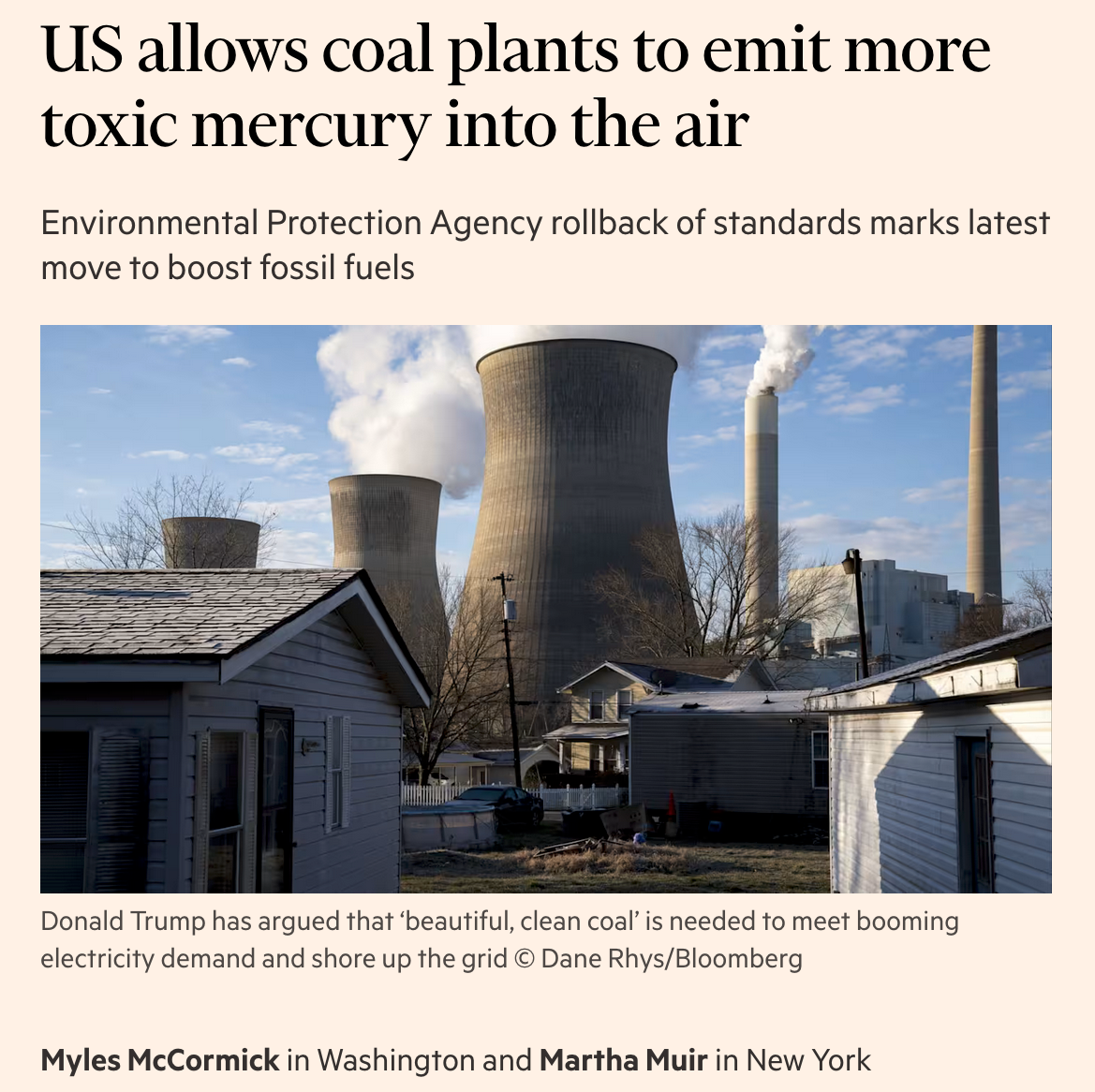
Weaknesses:
The article has no significant weaknesses. It is succinct, balanced, and deeply informed. If pressed, one could note that:
- The Health Impacts: The article mentions that mercury is a toxin but does not quantify the health impacts. How many cases of neurological damage will result? How many fish advisories? The absence of numbers leaves the reader to infer the scale of harm rather than being confronted with it.
- The Gender Dimension (SDG 5): As with almost all environmental reporting, the article is silent on gender. Mercury exposure affects fetal brain development: making it a reproductive health issue with profound gender dimensions. Pregnant women, nursing mothers, and children are the most vulnerable populations. This dimension cannot remain invisible.
- The Cumulative Story: The article notes the broader pattern of coal support but does not connect it to the endangerment finding lawsuit reported the previous day. Together, these stories form a portrait of systematic dismantling. The article treats the mercury rollback as a standalone story when it is part of a coordinated campaign.
Opportunities for C.A.T.:
This article provides C.A.T. with a critical case study in the human costs of regulatory rollback:
- Mercury as a Communications Tool: Unlike CO2, mercury is not abstract. It is a poison. The decision to allow more mercury into the air is a decision to poison people . . . particularly children. C.A.T. can use this framing to make the costs of deregulation visceral and undeniable.
- The 2012 Baseline: The fact that the rollback reverts to 2012 levels is a powerful argument against the claim that the administration is simply removing “burdensome” regulation. Trump’s administration is actively choosing a weaker standard than was in place for most of the past decade. This is not deregulation; it is backsliding.
- The Coal Consumption Increase: The 5% rise in coal consumption in Q3 2025 is a measurable outcome of the administration’s policies. C.A.T. can use this to track whether the “coal comeback” is real . . . and to document its consequences.
- The Defense Department Connection: The endangerment article noted the Defense Department coal purchase. This article adds mercury rollback to the same story. Together, they form a portrait of an administration using every tool at its disposal to prop up a dying industry.
- The Public Health Frame: The Clean Air Task Force’s invocation of “congressionally mandated efforts” is a reminder that these regulations have legal foundations beyond EPA discretion. C.A.T. can use this to argue that the rollback is not just bad policy; it is potentially unlawful.
Threats:
The biggest threat is that the mercury rollback is seen as a narrow technical adjustment rather than a direct attack on public health. The administration’s framing (“cost savings,” “reliable energy”) obscures the human costs. A second threat is that the rollback is upheld in court, setting a precedent for further weakening of toxics regulation. The endangerment finding lawsuit is the larger battle, but the mercury rollback is its immediate and deadly companion. A third threat is that the 5% rise in coal consumption is the beginning of a trend. If coal makes a comeback, the mercury, particulate matter, and CO2 emissions will follow . . . and the health impacts will accumulate.
Analysis Through Lenses:
United Nations Lens (IPCC/UNFCCC): From a UN climate governance perspective, this article is a case study in the human costs of fossil fuel dependency. The UNFCCC process has focused on CO2 emissions, but the health impacts of fossil fuel combustion (mercury, particulate matter, sulfur dioxide) are immediate and deadly. The decision to allow more mercury into the air is a decision to accept more neurological damage. The UN’s Sustainable Development Goals explicitly include health (SDG 3) and clean water (SDG 6). This policy directly undermines both.
EU Green New Deal Lens: For Brussels, this article is a reminder of the gap between US and European approaches. The EU’s Industrial Emissions Directive, its Mercury Regulation, and its broader chemicals framework are moving in the opposite direction: tightening standards, reducing pollution. The US is loosening standards, increasing pollution. This divergence has implications for trade, for competitiveness, and for the health of citizens on both sides of the Atlantic. The EU’s carbon border adjustment mechanism (CBAM) does not yet account for mercury or other toxics, but the logic of preventing “pollution havens” applies.
Draghi Report Lens: Mario Draghi’s report called for Europe to invest in competitiveness and innovation. It did not call for Europe to poison its citizens. The US approach (lowering environmental standards to prop up declining industries) is the opposite of the innovation-led growth Draghi advocates. Europe’s choice is clear: compete on quality, efficiency, and sustainability, or race to the bottom with the US. Draghi’s report implicitly rejects the race to the bottom.
Mark Jacobson Lens: Through Jacobson’s framework, this article is a case study in the irrationality of fossil fuel advocacy. Jacobson’s research shows that coal is not just a climate disaster; it is a public health disaster. The mercury emitted by coal plants damages brains. The particulate matter kills lungs. The decision to allow more mercury into the air is a decision to accept more death and disability. Jacobson would note that the transition to wind, water, and solar would eliminate this source of mercury entirely. Every coal plant kept open, every standard loosened, is a direct harm to human health. The 5% rise in coal consumption is not just a climate setback; it is a body count.
SDG Ratings:
| SDG | Rating | Rationale |
|---|---|---|
| SDG 1 No Poverty | 3/10 ★★★☆☆☆☆☆☆☆ | Cost claims ($100s of millions in savings); distributional impacts not explored |
| SDG 2 Zero Hunger | 1/10 ★☆☆☆☆☆☆☆☆☆ | Mercury accumulates in fish, affecting food systems; not explored |
| SDG 3 Good Health and Well-Being | 9/10 ★★★★★★★★★☆ | Core focus; mercury as neurotoxin, public health impacts |
| SDG 4 Quality Education | 1/10 ★☆☆☆☆☆☆☆☆☆ | Not addressed |
| SDG 5 Gender Equality | 0/10 ☆☆☆☆☆☆☆☆☆☆ | Complete absence. Mercury exposure affects fetal development: a reproductive health issue with profound gender dimensions that are invisible here |
| SDG 6 Clean Water and Sanitation | 7/10 ★★★★★★★☆☆☆ | Mercury accumulates in water systems and fish; not explored in depth |
| SDG 7 Affordable and Clean Energy | 4/10 ★★★★☆☆☆☆☆☆ | Coal consumption, energy reliability claims |
| SDG 8 Decent Work and Economic Growth | 3/10 ★★★☆☆☆☆☆☆☆ | Coal industry jobs mentioned; health costs not weighed against employment |
| SDG 9 Industry, Innovation and Infrastructure | 4/10 ★★★★☆☆☆☆☆☆ | Coal plants, power sector regulation |
| SDG 10 Reduced Inequalities | 4/10 ★★★★☆☆☆☆☆☆ | Pollution burdens disproportionately affect low-income communities; not explored |
| SDG 11 Sustainable Cities and Communities | 2/10 ★★☆☆☆☆☆☆☆☆ | Not addressed |
| SDG 12 Responsible Consumption and Production | 3/10 ★★★☆☆☆☆☆☆☆ | Coal consumption, waste disposal (coal ash noted) |
| SDG 13 Climate Action | 6/10 ★★★★★★☆☆☆☆ | Coal consumption, emissions; mercury not a climate pollutant |
| SDG 14 Life Below Water | 8/10 ★★★★★★★★☆☆ | Mercury accumulates in marine food chains; central to health story |
| SDG 15 Life on Land | 3/10 ★★★☆☆☆☆☆☆☆ | Coal ash disposal, land contamination noted |
| SDG 16 Peace, Justice and Strong Institutions | 5/10 ★★★★★☆☆☆☆☆ | EPA authority, regulatory process, legal challenges |
| SDG 17 Partnerships for the Goals | 2/10 ★★☆☆☆☆☆☆☆☆ | Not addressed |
19th February 2026: Financial Times Journalist Ian Johnston reports that energy ministers failed to reach agreement on tackling climate change over a two-day International Energy Agency meeting, marked by a sustained attack on net zero ambitions by US Energy Secretary Chris Wright. Unlike recent years, ministers did not agree a joint position following the talks, in a sign of the divisions stoked by the US. The meeting summary prepared by Dutch Energy Minister Sophie Hermans focused largely on “energy security,” noting that a “large majority of ministers had stressed the importance of the energy transition to combat climate change” while also affirming the “continued importance of oil and gas.” The US repeatedly threatened to withdraw from the IEA, though Wright said he did not want to risk China gaining more influence over the agency. UK Energy Secretary Ed Miliband responded: “For the vast majority of countries, the clean energy transition is unstoppable.” French counterpart Roland Lescure added: “We are convinced that climate change is both a reality and a threat that we must attack” https://www.ft.com/content/b05029de-46a0-4a3d-9bba-f26eb8dfd4bf?syn-25a6b1a6=1
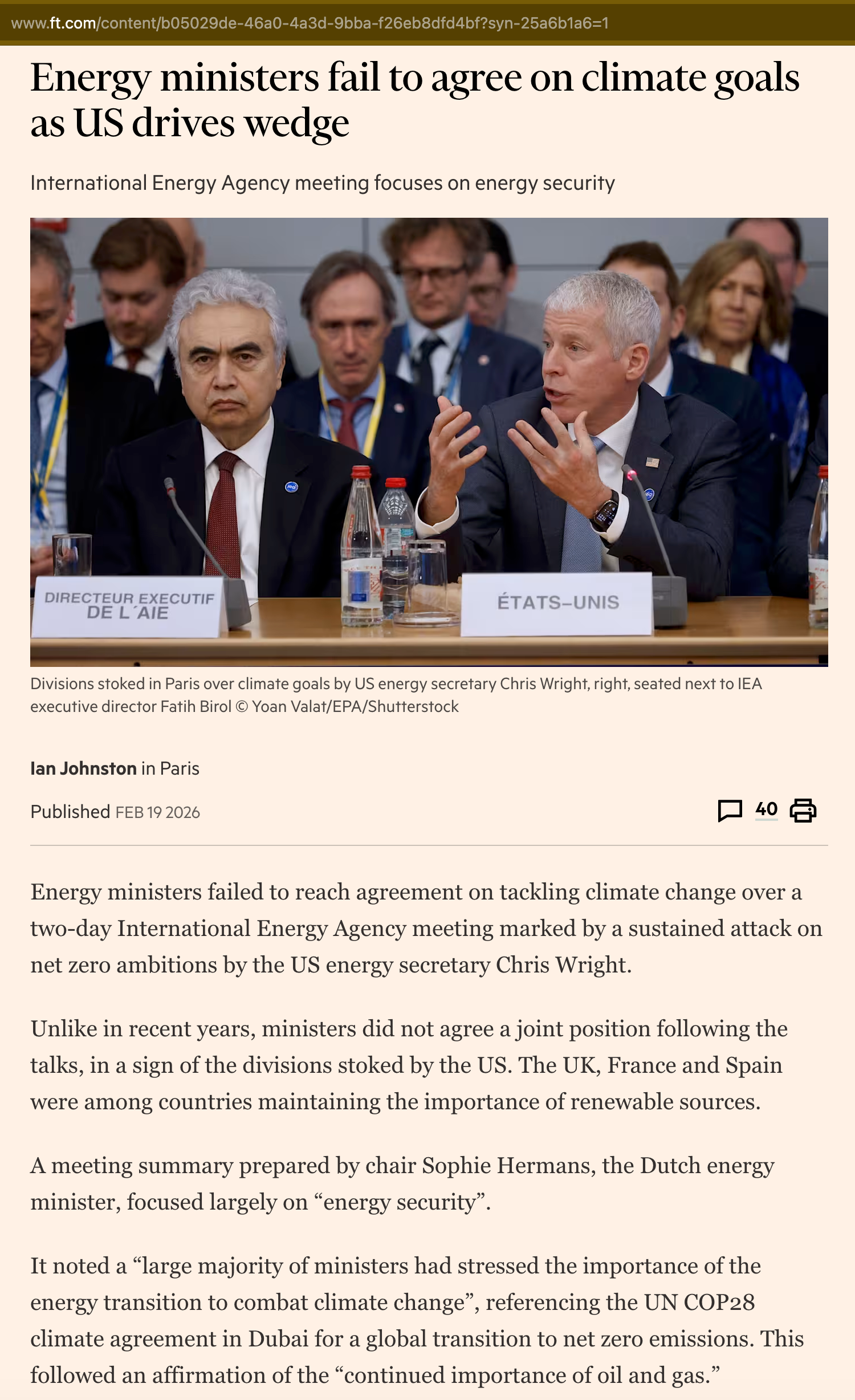
Overall C.A.T. Usefulness: 9/10 ★★★★★★★★★☆
Strengths:
This article captures a pivotal moment in the institutional history of global energy governance; namely, the fracturing of the IEA consensus that had held for nearly two decades. Its key strengths are:
- The Communiqué Absence: The fact that ministers did not agree a joint position following the talks is not a small procedural detail; it is the story. Previous IEA ministerial meetings had produced consensus on tackling climate change, with the 2024 gathering explicitly referencing the “triple planetary crisis.” The absence of a joint communiqué signals that the US has succeeded in breaking the institutional consensus.
- Naming the Mechanism: The article makes clear that the US is not just abstaining from consensus; it is actively attacking. Wright’s sustained assault on net zero ambitions, his threats to withdraw from the IEA, and his stated intention to pressure the agency over the “next year or so” to move away from advocating for net zero . . . all are documented with precision.
- The China Paradox: Wright’s admission that he does not want to risk China gaining more influence over the IEA is a crucial detail. The US is attacking the IEA’s net zero agenda while simultaneously recognizing that leaving the agency would cede influence to China. This is documented asymmetry: the US can afford to disrupt institutions because it knows other nations will not let them collapse entirely.
- The European Response: Miliband’s and Lescure’s statements are carefully chosen and powerfully understated. “For the vast majority of countries, the clean energy transition is unstoppable.” “Climate change is both a reality and a threat that we must attack.” These are not defensive positions; they are affirmations of a consensus that the US has chosen to abandon. The Irish minister’s pragmatic note (“it is better to have the US in the IEA than out”) acknowledges the strategic reality without endorsing US policy.
- The Hermans Summary: The meeting summary’s focus on “energy security” and its simultaneous affirmation of both the energy transition and “the continued importance of oil and gas” is a perfect artifact of the moment. It is a document designed to paper over divisions, but the divisions are visible in every line.
- The Birol Silence: Fatih Birol’s refusal to comment on whether he would seek renewal of his term (which ends in September 2027) speaks volumes. The director of the IEA is caught between member states with irreconcilable views. His silence is a measure of the pressure he is under.
Weaknesses:
The article has no significant weaknesses. It is concise, balanced, and deeply informed. If pressed, one could note that:
- The Gender Dimension (SDG 5): As with almost all political and institutional reporting, the article is silent on gender. The energy ministers photographed are overwhelmingly male. The decisions they make about energy policy have gendered impacts. This dimension is invisible.
- The Civil Society Absence: The article reports on government positions and institutional dynamics. The voices of civil society, climate activists, and the communities most affected by energy policy are absent. This is a limitation of the reporting frame, not a failure of the journalist.
- The Oil and Gas Affirmation: The article notes that the meeting summary affirmed the “continued importance of oil and gas.” It does not explore what this means in practice, or whether it represents a genuine shift in the IEA’s stance or a diplomatic compromise to keep the US at the table.
Opportunities for C.A.T.:
This article provides C.A.T. with a critical case study in the fracturing of international climate governance:
- The IEA as a Battlefield: The IEA has historically been a consensus-driven institution focused on energy security. Under Birol, it became a champion of the clean energy transition. The US is now trying to reverse that shift. C.A.T. can track whether the IEA can maintain its net zero advocacy or whether it will be forced back toward a more neutral, security-focused posture.
- The “Unstoppable” Framing: Miliband’s assertion that “for the vast majority of countries, the clean energy transition is unstoppable” is a powerful counter-narrative. It reframes US disruption as a rear-guard action against an inevitable shift. C.A.T. can amplify this framing.
- The China Factor, Revisited: Wright’s concern about China gaining influence over the IEA is a vulnerability. The US wants to disrupt the agency’s net zero agenda but does not want to cede influence to its strategic rival. C.A.T. can use this to argue that the US position is unstable: it cannot simultaneously attack the IEA and expect to retain influence.
- The Hermans Summary as Artifact: The meeting summary, with its dual affirmations of transition and fossil fuels, is a perfect artifact of the moment. C.A.T. can use it to illustrate the contradictions at the heart of global energy governance.
- The Birol Question: Birol’s future is uncertain. His term ends in September 2027. C.A.T. can track whether he is renewed, and if not, who replaces him . . . and whether the new director continues the agency’s net zero focus or pivots back toward a narrower energy security mandate.
Threats:
The biggest threat is that the IEA’s net zero advocacy is permanently weakened. Wright has stated he will continue to pressure the agency over the “next year or so.” If he succeeds, the world’s most authoritative energy institution will retreat from the climate leadership it has shown under Birol. A second threat is that the fracturing of the IEA is a template for other institutions. The US has already withdrawn from the UNFCCC. If it also weakens the IEA, and if other institutions follow, the multilateral framework for climate action could collapse. A third threat is that the “large majority” of countries that support the transition are not able to act collectively without US cooperation. Miliband’s assertion that the transition is “unstoppable” is a statement of conviction, not a description of physics. Political obstacles can slow the transition, and delay is dangerous.
Analysis Through Lenses:
United Nations Lens (IPCC/UNFCCC): From a UN climate governance perspective, this article is a disaster. The IEA is not a UN agency, but it is the world’s most authoritative energy institution. Its shift toward net zero advocacy was a crucial complement to the UNFCCC process. The US is now trying to reverse that shift. The fact that ministers could not agree a joint communiqué is a measure of how far the multilateral consensus has frayed. The UNFCCC process has already been weakened by US withdrawal; now the IEA . . . a key source of the data and analysis that underpins climate policy . . . is under attack. The “large majority” of countries still support the transition, but the minority (led by the US) is able to block consensus.
EU Green New Deal Lens: For Brussels, this article is a call to action. The US is attacking the IEA, but Europe remains committed to the transition. Miliband and Lescure’s statements are affirmations of that commitment. The question for the EU is whether it can fill the leadership vacuum the US is creating. The Green Deal’s credibility depends on the EU being able to maintain momentum even when the US is actively working to disrupt it. The Hermans summary’s affirmation of both transition and fossil fuels is a compromise Europe accepted to keep the US at the table. The question is whether such compromises will become the new normal.
Draghi Report Lens: Mario Draghi’s report called for Europe to invest in strategic autonomy. This article shows why. The US is using its position within the IEA to try to derail the net zero agenda. Europe cannot rely on the US to support its energy transition; it must build its own institutional capacity. The IEA may be fracturing, but the EU has its own institutions (the European Commission, the European Environment Agency, the European Climate, Infrastructure and Environment Executive Agency). Draghi’s call for investment in competitiveness must include investment in the institutional infrastructure of the transition.
Mark Jacobson Lens: Through Jacobson’s framework, this article is a case study in the political resistance to the transition. The technology for a 100% renewable system has long been proven. The economics work. The health benefits are enormous. But the US is using its power within the IEA to try to slow the transition. Jacobson would note that the IEA’s net zero advocacy was always a compromise: the agency’s scenarios still included significant fossil fuel use. The US is now trying to push the IEA even further back toward fossil fuel advocacy. This is not a debate about what is possible; it is a debate about what the world’s most authoritative energy institution will say is possible. The stakes are high because the IEA’s scenarios shape investment decisions, government policy, and public discourse.
SDG Ratings:
| SDG | Rating | Rationale |
|---|---|---|
| SDG 1 No Poverty | 2/10 ★★☆☆☆☆☆☆☆☆ | Not addressed; energy poverty implications not explored |
| SDG 2 Zero Hunger | 0/10 ☆☆☆☆☆☆☆☆☆☆ | Not addressed |
| SDG 3 Good Health and Well-Being | 2/10 ★★☆☆☆☆☆☆☆☆ | Not addressed; health benefits of transition not mentioned |
| SDG 4 Quality Education | 1/10 ★☆☆☆☆☆☆☆☆☆ | Not addressed |
| SDG 5 Gender Equality | 0/10 ☆☆☆☆☆☆☆☆☆☆ | Complete absence. No mention of women, gender, or differential impacts |
| SDG 6 Clean Water and Sanitation | 1/10 ★☆☆☆☆☆☆☆☆☆ | Not addressed |
| SDG 7 Affordable and Clean Energy | 8/10 ★★★★★★★★☆☆ | Central focus; energy security, transition, net zero |
| SDG 8 Decent Work and Economic Growth | 3/10 ★★★☆☆☆☆☆☆☆ | Not addressed; economic implications of transition mentioned |
| SDG 9 Industry, Innovation and Infrastructure | 4/10 ★★★★☆☆☆☆☆☆ | IEA as institution; not explored in depth |
| SDG 10 Reduced Inequalities | 2/10 ★★☆☆☆☆☆☆☆☆ | Not addressed |
| SDG 11 Sustainable Cities and Communities | 1/10 ★☆☆☆☆☆☆☆☆☆ | Not addressed |
| SDG 12 Responsible Consumption and Production | 2/10 ★★☆☆☆☆☆☆☆☆ | Not addressed |
| SDG 13 Climate Action | 9/10 ★★★★★★★★★☆ | Core focus; net zero, transition, climate commitment |
| SDG 14 Life Below Water | 0/10 ☆☆☆☆☆☆☆☆☆☆ | Not addressed |
| SDG 15 Life on Land | 0/10 ☆☆☆☆☆☆☆☆☆☆ | Not addressed |
| SDG 16 Peace, Justice and Strong Institutions | 8/10 ★★★★★★★★☆☆ | IEA as institution, multilateral governance, US-Europe divisions |
| SDG 17 Partnerships for the Goals | 7/10 ★★★★★★★☆☆☆ | IEA membership, international cooperation, fractures |
19th February 2026: Financial Times Energy Source columnist Jamie Smyth reports that health and climate groups have sued the Trump administration to block its elimination of the “endangerment finding”: a 2009 scientific determination that climate pollution is a threat to public health and welfare, which underpins the US government’s ability to regulate greenhouse gases under the Clean Air Act. The lawsuit, filed in the Court of Appeals for the District of Columbia, also challenges the EPA’s rollback of tailpipe rules. EPA administrator Lee Zeldin has called the endangerment finding the “holy grail of climate change religion” and claimed its rescission would save US taxpayers $1.3 Trillion. Environmental groups counter that repealing the finding would add up to 18bn tons of climate-altering pollution and increase net costs for Americans by up to $4.7 Trillion. The American Petroleum Institute did not advocate for rescission of the endangerment finding, citing concerns about state-level fragmentation and litigation risks. Legal experts warn that if the courts uphold the rule, “no future EPA will be able to regulate greenhouse gases” https://www.ft.com/content/6a666613-364e-4189-b02b-6f699257da40?syn-25a6b1a6=1
Overall C.A.T. Usefulness: 10/10 ★★★★★★★★★★
Strengths:
This article is a masterclass in legal, political, and environmental journalism, and captures a moment of existential consequence for US climate policy. Its key strengths are:
- Naming the Stakes: The article makes clear that the endangerment finding is not a peripheral regulation but the foundation upon which all US climate regulation rests. Jeff Holmstead’s warning . . . “if the courts uphold the rule, no future EPA will be able to regulate greenhouse gases” . . . is the most important sentence in the piece. This is not about tailpipe rules; it is about whether the US government has any authority to act on climate at all.
- The “Holy Grail” Framing: Zeldin’s characterization of the endangerment finding as the “holy grail of climate change religion” is the key. It reveals the ideological nature of the assault. This is not a technical debate about regulatory cost-benefit analysis; it is an attack on the very premise that climate pollution is a problem the government can address.
- Quantifying the Costs: The article presents dueling numbers: the EPA claims $1.3 Trillion in savings; the Environmental Defense Fund counters that repealing the finding would add up to 18 Billion tons of pollution and increase net costs by $4.7 Trillion, with an additional $1.7 Trillion in fuel costs. The EDF’s $100 Billion annual net benefits figure for the Biden-era standards, including $13 Billion in health benefits, provides a baseline for comparison. The reader is left to judge which numbers are credible.
- The API’s Strategic Silence: The reporting that the American Petroleum Institute “did not advocate for rescission of the endangerment finding, mainly due to concerns this would prompt US states to introduce their own emissions regulations, increase complexity and raise litigation risks” is a crucial detail. It reveals that even the oil industry recognizes the dangers of destroying the federal framework. State-by-state regulation, industry’s nightmare, is the alternative. This is a vulnerability that litigants can exploit.
- The Global Competitiveness Argument: Katherine García’s framing . . . that federal vehicle emissions standards are “essential for ensuring global competitiveness” . . . is a powerful counter-narrative to the administration’s “jobs vs. environment” framing. The article notes that US manufacturers risk losing access to overseas markets that impose tough climate rules. This connects the domestic legal battle to the global economic logic documented in previous articles (China battery surge, EU CBAM).
- The Legal Realism: The article does not pretend that the lawsuit is certain to succeed. Holmstead’s analysis that the Trump administration has “put together some legal arguments that could get at least five votes in the Supreme Court” is a sobering dose of realism. The litigation could be lengthy, and the outcome is uncertain.
Weaknesses:
The article has no significant weaknesses. It is comprehensive, balanced, and deeply informed. If pressed, one could note that:
- The Human Dimension: The article cites health benefits numbers ($13 Billion annually from reduced air pollution) but does not put a human face on them. Who dies from air pollution? What communities are most affected? The Sierra Club and the American Public Health Association are plaintiffs, but their members’ voices are absent.
- The Gender Dimension (SDG 5): As with almost all environmental reporting, the article is silent on gender. Air pollution affects women and men differently. The health burdens of pollution, the care burdens of climate impacts, the representation in the legal and political battles . . . all have gendered dimensions that are invisible here.
- The Timing Context: The article was published on 19th February 2026. It does not reference the Iran war, which began on 28th February after this article appeared. The war would later shift the energy landscape dramatically, as documented in subsequent articles. This is not a weakness of the reporting, but it is a reminder that the legal battle described here is unfolding alongside . . . and will be overtaken by . . . geopolitical shocks.
Opportunities for C.A.T.:
This article provides C.A.T. with a critical case study in the institutional foundations of climate policy:
- The Endangerment Finding as Keystone: The article makes clear that the endangerment finding is not just a regulation; it is the legal basis for all US climate action. If it falls, the US loses its primary tool for regulating greenhouse gases. C.A.T. can use this to argue that climate policy is not just about targets and pledges; it is about the legal infrastructure that makes regulation possible.
- The Litigation Front: The lawsuit is a reminder that the battle over climate policy is being fought in courts as well as legislatures. C.A.T. can track this case as a critical indicator of whether the US will retain any capacity to regulate emissions.
- The State-Level Fragmentation Risk: The API’s concern about state-by-state regulation is a strategic opening. If the federal framework falls, the US could fragment into a patchwork of state regulations: some strong (California), some weak (Texas). C.A.T. can use this to argue that a federal framework is not just environmentally necessary but also economically efficient.
- The Global Competitiveness Link: The article connects the domestic legal battle to the global economic logic of the transition. US manufacturers that lose access to markets with tough climate rules will be at a disadvantage. This framing should be central to C.A.T.’s messaging to business audiences.
- The Supreme Court Vulnerability: Holmstead’s analysis that the Trump administration has structured its legal arguments to appeal to the current Supreme Court is a warning. The fate of US climate policy may rest on the votes of five justices. C.A.T. can use this to argue that climate policy cannot rely on judicial outcomes; it must be embedded in durable institutions.
Threats:
The biggest threat is that the courts uphold the rescission. Holmstead’s assessment that the Trump administration has crafted legal arguments that could secure five votes in the Supreme Court is a genuine danger. If the endangerment finding falls, the US loses its primary tool for regulating greenhouse gases: no future administration, however committed to climate action, will have the authority to act. A second threat is that the litigation is lengthy, and the uncertainty itself deters investment. The API’s concern about state-level fragmentation is already a reality: California has its own regulations, but a federal framework creates certainty. Without it, manufacturers face a patchwork of rules. A third threat is that the global competitiveness argument is lost. If US manufacturers cannot compete in markets with tough climate rules, they will lose market share to Chinese and European competitors. The China battery surge article documented the scale of that competition.
Analysis Through Lenses:
United Nations Lens (IPCC/UNFCCC): From a UN climate governance perspective, this article is devastating. The endangerment finding was the US implementation of the scientific consensus that the IPCC has been building for decades. Its rescission is not just a domestic policy reversal; it is a rejection of the very premise that climate pollution is a problem the government can address. The UNFCCC process depends on the assumption that countries will act on the science. The US, the world’s second-largest emitter, is now arguing that the science does not empower regulation. If the courts uphold this rule, the US will have no federal authority to regulate greenhouse gases: making its Paris pledges meaningless. The article’s publication date (19th February) is notable: it appears just as the US was beginning to signal its withdrawal from the UNFCCC, a process documented in C.A.T.’s February Take-aways.
EU Green New Deal Lens: For Brussels, this article should be a warning. The US is not just retreating from climate action; it is dismantling the legal infrastructure that made action possible. The EU’s Green Deal is more institutionalized than the US framework ever was, but it is not immune to similar attacks. The ETS battle documented in the EU summit article is a milder version of the same phenomenon: political actors seeking to weaken the legal basis for climate regulation. The lesson for Brussels is to embed climate policy in durable institutions that can survive changes in government.
Draghi Report Lens: Mario Draghi’s report called for Europe to invest in competitiveness and innovation. This article shows what happens when a major economy abandons the regulatory framework for the transition. The API’s concern about state-level fragmentation is a preview of the chaos that could ensue. Draghi’s vision of a “clean industrial deal” requires regulatory certainty. The US is moving in the opposite direction, creating uncertainty that will deter investment. This is an opportunity for Europe: regulatory stability is a competitive advantage.
Mark Jacobson Lens: Through Jacobson’s framework, this article is a case study in the political dismantling of climate action. Jacobson’s roadmaps for 100% renewable energy assume that governments will act on the science. The Trump administration is doing the opposite: not just slowing the transition, but destroying the legal basis for the transition. Jacobson would note that the technology for a 100% renewable system exists; the barrier is political. This article shows that political barrier being fortified. The $4.7 Trillion in net costs that the EDF projects is a measure of what delay costs. The 18 Billion tons of additional pollution is a measure of what is at stake.
SDG Ratings:
| SDG | Rating | Rationale |
|---|---|---|
| SDG 1 No Poverty | 4/10 ★★★★☆☆☆☆☆☆ | Cost claims ($1.3 Trillion savings vs $4.7 Trillion costs); distributional impacts not explored |
| SDG 2 Zero Hunger | 0/10 ☆☆☆☆☆☆☆☆☆☆ | Not addressed |
| SDG 3 Good Health and Well-Being | 8/10 ★★★★★★★★☆☆ | Health benefits of regulation ($13 Billion annually) central; air pollution impacts |
| SDG 4 Quality Education | 1/10 ★☆☆☆☆☆☆☆☆☆ | Not addressed |
| SDG 5 Gender Equality | 0/10 ☆☆☆☆☆☆☆☆☆☆ | Complete absence. Air pollution, health impacts, and legal advocacy all have gendered dimensions that are invisible |
| SDG 6 Clean Water and Sanitation | 1/10 ★☆☆☆☆☆☆☆☆☆ | Not addressed |
| SDG 7 Affordable and Clean Energy | 7/10 ★★★★★★★☆☆☆ | Tailpipe rules, EVs, fuel costs: central to the debate |
| SDG 8 Decent Work and Economic Growth | 5/10 ★★★★★☆☆☆☆☆ | Regulatory costs, compliance, global competitiveness |
| SDG 9 Industry, Innovation and Infrastructure | 6/10 ★★★★★★☆☆☆☆ | Auto industry regulation, manufacturing competitiveness |
| SDG 10 Reduced Inequalities | 3/10 ★★★☆☆☆☆☆☆☆ | Health impacts disproportionately affect low-income communities; not explored |
| SDG 11 Sustainable Cities and Communities | 3/10 ★★★☆☆☆☆☆☆☆ | Tailpipe pollution affects urban air quality; not explored |
| SDG 12 Responsible Consumption and Production | 4/10 ★★★★☆☆☆☆☆☆ | Vehicle emissions, fuel consumption |
| SDG 13 Climate Action | 10/10 ★★★★★★★★★★ | Core focus; endangerment finding, tailpipe rules, 18bn tons of additional pollution |
| SDG 14 Life Below Water | 0/10 ☆☆☆☆☆☆☆☆☆☆ | Not addressed |
| SDG 15 Life on Land | 1/10 ★☆☆☆☆☆☆☆☆☆ | Not addressed |
| SDG 16 Peace, Justice and Strong Institutions | 9/10 ★★★★★★★★★☆ | Legal challenge, courts, regulatory institutions, rule of law |
| SDG 17 Partnerships for the Goals | 3/10 ★★★☆☆☆☆☆☆☆ | Coalition of plaintiffs (Sierra Club, APHA, etc.); global competitiveness mentioned |
Questions? Reflections? Ideas? Chat with C.A.T. and Christian: christian@youth4planet.org
– – – –