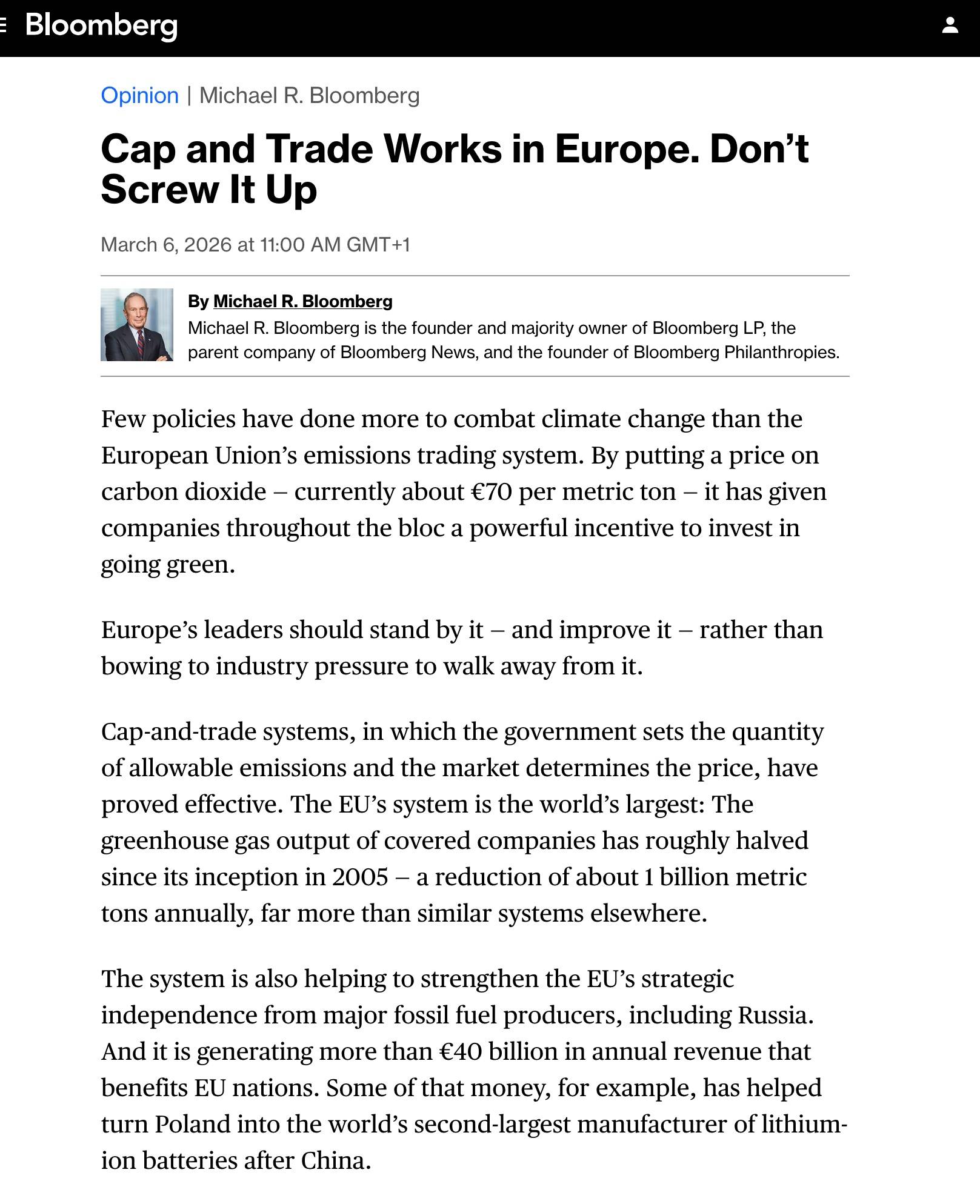
Today, Michael Bloomberg issued a warning to European policymakers: Do not weaken the carbon market. His argument was directed at the European Union Emissions Trading System, the world’s largest carbon market and one of the most consequential climate policy experiments of the modern era.
The warning deserves attention. For those of us who will live with the consequences of climate policy for the next half-century, the stakes extend far beyond political debate.
The consequences are generational: the decisions European leaders make in the coming years will determine whether Europe protects the most sophisticated climate policy architecture yet constructed . . . or abandons it just as it begins to deliver.
Therefore, understanding this moment requires understanding how the EU carbon market actually evolved.
Because the EU ETS was never designed to be elegant. It was designed to work.
And like many serious institutions, it learned by surviving its own mistakes. When the EU Carbon Market launched on the 1st January 2005, European policymakers attempted something unprecedented: rather than regulating emissions directly, they created a market for them.
The logic was simple:
- Set a cap on emissions.
- Issue tradable allowances.
- Allow companies to buy and sell permits depending on their needs.
The price of carbon would emerge from supply and demand.
Economists had long favored this approach. Carbon pricing had been widely recommended as the most efficient mechanism for reducing greenhouse gas emissions.
Translating theory into practice proved difficult. There were growing pains. During the first phase of the EU ETS, allowances were allocated based largely on estimated emissions rather than verified historical data. Those estimates proved far too generous. When verified emissions data were released in 2006, markets realized that the system contained a large surplus of allowances.
Result? Prices collapsed.
By 2007 the value of a carbon allowance had fallen close to zero.
Many observers declared Europe’s flagship climate policy a failure.
Yet Europe did something unusual.
It did not abandon the system.
Instead, policymakers began repairing it: Learning by Doing.
The second phase of the EU ETS coincided with the Global Financial Crisis, which sharply reduced industrial output across Europe.
Lower production meant fewer emissions.
Fewer emissions meant lower demand for allowances.
Another surplus accumulated.
Critics again declared the carbon market ineffective.
Yet the political response was not abandonment but reform.
Beginning in 2013 the European Union centralized the emissions cap and significantly increased the share of allowances distributed through auctioning rather than free allocation.
These reforms improved the system but did not eliminate oversupply.
The most important reform arrived later.
In 2019 the European Union introduced the Market Stability Reserve, a rule-based mechanism designed to adjust the supply of allowances when surpluses become excessive.
The reserve removes allowances from auction when the market is oversupplied and can release allowances when supply tightens. For the first time the carbon market possessed a self-correcting stabilizer.
Result? Confidence returned. Prices rose.
From less than €10 per ton in 2017, EU carbon prices climbed to approximately €105 per ton in February 2023, the highest level recorded since the system’s creation.
For the first time, the carbon price became large enough to influence major industrial decisions.
Coal generation became increasingly uneconomic, as Utilities accelerated investment in renewable electricity. Industrial firms began evaluating low-carbon production technologies, and after more than a decade of uncertainty, the market had matured.
Carbon markets are frequently misunderstood. Unlike solar farms or electric vehicles, they produce no visible infrastructure. They operate through financial signals. Yet those signals can reshape entire economies.
The EU ETS currently covers around 10,000 industrial installations and regulates approximately 40 percent of the European Union’s greenhouse gas emissions. These installations include power plants, steel mills, cement factories, refineries, and chemical facilities. Since 2005, emissions from stationary installations covered by the EU ETS have fallen by roughly half.
That represents close to one billion tons of carbon dioxide reductions annually. The system also generates substantial public revenue. Auctioning of allowances now produces more than €40 billion per year for EU member states. These funds are intended to support climate investment, innovation, and social policies that help manage the economic transition.
But the most important effect of carbon markets lies elsewhere.
- It lies in expectations.
- Markets anticipate the future.
A steadily tightening emissions cap signals to investors that emitting carbon will become progressively more expensive.
Power utilities therefore hedge future generation against rising carbon costs. Industrial firms begin evaluating low-carbon alternatives. Financial institutions integrate carbon pricing into long-term investment decisions.
In this sense the carbon market functions as an economic compass: it does not dictate the path toward decarbonization. But it points unmistakably toward the direction the economy must eventually travel.
The importance of Europe’s carbon market has grown dramatically since the Russian invasion of Ukraine. Europe’s dependence on imported fossil fuels suddenly revealed itself as a strategic vulnerability. Reducing emissions is no longer solely a climate objective.
It is also a matter of security.
Carbon pricing accelerates that transition. How? By increasing the cost of fossil fuel use, the system encourages investment in domestic renewable energy, electrification, and efficiency. These investments reduce both emissions and geopolitical exposure.
The carbon market therefore operates at the intersection of climate policy, industrial strategy, and energy security. That intersection helps explain why the EU ETS has become one of the most consequential economic instruments in modern European governance.
Despite its successes, the EU ETS faces growing political pressure. Energy-intensive industries argue that rising carbon prices threaten European competitiveness. Manufacturers facing global competition worry about losing market share to producers operating under weaker climate regulations.
These concerns are real.
In response, the European Union has introduced the Carbon Border Adjustment Mechanism, which applies a carbon cost to certain imported goods in order to prevent “carbon leakage” and protect European industry.
Yet political pressure persists. Some policymakers have suggested weakening elements of the carbon market to reduce industrial costs. Markets respond immediately to such signals.
When German Chancellor Friedrich Merz suggested openness to revisiting parts of the system, carbon prices experienced their sharpest decline in nearly three years. This reaction illustrates a fundamental reality:
- Carbon markets depend on credibility.
- The price of carbon today reflects expectations about scarcity tomorrow.
- If policymakers signal that the system may be weakened, markets adjust immediately.
- Prices fall.
- Investment signals weaken.
- And the credibility of the entire system erodes.
The American Counter-Factual: to appreciate the significance of Europe’s carbon market, it is helpful to examine the path not taken in the United States: in 2009 the U.S. Congress came close to establishing a national cap-and-trade system through the American Clean Energy and Security Act, commonly known as the Waxman–Markey bill.
The legislation passed the House of Representatives but never reached a vote in the Senate.
This failure fundamentally reshaped American climate policy.
Rather than carbon pricing, the United States pursued a strategy based largely on subsidies and incentives.
That strategy culminated in the Inflation Reduction Act, which provides hundreds of billions of dollars in incentives for clean energy technologies. These subsidies are already stimulating large-scale investment.
But they represent a different philosophy of climate policy:
- Europe chose markets.
- America chose incentives.
Both approaches can reduce emissions.
But . . . carbon markets possess a distinctive advantage.
Why? They shape long-term economic expectations.
Once investors believe that emitting carbon will become progressively more expensive, the entire economy begins adapting. Subsidy regimes can stimulate investment, but they can also be reversed quickly.
A future Congress could weaken American climate subsidies with a simple majority.
The EU ETS, by contrast, rests on two decades of institutional development, thousands of participating companies, and billions in economic commitments.
That institutional depth makes it harder to dismantle. The next phase of the EU ETS will extend carbon pricing even further. Beginning in 2027, a new system known as EU ETS2 will apply carbon pricing to fuels used in buildings and road transport.
This expansion will bring carbon pricing closer to everyday economic life. If poorly implemented, such policies could provoke public backlash. However, if revenues are transparently returned to households or invested in affordable alternatives, the system could accelerate decarbonization while protecting vulnerable citizens.
Carbon pricing works best when accompanied by visible social protections and credible governance.
The Long Game: Climate policy unfolds on long time horizons. Atmospheric systems change slowly. Energy infrastructure lasts decades. Economic transitions take time. The EU carbon market reflects that reality:
It took nearly twenty years for the system to evolve from a fragile experiment into a credible policy instrument. That transformation required political persistence, regulatory reform, and institutional learning. Today the European Union operates the most advanced carbon market in the world.
It generates billions in revenue. It shapes investment decisions across major industries, and it signals to global markets that the economics of fossil fuels are changing.
None of this guarantees success, but abandoning the system now would discard two decades of policy learning just as the mechanism begins to deliver.
The Thermometer: Carbon markets are not a cure for climate change. They are a diagnostic instrument. Carbon markets tell us whether our economic systems are aligned with the physical limits of the planet.
Breaking the thermometer does not cure the fever. It simply hides the symptoms.
Result? The fever continues to rise.
The thermometer merely tells us how serious the illness has become.
Our task is not to break the instrument.
Our task is to unequivocally and holistically bring the planet’s temperature down.