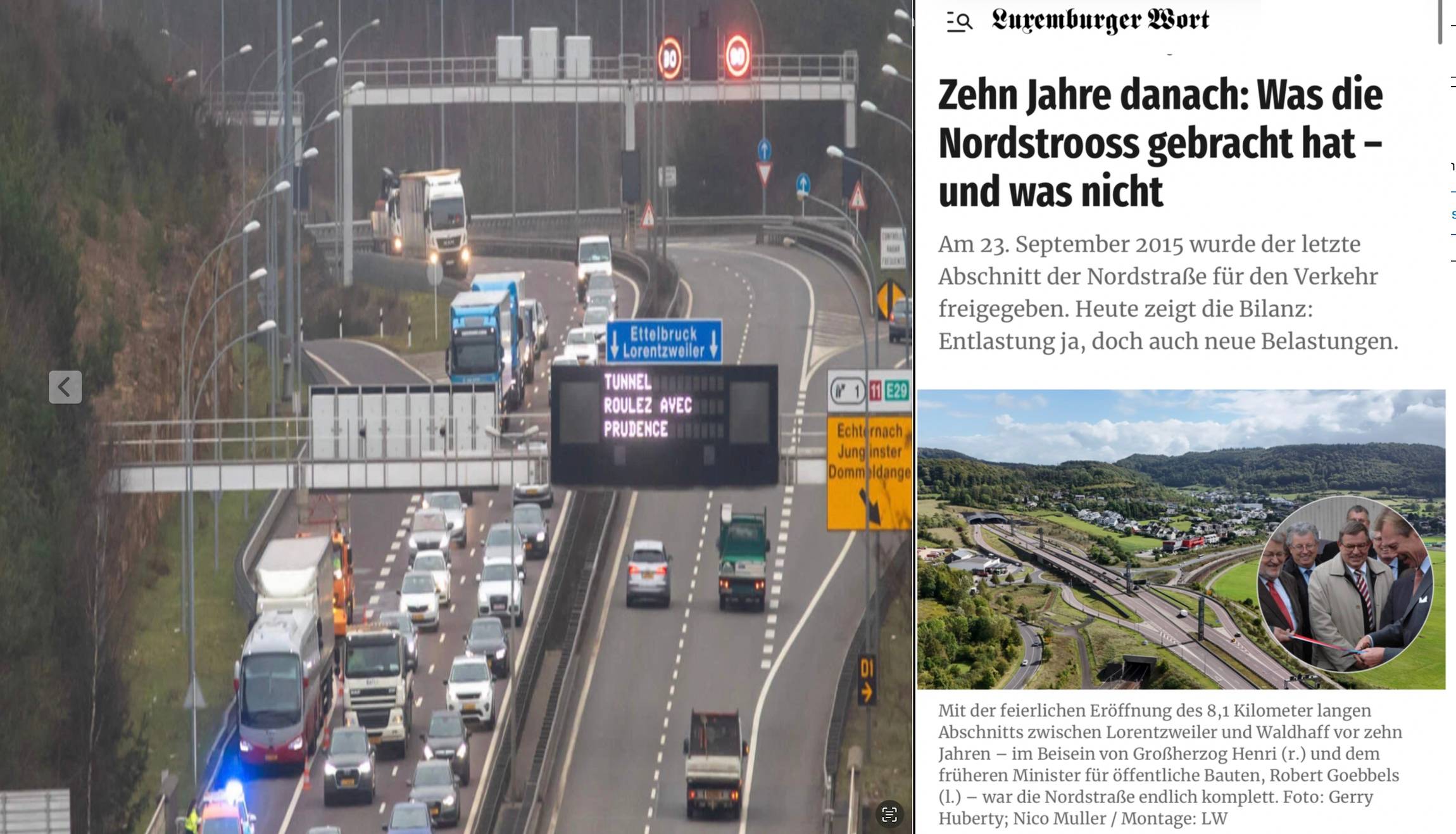
Read the Luxemburger Wort‘s article yesterday on the Nordstrooss (online on the Wort website https://www.wort.lu/luxemburg/stadaland/zehn-jahre-danach-was-die-nordstrooss-gebracht-hat-%E2%80%93-und-was-nicht/92062809.html) . . . a motorway through the Grünewald forest that politicians framed as a “triumph of connectivity”. Today, we can measure the outcome with numbers . . . and the numbers reveal deeper questions . . . including:
How deeply has the Nordstrooss locked us into a business model where pollution, noise, sprawl and induced traffic are top deliverables?
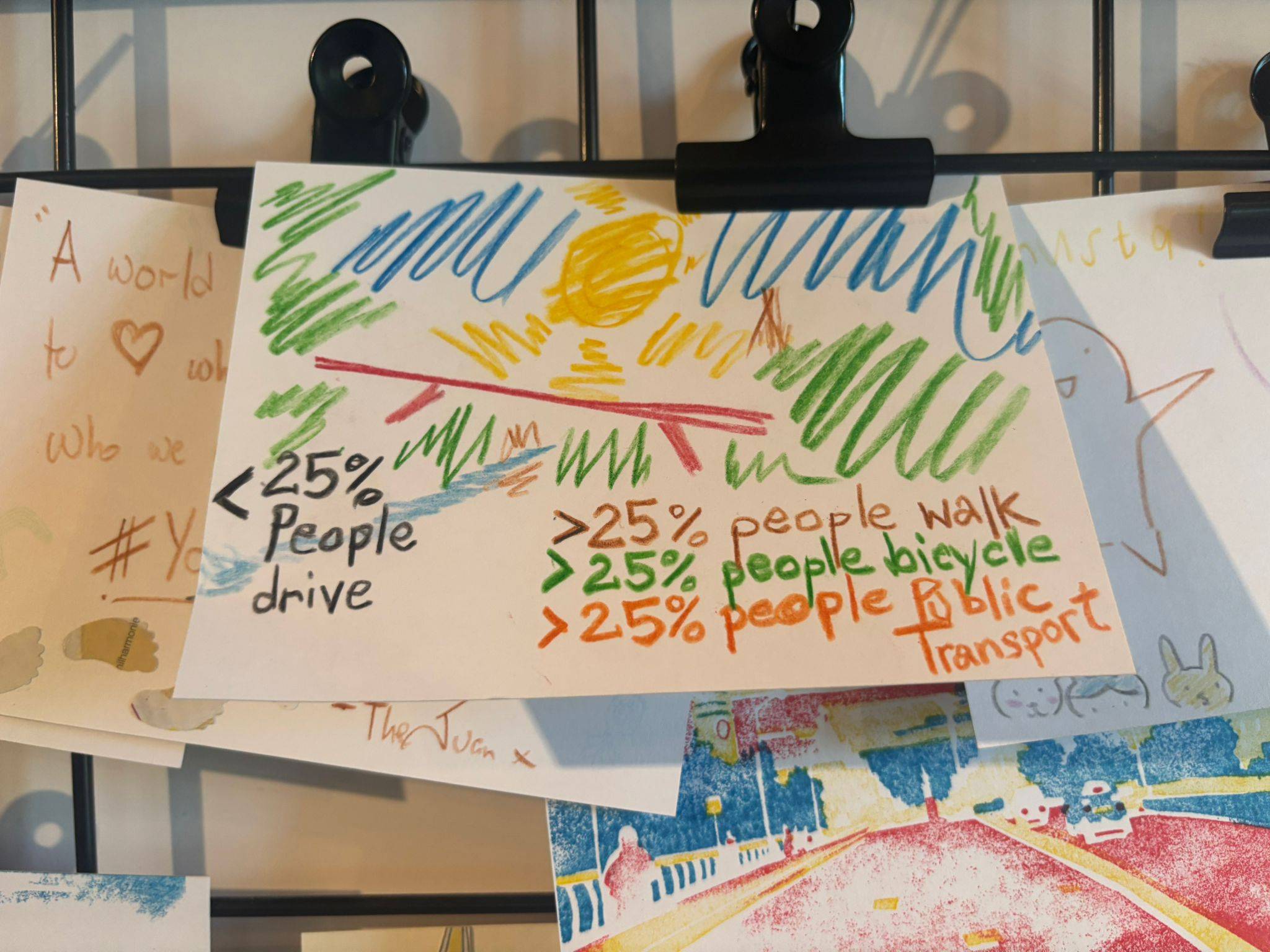
Compare: Luxembourg invested €750 million to cut through our largest forest . . . to cement car-dependent sprawl. The Netherlands invested in bicycling superhighways where 5,000-10,000 people per hour flow smoothly without emissions.
Which choice grows bio-capacity? Which erodes it? What could have been built?
I often visited the forests in Mersch + Schoenfels before the tunnel was carved into the hillside . . . before the auto-route’s 24-7-365 congesting cars + trucks’ noise-+-air pollution.
From the forests’ ridges, you could hear the river and the wind. You could re-charge in the power of a living landscape.
Today, in the same places, you hear Noise Pollution from tires + engines reverberating through the tunnel, bridges, highways . . . and across the valley. A few years ago, I bought my cargo bicycle at the locally owned shop in Schieren. I often pedal the path that parallels the motorway . . . past the Grand-Ducal château in Colmar-Berg. Two choices side-by-side: the rhythm of butterfly-speed Active Mobility and birdsong . . . and the noise + fumes of congestion dressed up as “business-as-usual”.
⸻
Consider:
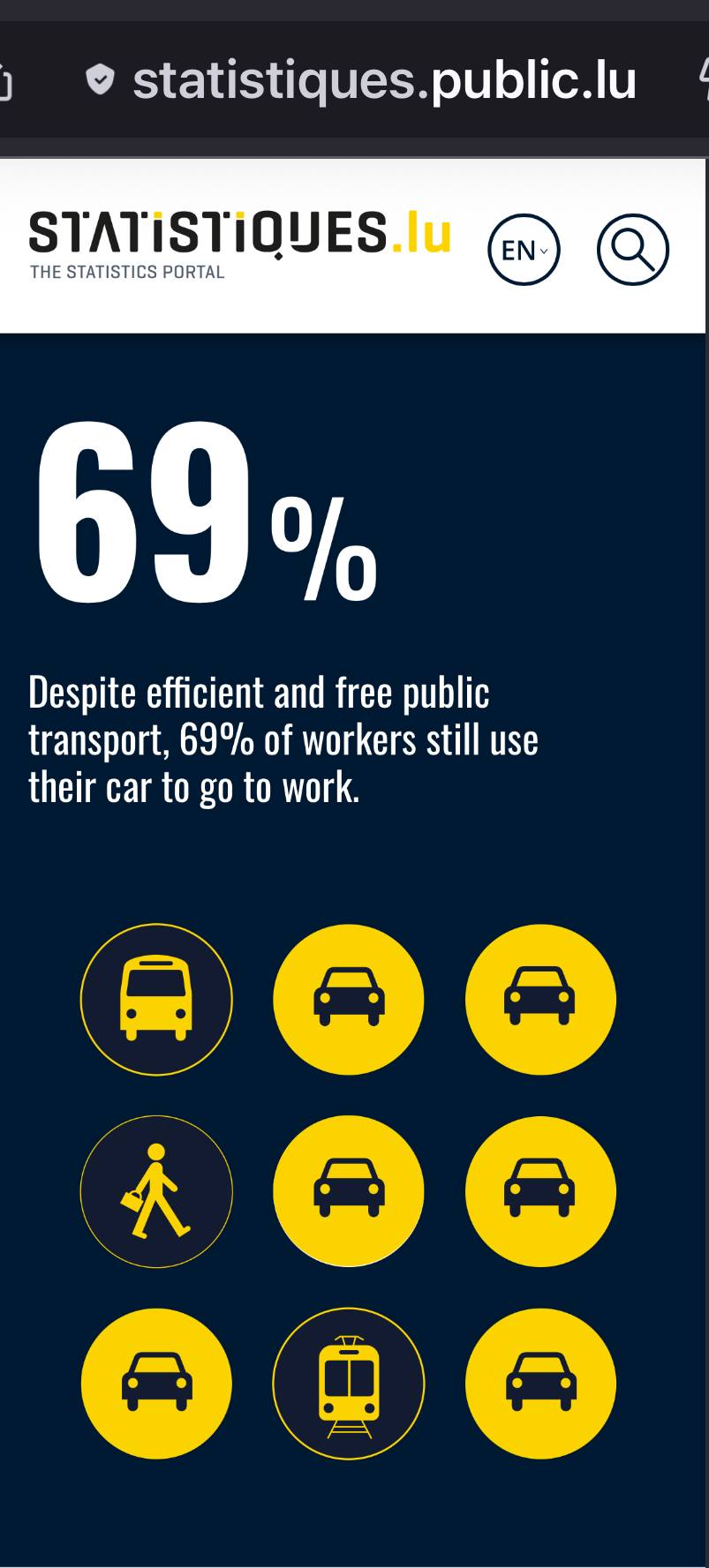
69% of employed people in Luxembourg commuted by car = 67% as drivers + 2% as passengers (Source: STATEC https://statistiques.public.lu/en/recensement/dependance-automobile-deplacements-domicile-travail.html).
The pyramid remains inverted to Healthy outcomes as the Transport-sector generates over 60% of Luxembourg’s non-ETS greenhouse gas emissions = the single largest share in Europe (source: OECD – OCDE 2025 Survey https://www.oecd.org/en/publications/2025/04/oecd-economic-surveys-luxembourg-2025_3eb782b5/full-report/managing-the-green-transition_8dafc271.html).
National emissions stood at 8.2 million tonnes CO₂-equivalent in 2022 and reached 14.5 tonnes of carbon dioxide equivalent (tCO2e) in 2023 (sources: European Commission https://climate.ec.europa.eu/document/download/49154181-7038-4454-8870-650448d9642c_en?filename=lu_2023_factsheet_en.pdf + European Parliament https://www.europarl.europa.eu/RegData/etudes/BRIE/2025/769560/EPRS_BRI(2025)769560_EN.pdf).
Nearly two-thirds of that comes from petrol and diesel vehicles (source: Ministry of Mobility & Public Works https://transports.public.lu/fr/planifier/strategie/modu2.html/).
Many questions brewing . . . including:
What would Melissa + Chris Bruntlett see? What would Lotte Bech + Gehl – Making Cities for People see?
Along Luxembourg’s motorways, Noise Pollution often exceeds 65–70 decibels . . . far above the European Union‘s harmful thresholds of 55 dB Lden (day-evening-night) and 45 dB Lnight (night) set by the EU Environmental Noise Directive (2002/49/EC) (source: European Union: https://eur-lex.europa.eu/legal-content/EN/ALL/?uri=CELEX%3A32002L0049).
Vehicular Traffic carries chronic disease risk into every household and habitat along its path. Household budgets stretched by car-ownership are a tax on Decency. Asphalt and concrete are a tax on climate budgets. Induced trips are a tax on time itself.
The invoice is itemizing, and . . . the invoice is enormous. The fundamental question being answered in Liveable Communities around the world: What could have been built to pollinate Decency? For starters:
• Supercycling highways: high-quality Dutch & Denmark bicycling-style networks from Ettelbrück, Diekirch, and Mersch into Kirchberg could have moved thousands of people per hour at a fraction of the cost of the autoroutes, tunnels, parking and crashes. Here are a few high-quality YouTube Q&As including:
- These are common in Dutch & Danish cycle networks. Why? https://www.youtube.com/watch?v=4gzHL9KzFPQ&pp=ygULI2VkZ2VvZnJvYWQ%3D
- COPENHAGEN: A Cycle Path Less Traveled Tour with City Staff https://www.youtube.com/watch?v=sTT1_8bjyAI
- Copenhagen Cycle Super Highways https://www.youtube.com/watch?v=wiGIxPz5yg8
- The Netherlands Bike Highways | NL by Bike – Day 6 https://www.youtube.com/watch?v=1SnPkIF8v1c&vl=en
- The Best-Designed Town in the Netherlands (and therefore the World … https://www.youtube.com/watch?v=r-TuGAHR78w
- Google-Search results for these videos: https://www.google.com/search?client=firefox-b-d&sca_esv=445b876859e41926&sxsrf=AE3TifMvtWul94BGpX7lfihj5RgqOEgHXA:1758717533440&udm=7&fbs=AIIjpHxU7SXXniUZfeShr2fp4giZud1z6kQpMfoEdCJxnpm_3W-pLdZZVzNY_L9_ftx08kxc57ZOWlwIFHRsU-MNpN0eXXFMUMYgS3kEgOpXQF1UFvzXFmqs5T6foogVpAnTQlj4V-flmQUk-gkHeGMeApYodCJFcnui07HVg3AA_Xjwc5ygkJNiKxX-ukHC5yftM-QSRXSK&q=high-quality+Dutch+and+Denmark+cycling+superhighways,+active+towns,+youtube.com&sa=X&ved=2ahUKEwjW89yutfGPAxVYhv0HHZrKGe8QtKgLegQIFhAB&biw=1157&bih=1245&dpr=2#ip=1
• Luxembourg Ministry of Mobility’s surveys show 83% of residents want bicycle paths separated from traffic + 77% want continuous routes without dangerous gaps + No lack of willingness among the population to cycle + Lack of good cycling infrastructure = This is latent demand waiting to be unlocked (source: Ministry of Mobility https://transports.public.lu/en/se-deplacer/cyclistes.html).
• Public Transport as the multi-modal backbone: 99.5% of Luxembourg residents live less than one kilometer (< 1 km) from a Public Transport stop. CFL – Société Nationale des Chemins de Fer Luxembourgeois carried 31.3 million passengers in 2024 (source: RTLToday https://today.rtl.lu/news/luxembourg/a/2267776.html). CFL’s Pfaffenthal-Kirchberg station alone serves over a million annual movements and provides secure cycle parking. Regional trains running every 15 minutes with full bike integration could have made Ettelbrück 20-minutes away . . . algorithming health, wealth, joy and time . . . without adding noise to the forest.
• Public money where the people are: Luxembourg spends about €52–53 per person annually on cycling at the national level (source: European Cyclists’ Federation‘s The state of national cycling strategies in Europe (2024) PDF https://www.ecf.com/media/resources/2024/The-State-of-National-Cycling-Strategies-in-Europe-2024_ECF_final%20241212.pdf). Imagine if such investments had been scaled holistically . . . over the last 30 years? The modal split . . . and our Obesity + Diabetes + Cancer + Cardiac Arrest risks . . . would look very different today: about 45% of people aged over 65 in Luxembourg report living with more than one chronic condition. This is well above the EU average, especially for men, and may reflect a better rate of diagnosis and awareness. However, a higher proportion of women (28%) than men (20%) in Luxembourg report having limitations in daily activities. Data from the European Health Interview Survey
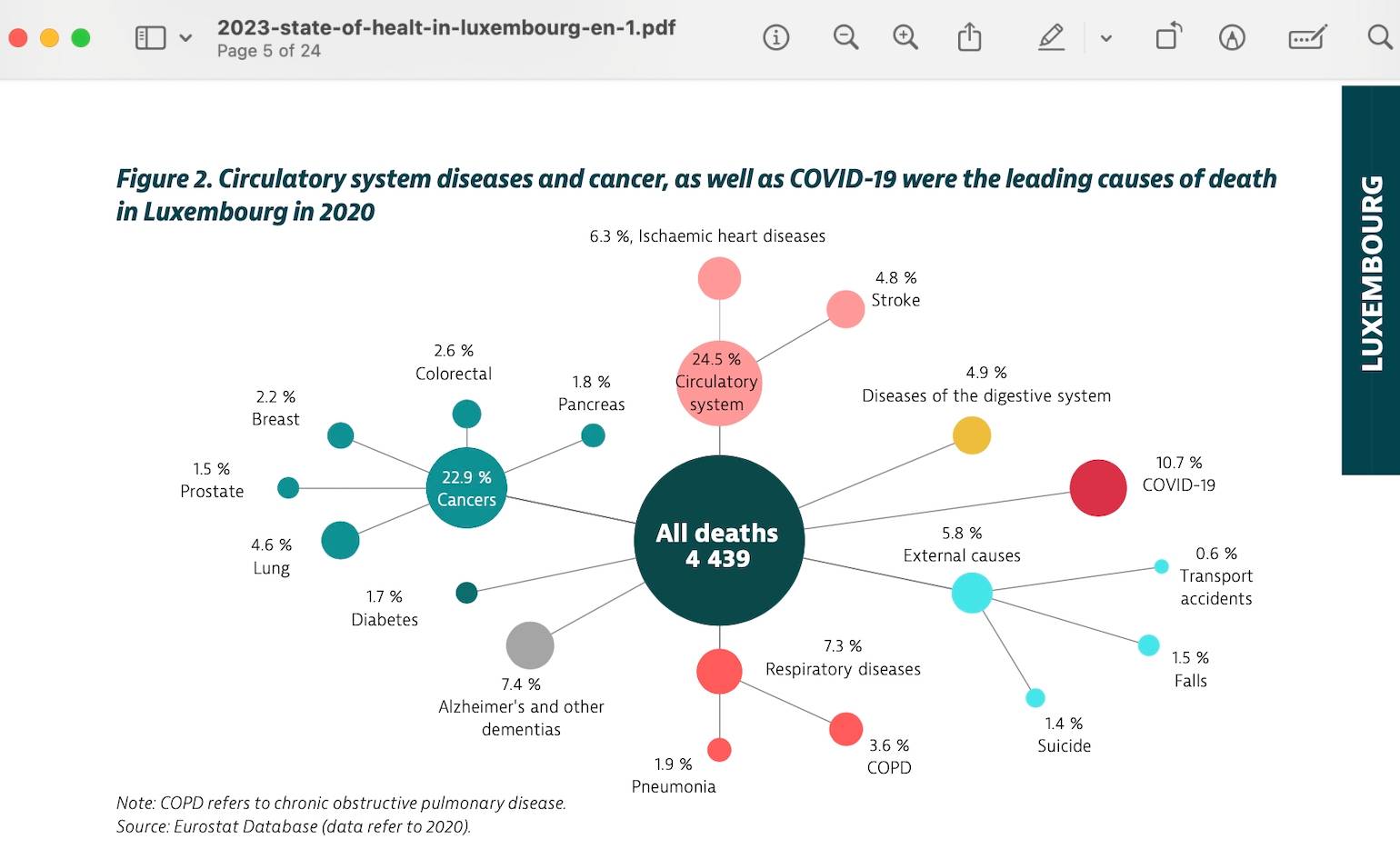
(EHIS) show that 10% of people in Luxembourg reported having depression (compared to the EU average of 7%) in 2019. Among the 7 Key Findings in the “State of Health in Luxembourg”: Over one third of all deaths in Luxembourg in 2019 could be attributed to behavioural risk factors, including smoking tobacco, dietary risks, alcohol consumption and low physical activity (source: Eurostat + OECD – OCDE: https://santesecu.public.lu/dam-assets/fr/publications/s/state-of-health-luxembourg-2023/2023-state-of-healt-in-luxembourg-en.pdf).
• Incentivizing Active Mobility per kilometer: Luxembourg must adopt . . . and expand universally Belgium’s private-employer tax-exempt bicycle allowance . . . which was raised from €0.27 per kilometer to €0.35 per kilometer . . . since 1st January 2024 (source: KPMG Belgium‘s update https://kpmg.com/be/en/home/insights/2024/02/ppl-bike-allowance-and-company-bikes-in-2024-important-updates.html). What if we in Luxembourg expanded Belgium’s €3,500 ceiling on an annual basis? What if we in Luxembourg maintain what works: if the ceiling is exceeded, the balance is subject to withholding tax and social security contributions. At tax return level, this ceiling is checked again, for example if the employee has worked for several employers. In other words, someone who commutes to the office by bicycle every working day can ride up to 47 kilometers round trip tax-free, considering 210 days of commuting. The likelihood that an employee reaches this limit will therefore be relatively limited. If the employee covers more kilometers, they can still receive a bicycle allowance, but it will no longer be tax-free.
• Holistic & Life-long Active Mobility as Games programs: Luxembourg must act now to build a holistic, lifelong Active Mobility as Games program . . . from balance bikes in preschool to Cycling Without Age rides for elders. We can no longer leave bicycling culture to chance . . . and further fragment it by age groups. Children must grow up mastering the joy and safety of cycling through bicycle games, traffic playgrounds, and safe school routes. Schools, Day-care centers, after-school programs, universities, workplaces, and retirement communities must weave bicycling into everyday identity, while municipalities coordinate across health, environment, and education. And for older generations, Luxembourg must guarantee “the right to wind in your hair” by scaling up Cycling Without Age. The task is clear: make active mobility a cultural inheritance, one that strengthens health, joy, and dignity across every stage of life—and set a standard for Europe to follow (source: Cycling Games https://www.cyklistforbundet.dk/english/cycling-games and Denmark’s National Bicycle Strategy PDF http://www.trm.dk/media/qkfpoagy/engelsk-cykelstrategi-til-web.pdf and Cycling Without Age: https://cyclingwithoutage.org/).
– – – – –
A personal note: Last night here in Luxembourg, the rain was pouring (https://today.rtl.lu/news/luxembourg/a/2339514.html) when I pedaled from my home in Ville de Luxembourg‘s Limpertsberg neighborhood . . . up to Terra (https://terra-coop.lu/en/), the community-supported farm on the Eicherfeld plateau . . . for my weekly groceries pick-up. My tweed raincoat was soaked; my full-face visored motorcycle helmet gleamed with raindrops . . . and the ride was easy . . . and joyful . . . as I passed congested car after traffic-jammed car.
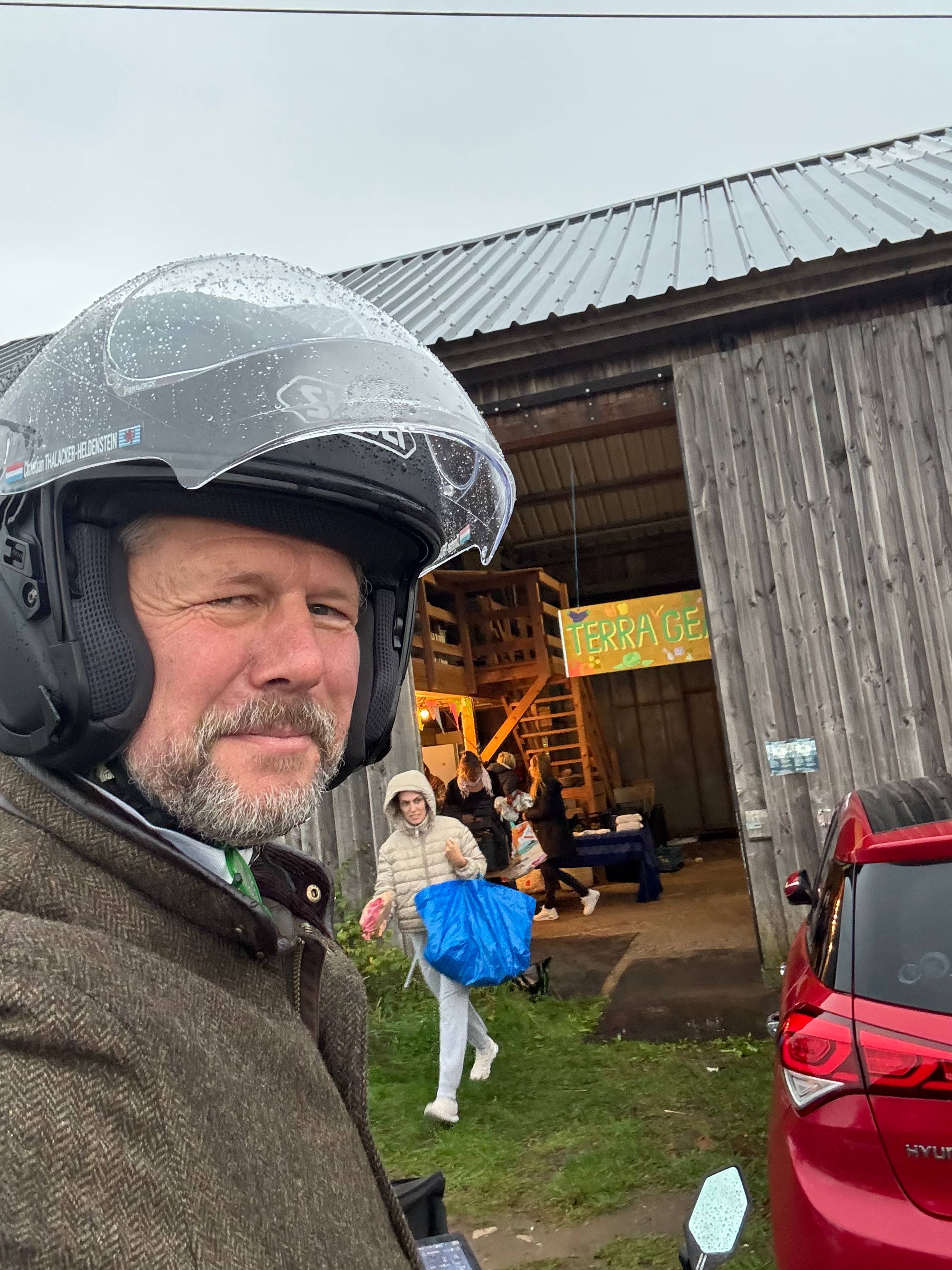
The numbers on my GPS read: 6.5 kilometers traveled to Terra, 9.3 kilometers traveled back, 136 meters of climb, 21 km/h average speed. The potatoes, mushrooms, veggies, eggs, and bread from Terra were dry in the cargo box. On the way back I even detoured a few kilometers simply because bicycling makes me happy.
As our population is always growing . . . question: what version of Luxembourg do you want to see thrive?
One where everyday trips to work, sporting events, the farm, the school, the movies, shopping, the train station are taken in rain, snow and shine without hesitation, without noise, without emissions, and without fear?
If it works for middle-aged me . . . in the rain with groceries . . . then Active Mobility 24-7-365 can work for all ages and all abilities . . . when we build the necessary high quality Public Works holistically . . . and in good faith.