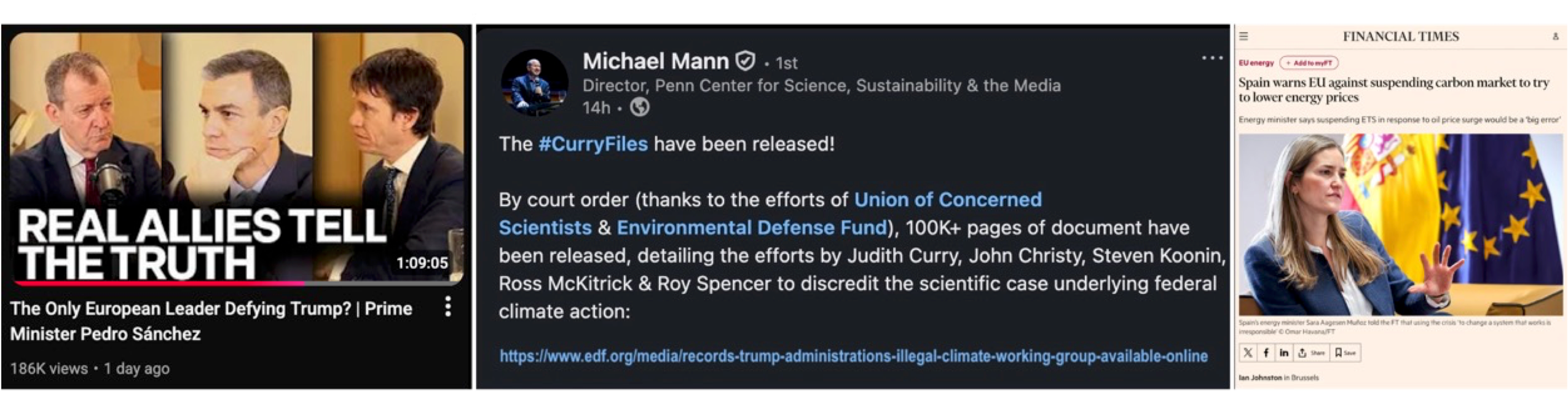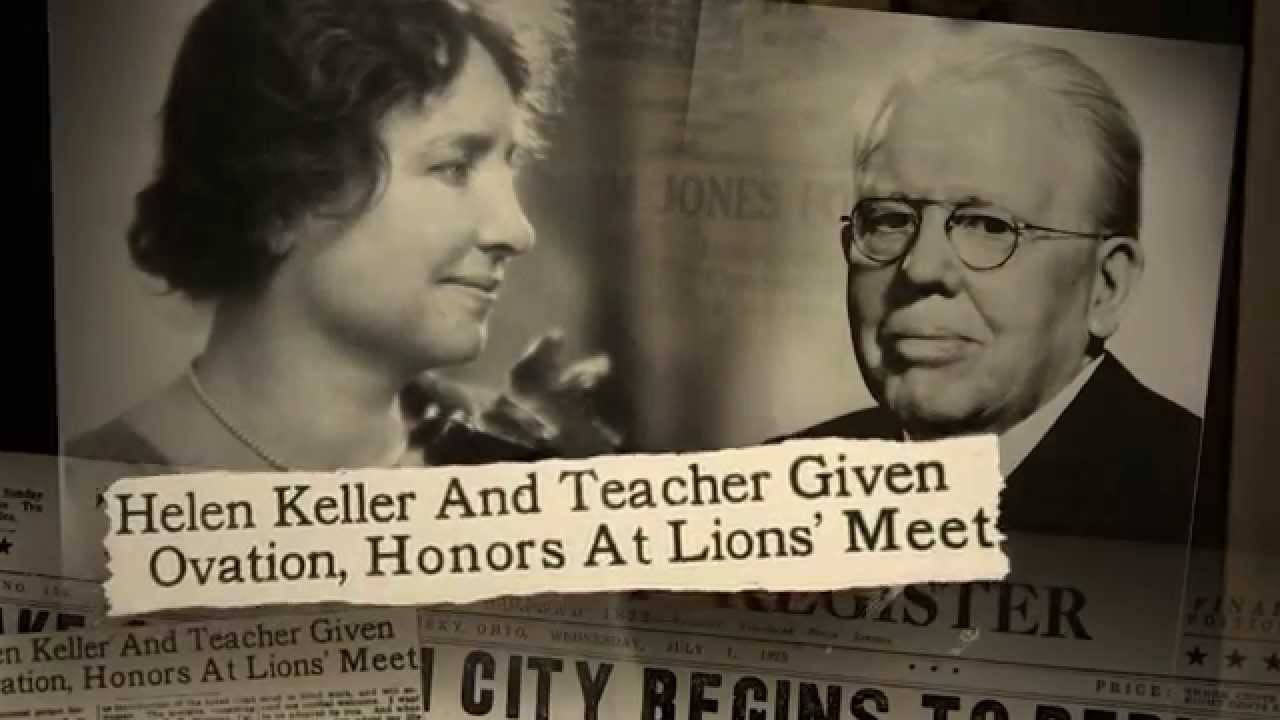
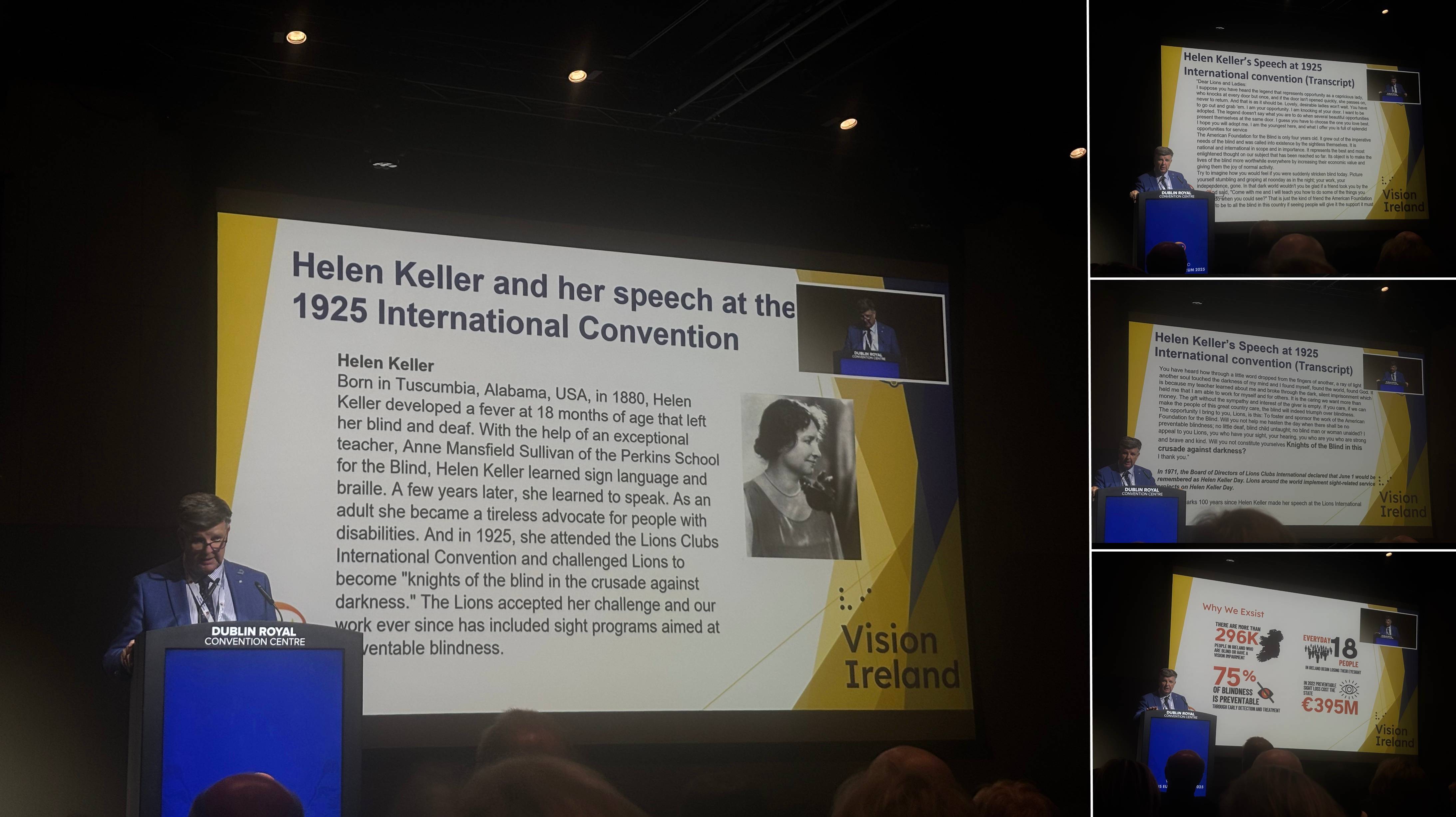
What would Helen Keller say while reading today’s two newspaper articles about the Düdelinger Wildtierstation? Here is the first article: Wildtierstation in Düdelingen . . . Wilmes und Hansen handeln endlich und das ist dringend notwendig, and here is the second article: Warum Martine Hansen und Dan Biancalana einen Bussard einfangen und Serge Wilmes Igel hätschelt (Subscription Required). Let’s look through the eyes of an expert. Last week during a keynote speech in Dublin, Kevin Whelan, Head of Foundation at Vision Ireland (formerly the National Council for the Blind Ireland) . . . did not simply present statistics. He re-told a story from 100 years ago: the story of Helen Keller issuing a challenge that would change history.
“I am your opportunity. I am knocking at your door,” Helen Keller said. “Will you not constitute yourselves Knights of the Blind in this crusade against darkness?”
One hundred years ago in a Lions Club international conference hall, the people accepted Helen Keller’s challenge. A century later, we see the legacy of that adoption in Vision Ireland. For example, the “Vision Van” which provides 15 sight-saving screenings daily across Ireland, and in the world’s first “Wayfinding Centre,” a transport training facility that has already empowered over 300 people with vision loss with the skills for independent travel. People . . . within an established and dynamic service organization . . . transformed Helen Keller’s plea into a tangible, compassionate system.
Question: is this the essential context for a needed “Hundred-Year Roadmap” for Luxembourg? Are we not facing a different, yet parallel, kind of darkness? Not of the eyes, but of perception . . . a societal blindness to our interconnectedness with the living world. The disconnection that fuels our ecological crisis is a failure to see the systems that sustain us.
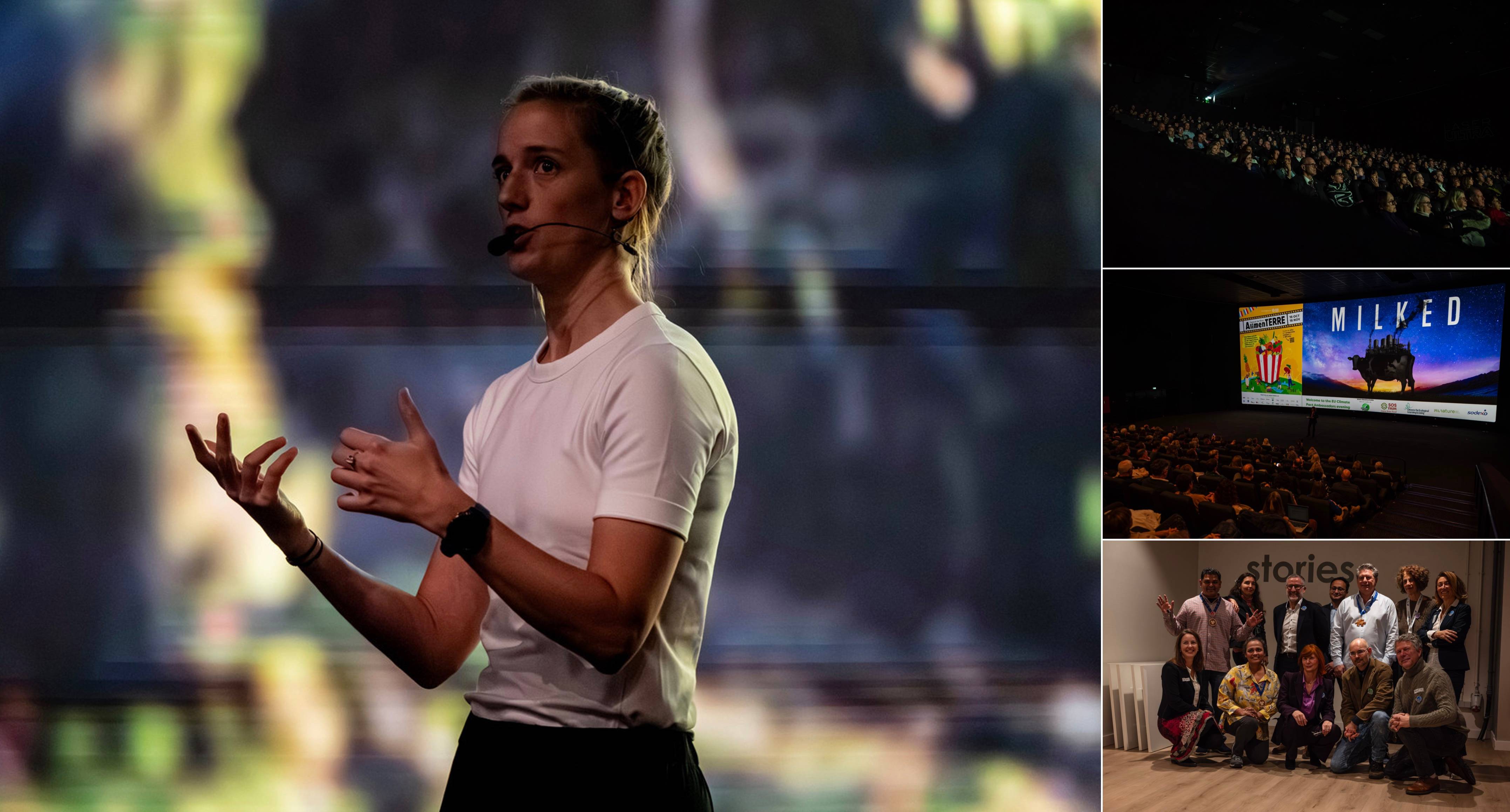
This past Wednesday evening, at the SOS FAIM and EU Climate Pact Ambassadors’ community event . . . that same theme emerged. Keynote-speaker Julie Schadeck correctly noted that all our challenges stem from a disconnection . . . from self, society, and nature. The roadmap, then, is our tool for re-connection. It is our plan to restore sight to a society that has forgotten how to see the whole.
Do you think that with Luxembourg’s strengths . . . to connect European and global cultures . . . can we now fulcrum global ecological wisdom to solve our disconnection from self, society and nature? What connections do you make . . . after reading about Helen Keller’s challenge . . . with the upgrades to the Düdelingen wildlife station . . . and with Julie Schadeck’s conversations?
How do our deep traditions of caring for the land . . . our orchards . . . and our communities . . . mirror the Chinese principle of 天人合一 (Tiān Rén Hé Yī) = the Unity of Heaven and Humanity? What examples can we borrow from our past, from China’s ecological precedents at scale and with urgency . . . and the century of service answering Helen Keller’s call . . . as we outline our own journey?
What do you see in this draft roadmap? A critic might say: “A 100-year roadmap is a utopian fantasy. It’s unrealistic and ignores the pressing economic needs of today.” Helen Keller today might respond: “is it more utopian than the alternative? The ‘pragmatic’ approach has given us 100% polluted rivers and over 80% unhealthy forests. That is the result of short-term thinking.”

- do you see rivers and water systems as the Luxembourg’s arteries?
- do you see forests and soils as Luxembourg’s lungs and long-term memory?
- do you see Agricultural landscapes as an essential interface between human need and ecological function?
- do you see indicator species . . . the hedgehog (猬), the buzzard (鵟), aquatic communities . . . as living sensors that tell us whether the system is truly healing?
The phased, interdependent nature of this recovery is clear. The dates will shift, but the underlying logic of phased healing . . . must not:
Stage 1) 2025 through 2035: The Decade of Foundations . . . Restoring the Arteries
We begin where life begins: water. China’s 海绵城市 (Hǎimián Chéngshì) “Sponge City” program provides the model. This is not just about engineering, but about rethinking land as a hydrating system. We can transform urban and rural areas into catchments that absorb, clean, and slow rainfall through permeable surfaces, green roofs, and, most critically, the restoration of wetlands and the “daylighting” of streams buried by concrete. The ‘Sponge City’ model from China isn’t “poetry”; it’s practical infrastructure that saves billions in flood damage.
Concurrently, what if our agricultural policy pivots toward the agro-ecological principles that saved the 朱鹮 (Zhūhuán) Crested Ibis? In the ibis’s home in Yang County, the government banned pesticides and promoted organic rice farming, restoring the aquatic food web. This “Ibis Rice” model proves that economic value and ecological function can be synergistic. For Luxembourg, this means a decisive shift away from systems critiqued in the documentary film Milked and toward diversified rotations, reduced inputs, and planting hedgerows that become corridors for the hedgehog (猬). This decade decides if Düdelingen is a token gesture or the prototype for a national network of ecological infrastructure. The ‘Ibis Rice’ model isn’t a niche product . . . it is a blueprint for adding value to our own self-sufficiency, resilience and agricultural exports.
Stage 2) 2035–2045: The Decade of Reconnection . . . Healing the Lungs
With improving water quality and soil health, we can apply the second major lever: our forests. The work of scientists like Professor Jiang Zhigang (蒋志刚) of the 中国科学院 (Chinese Academy of Sciences) shows that restoring key species restores ecosystem function. His work on the 野马 (Yěmǎ) Przewalski’s Horse demonstrates how a single herbivore can reshape the steppe, improving vegetation and water infiltration. From zero to over 300 horses in the Kalamaili Nature Reserve, the project didn’t just save a species; it restored the biocapacity of the entire landscape. Inspired by this, we must transition our maize+ monocultures into structurally diverse, climate-resilience. This involves reintroducing native flora and managing for complexity, not just timber yield. The hedgehog population, rigorously tracked, becomes our quantitative narrative: a living graph of whether landscape permeability is truly improving.
Stage 3) 2045–2055: The Decade of Resilience . . . The System Begins to Self-Heal
By mid-century, the positive feedback loops become visible. Forests, now healthier, function as powerful hydrological sponges, dampening floods and supporting river flows during droughts. This is a core benefit documented in China’s 天然林保护工程 (Tiānrán Lín Bǎohù Gōngchéng) Natural Forest Protection Program.
The buzzard (鵟) and other avian predators become commonplace, signalling that the trophic structure . . . from insects to small mammals to apex predators . . . is being rebuilt from the bottom up. What were once “conservation projects” start to feel like the everyday operating system of the country.
Stage 4) 2055–2125: The Half-Century of Maturity . . . Governing for Continuity and the Abundance of Maturity
The second half of the century is less about launching new initiatives and more about stewarding a mature, resilient system. Luxembourg could stand as a European micro-laboratory of 生态文明 (Shēngtài Wénmíng) Ecological Civilization . . . where:
- Rivers are not just legally “good status” but are ecologically complex, self-purifying ecosystems.
- Farmland feeds people while acting as a carbon sink and a habitat matrix.
- Forests protect towns from heat and storms instead of being vulnerable liabilities.
And in our gardens, parks, and field edges, the hedgehog is once again “unremarkable” . . . which is the highest compliment an indicator species can receive.
So . . . What Would Helen Keller Say . . . today . . . in Luxembourg? Maybe . . . something like this:
Dear Friends, Colleagues, and Fellow Guardians of Life,
You have heard the legend of Helen Keller, who called on the Lions to be Knights in a crusade against blindness. A century later, I stand before you not as a single opportunity, but as a voice for a multitude of opportunities that are knocking. They are the hedgehog, the buzzard, the polluted river, the unhealthy forest, the degraded soil. They are all asking to be adopted.
The legend doesn’t say what you do when an entire planet of beautiful, desperate opportunities presents itself at your door. I guess you have to choose to love them . . . all.
You have heard how through a connection to nature . . . a word dropped not from fingers, but from the beak of a bird, the rustle of a hedgehog in the leaves . . . a ray of light can touch the darkness of a disconnected mind. We can find ourselves, find the world, find the divine, in that re-connection. It is because teachers like Professor Jiang learned about the horse and broke through the silent imprisonment of the degraded steppe that a functioning ecosystem now works for itself and for others.
It is the caring we want more than mere sentiment. The pledge without the science, the policy, and the sweat of the giver is . . . empty. If you care, if we can make the people of this great continent care, life will indeed triumph over ecological blindness.
The opportunity I bring to you, Youth4Planet, is this: To foster and sponsor the work of the restorers everywhere. Will you not help me hasten the day when there shall be no preventable extinction . . . no little child growing up without experiencing the wonder of a buzzing, blooming, thriving natural world . . . no degraded ecosystem unaided?
I appeal to you . . . you who have your strength, your voice, your intellect, you who are brave and kind. Will you not constitute yourselves Guardians of the Living in this crusade against indifference? A critic might say: “This ‘Knights’ and ‘Guardians’ language is overly dramatic and alienating. We need practical solutions, not crusades.” You are right that the language is bold. I believe the moment demands it. The team at the Düdelingen station, who have been ‘Wurschteln’ . . . making do with sub-standard conditions to protect our national health . . . are not just employees. They are Guardians. Helen Keller a century ago would have honored them with the title: ‘knights’ . . . and thereby trying to give them the respect and recognition they deserve. What could be more practical, and more Luxembourgish . . . than an open invitation to everyone: the farmer planting a hedgerow . . . the student monitoring water quality . . . the policymaker securing long-term funding . . . to see themselves as essential heroes in a shared, vital mission? A critic might say: “Focusing on hedgehogs and buzzards is a sentimental distraction from human needs.” I understand that perspective, but it is based on a dangerous illusion. The hedgehog is not the goal. The hedgehog is the measuring stick. When the hedgehog population collapses . . . it is a signal that our landscape is fractured, our soils are poisoned, and our insect life . . . the foundation of our food web . . . has collapsed. This is not a sentimental issue. This is a public health and food security issue. The buzzard is not a distraction. The buzzard is a report card. The buzzard’s return signals that the entire system . . . from the insects it preys on to the health of the small mammals in the fields . . . is recovering. This roadmap uses these species as our most honest, non-political advisors. They tell us the truth about whether our actions are truly making Luxembourg healthier for all its inhabitants, humans included.
I thank you.
This rough roadmap is a work invitation . . . written for the weavers and the warriors of re-connection.
- For the students and youth: your critical reflection is needed. You will answer the call to become Guardians of the Living. You will build the systems that make this roadmap real.
- For the community builders: the CELL coaches, the Climate Pact Ambassadors . . . your role is to nurture the “sparks” of connection. You are the weavers of the social fabric that must underpin this transformation.
- For researchers in China and practitioners at Vision Ireland: your work proves that massive, systemic change is possible. Let us combine your wisdom with our emerging European movement.
- For policy-makers: the legacy of the service . . . and the vision of the young . . . are your mandate. A hedgehog clinic is not a Public Relations story. A hedgehog clinic is a forward operating base in this century-long crusade.
Let the released buzzard (鵟) stand as our symbol of possibility. Let the hedgehog (猬) be our symbol of obligation. Let Helen Keller’s words and the re-wilded horses of the steppe remind us that a single, courageous appeal, backed by science and sustained action . . . can illuminate the world.
If 天人合一 (Tiān Rén Hé Yī) is to mean anything here, it will be because we learned to weave its principles into the enduring legacies of our place, supporting the institutions, landscapes, and daily habits that have always, quietly, embodied it.
The mission is clear. Let’s get to work.
Questions? Would you like to discuss? Contact Youth4Planet’s C.A.T. (Climate Action Tiger) and Y4P Ambassador Christian Thalacker for feedback: christian@youth4planet.org
Further reading:
- An Update on Status and Conservation of the Przewalski’s Horse (Equus ferus przewalskii): Captive Breeding and Reintroduction Projects; Mardan Aghabey Turghan, Zhigang Jiang, Zhongze Niu; https://pubmed.ncbi.nlm.nih.gov/36428386/
- Understanding Recovery Is as Important as Understanding Decline: The Case of the Crested Ibis in China; by Xinhai Li, Jiayu Fu, Tianqing Zhai, Yazu Zhang, Michael W. Bruford, Yuehua Sun and Xiangjiang Zhan; https://www.mdpi.com/2073-445X/11/10/1817
- Vision Ireland’s “Vision Van” & “Wayfinding Centre”. www.visionireland.ie Study how a 100-year-old call to action was translated into a modern, mobile, and empowering service system. This is the operational model for community-centric care.
- Keller, Helen (1925): Full Transcript of her speech to the Lions International Convention. Read it in its entirety. The power, humor, and strategic clarity are a masterclass in advocacy; https://afb.org/about-afb/history/helen-keller/books-essays-speeches/afb/address-lions-clubs-international
- natur&ëmwelt Annual Reports & Position Papers; Understand the specific challenges and victories on the ground from the people living this work daily; www.naturemwelt.lu
- Julie Schadeck (the General Manager of UNature); https://www.unature.org/en/nature-reconnection
- Festival AlimenTERRE festival returns for its second edition, from 16 October to 16 November 2025, throughout Luxembourg; in Luxembourg, SOS Faim organised the first AlimentERRE festival in autumn 2024. In 2026, do you want to organize a screening in your association, your municipality, your school or your company? Join the movement! See you here: https://festivalalimenterre.lu/