
What becomes visible this spring, as one looks carefully enough, is not merely a sequence of events . . . but a sequence of scales: at the BNE Days 2026 in Luxembourg, the scale was national, pedagogical, almost deceptively modest. Yet the architecture was unusually ambitious. Three pillars . . . networking, training, youth. A public-facing day with more than 65 interactive stands. Certified teacher training extending beyond the fair itself. More than 70 youth activities distributed across the country. Ministries, schools, NGOs, public agencies, youth actors, educators . . . all temporarily operating inside the same field of reference. This was not just an event calendar. It was an attempt to build a learning ecosystem.
For ministries, municipalities, schools, and institutions across Luxembourg, the invitation is therefore straightforward. If you are working on a piece of the transition . . . whether that is curriculum design, urban mobility, public health, or climate strategy . . . consider opening that work to a co-creative layer that includes Youth4Planet. Not as observers. Not as communication amplifiers. But as participants in the design process itself. Because what was briefly visible during the BNE Networking day was not expertise alone . . . it was the alignment of perspectives. And alignment, once experienced, can be intentionally reproduced. I repeat: what was briefly visible during the BNE Networking day was not expertise alone . . . it was the alignment of perspectives. And alignment, once experienced, can be intentionally reproduced.
Here are abridged transcriptions from the following Ministers who thanked and challenged all present to engage in sustainable development:
Minister of Education Claude Meisch: We have come together here to present once again the wide range of educational offerings that are being brought into schools . . . to children and to young people. Above all, this moment is about networking . . . ensuring that the many good ideas already developed across Luxembourg can inspire others . . . that partnerships can emerge . . . and that schools can better understand what already exists and how these initiatives can be integrated into their own environments. This reflects a central ambition of education for sustainable development . . . to build a growing community . . . a true BNE family that continues to expand. Topics such as sustainable development are becoming increasingly important . . . for helping young people understand the world . . . how it functions . . . how conflicts arise . . . and how global challenges must be addressed. That is why we are strengthening these themes within our schools . . . while also bringing students beyond the classroom . . . into real-world contexts where they can experience and apply what they have learned. In primary education, we have now formally embedded a number of subjects into the curriculum . . . including education for sustainable development. We have also created the necessary time within the timetable to work meaningfully on these topics. This makes initiatives like those presented here today essential . . . they allow schools to fill that time with concrete, impactful activities. In the years ahead, schools will increasingly seek partnerships with associations and organizations . . . to bring these transversal subjects to life. And even more importantly . . . we must bring students directly into these activities . . . so they can experience firsthand what it means to engage in sustainable development. For that, I would like to express my sincere thanks . . . not only for your presence today . . . but for your daily commitment to education and to a more sustainable future.
Minister of Foreign Affairs, Development Cooperation and Humanitarian Affairs Xavier Bettel: Together with NGOs, you are doing essential work . . . raising awareness, fostering understanding, and helping people engage with complex global issues. Today, even very young people are exposed to an overwhelming amount of information. Where we once turned pages to inform ourselves, we now scroll . . . often without distinguishing between journalism, propaganda, and social media. This makes critical thinking more important than ever. And that critical thinking must begin early. We must inspire young people . . . even in areas where previous generations may not yet be fully engaged. As I walked through the exhibition today, I saw many associations demonstrating that things can be done differently. Yet we must also recognize that people are often resistant to change . . . whether in their habits, their consumption, or their daily behavior. That is why I am particularly pleased that we are working toward creating a “Maison de la coopération” . . . a space that is not a traditional administrative building, but a living place . . . with exhibitions, dialogue, and everyday interaction . . . where people can reflect and ask themselves . . . “Could things be done differently?” It is often more difficult to convince adults than young people. But children who are convinced can become powerful multipliers . . . influencing families, communities, and even municipalities. We must never underestimate that power. Together with Claude Meisch and Serge Wilmes, we are committed to giving young people the tools to face the challenges of tomorrow. Because the decisions we fail to make today . . . they are the ones who will bear the consequences. If we fall short in environmental protection, in cooperation, in education . . . they will pay the price. Awareness is not about convincing those who are already convinced. It is about reaching those who are not yet engaged. Each person, through their daily behavior, can be part of the solution . . . or, if nothing changes, part of the problem. There is no Planet B. There is only Planet A. And we must also recognize a fundamental reality . . . not everyone in the world has the same opportunities in life. Whether North or South . . . regardless of gender, origin, religion, or identity . . . inequality remains a defining challenge. That is why awareness and education are so essential. Even small efforts may not transform the world overnight . . . but they can help create a more balanced and just future. Thank you.
Minister of the Environment, Climate and Biodiversity Serge Wilmes: Many key points have already been made . . . but I would also like to express my sincere thanks for your work in anchoring sustainability within our society. Earlier today, I met with young civil servants from across Europe who are working to integrate sustainable development into public administration. One thing we all recognize is that the concept of “sustainable development” is not always easy to grasp. That is why it is so important to translate it into concrete, achievable goals. You represent the people who are making this happen in Luxembourg. This is my third time attending, and I continue to be impressed by the diversity of initiatives and by the dedication of those who carry them forward throughout the year. The government fully supports these efforts . . . including through new tools that showcase the breadth of BNE initiatives. At the same time, strengthening networks is essential, because many people are still unaware of what already exists. Education plays a central role here . . . teachers, students, and schools are key actors. What young people understand today about sustainability . . . and how they live it . . . will shape the next generation. But this knowledge has not yet reached everyone. That is clear from the many conversations we have here. We must therefore continue and intensify these efforts. As the Ministry of the Environment, we are working closely with the Ministry of Education . . . as well as with Cooperation and Foreign Affairs . . . because sustainable development is a global responsibility. The 17 Sustainable Development Goals of the United Nations are not abstract ideals . . . they are global commitments that we implement here in Luxembourg. You can continue to count on our support. Thank you again for your commitment.

After the BNE Summit . . . the 3-Day ChangeNOW Summit 2026 in Paris: the scale widened from the national to the planetary: at ChangeNOW’s Youth Parliament 2026 session . . . which was moderated less like a panel than like an invitation to democratic re-imagination . . . Steffi Bednarek, Louis Grego, and Rob Hopkins offered something that most climate discourse still lacks: not optimism, exactly, but permission to imagine credible futures again. Rob Hopkins argued that movements cannot survive on grief and critique alone; they also need what he called “evidence-based dreaming”: grounded ways of helping people experience that other futures are possible. Bednarek added an essential warning: in a complex living system, the goal is not to impose one perfect future from above, but to cultivate healthier relationships in the present from which better futures can emerge. For Youth4Planet, this is more than a philosophical aside. It is a strategic instruction. The task is not simply to inform youth about the world they are inheriting, but to create spaces where they can rehearse different ways of inhabiting it . . . through stories, dialogue, experimentation, film, mobility, and collective action. That is how new democratic muscle is built. Not by waiting for a better narrative to arrive . . . but by practicing one into existence.

Day 1 opened with Johan Rockström and the language of limits, tipping points, and planetary boundaries. The message was stark . . . the Earth system is no longer something humanity is simply pressuring. It is something humanity is beginning to destabilise. Yet the day did not stop at diagnosis. It moved immediately into adaptation, fossil fuels, information integrity, alternative economic models, women-led change, faith, oceans, and the architecture of transformation. The structure itself made a point. Climate is not one issue among others. It is the condition under which all other issues must now be rethought.
Day 2 deepened that insight. If Day 1 was diagnosis, Day 2 was implementation under pressure. Water, living soils, regenerative agriculture, African futures, cities, sufficiency, inclusion, refugee realities, transport, the built environment, and the increasingly uneasy question of whether markets can actually value what life depends on. The programme kept circling back to one underlying truth . . . the transition is not only a technological task. It is a design task. How do we reorganise cities, food systems, capital, public legitimacy, and everyday habits quickly enough to remain within a habitable world? That question belongs as much to Luxembourg’s classrooms as it does to Paris’s stages.
By Day 3, the summit turned even more inward . . . and, in a way, more honest. Finance within planetary boundaries. Boards that must be convinced. Extraction versus regeneration. War, climate, and decolonised crisis. Mental health in a world under tension. Indigenous and cultural heritage. Youth parliament. Information disorder. Debt traps. Career redefinition. Education for impact. Narrative, hope, and finally Olivier Goy in the closing ceremony, speaking of fragility, dignity, and the imperative to act now. By then the summit had quietly made its deepest admission . . . this is not only a crisis of emissions. It is a crisis of meaning, governance, coherence, and courage.
This is why BNE and ChangeNOW should not be understood as separate worlds. One is not “local education” while the other is “global strategy.” They are, in fact, consecutive layers of the same system. ChangeNOW asks the largest possible questions . . . about the future of capitalism, democracy, sovereignty, truth, land, water, and peace. BNE asks whether a society is building the human capacity to live inside those questions without retreating into passivity or cliché. A classroom workshop on circular economy. A biodiversity stand. A repair café. A youth filmmaking process. A sustainability training for teachers. These may appear small beside planetary panels on finance and tipping points. But they are not small. They are pre-political infrastructure. They are where a society learns whether it can metabolise complexity.
That is where Youth4Planet matters: not as an ornament to the transition . . . but as connective tissue inside it: because the deepest problem now is not that solutions are absent. It is that they remain stranded in separate compartments. Scientists diagnose. Policymakers regulate. Educators translate. Young people inherit. NGOs experiment. Investors hedge. Cities adapt. But the system still struggles to make these layers speak to one another with enough speed, honesty, and continuity. Youth4Planet’s opportunity is precisely there . . . to connect the pedagogical with the political, the local with the planetary, the school with the summit, the ministerial speech with the lived practice, the smartphone with the systems map.
The real challenge, then, is not scale in the abstract. It is coherence.
BNE showed what coherence can look like when a country briefly aligns its educational, civic, and grassroots energies. ChangeNOW showed what is at stake when that coherence fails to emerge at civilizational scale. One offered a prototype. The other offered a warning.
Between the two sits the real work of this generation . . . not simply to demand change, but to learn how to hold together the fragments from which change must actually be made.
Further Reading:
16th April 2026: Financial Times Journalist Ian Johnston reports that EU climate commissioner Wopke Hoekstra has warned that there is no financial “workaround” for “mind-boggling” energy price rises in Europe, and that the latest crisis shows the need to reduce dependence on imported fossil fuels through green investments. Speaking as the EU grapples with a €22 Billion price shock from the Iran war, Hoekstra said Europe was “overburdened with debt” and that countries’ weak public finances limited their ability to support citizens. He said: “The only way forward is more electrification, more nuclear, more solar, more wind, more battery capacity, more interconnectors in the European Union, and all of it with much more speed.” The European Commission is preparing to recommend widespread electrification plans to member states next week, including new rules to drive down grid charges and ensure electricity is taxed below fossil fuels. Hoekstra noted that 90% of revenue received by states from the emissions trading system does not go into “industrial transformation,” adding: “If you allow for flexibility or allow for free allowances, it makes sense to have as a quid pro quo that companies become cleaner and invest in Europe” https://www.ft.com/content/510292eb-afa1-4929-a2a8-59f5c15decc9?syn-25a6b1a6=1
Overall C.A.T. Usefulness: 10/10 ★★★★★★★★★★
Strengths: this article captures a pivotal moment in EU energy policy . . . a top official admitting that there is no shortcut out of the crisis except the transition. Its key strengths are:
- The “No Workaround” Frame: Hoekstra’s blunt admission . . . “there is no workaround”. . . is the heart of the article. The EU cannot subsidise its way out of the crisis. It cannot borrow its way out. The only solution is to reduce dependence on imported fossil fuels. This is a rare moment of honesty from a senior policymaker.
- The €22bn Price Shock: The article quantifies the crisis: the EU’s bill for fossil fuel imports has increased by €22bn compared with the period before the war. This is not an abstract number; it is a direct transfer of wealth from European consumers to fossil fuel producers.
- The “Overburdened with Debt” Reality Check: Hoekstra notes that Europe is “overburdened with debt” and that countries’ weak public finances limit their ability to support citizens. This is a direct contrast to the 2022 energy crisis, when many countries had more fiscal space. The crisis is hitting at a moment of vulnerability.
- The Hoekstra Prescription: Hoekstra’s list . . . “more electrification, more nuclear, more solar, more wind, more battery capacity, more interconnectors . . . and all of it with much more speed”. . . is a clear policy agenda. The article does not just report the problem; it reports the proposed solution.
- The ETS Revenue Critique: Hoekstra notes that 90% of revenue from the emissions trading system does not go into “industrial transformation.” This is a stunning admission. The ETS is supposed to drive investment in decarbonisation. Instead, most of the revenue is being used for other purposes. Hoekstra is signalling that this must change.
Weaknesses: except for Hoekstra’s pro-nuclear stance, the article has no significant weaknesses. It is concise, well-sourced, and strategically informed. If pressed, one could note that:
- The Missing Windfall Tax Analysis: The article notes that several finance ministers have asked for an EU-wide windfall tax on energy companies. Hoekstra says it is “legally complicated” with “significant economic side-effects.” The article does not explore these complications in depth. The reader is left to take Hoekstra’s word for it.
- The Gender Dimension (SDG 5): As with almost all energy and political reporting, the article is silent on gender. Hoekstra is a man. The finance ministers are predominantly men. The impacts of energy prices on women (who face higher fuel poverty rates) are not explored.
- The Missing 90% Detail: Hoekstra says that 90% of ETS revenue does not go into industrial transformation. The article does not specify where it does go. Is it being used for general budget purposes? For social programmes? The reader cannot assess whether this is a problem or a necessary redistribution.
Opportunities for C.A.T.: this article provides C.A.T. with a powerful statement from a top EU official:
- The “No Workaround” Frame as a Strategic Argument: Hoekstra’s admission is a gift. C.A.T. can use it to argue that the transition is not optional. There is no financial trick to avoid high energy prices. The only solution is to build a different system.
- The €22bn Figure: The €22bn price shock is a concrete number. C.A.T. can use it to quantify the cost of fossil fuel dependence. That money is leaving the EU every month. It could be invested in renewables instead.
- The “Overburdened with Debt” Reality: Hoekstra’s warning about weak public finances is a reality check. C.A.T. can use it to argue that the transition must be affordable. The EU cannot subsidise fossil fuels indefinitely. The money is not there.
- The ETS Revenue Reform Opportunity: Hoekstra is signalling that ETS revenue should be redirected to industrial transformation. C.A.T. can track whether this happens. The ETS review is due by the summer. The outcome will shape EU climate policy for years.
Threats:
- The biggest threat is that the “no workaround” message is ignored. Hoekstra is admitting that there is no shortcut. But policymakers may still try to subsidise their way out of the crisis. The fiscal space is limited. The attempt could lead to debt crises.
- A second threat is that the ETS review weakens the system. Hoekstra is “sympathetic” to heavy industry. He is open to “flexibility” on free allowances. If the review extends free allowances beyond 2034, the carbon price signal will weaken.
- A third threat is that the pro-nuclear shift comes at the expense of renewables. Hoekstra lists “more nuclear” alongside “more solar, more wind.” But if nuclear crowds out investment in renewables, the transition could slow. The article does not address this tension.
- A fourth threat is that the 90% of ETS revenue continues to be misallocated. Hoekstra is signalling that this should change. But changing it requires political will. Member states may resist losing control of the revenue.
- A fifth threat is that the electrification plans are too slow. Hoekstra calls for “much more speed.” But the Commission’s proposals, due next week, may not be ambitious enough. The gap between rhetoric and policy is a perennial risk.
Analysis Through Lenses:
United Nations Lens (IPCC/UNFCCC): From a UN climate governance perspective, this article is hopeful. A top EU official is explicitly linking the energy crisis to the need for faster decarbonisation. The “no workaround” frame is a clear statement that fossil fuel dependence is the problem. The UNFCCC process has struggled to make this case compellingly. Hoekstra is making it in real time.
EU Green New Deal Lens: For Brussels, this article is a roadmap. Hoekstra’s prescription . . . more electrification, more nuclear, more solar, more wind, more battery capacity, more interconnectors . . . is the Green Deal in action. The challenge is speed. The ETS review is a test of whether the EU can hold the line.
Draghi Report Lens: Mario Draghi’s report called for Europe to close the investment and innovation gap. Hoekstra’s call for “much more speed” is consistent with Draghi’s urgency. The €22bn price shock is a measure of the cost of delay. Draghi’s €800bn annual investment is the scale required to build the system Hoekstra describes.
Mark Jacobson Lens: Through Jacobson’s framework, this article is a vindication. Jacobson’s roadmaps for 100% renewables include all of Hoekstra’s prescriptions (except nuclear). The “no workaround” frame is Jacobson’s argument: the only solution is to build a different system. Hoekstra is not a climate activist; he is a former Shell employee and finance minister. His conversion is a signal.
SDG Ratings:
| SDG | Rating | Rationale |
|---|---|---|
| SDG 1 No Poverty | 5/10 ★★★★★☆☆☆☆☆ | Energy bills, fiscal constraints, support for citizens |
| SDG 2 Zero Hunger | 0/10 ☆☆☆☆☆☆☆☆☆☆ | Not addressed |
| SDG 3 Good Health and Well-Being | 2/10 ★★☆☆☆☆☆☆☆☆ | Not addressed |
| SDG 4 Quality Education | 1/10 ☆☆☆☆☆☆☆☆☆☆ | Not addressed |
| SDG 5 Gender Equality | 0/10 ☆☆☆☆☆☆☆☆☆☆ | Complete absence. Energy prices and fuel poverty have gendered dimensions . . . all invisible |
| SDG 6 Clean Water and Sanitation | 0/10 ☆☆☆☆☆☆☆☆☆☆ | Not addressed |
| SDG 7 Affordable and Clean Energy | 10/10 ★★★★★★★★★★ | Core focus; energy prices, electrification, renewables, nuclear |
| SDG 8 Decent Work and Economic Growth | 4/10 ★★★★☆☆☆☆☆☆ | Industrial transformation, competitiveness |
| SDG 9 Industry, Innovation and Infrastructure | 9/10 ★★★★★★★★★☆ | Core focus; grid interconnectors, battery capacity, clean tech |
| SDG 10 Reduced Inequalities | 4/10 ★★★★☆☆☆☆☆☆ | Fiscal constraints affect ability to support citizens |
| SDG 11 Sustainable Cities and Communities | 2/10 ★★☆☆☆☆☆☆☆☆ | Not addressed |
| SDG 12 Responsible Consumption and Production | 4/10 ★★★★☆☆☆☆☆☆ | Fossil fuel dependence, electrification |
| SDG 13 Climate Action | 10/10 ★★★★★★★★★★ | Core focus; transition acceleration, ETS, carbon pricing |
| SDG 14 Life Below Water | 0/10 ☆☆☆☆☆☆☆☆☆☆ | Not addressed |
| SDG 15 Life on Land | 1/10 ☆☆☆☆☆☆☆☆☆☆ | Not addressed |
| SDG 16 Peace, Justice and Strong Institutions | 5/10 ★★★★★☆☆☆☆☆ | EU governance, ETS review, state aid rules |
| SDG 17 Partnerships for the Goals | 4/10 ★★★★☆☆☆☆☆☆ | EU member state coordination, clean tech investment |
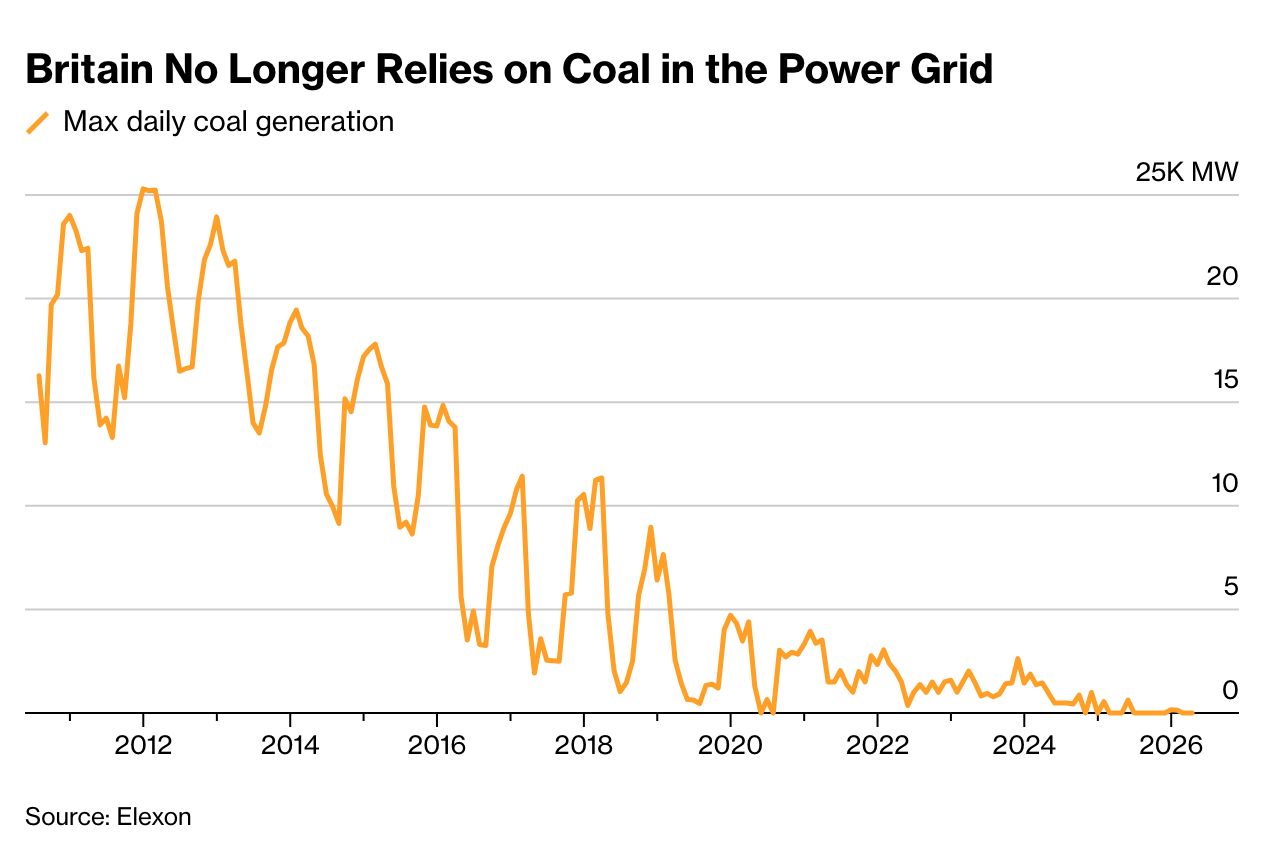
16th April 2026: Bloomberg Journalist Will Mathis reports that the UK will eliminate the Carbon Price Support (CPS), a carbon tax on gas generators and industry, from April 2028 as the government tries to slash energy bills while also decarbonizing the power grid. The mechanism, introduced in 2013, adds an extra £18 ($24.38) fee for every metric ton of carbon emissions released by power producers. Exchequer Secretary Dan Tomlinson said: “CPS has done its job and is no longer fit for purpose. With our Clean Power 2030 mission, we are already reducing our electricity system’s reliance on volatile fossil fuels and we no longer need this additional tax to provide incentives in the system to decarbonize our grid.” Since the CPS was introduced, the UK has stopped using coal to produce electricity and has dramatically ramped up renewable resources, particularly wind power. UK carbon futures rose as much as 8.5% on ICE Futures Europe following the announcement. Removing the tax brings the UK in line with the system in Europe and could increase the likelihood that Britain will link its emissions trading system to the larger EU market to avoid paying the bloc’s carbon border levy https://www.bloomberg.com/news/articles/2026-04-16/uk-to-scrap-carbon-tax-on-gas-plants-to-cut-energy-bills?srnd=phx-green
Overall C.A.T. Usefulness: 8/10 ★★★★★★★★☆☆
Strengths: this article captures a significant policy shift in the UK’s carbon pricing framework. Its key strengths are:
- The £18 Per Ton Removal: The UK is eliminating an £18 per ton carbon tax on gas generators. This is not a marginal adjustment; it is a complete removal. The article is clear about the mechanism and the timeline (April 2028).
- The “Has Done Its Job” Frame: Tomlinson’s statement . . . “CPS has done its job and is no longer fit for purpose”. . . is the government’s justification. The article reports this without endorsement, but the logic is worth examining. The CPS helped eliminate coal. The government argues that it is no longer needed because renewables are now competitive.
- The Clean Power 2030 Context: The article connects the CPS removal to the government’s Clean Power 2030 mission. The argument is that the tax is redundant because the grid is decarbonising through other means. The article does not challenge this logic, but it presents it clearly.
- The Lower Bills Frame: The government is framing the removal as a way to slash energy bills. The article notes that the cost is “paid for by generators and passed on to consumers.” Removing the tax should, in theory, lower electricity prices. The article does not estimate the impact, but the logic is clear.
- The EU ETS Link: The article notes that removing the CPS brings the UK in line with the EU system and could increase the likelihood of linking the UK and EU emissions trading systems. This is a significant geopolitical implication. A linked market would be larger and more liquid.
- The Carbon Futures Rise: UK carbon futures rose as much as 8.5% on ICE Futures Europe following the announcement. This is a market signal. Traders are betting that the removal of the CPS will increase demand for emissions permits from gas-fired power plants.
Weaknesses: the article has several weaknesses that lower its C.A.T. usefulness rating:
- The Missing Environmental Impact Analysis: The article reports the policy shift but does not quantify the emissions impact. Removing a carbon tax on gas generators will likely increase emissions from gas-fired power. How much? The article does not ask.
- The Missing Bill Impact Estimate: The government claims the removal will lower energy bills. The article does not estimate by how much. Is it £1 per year? £10? £100? The reader cannot assess the trade-off.
- The Gender Dimension (SDG 5): As with almost all energy and climate reporting, the article is silent on gender. The officials quoted are men (Tomlinson). The analysts are not identified. The impacts of energy bills on women (who face higher fuel poverty rates) are not explored.
- The Missing Coal Context: The article notes that the UK has stopped using coal since the CPS was introduced. It does not note that the remaining fossil fuel in the mix is gas. The CPS removal is a subsidy to gas, not to coal. The article could have made this distinction clearer.
- The “Has Done Its Job” Claim Unchallenged: Tomlinson’s claim that the CPS is “no longer fit for purpose” is reported without critical examination. The CPS helped eliminate coal. But does that mean it is no longer needed? Gas is still a fossil fuel. The article could have asked whether the job is truly done.
Opportunities for C.A.T.: yhis article provides C.A.T. with a case study in the politics of carbon pricing:
- The “Mission Accomplished” Frame: The government is declaring victory on carbon pricing and removing the tax. C.A.T. can use this to ask: is the job really done? Gas is still a fossil fuel. Emissions from gas are still a problem. The CPS removal is a step backwards.
- The Lower Bills vs. Higher Emissions Trade-off: The government is prioritising lower energy bills over carbon pricing. C.A.T. can use this to argue that the transition needs to be affordable. If carbon pricing makes electricity too expensive, public support will erode. The trade-off is real.
- The EU ETS Link Opportunity: The removal of the CPS could facilitate a link between the UK and EU emissions trading systems. C.A.T. can track this as a potential positive development. A linked market would be larger, more liquid, and more efficient.
- The Carbon Futures Rise as a Signal: The 8.5% rise in carbon futures suggests that traders expect higher emissions from gas. C.A.T. can use this to argue that the market understands the policy’s impact even if the government does not acknowledge it.
- The Clean Power 2030 Test: The government argues that the CPS is redundant because of Clean Power 2030. C.A.T. can track whether the 2030 target is met. If it is not, the removal of the CPS will look like a mistake.
Threats:
- The biggest threat is that the CPS removal increases emissions from gas. The carbon futures market is signalling that traders expect higher demand for emissions permits. If gas generation rises, the UK’s progress on decarbonisation could stall.
- A second threat is that the bill savings are negligible. The article does not estimate the impact. If the savings are small, the government will have sacrificed climate policy for little gain.
- A third threat is that the EU ETS link does not materialise. The article notes that the removal could increase the likelihood of a link. But linking is a complex political and technical process. It may not happen.
- A fourth threat is that the “has done its job” claim is premature. The UK has eliminated coal, but gas remains. The CPS was a tool to price carbon. Removing it sends the signal that carbon pricing is no longer a priority.
- A fifth threat is that the policy is reversed. The CPS removal takes effect in April 2028. A future government could reinstate it. The uncertainty is itself a cost.
Analysis Through Lenses:
United Nations Lens (IPCC/UNFCCC): From a UN climate governance perspective, this article is concerning. The UK has legally binding net zero targets. Removing a carbon tax on gas generators is a step in the wrong direction. The government argues that the tax is redundant because of Clean Power 2030. But the IPCC is clear: carbon pricing is a key tool for decarbonisation. Removing it sends a negative signal.
EU Green New Deal Lens: For Brussels, this article should be read as a development to watch. The UK is removing its carbon tax on gas. This could facilitate a link between the UK and EU ETS. A linked market would be positive. But the removal of the CPS also suggests that the UK is prioritising lower bills over carbon pricing. The EU must decide whether to follow suit.
Draghi Report Lens: Mario Draghi’s report called for Europe to close the investment and innovation gap. It also called for simplifying regulation. The UK is simplifying its carbon pricing by removing a redundant tax. That is consistent with Draghi’s call. But the risk is that simplification becomes regression.
Mark Jacobson Lens: Through Jacobson’s framework, this article is a mixed verdict. Jacobson’s roadmaps for 100% renewables require the electrification of everything. Lower electricity prices (from removing the CPS) could accelerate electrification. But if the lower prices come from cheaper gas (rather than cheaper renewables), the emissions benefit is lost. The key is whether the electricity is clean.
SDG Ratings:
| SDG | Rating | Rationale |
|---|---|---|
| SDG 1 No Poverty | 5/10 ★★★★★☆☆☆☆☆ | Lower energy bills could help households; impact not quantified |
| SDG 2 Zero Hunger | 0/10 ☆☆☆☆☆☆☆☆☆☆ | Not addressed |
| SDG 3 Good Health and Well-Being | 2/10 ★★☆☆☆☆☆☆☆☆ | Air pollution from gas; not explored |
| SDG 4 Quality Education | 1/10 ☆☆☆☆☆☆☆☆☆☆ | Not addressed |
| SDG 5 Gender Equality | 0/10 ☆☆☆☆☆☆☆☆☆☆ | Complete absence. Energy bills and fuel poverty have gendered dimensions . . . all invisible |
| SDG 6 Clean Water and Sanitation | 0/10 ☆☆☆☆☆☆☆☆☆☆ | Not addressed |
| SDG 7 Affordable and Clean Energy | 7/10 ★★★★★★★☆☆☆ | Lower bills, gas generation, clean power target |
| SDG 8 Decent Work and Economic Growth | 3/10 ★★★☆☆☆☆☆☆☆ | Energy costs for industry; not central |
| SDG 9 Industry, Innovation and Infrastructure | 3/10 ★★★☆☆☆☆☆☆☆ | Not addressed |
| SDG 10 Reduced Inequalities | 4/10 ★★★★☆☆☆☆☆☆ | Lower bills benefit lower-income households; not explored |
| SDG 11 Sustainable Cities and Communities | 1/10 ☆☆☆☆☆☆☆☆☆☆ | Not addressed |
| SDG 12 Responsible Consumption and Production | 3/10 ★★★☆☆☆☆☆☆☆ | Not addressed |
| SDG 13 Climate Action | 6/10 ★★★★★★☆☆☆☆ | Carbon tax removal, emissions impact, clean power target |
| SDG 14 Life Below Water | 0/10 ☆☆☆☆☆☆☆☆☆☆ | Not addressed |
| SDG 15 Life on Land | 1/10 ☆☆☆☆☆☆☆☆☆☆ | Not addressed |
| SDG 16 Peace, Justice and Strong Institutions | 3/10 ★★★☆☆☆☆☆☆☆ | Government policy, carbon pricing institutions |
| SDG 17 Partnerships for the Goals | 4/10 ★★★★☆☆☆☆☆☆ | Potential UK-EU ETS link |
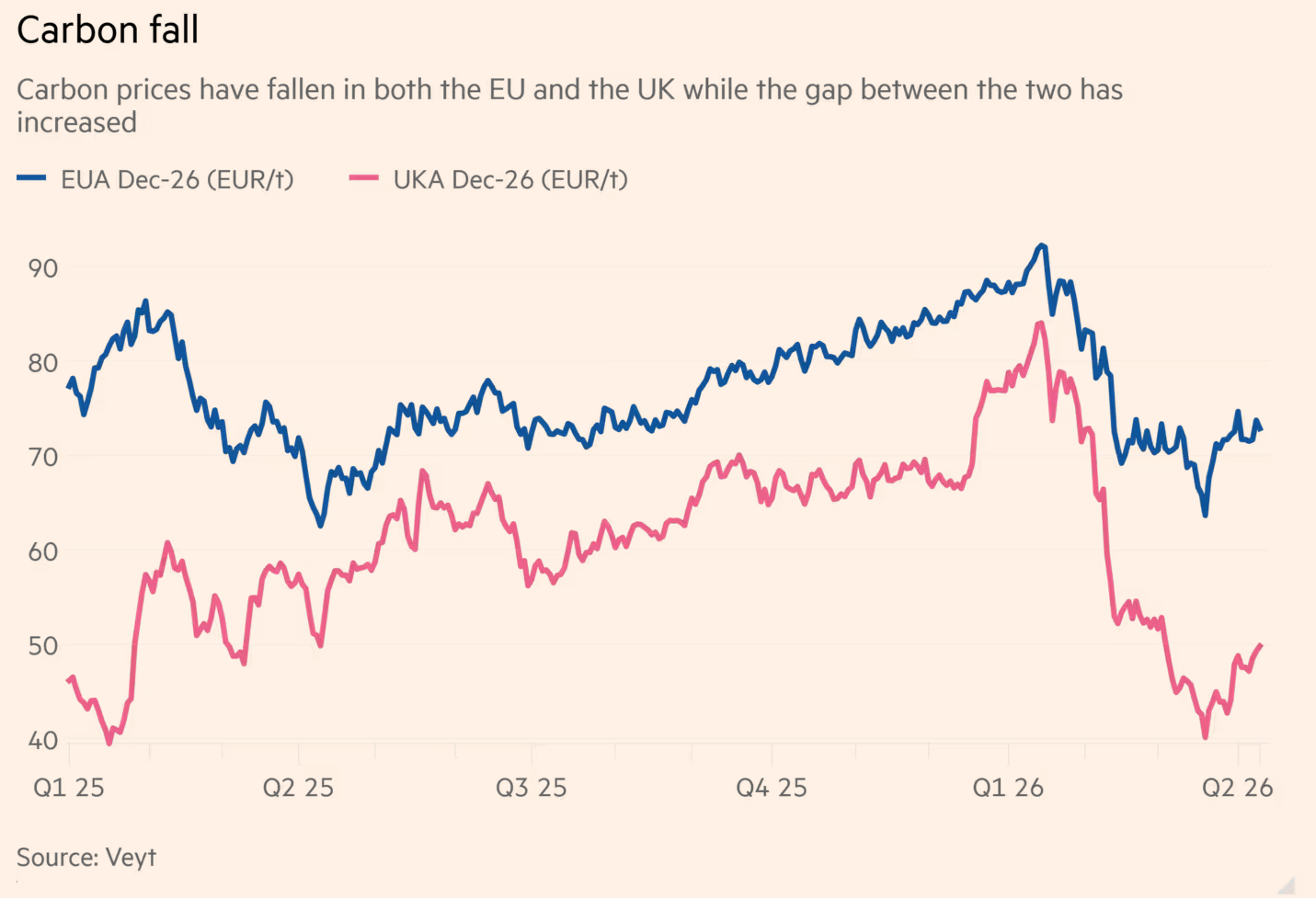
14th April 2026: Financial Times Journalist Rachel Millard reports that carbon prices in Europe and the UK have fallen since the start of 2026, with European carbon prices hovering at about €70 per tonne since the start of April . . . down about 20% from €87 at the start of the year. The gap between the cost of European and UK carbon permits has widened, making them more than €20 cheaper in Britain as of the end of last week. The trend raises questions for decarbonisation policies on both sides of the Channel, given the importance of carbon pricing in pushing investors towards lower-carbon options. The decline comes amid calls from some politicians to scrap or significantly weaken carbon pricing to bring down high energy costs. Marcus Ferdinand, carbon market expert at Veyt, warned: “If the response to high energy costs is to weaken the ETS, Europe swaps temporary relief on bills for long-term exposure to fossil fuels . . . from a strategic point of view, I think this is questionable.” The EU is due to carry out a fuller review of its ETS scheme by July, while the UK is working towards relinking its ETS scheme with the EU’s. Ferdinand said: “The price gap that has materialised this year is a temporary problem for the UK market if a linking agreement is reached by the EU-UK summit this summer, and a structural problem if that deal doesn’t materialise.” https://www.ft.com/carbon-prices-pressure
Overall C.A.T. Usefulness: 10/10 ★★★★★★★★★★
Strengths: this article captures a critical development in the world’s largest carbon market . . . prices are falling at the worst possible time. Its key strengths are:
- The 20% Drop: European carbon prices have fallen from €87 at the start of the year to about €70 per tonne. This is not a marginal fluctuation; it is a significant decline. The article quantifies the shift and its timing (since the start of the Iran war).
- The €23 Gap: UK carbon permits are now more than €20 cheaper than their European counterparts. The gap exceeds the “top up” of €18 per tonne that many emitters in Britain pay. This is a market signal that the UK ETS is functioning less effectively than the EU ETS.
- The Ferdinand Warning: Marcus Ferdinand’s quote is the analytical heart of the article. “If the response to high energy costs is to weaken the ETS, Europe swaps temporary relief on bills for long-term exposure to fossil fuels . . . from a strategic point of view, I think this is questionable.” This is a clear statement of the trade-off: short-term relief vs. long-term dependency.
- The Political Pressure Context: The article notes that politicians are calling for carbon pricing to be scrapped or weakened to bring down energy costs. It also notes that German Chancellor Friedrich Merz raised the prospect of revising the scheme in February, spooking traders. The political context is essential for understanding the price decline.
- The EU ETS Review Timeline: The EU is due to carry out a fuller review of its ETS scheme by July. The article identifies this as a key moment to watch. The review will cover the phase-out of free permits, putting it “at the centre of fierce industry lobbying.”
- The UK-EU Linkage Stakes: The article notes that the UK is working towards relinking its ETS scheme with the EU’s. Ferdinand frames the stakes clearly: linkage would make the price gap a “temporary problem”; failure would make it a “structural problem.”
Weaknesses: the article has no significant weaknesses. It is concise, data-driven, and strategically informed. If pressed, one could note that:
- The Missing Volume Data: The article reports prices but not volumes. How many permits are trading? Is the market liquid? The absence of volume data makes it harder to assess the significance of the price moves.
- The Gender Dimension (SDG 5): As with almost all carbon market reporting, the article is silent on gender. The analysts and policymakers quoted are men. The impacts of carbon pricing on households (including women) are not explored.
- The Missing Comparison to 2022: The article notes that carbon prices have fallen 20% since the start of the year. It does not compare this to the price crash during the 2022 energy crisis. Context would help readers understand whether this decline is typical or exceptional.
Opportunities for C.A.T.: this article provides C.A.T. with a critical update on the state of carbon pricing:
- The €70 Price Level: Carbon prices at €70 per tonne are still significant, but they are down from €87. C.A.T. can use this to argue that the carbon price signal is weakening at the worst possible time. The crisis should be increasing the price of carbon, not decreasing it.
- The Ferdinand Trade-off Frame: Ferdinand’s quote is a gift. C.A.T. can use it to argue that weakening carbon pricing is a trap. Short-term relief on bills leads to long-term exposure to fossil fuels. The trade-off is not worth it.
- The UK-EU Linkage as a Test: The UK’s effort to relink its ETS with the EU’s is a crucial test. C.A.T. can track whether the link is established by the summer summit. Success would strengthen both markets. Failure would leave the UK ETS isolated and less effective.
- The July Review as a Battleground: The EU’s ETS review, due by July, is a battleground. C.A.T. can track whether free permits are phased out as planned or extended. The outcome will determine the effectiveness of the ETS for the rest of the decade.
- The Merz Episode as a Warning: Merz’s comments in February spooked traders. C.A.T. can use this to argue that political rhetoric matters. Carbon markets are sensitive to signals from policymakers. The same politicians who want to weaken the ETS are causing the price decline.
Threats:
- The biggest threat is that the price decline accelerates. If carbon prices fall further, the incentive to invest in low-carbon options weakens. The transition could slow.
- A second threat is that the EU ETS review weakens the system. Ferdinand notes that the review is “at the centre of fierce industry lobbying.” If industry succeeds in extending free permits, the carbon price signal will be diluted.
- A third threat is that the UK-EU linkage fails. If the UK cannot relink its ETS with the EU’s, the price gap could become permanent. The UK market would remain smaller, less liquid, and less effective.
- A fourth threat is that the political calls to scrap carbon pricing succeed. The article notes that some politicians are calling for carbon pricing to be weakened or scrapped. If they succeed, the EU and UK would lose their primary tool for decarbonisation.
- A fifth threat is that the price decline becomes self-reinforcing. Lower prices reduce the incentive to decarbonise, which reduces demand for permits, which lowers prices further. A negative feedback loop is possible.
Analysis Through Lenses:
United Nations Lens (IPCC/UNFCCC): From a UN climate governance perspective, this article is deeply concerning. The EU ETS is the world’s largest carbon market. If it is weakened, the signal to global markets is that carbon pricing is politically fragile. The UNFCCC process has long promoted carbon pricing as a key tool. The EU’s struggles undermine that promotion.
EU Green New Deal Lens: For Brussels, this article is a warning. The ETS is the cornerstone of the Green Deal. If it is weakened, the entire architecture is at risk. The July review is a test of whether the EU can hold the line against industry lobbying. The outcome will determine the credibility of the Green Deal.
Draghi Report Lens: Mario Draghi’s report called for Europe to close the investment and innovation gap. It also called for simplifying regulation. Weakening the ETS would be the opposite of closing the gap. It would make Europe less competitive in the long run by locking in fossil fuel dependence.
Mark Jacobson Lens: Through Jacobson’s framework, this article is a case study in the limits of market-based climate policy. Jacobson prefers direct regulation (bans, mandates) over carbon pricing because prices are volatile and politically vulnerable. The 20% drop in carbon prices is evidence for his case. The transition cannot rely on prices alone.
SDG Ratings:
| SDG | Rating | Rationale |
|---|---|---|
| SDG 1 No Poverty | 3/10 ★★★☆☆☆☆☆☆☆ | Energy bills, carbon pricing impacts on consumers; not central |
| SDG 2 Zero Hunger | 0/10 ☆☆☆☆☆☆☆☆☆☆ | Not addressed |
| SDG 3 Good Health and Well-Being | 1/10 ☆☆☆☆☆☆☆☆☆☆ | Not addressed |
| SDG 4 Quality Education | 1/10 ☆☆☆☆☆☆☆☆☆☆ | Not addressed |
| SDG 5 Gender Equality | 0/10 ☆☆☆☆☆☆☆☆☆☆ | Complete absence. Carbon pricing and energy bills have gendered dimensions . . . all invisible |
| SDG 6 Clean Water and Sanitation | 0/10 ☆☆☆☆☆☆☆☆☆☆ | Not addressed |
| SDG 7 Affordable and Clean Energy | 9/10 ★★★★★★★★★☆ | Core focus; carbon pricing, energy costs, transition |
| SDG 8 Decent Work and Economic Growth | 4/10 ★★★★☆☆☆☆☆☆ | Industry competitiveness, carbon border tax |
| SDG 9 Industry, Innovation and Infrastructure | 5/10 ★★★★★☆☆☆☆☆ | ETS as infrastructure for decarbonisation |
| SDG 10 Reduced Inequalities | 2/10 ★★☆☆☆☆☆☆☆☆ | Not addressed |
| SDG 11 Sustainable Cities and Communities | 1/10 ☆☆☆☆☆☆☆☆☆☆ | Not addressed |
| SDG 12 Responsible Consumption and Production | 3/10 ★★★☆☆☆☆☆☆☆ | Not addressed |
| SDG 13 Climate Action | 10/10 ★★★★★★★★★★ | Core focus; carbon pricing, ETS, decarbonisation |
| SDG 14 Life Below Water | 0/10 ☆☆☆☆☆☆☆☆☆☆ | Not addressed |
| SDG 15 Life on Land | 1/10 ☆☆☆☆☆☆☆☆☆☆ | Not addressed |
| SDG 16 Peace, Justice and Strong Institutions | 5/10 ★★★★★☆☆☆☆☆ | EU governance, UK-EU relations, policy review |
| SDG 17 Partnerships for the Goals | 6/10 ★★★★★★☆☆☆☆ | UK-EU ETS linkage, international carbon market cooperation |
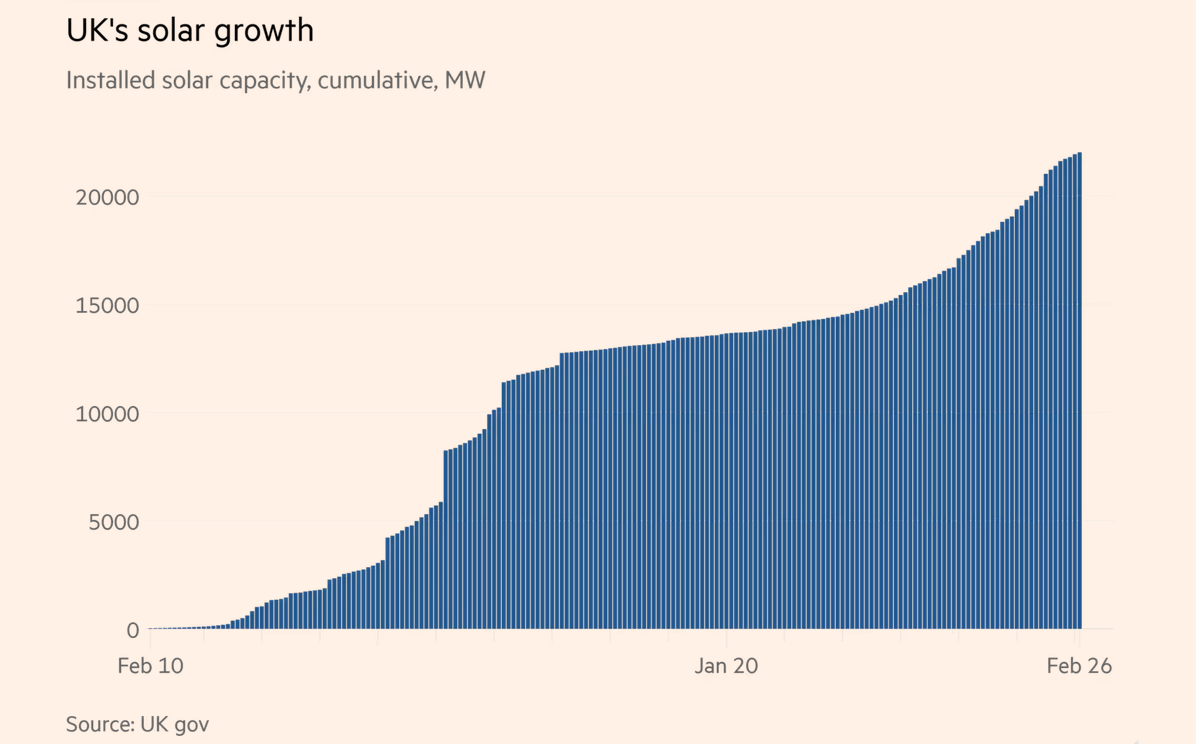
11th April 2026: Financial Times journalist Rachel Millard reports that UK households are turning to solar panels as energy bills bite, with the Iran war causing heating oil prices to jump from 54 pence per litre in January to £1.35 per litre in less than eight weeks. Rob Smithers, a 43-year-old local government officer in Derby, said he has spent “tens of hours” looking into replacing his old boiler system with solar panels and a heat pump to be less “at the mercy” of sharp moves in Brent crude. Solar panel sales climbed 54% in the first three weeks of March compared with the same period in February, according to Octopus Energy, the UK’s largest retail electricity supplier. EDF said residential sales were double their rate compared with last spring. The government is making a fresh push, with new standards requiring solar panels to be automatically fitted in most newly built homes in England, and plans to allow “plug-in” solar systems to be sold in UK supermarkets. However, record solar output on Monday and Tuesday last week drove electricity prices as low as minus £81 per megawatt-hour, as generation exceeded demand. Experts warn that negative prices are a growing trend and that households need to probe the credibility of installers as less reliable outlets try to cash in on the boom https://www.ft.com/content/5b45c7cc-2745-43ad-8809-bada96703ff9?syn-25a6b1a6=1
Overall C.A.T. Usefulness: 10/10 ★★★★★★★★★★
Strengths: This article connects geopolitical crisis to household decision-making . . . translating the abstract volatility of global oil markets into the lived reality of shorter showers and turned-down thermostats. Its key strengths are:
- The Human Entry Point: Rob Smithers is not a statistic. He is a 43-year-old local government officer in Derby who watched heating oil prices climb from 54 pence per litre to £1.35 per litre in less than eight weeks. He has spent “tens of hours” researching inverters and panel sizes. He wants to be less “at the mercy” of Brent crude. This is the human face of the energy transition.
- The Sales Surge Signal: Solar panel sales climbed 54% in the first three weeks of March compared with February. EDF residential sales doubled compared with last spring. Steve Edmonds, a smaller installer in Cheshire, said he had “had the best month of trading that we’ve had in the last three to five years.” These are not projections; they are purchase orders. The market is moving.
- The Government Push: New standards will require solar panels to be automatically fitted in most newly built homes in England. Plans are being laid to allow “plug-in” solar systems to be sold in UK supermarkets. This is not niche policy; it is mainstreaming. Solar panels are becoming as normal as washing machines.
- The Negative Price Paradox: Record solar output drove electricity prices as low as minus £81 per megawatt-hour . . . traders effectively paying consumers to take power off their hands. This is a stunning illustration of the transition’s growing pains. Too much solar is a good problem to have, but it is still a problem. The grid needs storage, and fast.
- The Ukraine War Parallel: The article explicitly compares the current rush to the period after Russia’s invasion of Ukraine, when installations jumped from 63,695 to 148,809 households. This is the second major fossil fuel shock in four years. The pattern is clear: crisis accelerates deployment. The question is whether the acceleration is fast enough.
- The Installer Credibility Warning: The article notes that Neilson had to switch installers after his initial choice went bust, and that Smithers found the market “all alien to me.” Chris Hewett of Solar Energy UK stressed that installations should be carried out by MCS-registered installers. This is responsible journalism . . . not boosterism, but honest guidance.
Weaknesses: The article has no significant weaknesses. It is comprehensive, humanely reported, and technically informed. If pressed, one could note that:
- The Gender Dimension (SDG 5): As with almost all energy and household reporting, the article is silent on gender. Smithers is a man. Neilson is a man. Brass is a man. The decision-makers quoted are all men. Women’s roles in household energy decisions, the gendered impacts of energy poverty, the differential access to capital for solar installations . . . all are invisible.
- The Upfront Cost Barrier: The article notes that solar panels can cost several thousand pounds, with Neilson’s system costing roughly £10,000 and taking seven years to pay back. It does not explore how lower-income households . . . those most vulnerable to energy price shocks . . . can access these savings. The return on investment argument works for those with capital. For those without, the barrier remains.
- The Heating Oil Context: The article notes that heating oil affects a “relatively small number of homes not on the gas grid.” Smithers’s experience is not universal. The article does not explore the different vulnerabilities of gas-grid homes, which face Ofgem price cap increases but not the same acute shortage-driven price spikes.
Opportunities for C.A.T.: This article provides C.A.T. with a powerful narrative of household-level climate action driven by crisis:
- The “At the Mercy” Frame: Smithers’s language . . . “at the mercy” of Brent crude . . . is a gift. It captures the powerlessness of fossil fuel dependence and the agency of distributed generation. C.A.T. can use this to argue that solar panels are not just about emissions; they are about sovereignty . . . at the household scale.
- The 54% Surge as Evidence: The 54% increase in solar panel sales in three weeks is not a marginal shift. It is a demand shock. C.A.T. can use this to argue that the transition is not waiting for policy; it is being driven by household economics and geopolitical fear.
- The Negative Price Signal: Negative electricity prices . . . minus £81 per megawatt-hour . . . are a powerful argument for storage. C.A.T. can use this to connect household solar to the battery storage story. The missing piece is not generation; it is storage. And storage is coming.
- The Mainstreaming Moment: Solar panels in new homes. Plug-in systems in supermarkets. This is not the early adopter phase anymore. C.A.T. can use this to argue that the transition has reached the mass market . . . and that policy should accelerate, not impede, this mainstreaming.
- The Installer Credibility Gap: The warning about less reliable outlets cashing in on the boom is a reminder that rapid transitions create opportunities for bad actors. C.A.T. can use this to argue for consumer protection, quality standards, and MCS registration as essential infrastructure for the transition.
Threats:
- The biggest threat is that the upfront cost barrier excludes lower-income households. If solar panels remain accessible only to those with £10,000 of capital, the transition will exacerbate inequality. The households most vulnerable to energy price shocks . . . those least able to afford £10,000 . . . will be left behind.
- A second threat is that the installer quality gap leads to consumer harm. If less reliable outlets cash in on the boom, homeowners could face faulty installations, safety risks, or bankruptcy of their installer (as Neilson experienced). A high-profile failure could set back public confidence in solar.
- A third threat is that the negative price trend discourages further solar investment. If electricity prices are sometimes negative, the financial case for solar becomes less certain. The article notes that negative prices are a “growing trend.” Without storage, this trend could dampen deployment.
- A fourth threat is that the grid cannot keep pace. The National Energy System Operator faces increasing complexity balancing supply and demand as solar penetration rises. If grid management fails . . . leading to blackouts or curtailment of renewable generation . . . the political backlash could slow the transition.
- A fifth threat is that the crisis passes and the urgency fades. The article draws a direct line from the Iran war to solar sales. If the war ends and oil prices fall, will households still invest in solar? The Ukraine war created a lasting boost, but the article does not project whether the current surge will be sustained.
Analysis Through Lenses:
United Nations Lens (IPCC/UNFCCC): From a UN climate governance perspective, this article is a case study in how geopolitical crisis can drive household climate action. The IPCC has long argued that climate policy must be aligned with energy security. Smithers is living that alignment. He is not installing solar because of an IPCC report; he is installing it because heating oil jumped from 54p to £1.35. The UNFCCC process struggles to create this kind of direct, immediate incentive. The market is doing it faster.
EU Green New Deal Lens: For Brussels, this article should be read as evidence that the energy security argument for the transition is working. The UK is no longer in the EU, but its experience is instructive. The Green Deal’s emphasis on energy independence, on renewables, on household-level generation . . . all are validated by the surge in solar sales. The question is whether the EU can replicate the UK’s policy package (new build standards, plug-in systems, MCS certification) and whether it can do so faster.
Draghi Report Lens: Mario Draghi’s report called for Europe to close the investment and innovation gap with China and the US. This article shows that the demand side of the transition is ready. UK households are scrambling for solar panels. The question is whether European manufacturing can meet that demand. The article does not mention where the panels come from . . . likely China. Draghi’s call for investment in domestic clean tech manufacturing is a call to capture this demand.
Mark Jacobson Lens: Through Jacobson’s framework, this article is a vindication of distributed generation. Jacobson’s 100% wind-water-solar roadmaps include rooftop solar as a key component. The UK’s surge in household solar is exactly what Jacobson’s models prescribe. However, the negative price signal is a warning: without storage, solar penetration will hit a ceiling. Jacobson’s roadmaps include storage at every scale . . . household batteries, grid-scale storage, pumped hydro. The UK’s transition is not yet complete.
SDG Ratings:
| SDG | Rating | Rationale |
|---|---|---|
| SDG 1 No Poverty | 6/10 ★★★★★★☆☆☆☆ | Energy bills, upfront cost barrier for lower-income households; not explored in depth |
| SDG 2 Zero Hunger | 0/10 ☆☆☆☆☆☆☆☆☆☆ | Not addressed |
| SDG 3 Good Health and Well-Being | 2/10 ★★☆☆☆☆☆☆☆☆ | Shorter showers, turned-down thermostats . . . health impacts not explored |
| SDG 4 Quality Education | 2/10 ★★☆☆☆☆☆☆☆☆ | Smithers spending “tens of hours” researching inverters; consumer education gap noted |
| SDG 5 Gender Equality | 0/10 ☆☆☆☆☆☆☆☆☆☆ | Complete absence. All quoted decision-makers are men. Women’s roles in household energy invisible |
| SDG 6 Clean Water and Sanitation | 0/10 ☆☆☆☆☆☆☆☆☆☆ | Not addressed |
| SDG 7 Affordable and Clean Energy | 10/10 ★★★★★★★★★★ | Core focus; solar panels, energy bills, price shocks, household generation |
| SDG 8 Decent Work and Economic Growth | 5/10 ★★★★★☆☆☆☆☆ | Installer jobs, trading activity; job quality and worker protections not explored |
| SDG 9 Industry, Innovation and Infrastructure | 8/10 ★★★★★★★★☆☆ | Solar manufacturing, grid management, negative prices, installer certification |
| SDG 10 Reduced Inequalities | 4/10 ★★★★☆☆☆☆☆☆ | Upfront cost barrier; lower-income households excluded; not explored in depth |
| SDG 11 Sustainable Cities and Communities | 7/10 ★★★★★★★☆☆☆ | Rooftop solar, new build standards, household energy resilience |
| SDG 12 Responsible Consumption and Production | 5/10 ★★★★★☆☆☆☆☆ | Household energy consumption, solar panel lifecycle not addressed |
| SDG 13 Climate Action | 10/10 ★★★★★★★★★★ | Core focus; solar deployment, net zero target, fossil fuel displacement |
| SDG 14 Life Below Water | 0/10 ☆☆☆☆☆☆☆☆☆☆ | Not addressed |
| SDG 15 Life on Land | 1/10 ★☆☆☆☆☆☆☆☆☆ | Not addressed |
| SDG 16 Peace, Justice and Strong Institutions | 4/10 ★★★★☆☆☆☆☆☆ | Iran war as driver, government policy (new standards, Ofgem price cap) |
| SDG 17 Partnerships for the Goals | 3/10 ★★★☆☆☆☆☆☆☆ | Installers, suppliers (Octopus, EDF), trade association (Solar Energy UK) |
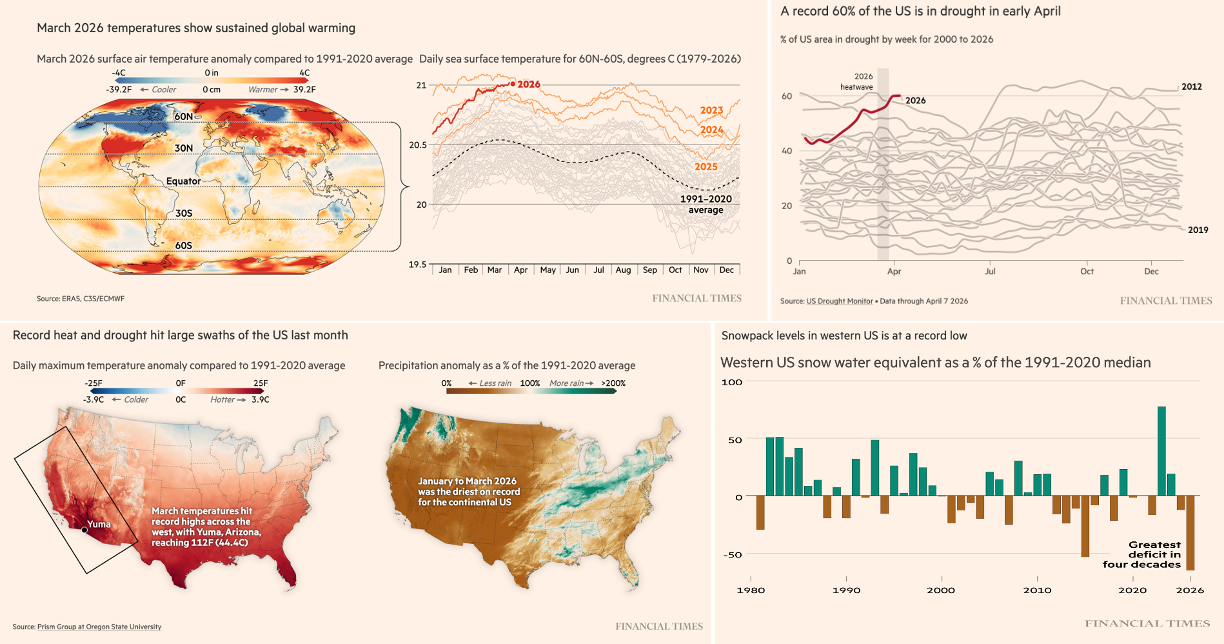
10th April 2026: Financial Times journalists Aditi Bhandari + Eva Xiao + Kenza Bryan report that >60% of the United States is now experiencing drought conditions . . . the highest percentage recorded for early April since monitoring began in 2000 . . . following near-record March 2026 temperatures across the northern hemisphere. The Copernicus Climate Change Service reported that global average temperatures for March 2026 reached 1.48°Celsius above pre-industrial levels, while Arctic sea ice hit its lowest March extent on record. The FT’s data visualisation reveals the scale: January to March 2026 was the driest first quarter on record for the continental US, western snowpack sits at its lowest level in four decades relative to the 1991–2020 median, and a record-breaking heatwave in the western US saw Yuma, Arizona reach 44.4°Celsius. The article connects these physical impacts to economic consequences: only one-third of winter wheat is rated good or excellent condition (down from 48% last year) + Denver has mandated 20% water use reductions, and Arkansas ranchers face mounting feed costs as pasture grass fails. Scientists forecast a probable El Niño return by mid-2026, which could intensify heat in the second half of the year https://www.ft.com/content/0467d3a7-0fa9-4895-8feb-6be4343e01be?syn-25a6b1a6=1
Overall C.A.T. Usefulness: 10/10 ★★★★★★★★★★
Strengths
1. The Ground-Truthing of Climate Projections: This article translates climate model outputs into lived, local, economically tangible reality. The 60% drought coverage is not an abstract statistic: it is a cattle rancher in Arkansas buying hay instead of grazing pasture. It is a wheat farmer in Texas watching half the crop fail. It is Denver imposing mandatory water restrictions. The article does not argue about whether climate change is happening; it documents what is already happening and attaches price tags to it.
2. The Visual Evidence Is Devastating: FT’s data visualisation tells a story that words alone cannot fully convey. The four-panel graphic shows: (1) March temperature anomalies concentrated in a deep red band across the western US; (2) January–March precipitation at a fraction of normal levels across nearly the entire continental US; (3) the 60% drought figure as the highest early-April reading in the 26-year observational record, visibly exceeding previous peaks in 2012, 2016, and 2022; and (4) western snow water equivalent at “the greatest deficit in four decades” relative to the 1991–2020 median. The temporal trend line on the drought chart is particularly striking: it shows a system that has oscillated but with an unmistakable upward drift in peak drought extent over the past decade.
3. The Snowpack Story: the article’s explanation of snowpack as water infrastructure is a masterclass in climate communication. The visual showing snow water equivalent at a four-decade low relative to the 1991–2020 median makes the point with brutal clarity. “In some western states, snowpack accounts for as much as 75% of water supplies” and “much of that is already melted out” is devastating precisely because it is so matter-of-fact. The article re-frames snow not as a seasonal nuisance but as a critical reservoir: one that is disappearing earlier each year. Brian Fuchs‘ quote: “We’re not going to see that mid-to-late-summer push of water” is the quiet, technical language of systemic failure.
4. Economic Granularity: the article connects the physical climate story to specific economic actors and commodities: winter wheat condition ratings (33% good/excellent vs. 48% last year), Texas wheat (50% very poor or poor), Arkansas cattle feed costs, Denver water restrictions. This is not an article about “the economy”; it is an article about this farmer, this rancher, this water utility. The specificity makes the crisis legible.
5. The Multi-Scale Framing: the article moves fluidly between scales: global (Copernicus temperature data, Arctic sea ice, El Niño forecast), national (60% drought coverage), regional (western heatwave, Midwest fires), state (Nebraska’s 640,000 burned acres, Utah’s 39% reservoir capacity), and local (Denver’s water rules, Arkansas ranchers). This demonstrates the nested nature of climate impacts and avoids the trap of treating any single data point as the whole story.
6. The Accumulation Narrative: Fuchs’s observation that “year after year” precipitation deficits are building long-term water deficits is crucial . . . and the FT’s drought chart visually confirms it. The time series from 2000 to 2026 shows that peak drought extents are not only becoming more frequent but also reaching higher levels. The article resists the temptation to frame drought as a discrete, reversible event. It correctly frames it as a cumulative condition . . . a debt that compounds. The line “If drought conditions persist, I don’t think people are going to be rebuilding the herd” signals a structural shift, not a cyclical downturn.
7. The Copernicus Voice of Authority: Carlo Buontempo‘s quote . . . “Each figure is striking on its own—together, they paint a picture of a climate system under sustained and accelerating pressure” . . . provides the authoritative scientific frame that legitimizes the on-the-ground reporting. It also introduces the critical concept of “accelerating pressure,” which aligns with the Earth energy imbalance analysis from the previous C.A.T. round-up.
Weaknesses
1. The Gender Dimension (SDG 5) Is Entirely Absent: the article documents impacts on farmers, ranchers, and water utility managers without once asking how these impacts are distributed by gender. Who makes the decisions about herd reduction? Who bears the care burden when water rationing affects households? Who has access to the capital needed to purchase supplemental feed? The agricultural sector has a gender profile, and drought does not affect men and women equally. This dimension is invisible.
2. The Policy Response Is Underdeveloped: the article notes Denver’s 20% water reduction mandate but does not explore the broader policy landscape. What is the federal government doing? What about state-level drought declarations and emergency assistance? Are there longer-term adaptation strategies being deployed, or are these purely reactive measures? The reader is left with a sense of impacts but no clear picture of institutional response.
3. The Global South Comparison Is Missing: the article is appropriately focused on US impacts for an FT audience, but the 60% drought figure invites comparison. What is happening in the Horn of Africa? In the Amazon? In the Mediterranean? The US is experiencing drought with significant institutional capacity to respond. The same physical conditions in lower-income countries produce different outcomes. The article does not gesture toward this global context.
4. The El Niño Framing Could Be Sharper: the article mentions El Niño as a potential intensifier but does not fully explain the mechanism or the confidence level of the forecast. Given that the return of El Niño conditions could be the dominant climate story of the second half of 2026, a paragraph unpacking what this means for temperature records, precipitation patterns, and fire risk would strengthen the piece.
5. The “Four-Decade” Deficit Needs More Context: the visual shows western snowpack at “the greatest deficit in four decades.” This is a powerful data point, but the article does not explain what the four-decade comparison means. Is this a function of data availability, or is it a meaningful climate benchmark? The reader is left to infer the significance.
Opportunities for C.A.T.
1. The Visual Evidence as a Communications Asset: the FT’s four-panel chart is a ready-made communications tool. Climate Action Tiger can reference these specific data visualisations in future analyses: the drought time series showing the 2026 peak exceeding all previous records; the snowpack chart showing the four-decade deficit; the precipitation anomaly map with its almost uniform red/brown across the continental US. These are not just data points: they are visual arguments that bypass the need for verbal persuasion.
2. The “Accelerating Pressure” Frame: Buontempo’s language (“a climate system under sustained and accelerating pressure”) should become central to C.A.T.’s vocabulary. It connects directly to the Earth energy imbalance analysis (doubled in 20 years), and provides a scientific anchor for the on-the-ground impacts documented here. C.A.T. can correctly use this to argue that we are not experiencing “weather”; we are experiencing the early stages of a system-state shift.
3. Drought as Economic Data: the article provides granular economic indicators (wheat condition ratings, cattle feed costs, water restrictions) that C.A.T. can track over time. These are leading indicators of climate-driven economic disruption. If winter wheat conditions deteriorate further, or if cattle herd reductions accelerate, these become data points in the argument that climate inaction is already imposing measurable costs.
4. The Snowpack Infrastructure Frame: re-framing snowpack as “critical water infrastructure” is a powerful communications tool. C.A.T. can amplify this framing to shift the conversation from “climate change affects snow” (abstract, distant) to “climate change is degrading our water storage infrastructure” (concrete, immediate, economically consequential). The four-decade deficit chart makes this point visually undeniable.
5. The Accumulation/Compounding Frame: Fuchs’s “year after year” language (visually confirmed by the drought time series) should be elevated and amplified. The drought is not a one-year event; it is a cumulative deficit. This aligns with the ocean heat storage story (heat captured for “hundreds or thousands of years”) from the previous round-up. C.A.T. can build a “compounding crises” narrative that connects drought, ocean heat, sea level rise, and the Earth energy imbalance into a single coherent story about accelerating system pressure.
6. The Adaptation Imperative: the article documents reactive adaptation (Denver’s water restrictions, ranchers buying feed) but does not name it as such. C.A.T. can use these examples to argue that adaptation is not a future concern . . . it is already happening, and it is happening unevenly. The question is whether it will be planned and equitable or reactive and regressive.
7. Connecting US Drought to Geopolitics: this article should be read alongside the Sharma analysis (US resilience, dollar dominance) from the previous round-up. The US may be resilient to energy shocks, but it is demonstrably not resilient to water shocks. C.A.T. can use this to complicate the “American resilience” narrative and argue that climate impacts do not respect geopolitical power hierarchies.
8. The El Niño Warning as a Forward-Looking Hook: the article’s note that NOAA forecasts an above-average chance of El Niño conditions by mid-2026 provides C.A.T. with a forward-looking hook. The next round-up can return to this forecast and assess whether conditions are materializing as predicted. This creates narrative continuity across C.A.T. editions.
Threats
1. Biggest threat is that this article is read as a “weather story” rather than a structural signal about the US economy’s vulnerability to climate impacts. The 60% drought figure (visually the highest early-April reading in 26 years) could be normalized as “a bad year” rather than recognized as part of a trend that the time-series chart makes unmistakably clear.
2. Second threat is that the focus on US impacts obscures the global picture: if 60% of the US is in drought, what is happening in regions with far less adaptive capacity? The silence on the Global South risks reinforcing a narrative that climate impacts are a rich-world concern . . . when the opposite is true.
3. Third threat is that the El Niño forecast proves accurate and the second half of 2026 brings intensified heat and fire . . . overwhelming the already-strained response systems documented here. The article gestures toward this possibility but does not fully explore its implications for food prices, water rationing, and firefighting capacity.
4. Fourth threat is that the visual evidence . . . powerful as it is . . . becomes a source of paralysis rather than action. The four-panel chart can induce resignation. The challenge for C.A.T. is to use it to pollinate demand for Decency.
5. Fifth threat is that the “greatest deficit in four decades” language is stripped of its temporal context. Readers may not register that the 1980s . . . the baseline for this comparison . . . was itself already a warmed period relative to pre-industrial conditions. The deficit is measured against a moving, warming baseline, which means the true anomaly is even larger than the chart suggests.
Analysis Through Lenses
United Nations Lens (IPCC/UNFCCC): From a UN climate governance perspective, this article is a documentation of what the IPCC’s Working Group II (Impacts, Adaptation, and Vulnerability) has been warning about for decades. The 60% drought coverage, the four-decade snowpack deficit, the wheat failures: these are not surprises. They are the expected outcomes of a warming world. The article’s value is that it attaches specific, local, economically legible details to the IPCC’s general warnings. For the UNFCCC process, the challenge is that this kind of ground-truth reporting makes the gap between diplomatic commitments (NDCs, adaptation finance pledges) and lived reality increasingly visible and increasingly politically untenable.
EU Green New Deal Lens: For Brussels, this article is both a warning and an opportunity. The warning: Europe is not immune to drought. The Mediterranean region is a climate hotspot, and southern Europe faces many of the same water stress dynamics documented in the US West. The FT’s visualisation of snowpack deficit (a four-decade low relative to the 1991–2020 median) should focus European minds on the Alps, which serve as Europe’s water tower. The opportunity: Europe’s Green Deal includes water resilience and adaptation components (the EU Adaptation Strategy, the Water Framework Directive) that could position European agriculture and water infrastructure ahead of the curve. But the article’s implicit message is that reactive measures (Denver’s 20% cut) are insufficient. Planned, systemic adaptation is required.
Draghi Report Lens: Mario Draghi’s report called for Europe to close the competitiveness gap with the US and China. This article suggests a different kind of competitiveness: resilience competitiveness. The US enjoys the dollar, deep capital markets, and energy independence, but it is demonstrably vulnerable to water shocks. Europe, with its denser urban fabric, more extensive public transit, and (in parts) more water-secure geography, may have underappreciated resilience advantages. Draghi’s call for investment should include water infrastructure, drought-resistant agriculture, and fire management capacity . . . not just batteries and chips.
Mark Jacobson Lens: Through Jacobson’s framework, this article is a case study in why the transition to 100% wind-water-solar is not just about emissions reduction. It is about reducing the heat that drives drought, snowpack loss, and fire risk. The 1.48°Celsius March temperature anomaly (visualized as a deep red band across the western US) is a measure of how far the system has already shifted. Every ton of CO₂ avoided reduces the long-term pressure on water systems. Jacobson would note that the technologies to eliminate emissions exist: the barrier is not technical but political. The drought documented here—the four-decade snowpack deficit, the 60% drought coverage—is not an act of God; it is a predictable consequence of energy choices made over decades.
SDG Ratings
| SDG | Rating | Rationale |
|---|---|---|
| SDG 1 No Poverty | 6/10 ★★★★★★☆☆☆☆ | Economic impacts on farmers/ranchers documented; poverty dynamics not explored |
| SDG 2 Zero Hunger | 9/10 ★★★★★★★★★☆ | Core focus; wheat crop failure (33% good/excellent vs 48% last year), cattle feed costs, food system stress |
| SDG 3 Good Health and Well-Being | 4/10 ★★★★☆☆☆☆☆☆ | Fire risk and heat stress mentioned; 44.4°C in Yuma; health impacts not primary focus |
| SDG 4 Quality Education | 1/10 ★☆☆☆☆☆☆☆☆☆ | Not addressed |
| SDG 5 Gender Equality | 0/10 ☆☆☆☆☆☆☆☆☆☆ | Complete absence; gendered impacts of drought and agricultural stress invisible |
| SDG 6 Clean Water and Sanitation | 10/10 ★★★★★★★★★★ | Central focus; 60% drought, four-decade snowpack deficit, 39% reservoir capacity (Utah), Denver 20% water restrictions |
| SDG 7 Affordable and Clean Energy | 2/10 ★★☆☆☆☆☆☆☆☆ | Not addressed; fertilizer/fuel costs mentioned in passing via Middle East war context |
| SDG 8 Decent Work and Economic Growth | 7/10 ★★★★★★★☆☆☆ | Agricultural livelihoods, input costs, herd rebuilding decisions documented; Arkansas ranchers specifically profiled |
| SDG 9 Industry, Innovation and Infrastructure | 5/10 ★★★★★☆☆☆☆☆ | Snowpack as water infrastructure framed; adaptation infrastructure not explored |
| SDG 10 Reduced Inequalities | 3/10 ★★★☆☆☆☆☆☆☆ | Distributional impacts within US implicit; global North/South comparison absent |
| SDG 11 Sustainable Cities and Communities | 5/10 ★★★★★☆☆☆☆☆ | Denver water restrictions mentioned; urban water systems implicit |
| SDG 12 Responsible Consumption and Production | 6/10 ★★★★★★☆☆☆☆ | Water consumption, agricultural inputs, resource constraints central |
| SDG 13 Climate Action | 10/10 ★★★★★★★★★★ | Core focus; 1.48°C March anomaly, drought time series (highest early-April reading in 26 years), El Niño forecast, “accelerating pressure” frame |
| SDG 14 Life Below Water | 2/10 ★★☆☆☆☆☆☆☆☆ | Sea surface temperatures mentioned briefly in Copernicus context |
| SDG 15 Life on Land | 9/10 ★★★★★★★★★☆ | 640,000 Nebraska acres burned, four-decade snowpack deficit, vegetation drying, ecosystem stress |
| SDG 16 Peace, Justice and Strong Institutions | 4/10 ★★★★☆☆☆☆☆☆ | Institutional responses (Denver Water, US Drought Monitor, Copernicus) noted; policy gaps implicit |
| SDG 17 Partnerships for the Goals | 2/10 ★★☆☆☆☆☆☆☆☆ | Copernicus data sharing (C3S/ECMWF) noted; global coordination not explored |
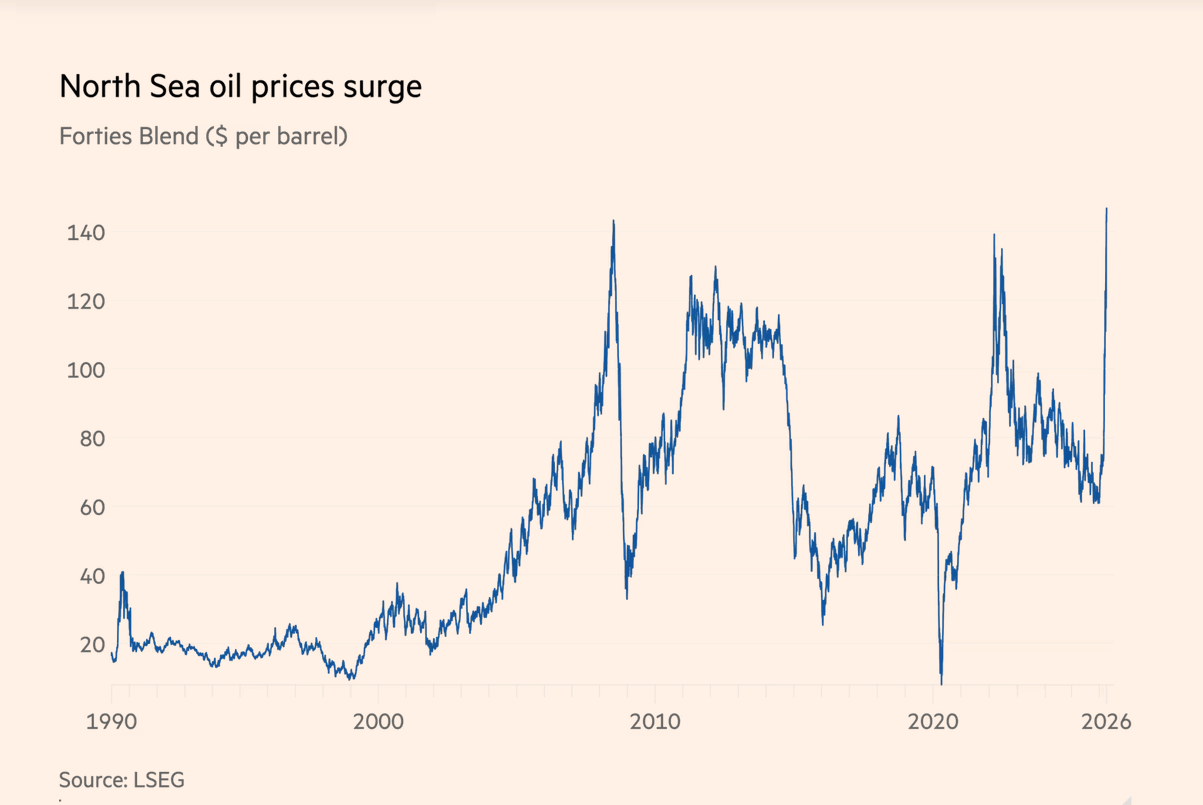
10th April 2026: Financial Times Journalists Jamie Smyth and Verity Ratcliffe report that a rush among European and Asian refineries to secure oil cargoes has pushed North Sea oil prices to a record high as Iran’s stranglehold on the Strait of Hormuz triggers fresh angst in the market. Forties Blend, a marker for oil for immediate delivery, hit almost $147 a barrel on Thursday . . . above the highs reached on the eve of the 2008 financial crisis . . . as traders scrap for oil cargoes to replace huge volumes now trapped in the Gulf. The physical barrels from the North Sea were trading far above the roughly $97 price of Brent, the international benchmark, for delivery in June. The rush was so intense it disrupted a vital pillar of the oil market: traders said they were unable to buy Brent contracts for difference for next week after prices exceeded $30 a barrel, breaching the Intercontinental Exchange’s threshold. Oil exports via the strait have fallen to only 8% of normal levels, with Asia especially vulnerable because about 80% of the oil and petroleum products it needs transit the waterway. Amos Hochstein, former energy adviser to President Biden, warned: “If this continues for a few more days, we can see the market deciding that the straits are closed indefinitely, which could lead not only to an increase in price but to a crisis in Asia. This is not just about high prices. This is about an actual physical shortage, which is playing out” https://www.ft.com/content/f04ad855-81e3-49c5-827e-d3c4acb901c9?syn-25a6b1a6=1
Overall C.A.T. Usefulness: 10/10 ★★★★★★★★★★
Strengths:
This article translates complex physical dynamics into a clear narrative of crisis. Its key strengths are:
- The Record High Signal: Forties Blend at almost $147 a barrel . . . above the 2008 financial crisis peak . . . is not a marginal increase. It is a signal that the physical oil market is breaking. The gap between immediate delivery ($147) and future delivery ($97) is a measure of acute scarcity. Traders are not betting on higher prices. Economies are scrambling for actual barrels.
- The Market Disruption Detail: The inability to trade Brent contracts for difference because prices breached ICE’s circuit-breakers’ threshold is a technical detail with profound implications. A major pillar of the global oil market has temporarily ceased functioning. The article notes that some dealing is now taking place “outside of the exchange”. This is the kind of systemic vulnerability that central banks and regulators monitor closely.
- The 8% Figure: Oil exports via the Strait of Hormuz have fallen to 8% of normal levels. That is not a disruption; it is a near-total blockade. The strait normally transports 20% of global oil supplies. The cumulative numbers imply a global supply reduction of roughly 18-19%. This is unprecedented.
- The Asia Vulnerability: The article notes that Asia is “especially vulnerable” because about 80% of the oil and petroleum products it needs transit the waterway. This connects directly to Li Shuo’s warning in the China battery surge article: East Asian countries reliant on imported fossil fuels face “immeasurable economic shock.” The transition is not just about climate; it is about economic survival echoing the ruptures that led to Japan attacking Pearl Harbor.
- The Hochstein Warning: Amos Hochstein’s quote is the strategic heart of the article. “This is not just about high prices. This is about an actual physical shortage, which is playing out.” He distinguishes between financial markets (which can absorb price shocks) and physical markets (which cannot). The world is facing a physical shortage of oil. That has not happened at this scale since the 1970s.
- The Futures vs. Physical Divergence: Helima Croft’s observation that futures markets are a “lagging indicator for the physical market realities” is a crucial analytical point. The futures market ($97 Brent) is not reflecting the physical reality ($147 Forties). Traders who rely on futures prices to hedge are getting a false signal. The divergence is a measure of market dysfunction.
Weaknesses:
The article has no significant weaknesses. It is comprehensive, technically precise, and strategically informed. If pressed, one could note that:
- The Gender Dimension (SDG 5): As with almost all commodity market reporting, the article is silent on gender. The 80% of Asian oil imports, the refineries scrambling for cargoes, the traders navigating the broken market . . . all are presented in gender-neutral terms. The gendered impacts of energy scarcity . . . fuel poverty, care burdens, differential access to resources . . . are invisible.
- The Saudi Production Loss: The article notes that Saudi Arabia’s production capacity has fallen by 600,000 barrels per day due to attacks on its energy infrastructure. It does not explore whether this damage is temporary or permanent, or what it means for global spare capacity. The loss of Saudi spare capacity compounds the Strait of Hormuz blockade.
- The Trump Assurance: The article includes Trump’s assurance that “very quickly, you’ll see oil start flowing.” It does not assess the credibility of this assurance. Given the track record of the administration’s statements on Iran, the reader is left to infer . . . at best . . . skepticism. A more explicit evaluation would have been helpful.
Opportunities for C.A.T.:
This article provides C.A.T. with the most dramatic evidence yet of the fossil fuel system’s fragility:
- The Physical Shortage Frame: Hochstein’s distinction between price shocks and physical shortages is the key. The world has experienced price shocks before. Physical shortages are rarer and more dangerous. C.A.T. can use this to argue that the fossil fuel system is not just expensive; it is unreliable. Renewables, once installed, do not face “physical shortages” of sun or wind.
- The 80% Asia Figure: The statistic that 80% of Asia’s oil and petroleum products transit the Strait of Hormuz is a devastating vulnerability. C.A.T. can use this to argue that Asia’s energy security depends on a single chokepoint . . . and that chokepoint is now controlled by a hostile power. The transition to renewables is not optional; it is a strategic imperative.
- The Market Breakdown Signal: The inability to trade Brent CFDs because prices breached ICE’s threshold is a systemic warning. Financial markets are supposed to absorb shocks. This shock has broken a major market mechanism. C.A.T. can use this to argue that the financial system is not prepared for the climate-driven disruptions to come.
- The 1970s Echo: The article echoes the oil shocks of the 1970s . . . which led to speed limits, fuel economy standards, and a lasting shift in energy policy. C.A.T. can use this historical parallel to argue that the current crisis could drive similar structural changes . . . if policymakers respond with conservation and transition, not just subsidies and bailouts.
- The Futures Lag Warning: Croft’s observation that futures markets are lagging physical realities is a warning to investors and policymakers who rely on futures prices as signals. C.A.T. can use this to argue that market signals are distorted . . . and that relying on them for decision-making is dangerous.
Threats:
- The biggest threat is that the physical shortage persists. Oil exports via the strait are running at 8% of normal levels. If this continues for weeks or months, the global economy will face an energy shock worse than 1973. Refineries will close. Industries will shut down. Households will lose access to heating and transport.
- A second threat is that the market dysfunction spreads. The inability to trade Brent CFDs is a warning. If other market mechanisms break, the financial system could face a cascade of failures. Hedges will fail. Counterparties will default.
- A third threat is that the crisis locks in fossil fuel dependency rather than accelerating the transition. If governments respond by subsidising oil imports, building new storage, or investing in domestic fossil fuel production, they will entrench the very system that caused the crisis.
- A fourth threat is that Asia’s 80% dependence becomes a geopolitical weapon. Iran has shown that it can close the strait. Other powers may learn from this. The transition is not just about climate; it is about sovereignty.
- A fifth threat is that the futures market’s lagging signal misleads policymakers. If they rely on the $97 Brent futures price rather than the $147 physical price, they will underestimate the severity of the crisis. Response will be too slow, too small, too late.
Analysis Through Lenses:
United Nations Lens (IPCC/UNFCCC): From a UN climate governance perspective, this article is a disaster scenario playing out in real time. The UNFCCC process was designed to prevent climate change, but it has no mechanism to respond to an oil shock of this magnitude. The IEA’s demand reduction call is suddenly not a recommendation but a necessity. The irony is that the crisis is accelerating the transition (as CATL’s marine push and the China battery surge show), but the transition is not yet fast enough to replace the lost oil.
EU Green New Deal Lens: For Brussels, this article should be an emergency alert. Europe is not as dependent on the Strait of Hormuz as Asia . . . but European refineries are scrambling for North Sea oil, and prices have hit record highs. The Green Deal’s emphasis on energy independence is suddenly not a long-term aspiration but a short-term necessity. The question is whether the crisis will accelerate the Green Deal . . . or whether short-term fixes will lock in longer-term dependency.
Draghi Report Lens: Mario Draghi’s report called for Europe to close the investment and innovation gap with China and the US. This article shows what happens when a major economy fails to close that gap. The 80% dependence on a single chokepoint is a failure of strategic autonomy. Draghi’s call for investment in resilience is not abstract; it is a prescription for avoiding exactly this scenario.
Mark Jacobson Lens: Through Jacobson’s framework, this article is the ultimate vindication. Jacobson’s 100% wind-water-solar roadmaps are designed to eliminate dependence on fossil fuels entirely. A world powered by renewables does not have a Strait of Hormuz problem. The $147 oil price, the broken CFD market, the physical shortage . . . all are symptoms of a system that is fundamentally brittle. Jacobson would say: the solution is not to find more oil; it is to stop needing oil.
SDG Ratings:
| SDG | Rating | Rationale |
|---|---|---|
| SDG 1 No Poverty | 5/10 ★★★★★☆☆☆☆☆ | Energy price shocks affect household budgets; physical shortage could cut off access entirely |
| SDG 2 Zero Hunger | 2/10 ★★☆☆☆☆☆☆☆☆ | Fertiliser production (natural gas intensive) could be affected; not explored |
| SDG 3 Good Health and Well-Being | 3/10 ★★★☆☆☆☆☆☆☆ | Physical shortage could disrupt hospital supplies, heating, transport; not explored |
| SDG 4 Quality Education | 1/10 ☆☆☆☆☆☆☆☆☆☆ | Not addressed |
| SDG 5 Gender Equality | 0/10 ☆☆☆☆☆☆☆☆☆☆ | Complete absence. Energy scarcity has gendered impacts, all invisible here |
| SDG 6 Clean Water and Sanitation | 1/10 ☆☆☆☆☆☆☆☆☆☆ | Not addressed |
| SDG 7 Affordable and Clean Energy | 10/10 ★★★★★★★★★★ | Core focus; oil prices, physical shortage, energy security crisis |
| SDG 8 Decent Work and Economic Growth | 6/10 ★★★★★★☆☆☆☆ | Refineries, trading houses, shipping; economic disruption from physical shortage |
| SDG 9 Industry, Innovation and Infrastructure | 5/10 ★★★★★☆☆☆☆☆ | Oil infrastructure, refineries, pipelines; market mechanisms (ICE) |
| SDG 10 Reduced Inequalities | 4/10 ★★★★☆☆☆☆☆☆ | Asia disproportionately vulnerable (80% dependence); Global South impacts not explored |
| SDG 11 Sustainable Cities and Communities | 2/10 ★★☆☆☆☆☆☆☆☆ | Urban energy systems, transport fuels; not explored |
| SDG 12 Responsible Consumption and Production | 4/10 ★★★★☆☆☆☆☆☆ | Oil consumption, supply chains, physical shortage |
| SDG 13 Climate Action | 8/10 ★★★★★★★★☆☆ | Fossil fuel crisis; transition acceleration implied but not explicit |
| SDG 14 Life Below Water | 0/10 ☆☆☆☆☆☆☆☆☆☆ | Not addressed |
| SDG 15 Life on Land | 1/10 ☆☆☆☆☆☆☆☆☆☆ | Not addressed |
| SDG 16 Peace, Justice and Strong Institutions | 7/10 ★★★★★★★☆☆☆ | Geopolitical conflict, market dysfunction, ceasefire and negotiation dynamics |
| SDG 17 Partnerships for the Goals | 3/10 ★★★☆☆☆☆☆☆☆ | Global oil market, ICE as institution, US-Iran negotiations |
9th April 2026: Financial Times journalists Ciara Nugent and Daniel Politi report that Argentina’s lower house has approved the overhaul of the country’s glacier protection law: handing President Javier Milei a legislative victory as he pushes to expand mining near some of South America’s most critical freshwater reserves. The reform . . . passed 137-111 with three abstentions . . . shifts authority from a national framework with minimum environmental standards to provincial governments, giving them greater discretion to determine which glacial and periglacial areas warrant protection based on “hydrological significance.” Milei, who has positioned mining as central to economic recovery and aligned Argentina ideologically with the Trump administration, celebrated the vote by stating the reform would allow mining in areas “incorrectly classified as glaciers.” Environmental groups and legal experts warn the changes conflict with constitutional provisions requiring nationwide minimum protections and will invite protracted legal challenges. The debate unfolds as Andean glaciers . . . which regulate water supply for arid regions despite covering only 1% of the mountain range . . . continue to shrink in a warming climate https://www.ft.com/content/e8fd65b3-bb81-4544-8b62-af8932fbbd37?syn-25a6b1a6=1
Overall C.A.T. Usefulness: 10/10 ★★★★★★★★★★
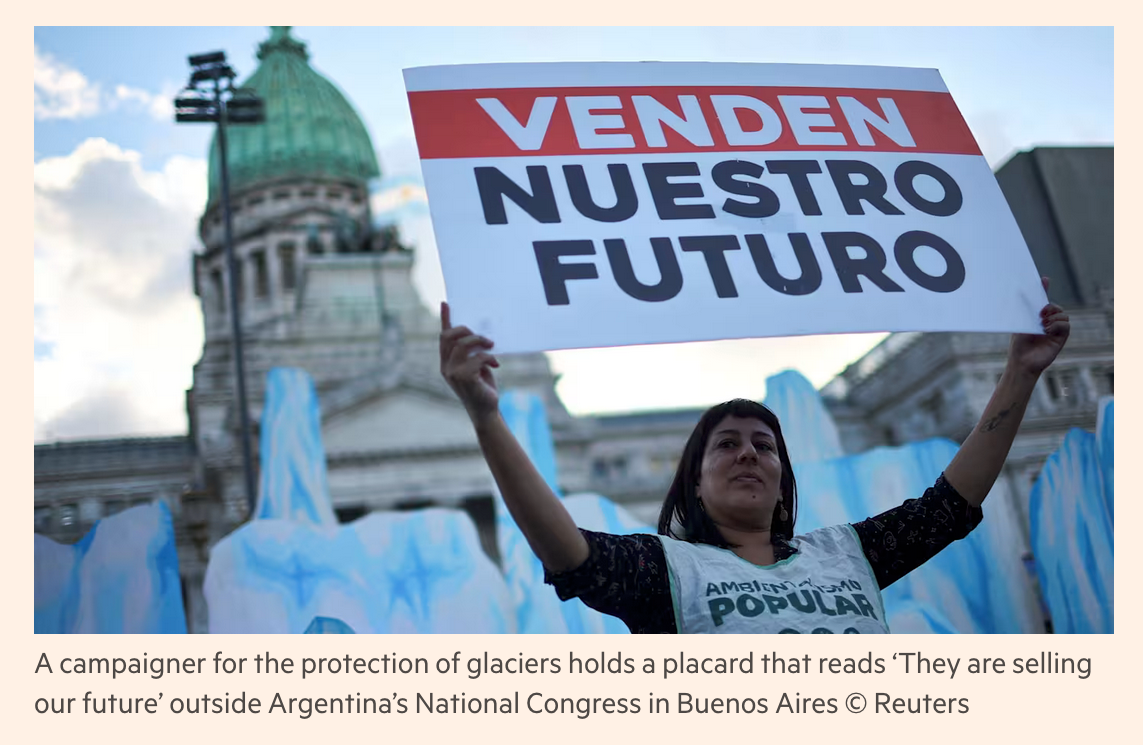
Strengths
- The Legal-Climate Nexus Is Centered: this article documents the precise legal mechanism through which environmental protections are being dismantled. The shift from national minimum standards to provincial discretion is not a technical detail . . . it is the entire story. By naming the constitutional tension and the expected legal challenges, the article frames glacier protection not as an environmental preference but as a contest over governance structure. This is essential reading for understanding how the transition is being contested at the level of law, not just politics.
- The Water Security Framing: the article correctly identifies glaciers as “strategic mountain reserves of water” and notes that they cover only 1% of the Andes but play a “key role in regulating water supply” for arid regions. This re-framing . . . from glaciers as scenic features to glaciers as water infrastructure . . . is the same logic the FT applied to snowpack in the US drought article. It makes the stakes legible to readers who may not care about ice but do care about water.
- The Mining-Milei Connection Is Clear: the article situates the glacier law reform within Milei’s broader project: mining as economic recovery, deregulation, ideological alignment with Trump, combative stance at climate talks. This is not an isolated environmental story; it is a story about a governing philosophy. The mention of the “lithium triangle” . . . Argentina, Chile, Bolivia . . . connects the local reform to global supply chains for the energy transition, introducing a rich irony: the minerals needed for climate solutions are being extracted by dismantling climate protections.
- The Legal Uncertainty Paradox: Andrés Nápoli‘s warning . . . “This will not give investors the legal certainty they are looking for” . . . is the article’s most subversive insight. The reform is sold as clarifying an “unclear” law to unlock investment, but by inviting constitutional challenges and making protections dependent on shifting provincial administrations, it may produce the opposite: prolonged litigation and regulatory volatility. The article lets this contradiction sit unresolved, which is intellectually honest and strategically significant.
- The Public Engagement Metric: the detail that more than 100,000 people registered to participate in public hearings is not decorative. It signals that glacier protection is not an elite preoccupation but a matter of broad public concern in Argentina. This is a valuable counterweight to the narrative that deregulation reflects popular demand.
- The Climate Context Is Present but Not Dominant: the article notes that Andean glaciers “have been shrinking in recent years, according to official data, underscoring their importance as strategic mountain reserves of water in a warming climate.” This is the right calibration: the climate context is provided, but the story remains focused on the political and legal contest. The shrinking glaciers make the reform more consequential, but the article does not let climate overwhelm the governance story.
- Balance Without False Equivalence: the article quotes both supporters (Mayoraz, Cacciola) and opponents (Nápoli, Viale) of the reform, but it does not treat their claims as equally weighted. The supporters’ arguments . . . “does not alter” protections, “clarify aspects” of an unclear law . . . are reported, but the article’s framing (opening with “overhaul,” noting constitutional conflicts, citing specific mining projects) makes clear that this is a substantive rollback, not a technical clarification.
Weaknesses
- The article does not explain what the existing 2010 glacier law actually protects, how many glaciers and periglacial areas are currently covered, or which specific mining projects have been blocked or delayed under the current framework. Readers are told the law is being “overhauled” but not given a clear baseline against which to measure the change.
- The mention of the “lithium triangle” and specific mining companies . . . Barrick Gold, Glencore, Rio Tinto, Lundin Mining . . . is valuable but underdeveloped. The article does not explore the connection between Argentina’s lithium reserves and the global energy transition. Is the glacier reform driven by lithium demand? By gold and copper? The reader is left to infer.
- The article does not address how provincial governments will make determinations about “hydrological significance.” What expertise will they draw on? What is the appeals process? What happens when a glacier spans multiple provinces? The governance vacuum created by the reform is gestured toward but not mapped.
- The Gender Dimension (SDG 5) is entirely absent. Water scarcity in arid regions has gendered impacts . . . women typically bear the burden of water collection and household management when supplies are disrupted. Mining economies have gendered labor profiles. The reform’s implications for women in affected communities are invisible.
- The international dimension is mentioned . . . “international agreements that prohibit the rollback of existing safeguards” . . . but not specified. Which agreements? The Paris Agreement? The Escazú Agreement on environmental access rights in Latin America? Bilateral investment treaties? The legal architecture that might constrain Argentina’s rollback is left vague.
- The article notes that Milei “has yet to sign the measure into law.” This is a crucial detail that could have been elevated. The reform is not yet law, and the moment between legislative passage and presidential signature is often a pressure point for advocacy, legal maneuvers, and international diplomatic engagement. The article treats signature as a formality rather than a strategic window.
Opportunities for C.A.T.
- The “Water Infrastructure” Frame, Extended: FT’s framing of snowpack as water infrastructure in the US drought article now has a companion: glaciers as “strategic mountain reserves of water.” C.A.T. can build a cross-article theme: climate change is degrading the planet’s natural water storage infrastructure . . . snowpack in the American West, glaciers in the Andes, ice sheets in Greenland and Antarctica . . . and policy responses are not keeping pace. This connects local governance battles to global system dynamics.
- The Legal Certainty Paradox as a Strategic Argument: Nápoli’s insight . . . that the reform will not deliver the investment certainty it promises . . . is a gift. C.A.T. can use it to argue that environmental rollbacks are not just morally questionable but strategically self-defeating. Investors need stable rules, not shifting provincial determinations subject to constitutional challenge and electoral reversal. This is a “vocabulary of agency” for engaging with business audiences who may not respond to environmental arguments.
- The Lithium Triangle Irony: Argentina is part of the “lithium triangle” . . . a region whose minerals are essential for the global energy transition. Yet the Milei government is dismantling environmental protections to extract those minerals. C.A.T. can use this irony to complicate the narrative that the transition is a simple story of “green vs. brown.” The transition has its own extractive logic, and governance matters as much as technology.
- The International Agreements Lever: the article mentions that the reform may conflict with international agreements. C.A.T. can research and amplify this dimension. Which specific agreements? Can they be invoked in legal challenges? Can international pressure . . . from trade partners, from climate funds, from multilateral development banks . . . influence the implementation of the reform? This opens a line of inquiry that the article only gestures toward.
- The Public Mobilization Signal: The 100,000+ people registering for public hearings is a data point C.A.T. can track over time. If the reform is signed into law and legal challenges proceed, does public engagement persist? Does it translate into electoral consequences? C.A.T. can monitor whether glacier protection becomes a durable political cleavage in Argentina, with implications for other resource-dependent democracies.
- The Provincial Politics Dimension: the reform shifts power to provincial governments. C.A.T. can track how different provinces exercise this new discretion. Do some provinces maintain strong protections while others open the door to mining? Does this create a “race to the bottom” or a patchwork of varying standards? The provincial level is where the reform will be implemented . . . or contested . . . and C.A.T. can bring granularity to a story that the FT covers at the national level.
- Connecting to the US Drought Story: FT’s US drought article documented snowpack loss and water stress in the American West. This article documents the dismantling of protections for glacial water reserves in the Andes. Both are stories about the governance of water in a warming world. C.A.T. can build a “water governance” theme that spans hemispheres, connecting local policy battles to the global climate crisis.
Threats
- The biggest threat is that this article is read as a purely Argentine story rather than a case study in a global pattern. Milei’s alignment with Trump, the push for mining deregulation, the dismantling of environmental protections . . . these dynamics are playing out in multiple jurisdictions. If the article is siloed as “Latin America news,” its relevance to C.A.T.’s broader themes is diminished.
- A second threat is that the reform is normalized as a technical adjustment. Mayoraz claims the changes “do not alter” glacier protection. Cacciola claims they merely “clarify aspects of the current law that are unclear.” If these framings gain traction, the substantive rollback is obscured. The legal challenges that Nápoli and Viale anticipate are crucial to preventing this normalization.
- A third threat is that the international climate community . . . focused on COP negotiations, NDCs, and finance pledges . . . misses the significance of subnational governance battles. Glacier protection in Argentina may seem marginal compared to global emissions trajectories, but it is precisely at this scale . . . the specific legal provision, the provincial determination, the mining permit . . . that the transition is being shaped.
- A fourth threat is that the lithium demand narrative overwhelms the water security narrative. The “lithium triangle” framing can make the reform seem like a necessary accommodation for the energy transition . . . a trade-off between local environmental protection and global climate action. This is a false choice, but it is a rhetorically powerful one. C.A.T. must be prepared to counter it.
- A fifth threat is that Milei signs the law quickly and implementation proceeds before legal challenges can be mounted. The window for intervention may be narrow. If C.A.T. wants to amplify this story, timing matters.
- A sixth threat is that the shrinking Andean glaciers . . . mentioned in the final paragraph . . . are treated as background context rather than the central fact that makes the reform so consequential. The reform is not happening in a stable climate; it is happening in a climate where the very glaciers being deregulated are already disappearing. This should be the lede, not the footnote.
Analysis Through Lenses
United Nations Lens (IPCC/UNFCCC): from a UN climate governance perspective, this article is a documentation of retreat of legal protections. The 2010 glacier law was a national implementation of the principle that environmental safeguards should be minimum, binding, and not subject to local derogation. The “reform” replaces that with provincial discretion. For the UNFCCC process, this is a warning: national commitments (NDCs) can be hollowed out by subnational implementation. The Paris Agreement relies on the assumption that national governments can deliver on their pledges. Argentina’s glacier reform shows how easily that assumption can break down. The article’s mention of “international agreements that prohibit the rollback of existing safeguards” raises the question of whether the UN system has any enforcement mechanism to prevent this kind of deregulation. The answer, historically, is no.
EU Green New Deal Lens: for Brussels, this article is a reminder that the EU’s demand for lithium, copper, and other transition minerals has downstream governance consequences. The EU’s Critical Raw Materials Act sets targets for domestic extraction and processing, but it also commits to “sustainable and responsible sourcing” from third countries. Argentina’s glacier reform tests that commitment. Will the EU apply its sustainability standards to Argentine lithium imports? Will it condition trade preferences on environmental governance? Or will it look the other way because the minerals are needed for the Green Deal? The article does not mention the EU, but the connection is implicit. C.A.T. asks directly: Europe’s transition runs through the Andes, and how will Europe incarnate our choices about the standards we demand?
Draghi Report Lens: Mario Draghi’s report called for Europe to secure its supply chains for critical raw materials. Argentina . . . part of the “lithium triangle” . . . is a key potential supplier. But Draghi also emphasized that Europe should not replicate the dependencies and governance failures of the fossil fuel era. The glacier reform is a test of that principle. Will European mining companies (Rio Tinto, Glencore are mentioned) operate to higher standards in Argentina than domestic law requires? Will European investors demand legal certainty that the reform, paradoxically, may undermine? The article suggests that the reform may not deliver the investment climate it promises. Draghi’s framework would ask: what kind of partnership with Argentina serves Europe’s long-term interests . . . one that accepts deregulation, or one that insists on stable, enforceable environmental standards?
Mark Jacobson Lens: through Jacobson’s framework, this article is a cautionary tale about the material demands of the transition. Jacobson’s 100% wind-water-solar roadmaps require industrial quantities of lithium, copper, and other minerals. Jacobson also emphasizes that the transition must be just and sustainable across the entire supply chain. The glacier reform raises the question: is the transition being built on the same extractive logic that characterized the fossil fuel era? Mining in glacier-adjacent areas, with weakened environmental protections, to supply minerals for electric vehicles and grid storage . . . this is not a clean break with the past. Jacobson would argue that the transition must be accompanied by governance reforms that protect water, ecosystems, and communities. The technology is necessary, but it is not sufficient. The glacier reform is a reminder that the transition is a political and legal project, not just a technological one.
SDG Ratings
| SDG | Rating | Rationale |
|---|---|---|
| SDG 1 No Poverty | 4/10 ★★★★☆☆☆☆☆☆ | Mining as economic recovery framed; poverty and distributional impacts of water stress not explored |
| SDG 2 Zero Hunger | 3/10 ★★★☆☆☆☆☆☆☆ | Glacier-fed water supports agriculture in arid regions; food security implications implicit |
| SDG 3 Good Health and Well-Being | 3/10 ★★★☆☆☆☆☆☆☆ | Water security and health connection not explored; mining health impacts absent |
| SDG 4 Quality Education | 1/10 ★☆☆☆☆☆☆☆☆☆ | Not addressed |
| SDG 5 Gender Equality | 0/10 ☆☆☆☆☆☆☆☆☆☆ | Complete absence; gendered impacts of water scarcity and mining economies invisible |
| SDG 6 Clean Water and Sanitation | 10/10 ★★★★★★★★★★ | Central focus; glaciers as “strategic mountain reserves of water,” Andean water security, arid region dependence |
| SDG 7 Affordable and Clean Energy | 2/10 ★★☆☆☆☆☆☆☆☆ | Mining for energy transition minerals implicit; not explored |
| SDG 8 Decent Work and Economic Growth | 6/10 ★★★★★★☆☆☆☆ | Mining as economic pillar; job quality and labor conditions not addressed |
| SDG 9 Industry, Innovation and Infrastructure | 6/10 ★★★★★★☆☆☆☆ | Mining infrastructure, lithium triangle supply chains; infrastructure planning absent |
| SDG 10 Reduced Inequalities | 5/10 ★★★★★☆☆☆☆☆ | Provincial vs. national standards creates potential for uneven protections; distributional impacts not analyzed |
| SDG 11 Sustainable Cities and Communities | 3/10 ★★★☆☆☆☆☆☆☆ | Glacier-fed water supports urban areas in arid regions; not explored |
| SDG 12 Responsible Consumption and Production | 7/10 ★★★★★★★☆☆☆ | Mining governance, resource extraction standards; responsible sourcing implicit |
| SDG 13 Climate Action | 8/10 ★★★★★★★★☆☆ | Glacier shrinkage context provided; climate implications of mining not addressed; policy rollback in warming world is central tension |
| SDG 14 Life Below Water | 0/10 ☆☆☆☆☆☆☆☆☆☆ | Not addressed |
| SDG 15 Life on Land | 9/10 ★★★★★★★★★☆ | Glacier and periglacial ecosystem protection central; Andean mountain ecosystems at stake |
| SDG 16 Peace, Justice and Strong Institutions | 10/10 ★★★★★★★★★★ | Core focus; constitutional conflict, legal challenges, governance shift from national to provincial, institutional design |
| SDG 17 Partnerships for the Goals | 4/10 ★★★★☆☆☆☆☆☆ | International agreements mentioned; global supply chains for transition minerals; partnerships not explored |
9th April 2026: Financial Times Columnist Alexandra White reports that Vermont and New York’s landmark “climate superfund” laws . . . passed in 2024 to allow states to seek climate-related damages from fossil fuel companies . . . are facing legal challenges from industry groups and a coalition of red states. New York expects to seek $75 Billion over 25 years from oil and gas groups, while Vermont has not publicly disclosed its figure. The US Department of Justice has joined the fight to block the laws, arguing they are unconstitutional because states are not legally authorised to regulate emissions that cross state and international boundaries. A pending US Supreme Court case . . . stemming from a 2018 lawsuit by Boulder, Colorado against ExxonMobil and Suncor . . . could establish precedent on whether oil and gas companies can be sued under state law. An oil industry insider said: “If the Supreme Court case goes the direction that I suspect it will, I think that will inform how the courts dispose of these climate superfund laws.” However, Columbia University’s Michael Gerrard noted that the Trump administration’s repeal of the endangerment finding could strengthen states’ arguments for stepping in: “The states are saying that EPA has the authority to regulate greenhouse gas emissions, but now that they’ve revoked the endangerment finding, they’re not doing that. Therefore that leaves the states open to do it” https://www.ft.com/climate-superfund-states
Overall C.A.T. Usefulness: 9/10 ★★★★★★★★★☆
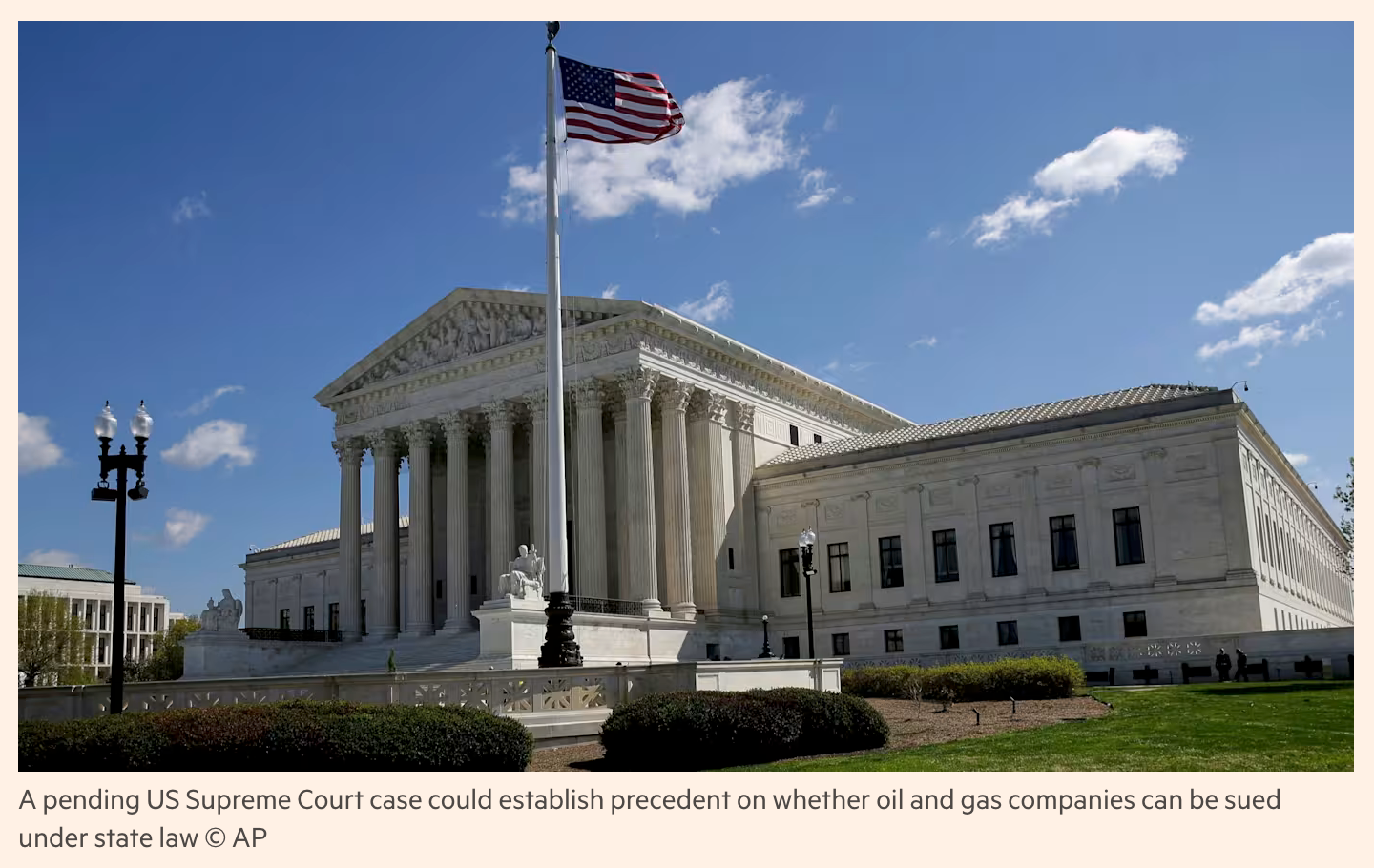
Strengths: This article captures a pivotal legal battle at the intersection of climate liability, state authority, and federal deregulation. Its key strengths are:
- The $75 Billion Signal: New York expects to seek $75 Billion over 25 years from oil and gas groups. This is not a symbolic figure; it is a material liability. The article does not specify how the figure was calculated, but the magnitude alone signals that states are serious about holding fossil fuel companies financially accountable for climate damages.
- The Legal Frontier: The article identifies the pending Supreme Court case (Boulder vs. ExxonMobil and Suncor) as the key precedent. An oil industry insider’s candid assessment . . . “If the Supreme Court case goes the direction that I suspect it will, I think that will inform how the courts dispose of these climate superfund laws”. . . reveals that the industry expects a favourable ruling from the conservative-majority court.
- The Endangerment Finding Reversal: Michael Gerrard’s argument is the strategic heart of the article. The Trump administration’s repeal of the endangerment finding . . . documented in an earlier article . . . removes the federal government’s authority to regulate greenhouse gases. Gerrard argues that this creates a vacuum that states can legitimately fill. The administration’s deregulation may inadvertently empower state climate action.
- The Industry Warning: Ryan Meyers of the American Petroleum Institute warns that the superfund laws could set a “dangerous new legal precedent” and that they are part of a “co-ordinated campaign against an industry that is vital to everyday life.” This is standard industry rhetoric, but the article includes it without endorsement, allowing readers to judge its credibility.
- The Red State Coalition: The article notes that a coalition of red states has joined industry groups in suing to block the laws. This is not just industry vs. environment; it is a partisan legal battle. The US Department of Justice has also joined the fight against the states. The alignment is clear: Republican-led states and the federal government are defending fossil fuel companies.
- The Vermont Law School Voice: Patrick Parenteau’s distinction between the New York City public nuisance case (which the oil companies won) and the current cases based on allegations of deception is a crucial legal nuance. He calls the New York City decision “an outlier” and does not think the Supreme Court will follow it. This gives hope to climate liability advocates.
Weaknesses: The article has no significant weaknesses. It is concise, legally informed, and strategically aware. If pressed, one could note that:
- The Missing $75 Billion Calculation: The article reports that New York expects $75 Billion over 25 years but does not explain how this figure was derived. Is it based on historical emissions? Projected damages? A percentage of profits? The lack of methodological transparency weakens the reader’s ability to assess the credibility of the claim.
- The Gender Dimension (SDG 5): As with almost all legal and political reporting, the article is silent on gender. The climate damages sought by the states will be used for “local climate resilience projects.” The article does not ask whether those projects will address the gendered impacts of climate change . . . which are well documented and disproportionately affect women.
- The Supreme Court Timeline: The article notes that the Supreme Court will hear arguments “later this year” but does not provide a specific timeline. The outcome of the Boulder case could take months or years. The article’s urgency is somewhat undercut by the slow pace of litigation.
Opportunities for C.A.T.: This article provides C.A.T. with a critical update on the legal front of climate accountability:
- The Endangerment Finding Reversal as a Strategic Opening: Gerrard’s argument is a powerful frame. The Trump administration’s repeal of the endangerment finding . . . intended to deregulate . . . may actually empower state climate action by removing federal preemption. C.A.T. can use this to argue that deregulation creates a vacuum that states, cities, and communities can fill.
- The $75bn Liability Signal: Even if the superfund laws are struck down, the fact that New York is seeking $75 Billion signals that the era of fossil fuel companies avoiding financial accountability may be ending. C.A.T. can use this to track the growing movement for climate liability.
- The Precedent Watch: The Supreme Court’s decision in the Boulder case will determine whether states can sue fossil fuel companies under state law. C.A.T. should track this case closely. A favourable ruling could open the door to dozens of similar lawsuits. An unfavourable ruling could shut down the climate superfund movement.
- The Partisan Alignment: The article reveals that red states and the federal government are aligned with fossil fuel companies against blue states. C.A.T. can use this to argue that climate accountability has become a partisan issue . . . and that the outcome of the 2026 midterm elections could reshape the legal landscape.
- The Deception Allegation: Parenteau distinguishes the current cases (based on allegations of deception) from the New York City case (based on public nuisance). The oil industry’s historical deception about climate science . . . documented in the “Exxon knew” reporting . . . could be the legal hook that holds them accountable.
Threats:
- The biggest threat is that the Supreme Court rules against the states. The article notes that the court’s conservative majority “has been hostile to environmental and climate cases in the past.” An unfavourable ruling could kill the climate superfund laws in Vermont and New York and deter other states from pursuing similar legislation.
- A second threat is that the industry’s “dangerous precedent” argument resonates with the court. If the court accepts that holding fossil fuel companies liable for emissions would create a precedent that could extend to electric utilities, carmakers, and other industries, the justices may rule narrowly to avoid opening a floodgate of litigation.
- A third threat is that the repeal of the endangerment finding backfires. Gerrard argues that it strengthens states’ arguments. But the Supreme Court could also rule that without federal authority to regulate emissions, states also lack authority . . . that climate change is a global problem requiring a federal solution, and that state-level lawsuits are an improper patchwork.
- A fourth threat is that the $75 Billion figure becomes a political liability. If the superfund laws are portrayed as a “tax on energy” that will raise consumer prices, public support could erode. The article notes that industry groups are already making this argument.
- A fifth threat is that the litigation drags on for years. Even if the Supreme Court rules in favour of the states, the lawsuits will then proceed to discovery, trial, and appeals. The oil companies have deep pockets and every incentive to delay. The children of Youth4Planet may be adults before any money changes hands.
Analysis Through Lenses:
United Nations Lens (IPCC/UNFCCC): From a UN climate governance perspective, this article is a case study in the fragmentation of climate accountability. The UNFCCC process has focused on nation-state emissions targets and climate finance. But the real action on accountability may be happening in state courts and legislatures. The article’s $75bn figure dwarfs the Loss and Damage fund established at COP28. If states succeed in holding fossil fuel companies liable, it could create a model for climate litigation globally.
EU Green New Deal Lens: For Brussels, this article should be read as a warning and an opportunity. The warning: the US is fragmenting. Red states and the federal government are aligned with fossil fuel companies; blue states are pursuing climate accountability. The EU’s unified approach to climate policy looks increasingly stable by comparison. The opportunity: the EU could establish its own climate liability framework, learning from the US legal battles. The Green Deal’s emphasis on “polluter pays” could be operationalised through legislation that holds fossil fuel companies accountable for historical emissions.
Draghi Report Lens: Mario Draghi’s report called for Europe to close the investment and innovation gap. It did not address climate liability. But the two are connected. If US states succeed in extracting $75bn from fossil fuel companies, that money could fund climate resilience projects . . . exactly the kind of investment Draghi calls for. The question is whether Europe will establish similar liability mechanisms, or whether it will leave the money on the table.
Mark Jacobson Lens: Through Jacobson’s framework, this article is about accountability for the delay. Jacobson’s roadmaps for 100% wind-water-solar have been available for decades. The fossil fuel industry fought them. If the climate superfund laws succeed, they would force the industry to pay for the consequences of that delay. Jacobson would likely support this as a matter of justice. But he would also note that lawsuits are slow. The money from the $75bn settlement, even if it materialises, will come years or decades after the emissions were released. The climate does not wait for the courts.
SDG Ratings:
| SDG | Rating | Rationale |
|---|---|---|
| SDG 1 No Poverty | 4/10 ★★★★☆☆☆☆☆☆ | Funds would support resilience projects; consumer price impact warning noted |
| SDG 2 Zero Hunger | 0/10 ☆☆☆☆☆☆☆☆☆☆ | Not addressed |
| SDG 3 Good Health and Well-Being | 3/10 ★★★☆☆☆☆☆☆☆ | Climate damages affect health; not explored |
| SDG 4 Quality Education | 1/10 ☆☆☆☆☆☆☆☆☆☆ | Not addressed |
| SDG 5 Gender Equality | 0/10 ☆☆☆☆☆☆☆☆☆☆ | Complete absence. Climate damages and resilience projects have gendered dimensions; all invisible |
| SDG 6 Clean Water and Sanitation | 1/10 ☆☆☆☆☆☆☆☆☆☆ | Not addressed |
| SDG 7 Affordable and Clean Energy | 4/10 ★★★★☆☆☆☆☆☆ | Industry argues superfund laws will raise energy costs; not central to article |
| SDG 8 Decent Work and Economic Growth | 3/10 ★★★☆☆☆☆☆☆☆ | Fossil fuel industry as “engine of America’s economy”; job impacts not explored |
| SDG 9 Industry, Innovation and Infrastructure | 2/10 ★★☆☆☆☆☆☆☆☆ | Not addressed |
| SDG 10 Reduced Inequalities | 5/10 ★★★★★☆☆☆☆☆ | Red state vs. blue state; climate damages disproportionately affect vulnerable communities |
| SDG 11 Sustainable Cities and Communities | 4/10 ★★★★☆☆☆☆☆☆ | Resilience projects for local communities; not explored in depth |
| SDG 12 Responsible Consumption and Production | 2/10 ★★☆☆☆☆☆☆☆☆ | Not addressed |
| SDG 13 Climate Action | 9/10 ★★★★★★★★★☆ | Core focus; climate liability, superfund laws, accountability for emissions |
| SDG 14 Life Below Water | 0/10 ☆☆☆☆☆☆☆☆☆☆ | Not addressed |
| SDG 15 Life on Land | 1/10 ☆☆☆☆☆☆☆☆☆☆ | Not addressed |
| SDG 16 Peace, Justice and Strong Institutions | 8/10 ★★★★★★★★☆☆ | Legal challenges, Supreme Court, state vs. federal authority, rule of law |
| SDG 17 Partnerships for the Goals | 3/10 ★★★☆☆☆☆☆☆☆ | Coalition of red states, industry groups, federal government alignment |
9th April 2026: Financial Times journalist Martin Arnold reports that EU insurance + pensions + financial regulators have called for the creation of a €10 billion to €65 billion EU-wide risk-sharing mechanism to close the growing insurance gap for natural and climate disasters. The proposal . . . jointly authored by the European Insurance and Occupational Pensions Authority (EIOPA) and the European Stability Mechanism (ESM) . . . would allow the bloc to leverage its strong credit rating to raise cheaper funding in debt markets and provide reinsurance cover for major events including floods, wildfires, storms, heatwaves, and earthquakes. The urgency is underscored by stark data: only €4.5 billion of the €11 billion in losses from the 2024 Valencia floods were insured, and only €13 billion of the €51 billion in losses from the 2021 Ahr valley floods were covered. Europe is warming at twice the global average. Natural catastrophes have caused more than €900 billion in damage across the EU since 1981 . . . only a fraction of which was insured. The regulators argue that pooling risks across countries and perils could reduce capital requirements by up to 67%, lower reinsurance costs, and reduce reliance on ad hoc government bailouts https://www.ft.com/content/a149226e-65b7-4d70-ae5c-f0f24236802f?syn-25a6b1a6=1
Overall C.A.T. Usefulness: 10/10 ★★★★★★★★★★
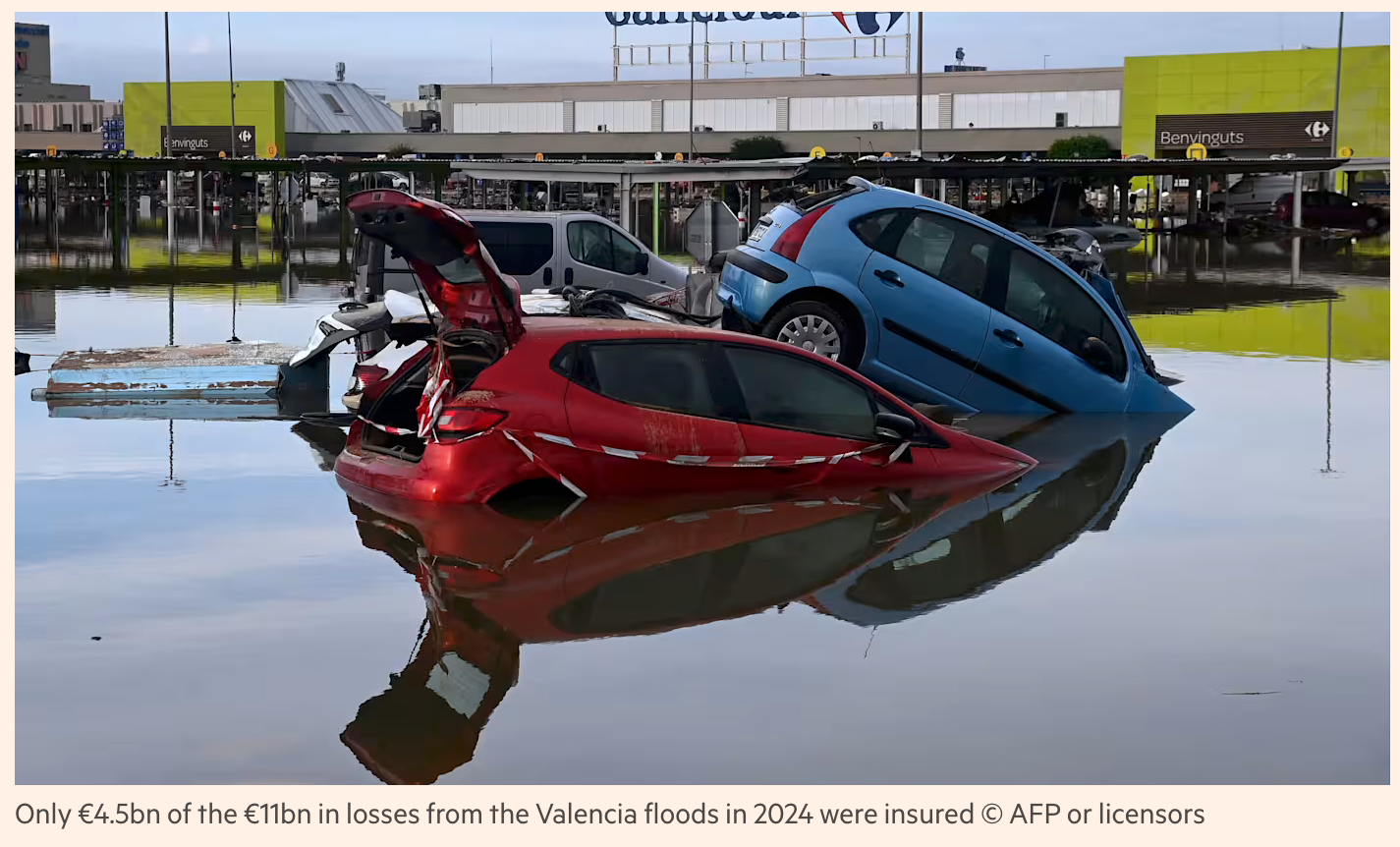
Strengths
- The Insurance Gap Is Quantified with Precision: the article provides concrete, comparable figures that make the scale of the problem legible. Valencia 2024: €11 billion losses, €4.5 billion insured (41% coverage). Ahr valley 2021: €51 billion losses, €13 billion insured (25% coverage). These are not abstract percentages; they are specific disasters that readers may remember, attached to specific financial shortfalls that real households and businesses experienced. This is how you make climate risk tangible without relying on future projections alone.
- The Institutional Architecture Is Clear: the article explains not just what is being proposed . . . a €10 billion to €65 billion pool . . . but how it would work. The EU would use its credit rating to raise cheaper debt funding. The mechanism would provide loans, not grants, making it fiscally neutral. It would complement . . . not replace . . . existing national schemes like Spain’s Consorcio and France’s Caisse Centrale de Réassurance. This level of institutional detail is rare in climate finance reporting and invaluable for readers who need to understand how the mechanism would actually function.
- The “Fiscally Neutral” Framing Is Strategically Significant: the article explicitly notes that the scheme would be “fiscally neutral for the EU” because it would provide loans rather than grants, with the pool funded primarily by premiums collected from insurers. This is a crucial framing for political viability. The proposal is not a new spending program; it is a liquidity backstop that leverages the EU’s balance sheet without adding to deficits. C.A.T. can use this to counter the narrative that climate adaptation is fiscally unsustainable.
- The 67% Capital Reduction Figure: the estimate that pooling risks across countries and perils could reduce required capital by as much as 67% is the article’s most powerful efficiency argument. This is the logic of insurance made visible at the continental scale: diversification works. A flood in Valencia and a wildfire in Greece and a windstorm in Belgium do not all happen at the same time. Pooling them reduces the capital needed to cover them. This is a technical point with profound political implications: European solidarity is not charity; it is mathematically efficient.
- The Geographic Specificity: the article names the countries with the largest protection gaps . . . Italy, Greece, Bulgaria . . . and notes that others like France, Spain, and Belgium have relatively small gaps. This granularity allows readers to see that the insurance gap is not uniform across the EU. It also raises the political question that the article does not answer but invites: will countries with smaller gaps be willing to participate in a pool that disproportionately benefits countries with larger gaps?
- The Warming Context Is Present and Precise: the article states plainly: “Europe is the fastest-warming continent, heating at about twice the global average, in part because of its proximity to the Arctic.” This is not editorializing; it is the physical context that makes the insurance proposal necessary. The mechanism is not being proposed for a stable climate; it is being proposed for a climate that is destabilizing faster in Europe than almost anywhere else on Earth.
- The Distinction Between Perils: the article notes that earthquakes have the largest insurance protection gap because they are “rare events that can cause major damage,” while wind storms have the highest level of cover. This distinction is important. It shows that the insurance gap is not just about climate change; it is also about the fundamental challenge of insuring low-probability, high-impact events. The climate crisis amplifies this challenge by making previously rare events . . . floods, heatwaves, wildfires . . . more frequent.
Weaknesses
- The article does not explain why Italy, Greece, and Bulgaria have the largest protection gaps. Is it income levels? Regulatory frameworks? Historical experience with disasters? The geography of risk? Without this context, the gap appears as a technical fact rather than a political economy question.
- The “€10 billion to €65 billion” range is wide . . . a factor of 6.5 . . . and the article does not unpack what determines where on that spectrum the final figure would fall. The regulators say it depends on “risk appetite” and “climate change dynamics,” but these terms are left undefined. What level of risk appetite would justify €10 billion versus €65 billion? What climate scenarios are being modeled?
- The article does not address the political obstacles to creating an EU-wide mechanism. The insurance sector is nationally regulated. National schemes already exist in several countries. Will member states . . . particularly those with well-functioning national schemes like France and Spain . . . support a new EU layer? The article reports that the regulators say the EU vehicle would “complement” national schemes, but it does not explore whether member states agree.
- The Gender Dimension (SDG 5) is entirely absent. Disaster recovery is not gender-neutral. Women are disproportionately affected by displacement, by the loss of household assets, and by the care burdens that follow disasters. Insurance payouts . . . who receives them, who controls them, who is named on policies . . . have gendered dynamics. None of this appears in the article.
- The article does not connect the insurance gap to the broader question of managed retreat. If some areas become uninsurable . . . or insurable only at prohibitive cost . . . what happens to the people and businesses located there? The insurance mechanism is presented as a solution to the coverage gap, but it does not ask whether coverage should be provided in all locations at all.
- The €900 billion figure . . . total natural catastrophe damage since 1981 . . . is presented without comparison to other EU spending categories. Is this more than the EU’s entire seven-year budget? More than the Recovery and Resilience Facility? The number is large, but without context, its scale is difficult to grasp.
- The article mentions that the proposal comes from EIOPA and the ESM but does not explain the significance of the ESM’s involvement. Luxembourg-based ESM is the eurozone’s bailout fund, created during the sovereign debt crisis. Its participation signals that this proposal is being taken seriously at the highest levels of EU financial governance, but the article does not make this explicit.
Opportunities for C.A.T.
- The “Insurance Gap” as a Climate Metric: the insurance protection gap . . . the difference between total losses and insured losses . . . is a metric C.A.T. can track systematically. It is a market-based indicator of climate vulnerability that does not depend on climate models or political commitments. As the gap widens, it signals that the financial system is failing to price and allocate climate risk. C.A.T. can monitor this metric across regions and over time.
- The “Fiscally Neutral” Frame as a Rebuttal: the article’s emphasis that the scheme would be fiscally neutral . . . loans, not grants; premiums, not taxes . . . is a powerful counter to the narrative that climate adaptation is a fiscal burden. C.A.T. can use this to argue that smart institutional design can deliver resilience without expanding government deficits. This is a “vocabulary of agency” for engaging with fiscally conservative audiences.
- The 67% Efficiency Argument: the estimate that pooling risks can reduce capital requirements by up to 67% is a mathematical argument for European solidarity. C.A.T. can amplify this: climate risk shared is climate risk reduced. The same logic applies to energy grids (interconnectors reduce the need for backup capacity), to water systems, to food supply chains. The insurance pool is a specific application of a general principle: in a destabilizing climate, integration is efficiency.
- The ESM Connection: the involvement of the European Stability Mechanism . . . the institution created to backstop sovereign debt . . . is a signal that climate risk is being recognized as a systemic financial risk. C.A.T. can track this institutional migration: climate policy is moving from environment ministries to finance ministries, from the European Environment Agency to the ESM. This is a structural shift worth documenting.
- The National vs. EU Tension: the article notes that several countries already have national reinsurance schemes and that the EU mechanism would “complement” rather than replace them. This raises a question C.A.T. can monitor: will the EU mechanism actually complement national schemes, or will it create political friction? Will countries with strong national schemes resist contributing to an EU pool? This is a live political question that will play out over the coming months.
- The Adaptation Finance Gap, Grounded: the global conversation about adaptation finance often takes place at high levels of abstraction . . . “billions to trillions” + “blended finance” + “MDB reform.” This article grounds the conversation in a specific, actionable proposal with a defined institutional architecture and a clear funding range. C.A.T. can use this as a case study in what adaptation finance actually looks like when it moves from rhetoric to institutional design.
- Connecting to the US Drought Story: the FT’s US drought article documented snowpack loss and water stress in the American West. The Valencia and Ahr valley floods documented in this article are the flip side of the same coin: a warming atmosphere holds more water, producing both more intense drought and more intense precipitation. The insurance gap is a measure of how unprepared societies are for this new hydrological reality. C.A.T. can build a “water extremes” theme that connects drought and flood as two manifestations of the same physical process.
- The Youth Dimension: young Europeans will live with the consequences of today’s insurance gap for decades. A 20-year-old today will be 44 in 2050. The homes they buy, the businesses they start, the communities they build . . . all will be shaped by whether Europe closes its insurance gap now or allows it to widen. C.A.T. can frame this as an inter-generational equity question: delaying action on the insurance gap transfers risk to the young.
Threats
- The biggest threat is that this proposal is read as a technical financial adjustment rather than a structural response to a destabilizing climate. The article’s focus on institutional mechanics . . . premiums, loans, capital requirements . . . could obscure the underlying physical reality: Europe is warming twice as fast as the global average, and the current insurance model is breaking.
- A second threat is that the €10 billion to €65 billion range becomes a point of political contention that delays action. Member states may debate the “right” number rather than agreeing to a mechanism that can be scaled over time. The regulators’ note that funding “may have to grow over time” is crucial . . . but it could also be used as an argument for starting small and delaying.
- A third threat is that the proposal is perceived as a bailout for the insurance industry rather than a backstop for households and businesses. The article describes the mechanism as providing “cover to insurers,” which is technically accurate . . . but the ultimate beneficiaries are policyholders. If this distinction is lost, the political support for the proposal could erode.
- A fourth threat is that the national schemes in France, Spain, and other countries become a barrier to EU-level action. If countries with functioning national schemes see little benefit in an EU pool, they may block or dilute the proposal. The “complementarity” framing is politically necessary but may not be sufficient.
- A fifth threat is that the proposal addresses the symptom . . . the insurance gap . . . but not the cause . . . emissions. The article does not mention mitigation or the energy transition. An insurance pool that makes it easier to rebuild in high-risk areas could, perversely, lock in exposure that should be reduced through managed retreat or stricter land-use planning.
- A sixth threat is that the fiscal neutrality of the scheme is overstated. The article says the scheme would be fiscally neutral “because it would provide loans rather than grants.” But loans must be repaid. If a disaster exhausts the pool’s premium revenue and it draws on the EU backstop, who repays that loan? Over what time horizon? The fiscal neutrality claim deserves scrutiny.
- A seventh threat is that the 67% capital reduction figure is taken as a precise estimate rather than a modeling output dependent on assumptions about correlation between perils. In a world where climate change is increasing the correlation between extreme events . . . where drought in one region and flood in another may be driven by the same atmospheric patterns . . . the diversification benefit of pooling may be smaller than the model suggests.
Analysis Through Lenses
United Nations Lens (IPCC/UNFCCC): from a UN climate governance perspective, this article is a documentation of what “Loss and Damage” looks like in a high-income context. The UNFCCC has spent years debating how to compensate developing countries for climate impacts they did not cause. The Valencia and Ahr valley floods show that even wealthy European countries are struggling to finance recovery from climate-driven disasters. The insurance gap in Europe is a reminder that adaptation is not just a developing-country concern; it is a universal challenge. The UN’s Sendai Framework for Disaster Risk Reduction calls for risk transfer mechanisms like insurance pools. The EU proposal is a concrete implementation of that principle at the regional scale. For the UN system, the question is whether this model can be replicated in other regions . . . the African Union, ASEAN, Mercosur . . . or whether it remains a European exception.
EU Green New Deal Lens: for Brussels, this article is a milestone. The Green Deal has focused primarily on mitigation . . . emissions reduction, renewable energy, the energy transition. Adaptation has been a secondary pillar. The EIOPA-ESM proposal signals that adaptation is moving to the center of the EU’s financial architecture. The involvement of the ESM . . . a core institution of the eurozone . . . indicates that climate risk is being recognized as a systemic threat to financial stability. The question for the Green Deal is whether this insurance mechanism is integrated with broader adaptation planning. Does the EU have a framework for determining where insurance should be provided and where retreat should be encouraged? Or is the insurance pool a standalone financial instrument without a spatial strategy?
Draghi Report Lens: Mario Draghi’s report called for Europe to mobilize investment at scale to close the competitiveness gap with the US and China. The insurance gap documented in this article is a competitiveness issue. Businesses cannot invest in regions where they cannot insure their assets. Households cannot build wealth if their homes are uninsurable or under-insured. The €10 billion to €65 billion pool is not a cost; it is an enabler of investment. Draghi’s framework would ask: does this proposal go far enough? Is €65 billion sufficient given the trajectory of climate risk in Europe? Or is this a down payment on a much larger adaptation finance requirement?
Mark Jacobson Lens: through Jacobson’s framework, this article is a case study in the costs of delay. Jacobson’s 100% wind-water-solar roadmaps are designed to arrest the accumulation of heat that drives the floods, wildfires, and storms that create the insurance gap. Every ton of CO₂ emitted today increases the frequency and intensity of the disasters that the EU insurance pool will have to cover tomorrow. The article’s note that Europe is warming “at about twice the global average” is a direct consequence of Arctic amplification . . . a process that will continue as long as emissions continue. Jacobson would argue that the insurance pool is necessary, and it is not sufficient. The primary task is to eliminate emissions as fast as technically possible. The insurance pool is a bridge to a lower-risk future, and it cannot be the destination.
SDG Ratings
| SDG | Rating | Rationale |
|---|---|---|
| SDG 1 No Poverty | 7/10 ★★★★★★★☆☆☆ | Insurance gap leaves households exposed to financial ruin after disasters; closing gap protects household wealth |
| SDG 2 Zero Hunger | 2/10 ★★☆☆☆☆☆☆☆☆ | Agricultural losses from disasters implicit; not addressed |
| SDG 3 Good Health and Well-Being | 4/10 ★★★★☆☆☆☆☆☆ | Disaster recovery and health connection not explored; mental health impacts of uninsured losses implicit |
| SDG 4 Quality Education | 1/10 ★☆☆☆☆☆☆☆☆☆ | Implicit connection not addressed |
| SDG 5 Gender Equality | 0/10 ☆☆☆☆☆☆☆☆☆☆ | Complete absence; gendered impacts of disasters and insurance access invisible |
| SDG 6 Clean Water and Sanitation | 3/10 ★★★☆☆☆☆☆☆☆ | Floods mentioned; water infrastructure and insurance not connected |
| SDG 7 Affordable and Clean Energy | 1/10 ★☆☆☆☆☆☆☆☆☆ | Implicit connection not addressed |
| SDG 8 Decent Work and Economic Growth | 7/10 ★★★★★★★☆☆☆ | Uninsured business losses undermine economic recovery; insurance pool supports investment certainty |
| SDG 9 Industry, Innovation and Infrastructure | 6/10 ★★★★★★☆☆☆☆ | Financial infrastructure for disaster resilience; institutional innovation (EU risk-sharing mechanism) |
| SDG 10 Reduced Inequalities | 6/10 ★★★★★★☆☆☆☆ | Insurance gap varies by country (Italy, Greece, Bulgaria highest); pool reduces disparities in coverage |
| SDG 11 Sustainable Cities and Communities | 8/10 ★★★★★★★★☆☆ | Disaster resilience central; uninsured losses undermine community recovery; urban and rural communities affected |
| SDG 12 Responsible Consumption and Production | 2/10 ★★☆☆☆☆☆☆☆☆ | Implicit connection not addressed |
| SDG 13 Climate Action | 9/10 ★★★★★★★★★☆ | Core focus; climate-driven disasters, warming Europe, adaptation finance, resilience |
| SDG 14 Life Below Water | 1/10 ★☆☆☆☆☆☆☆☆☆ | Coastal flooding implicit; not addressed |
| SDG 15 Life on Land | 3/10 ★★★☆☆☆☆☆☆☆ | Wildfires mentioned; ecosystem impacts of disasters not explored |
| SDG 16 Peace, Justice and Strong Institutions | 9/10 ★★★★★★★★★☆ | Institutional design (EIOPA, ESM, EU-wide mechanism); governance of risk; complementarity with national schemes |
| SDG 17 Partnerships for the Goals | 8/10 ★★★★★★★★☆☆ | EU-level cooperation central; pooling risks across countries; ESM-EIOPA partnership |
8th April 2026: Financial Times Journalists Ian Johnston, Amy Kazmin, and Rachel Millard report that surging gas prices driven by the Iran war are pushing countries in Asia and Europe towards coal to power their economies. Thailand has restarted coal-fired power plants since the start of the Middle East conflict. Japan and South Korea have lifted caps on burning the polluting fuel. Italy has delayed a deadline for ending coal-fired power by more than a decade, to 2038. Germany’s coal plants have been producing more electricity than its gas-fired power stations since the war began. However, analysts argue that the war should accelerate the deployment of cleaner technologies in the long run, as governments look to cut reliance on fossil fuel imports from volatile regions. Miguel Stilwell d’Andrade, CEO of renewables developer EDP, said: “Broadly speaking, it’s positive for renewables. It just reinforces the idea that we need to be more [energy] independent and renewables are more immune to shocks.” Global renewable installed capacity has climbed about 50% since the end of 2022 to 5.1 terawatts, while global coal capacity has risen by 6% to about 2.2TW over the same period. The price of solar panels plummeted by nearly 70% between the start of 2022 and the end of 2025. Octopus Energy reported that its solar panel sales climbed 54% during the first three weeks of March compared with the previous month. However, executives warn that interest rates, grid access, planning permissions, and the rise of populist parties opposing the transition remain significant challenges https://www.ft.com/content/1ede9e81-6d4d-49cc-95f7-b733776ff9ae?syn-25a6b1a6=1
Overall C.A.T. Usefulness: 10/10 ★★★★★★★★★★
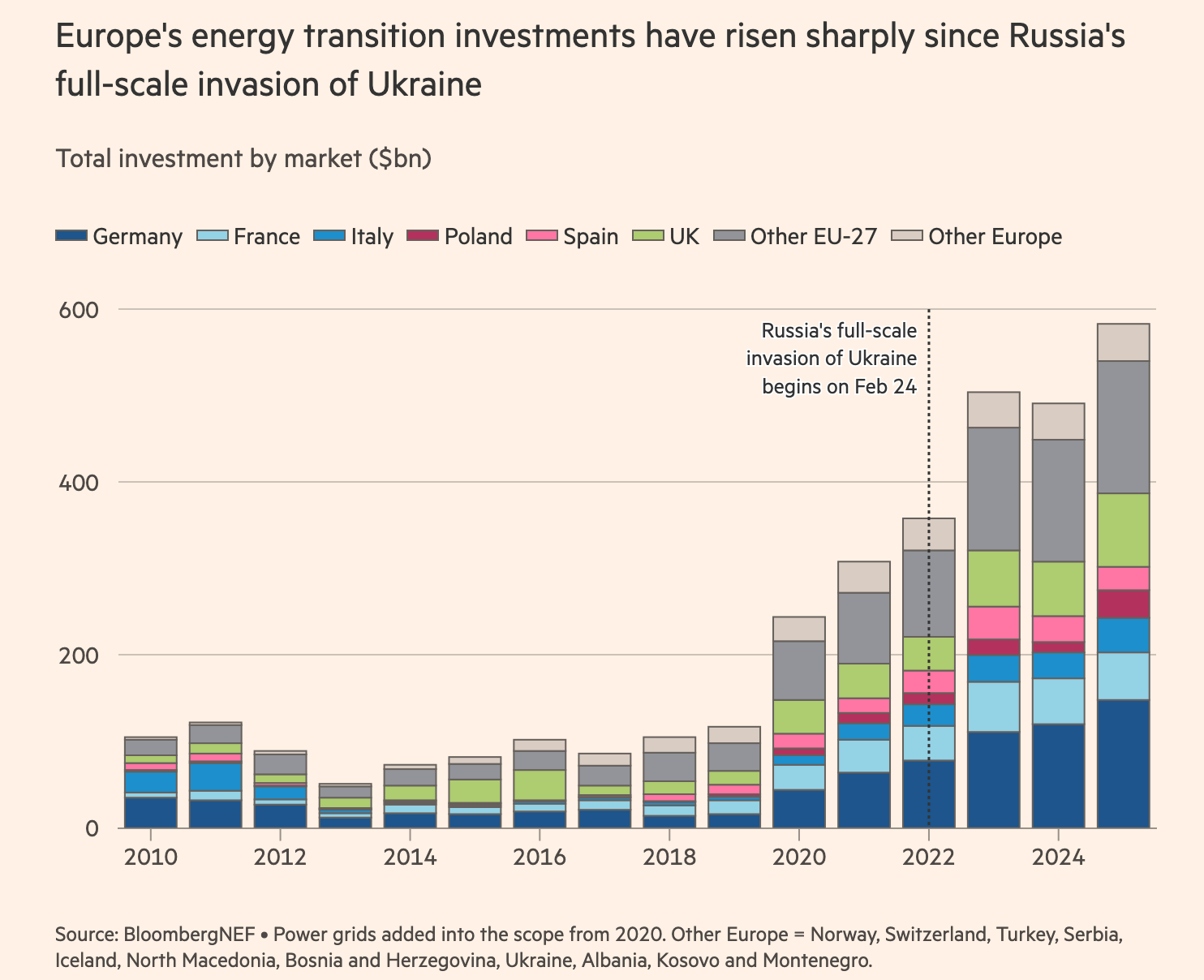
Strengths: This article is a masterful synthesis of the competing forces at play in the energy transition during a geopolitical crisis. Its key strengths are:
- The Simultaneous Outcomes Frame: The article captures the central paradox of the moment. Coal is an early winner: Thailand restarting coal plants, Japan and South Korea lifting caps, Italy delaying coal phase-out to 2038, Germany’s coal outproducing natural gas. Yet renewables are also accelerating: 50% growth in global installed capacity since 2022, solar panel prices down nearly 70%, battery prices down 36%. The crisis is pushing in both directions at once.
- The 5.1TW vs. 2.2TW Comparison: Global renewable installed capacity (5.1 terawatts) now more than doubles global coal capacity (2.2 terawatts). This is a striking statistic. Even accounting for intermittency . . . the FT notes that 5.1TW of renewables is equivalent to about 1.5TW of reliable capacity . . . the gap has narrowed dramatically. The trajectory is clear.
- The Stilwell d’Andrade Quote: The EDP CEO’s framing . . . “renewables are more immune to shocks”. . . is the strategic case for the transition. Fossil fuels are vulnerable to war, to chokepoints, to price manipulation. Renewables, once installed, are not. This is the same argument made by Microsoft’s Hollis and by Ellison’s “constant flow” vulnerability.
- The 54% Sales Surge (Again): The article cross-references the Octopus Energy data from the 11th April household solar article. This is good journalism . . . connecting the macro analysis (global energy crisis) to the micro evidence (household decisions). The consistency of the data strengthens the case.
- The Interest Rate Warning: Ben Guest’s observation . . . “there’s an irony here. In higher-priced energy markets, the business case [for renewables] might improve, but the cost of debt is going up.” . . . is a crucial caveat. Renewables are capital-intensive. Higher interest rates increase the cost of that capital. The crisis that improves the revenue case also worsens the financing case.
- The Grid and Planning Reality: Mark Dooley’s comment . . . “our challenges are the perennial ones of planning processes and access to the grid which we run into all over the world”. . . is a reminder that technology is not the bottleneck. Permitting is the bottleneck. The article does not let techno-optimism obscure the institutional barriers.
Weaknesses: The article has no significant weaknesses. It is comprehensive, balanced, and strategically informed. If pressed, one could note that:
- The Gender Dimension (SDG 5): As with almost all energy transition reporting, the article is silent on gender. The executives quoted are all men. The analysts quoted are not identified by gender. The households installing solar panels . . . the article does not ask who makes the decisions within those households.
- The Populist Threat: The article notes that the economic shock “risks bolstering populist parties that oppose a rapid shift away from fossil fuels.” It does not explore this threat in depth. Which parties? In which countries? What is the mechanism by which economic shock translates into anti-transition votes? The article raises the issue but does not analyse it.
Opportunities for C.A.T.: This article provides C.A.T. with a comprehensive framework for understanding the competing forces of the transition:
- The Coal vs. Renewables Horse Race: The article provides a clear framework for tracking the transition. Coal is winning in the short term (restarts, lifted caps, delayed phase-outs). Renewables are winning in the long term (50% capacity growth, 70% price declines). C.A.T. can track this horse race as a key indicator of whether the crisis accelerates or delays the transition.
- The Intermittency Caveat: The FT’s rough calculation . . . 5.1TW of renewables equivalent to 1.5TW of reliable capacity . . . is a useful corrective to techno-optimism. C.A.T. can use this to argue that storage is not optional; it is essential. The 5.1TW figure is impressive, but without storage, it is not a replacement for fossil fuel baseload.
- The Interest Rate Paradox: Guest’s irony . . . better revenue case, worse financing case . . . is a crucial insight. C.A.T. can use this to argue that monetary policy is climate policy. Central banks that raise interest rates to fight inflation are also raising the cost of capital for renewables. This tension deserves more attention.
- The Permitting Bottleneck: Dooley’s comment about planning processes and grid access is a reminder that the transition is not just about technology and economics. It is about institutions. C.A.T. can use this to argue that permitting reform is climate policy.
- The Populist Risk: The article’s brief mention of populist opposition to the transition is an underdeveloped but important theme. C.A.T. can track whether the Iran war bolsters populist parties (as the article suggests) or whether the energy price shock discredits fossil fuel dependence (as the solar sales surge suggests). The answer is not yet clear.
Threats:
- The biggest threat is that the coal rebound becomes permanent. Italy has delayed its coal phase-out to 2038 . . . a 15-year delay. Japan and South Korea have lifted caps. If these emergency measures become permanent, the emissions locked in will be substantial. The article notes that most reports point to “lifting consumption caps or delaying retirements, not building new coal plants,” but delays of 15 years are not trivial.
- A second threat is that the interest rate environment chokes off renewable investment. The surge in interest rates after the Covid-19 pandemic “created particular challenges for offshore wind.” If central banks raise rates further to combat Iran-war inflation, the capital-intensive renewables sector could face a financing crisis.
- A third threat is that the grid and planning barriers prove insurmountable. Dooley notes that these are “perennial” challenges “all over the world.” The article does not offer a solution. If permitting remains a multi-year obstacle, the 830GW solar forecast from Thunder Said Energy may be unachievable.
- A fourth threat is that the populist backlash against the transition accelerates. The article notes that Italy and central European nations have intensified calls for reforms to the EU’s carbon trading scheme. If populist parties gain ground, the policy environment for renewables could worsen.
- A fifth threat is that the crisis creates a “doom loop” of short-term fixes that lock in long-term vulnerability. The article does not use Ellison’s term, but the dynamic is the same: crisis leads to coal restarts, which delay the transition, which prolongs fossil fuel dependence, which makes the next crisis worse.
Analysis Through Lenses:
United Nations Lens (IPCC/UNFCCC): From a UN climate governance perspective, this article is a stress test for the transition. The IPCC’s scenarios for 1.5°C require rapid decarbonisation. The Iran war is pushing in the opposite direction . . . coal restarts, delayed phase-outs, lifted caps. Yet the article also shows that the underlying momentum of the transition (50% renewable capacity growth, 70% solar price declines) is intact. The UNFCCC process cannot control the war, but it can influence the policy response. The question is whether governments will use the crisis to accelerate the transition or to entrench fossil fuels.
EU Green New Deal Lens: For Brussels, this article should be read as a warning. Italy has delayed coal phase-out to 2038. Germany’s coal plants are outproducing gas. Central European nations are calling for ETS reforms. The Green Deal is under pressure. Yet the article also notes that renewables are more immune to shocks. Stilwell d’Andrade’s quote . . . “renewables are more immune to shocks”. . . should be the EU’s mantra. The response to the crisis should not be coal; it should be renewables, storage, and grid investment.
Draghi Report Lens: Mario Draghi’s report called for Europe to close the investment and innovation gap. This article shows that the gap is not just about investment; it is about institutions. The “perennial challenges” of planning processes and grid access are not technical problems; they are governance problems. Draghi’s call for investment must be paired with a call for permitting reform. Otherwise, the money will be spent, but the projects will not be built.
Mark Jacobson Lens: Through Jacobson’s framework, this article is a mixed verdict. The good news: renewable capacity has grown 50% since 2022, solar prices are down 70%, battery prices down 36%. The bad news: coal restarts, delayed phase-outs, lifted caps. Jacobson would argue that the solution is not to manage the trade-offs but to eliminate them. The transition must be fast enough that coal restarts are unnecessary. The article shows that the world is not there yet.
SDG Ratings:
| SDG | Rating | Rationale |
|---|---|---|
| SDG 1 No Poverty | 3/10 ★★★☆☆☆☆☆☆☆ | Energy prices affect households; coal restarts may lower prices but increase pollution |
| SDG 2 Zero Hunger | 0/10 ☆☆☆☆☆☆☆☆☆☆ | Not addressed |
| SDG 3 Good Health and Well-Being | 3/10 ★★★☆☆☆☆☆☆☆ | Coal restarts increase air pollution; health impacts not explored |
| SDG 4 Quality Education | 1/10 ☆☆☆☆☆☆☆☆☆☆ | Not addressed |
| SDG 5 Gender Equality | 0/10 ☆☆☆☆☆☆☆☆☆☆ | Complete absence. Energy transition, coal restarts, and household decisions all have gendered dimensions . . . all invisible |
| SDG 6 Clean Water and Sanitation | 1/10 ☆☆☆☆☆☆☆☆☆☆ | Not addressed |
| SDG 7 Affordable and Clean Energy | 9/10 ★★★★★★★★★☆ | Core focus; coal vs. renewables, energy independence, price shocks |
| SDG 8 Decent Work and Economic Growth | 4/10 ★★★★☆☆☆☆☆☆ | Coal jobs, renewable jobs; interest rates affect investment |
| SDG 9 Industry, Innovation and Infrastructure | 9/10 ★★★★★★★★★☆ | Solar manufacturing, grid access, planning permissions, battery storage |
| SDG 10 Reduced Inequalities | 3/10 ★★★☆☆☆☆☆☆☆ | Developing vs. developed country impacts; not explored |
| SDG 11 Sustainable Cities and Communities | 2/10 ★★☆☆☆☆☆☆☆☆ | Not addressed |
| SDG 12 Responsible Consumption and Production | 4/10 ★★★★☆☆☆☆☆☆ | Coal consumption, renewable deployment, supply chains |
| SDG 13 Climate Action | 10/10 ★★★★★★★★★★ | Core focus; emissions, coal vs. renewables, transition acceleration |
| SDG 14 Life Below Water | 0/10 ☆☆☆☆☆☆☆☆☆☆ | Not addressed |
| SDG 15 Life on Land | 2/10 ★★☆☆☆☆☆☆☆☆ | Coal mining impacts not explored |
| SDG 16 Peace, Justice and Strong Institutions | 6/10 ★★★★★★☆☆☆☆ | Iran war as driver, planning processes, grid governance, populist politics |
| SDG 17 Partnerships for the Goals | 4/10 ★★★★☆☆☆☆☆☆ | Global renewable supply chains (China dominant), EU coordination challenges |
6th April 2026: Financial Times journalist Edward White reports that CATL . . . the world’s largest battery maker with 37% of the global EV battery market + 22% of energy storage systems market . . . is mounting a major push to electrify maritime shipping. The Chinese group has already deployed batteries on approximately 900 vessels . . . mostly smaller craft operating near coastlines, ports, and rivers . . . and plans to more than double its marine business unit to 500 staff this year. CATL’s net profit surged 42% in 2025 to Rmb72.2 billion ($10.4 billion), driven by energy storage demand, and its shares have risen 13% since the Iran war began. The company is working to build an entirely new marine battery supply chain from scratch, collaborating with ports and municipalities like Guangzhou, which now offers subsidies for battery-powered vessels. While deep-sea battery-only shipping remains constrained by energy density limitations compared to heavy fuel oil, the International Maritime Organization aims to halve shipping emissions . . . currently 3% of global carbon emissions . . . by 2050. The Iran war and Strait of Hormuz closure have added strategic urgency to the hunt for alternatives to oil-dependent maritime transport https://www.ft.com/content/06563cf9-e200-42d2-853d-cefa78db7d30?syn-25a6b1a6=1
Overall C.A.T. Usefulness: 10/10 ★★★★★★★★★★
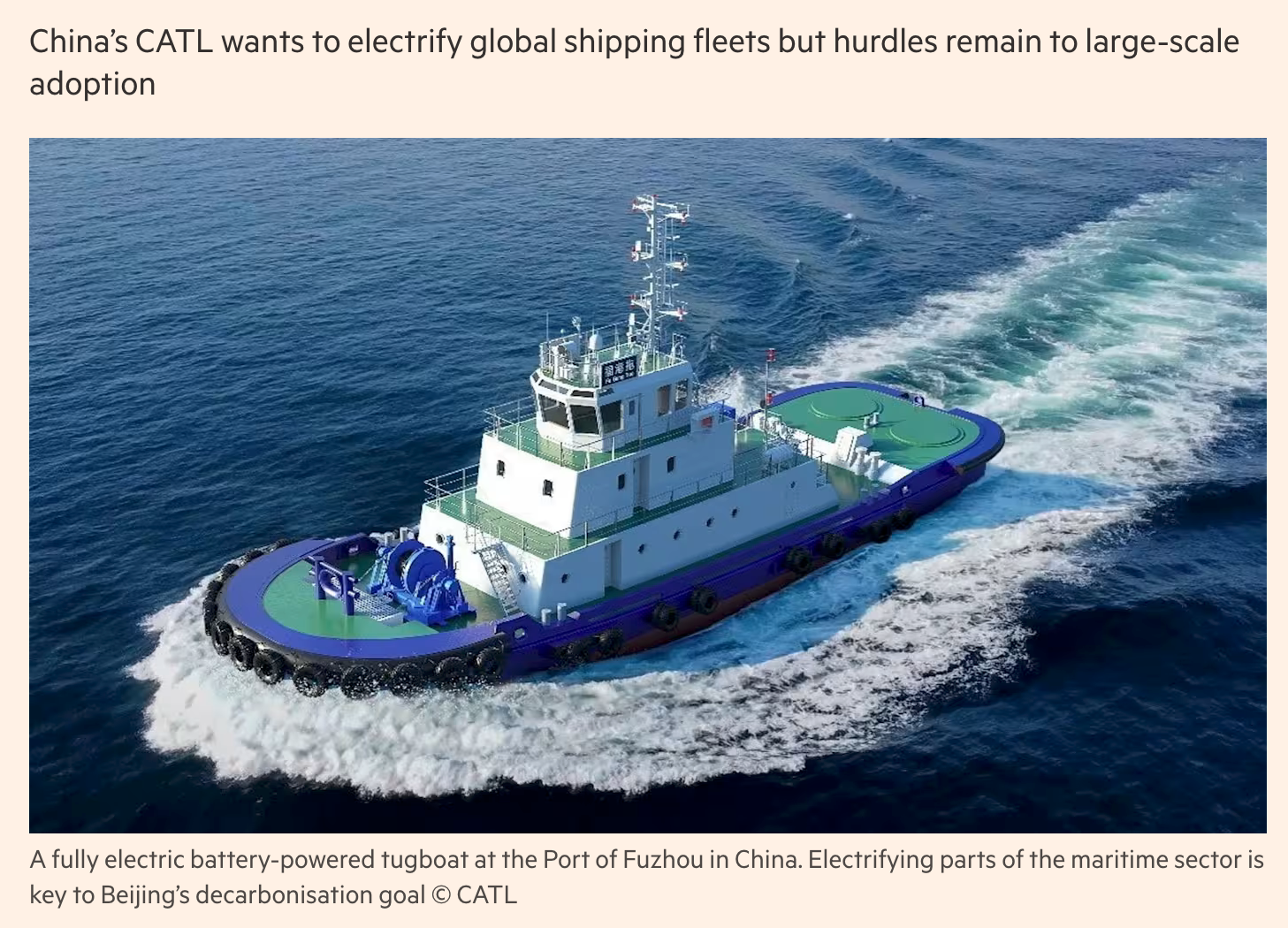
Strengths: This article captures a pivotal expansion of the electrification frontier . . . from land to sea . . . with profound implications for global decarbonisation. Its key strengths are:
- The New Frontier: Shipping accounts for 3% of global carbon emissions . . . a share comparable to aviation. CATL’s ambition to electrify parts of this sector opens a new front in the transition. The article makes clear that this is not a speculative sideline; CATL has already deployed batteries on 900 ships and is doubling its marine team to 500 people. This is real industrial momentum.
- The Geopolitical Accelerant: The article explicitly connects CATL’s marine push to the Iran war: “The hunt for alternatives has gained greater urgency after the world’s energy supply chains were rocked.” Neil Beveridge’s framing . . . an acceleration of “the global electrification megatrend”. . . echoes his earlier “paradigm shift” comment from the China battery surge article. Crisis is accelerating the transition, not slowing it.
- The Su Yi Voice: The inclusion of Su Yi, who leads CATL’s marine business unit, is a notable detail. She is a woman leading a major industrial expansion in a sector where women are vastly underrepresented. Her quote . . . “We will spare no effort in investing in R&D, human resources and materials to build the supply chain for this industry”. . . conveys strategic resolve. Her planned team expansion from roughly 250 to 500 signals scale.
- The Battery-Swap Model for Ships: CATL is adapting its battery-swap model . . . already deployed for commercial trucks on Chinese highways . . . to vessel operators. This innovation could address the cost barrier by removing the price of batteries from vessel acquisition costs. The analogy to the highway network makes the concept legible.
- The Technical Honesty: The article does not oversell. It notes that large-scale adoption of purely battery-powered deep-sea vessels “has yet to materialise because the energy density is low compared with fuels.” It acknowledges the hybrid approach as more promising in the near term. It flags the risks of fire and explosion at sea, where rescue is more difficult. This is “high-resolution realism” applied to marine electrification.
- The Founder’s Origin Story: Robin Zeng majored in marine engineering as an undergraduate. This is not a random diversification; it is a return to first principles. The detail humanises the company and reveals the long arc of its founder’s ambition.
Weaknesses: The article has no significant weaknesses. It is concise, technically informed, and strategically aware. If pressed, one could note that:
- The Scale Gap: The article reports that CATL has deployed batteries on about 900 ships. The global shipping fleet numbers tens of thousands of vessels. The transition from 900 to scale is not yet visible. The article does not project how quickly this could change.
- The Hybrid Honesty: The acknowledgment that deep-sea vessels will likely require hybrid systems (batteries plus internal combustion engines) means that the transition will not be zero-emission in the near term. The article does not quantify the emissions reduction potential of hybrid vs. pure battery vs. current heavy-fuel oil.
- The Gender Dimension (SDG 5): Su Yi is present, which is notable and commendable. But the article does not explore the gender profile of the marine battery industry, the shipping sector, or CATL’s workforce more broadly. One woman leading a division does not constitute gender equality.
Opportunities for C.A.T.: This article provides C.A.T. with a critical expansion of the transition narrative:
- The Electrification of Everything: CATL’s marine push is the latest evidence that the “electrify everything” thesis is not a slogan but an industrial strategy. From EVs to grid storage to data centres to ships . . . batteries are becoming the universal energy carrier. C.A.T. can track this expansion as a key indicator of transition momentum.
- The Crisis-as-Catalyst Frame: The Iran war is accelerating the transition. This article joins the China battery surge and the Microsoft price-stability argument in making that case. C.A.T. can use this to counter the narrative that crisis leads to fossil fuel lock-in. It can lead to acceleration . . . if the industrial capacity exists.
- The Su Yi Signal: A woman leading a major industrial expansion in the battery sector is a signal. C.A.T. can highlight this as a counterpoint to the persistent SDG 5 invisibility in most reporting. It is not enough, but it is something.
- The Battery-Swap Innovation: The adaptation of battery-swap technology from trucks to ships is a model of technological transfer. C.A.T. can track whether this model scales and whether it is adopted outside China.
- The Hybrid Reality: The article’s honesty about the limitations of pure battery power for deep-sea shipping is a useful corrective to techno-optimism. C.A.T. can use this to argue that the transition requires multiple solutions: batteries for nearshore, green fuels (methanol, ammonia, hydrogen) for deep-sea, and demand reduction where possible.
Threats:
- The biggest threat is that the technical challenges prove insurmountable at scale. Energy density, safety, cost, and lifespan in marine environments are non-trivial hurdles. If CATL cannot solve them, the marine electrification frontier will remain limited to nearshore craft.
- A second threat is that the hybrid approach locks in continued use of internal combustion engines for deep-sea shipping, delaying full decarbonisation. The “promising solution” of hybrids could become a permanent compromise rather than a bridge to zero-emission vessels.
- A third threat is that the concentration of marine battery manufacturing in China creates new dependencies. If the transition becomes dependent on Chinese supply chains for ship batteries as well as EV batteries and grid storage, the geopolitical risks documented in earlier articles are simply transferred to a different set of actors.
- A fourth threat is that the 900 ships already deployed remain a niche achievement. The global shipping fleet numbers tens of thousands of vessels. Without rapid scaling, marine electrification will not meaningfully reduce the 3% of global emissions from shipping in time to meet IMO’s 2050 target.
- A fifth threat is that the fire and explosion risk at sea proves more difficult to manage than on land. The article notes that rescue or evacuation would be “more difficult than on land.” A high-profile maritime battery incident could set back public and regulatory acceptance for years.
Analysis Through Lenses:
United Nations Lens (IPCC/UNFCCC): From a UN climate governance perspective, this article is hopeful. The International Maritime Organization’s 2050 target to halve shipping emissions is a UN-aligned goal. CATL’s marine push is a market-driven response to that regulatory signal. However, the UN system has struggled to enforce IMO targets. The article does not mention whether CATL’s batteries will help meet the 2050 goal or whether the pace is sufficient. The 3% of global emissions from shipping is not trivial, but it is also not the largest sector. The real test is whether marine electrification can scale as fast as EV electrification.
EU Green New Deal Lens: For Brussels, this article should be both a warning and a model. The warning: CATL is expanding into marine batteries, and European battery makers are not mentioned. The EU’s Net-Zero Industry Act and its maritime decarbonisation regulations (FuelEU Maritime) are creating demand. But is European supply keeping pace? The model: CATL’s collaboration with ports and governments to build a new industry from scratch is a blueprint. The EU could support similar consortia . . . linking port authorities, shipbuilders, battery makers, and grid operators . . . to create a European marine battery industry.
Draghi Report Lens: Mario Draghi’s report called for Europe to close the investment and innovation gap with China. CATL’s marine push is another data point on the scale of that gap. CATL is not waiting for the market to mature; it is investing to create the market. The planned team expansion to 500 people, the battery-swap model, the collaboration with ports and municipalities . . . this is the kind of strategic industrial investment Draghi called for. Europe is not matching it.
Mark Jacobson Lens: Through Jacobson’s framework, this article is a vindication of the “electrify everything” thesis. Jacobson’s 100% wind-water-solar roadmaps include electrification of transport, including short-sea shipping. CATL’s marine batteries are exactly what Jacobson’s models require for nearshore and inland waterway vessels. However, Jacobson would note that deep-sea shipping will require green hydrogen or ammonia for the hardest-to-abate routes. The article’s hybrid caveat is consistent with Jacobson’s multi-technology approach. The key is that the transition is happening . . . and China is leading it.
SDG Ratings:
| SDG | Rating | Rationale |
|---|---|---|
| SDG 1 No Poverty | 1/10 ☆☆☆☆☆☆☆☆☆☆ | Implicit. Not addressed |
| SDG 2 Zero Hunger | 0/10 ☆☆☆☆☆☆☆☆☆☆ | Not addressed |
| SDG 3 Good Health and Well-Being | 1/10 ☆☆☆☆☆☆☆☆☆☆ | Implicit. Not addressed |
| SDG 4 Quality Education | 1/10 ☆☆☆☆☆☆☆☆☆☆ | Implicit. Not addressed |
| SDG 5 Gender Equality | 2/10 ★★☆☆☆☆☆☆☆☆ | Su Yi is quoted and featured, which is notable. But no analysis of gender representation in the marine battery industry, shipping sector, or CATL workforce. A rare partial point for visibility, but still far from adequate. |
| SDG 6 Clean Water and Sanitation | 1/10 ☆☆☆☆☆☆☆☆☆☆ | Implicit. Not addressed |
| SDG 7 Affordable and Clean Energy | 9/10 ★★★★★★★★★☆ | Core focus; marine electrification, battery storage, energy transition |
| SDG 8 Decent Work and Economic Growth | 5/10 ★★★★★☆☆☆☆☆ | Team expansion (500 people), industrial growth; job quality not addressed |
| SDG 9 Industry, Innovation and Infrastructure | 10/10 ★★★★★★★★★★ | Core focus; marine battery manufacturing, battery-swap infrastructure, port collaboration |
| SDG 10 Reduced Inequalities | 1/10 ☆☆☆☆☆☆☆☆☆☆ | Implicit. Not addressed |
| SDG 11 Sustainable Cities and Communities | 2/10 ★★☆☆☆☆☆☆☆☆ | Port cities, coastal communities; not explored |
| SDG 12 Responsible Consumption and Production | 4/10 ★★★★☆☆☆☆☆☆ | Battery production, shipping emissions, fuel alternatives |
| SDG 13 Climate Action | 10/10 ★★★★★★★★★★ | Core focus; shipping emissions (3% of global), decarbonisation, IMO 2050 target |
| SDG 14 Life Below Water | 5/10 ★★★★★☆☆☆☆☆ | Marine environments, ocean shipping; pollution and risk of battery fires at sea noted |
| SDG 15 Life on Land | 1/10 ☆☆☆☆☆☆☆☆☆☆ | Implicit. Not addressed |
| SDG 16 Peace, Justice and Strong Institutions | 4/10 ★★★★☆☆☆☆☆☆ | Iran war as driver, IMO as institution, port-government collaboration |
| SDG 17 Partnerships for the Goals | 6/10 ★★★★★★☆☆☆☆ | Collaboration across ship designers, shipyards, ports, grids; “silos must be broken down”9 |
6th April 2026: Financial Times Journalist Christian Davies reports that sales of used electric vehicles are surging in the US, with first-quarter used EV sales rising 12% compared with the same period last year and 17% on the previous quarter, according to Cox Automotive estimates. The surge is driven by a glut of hundreds of thousands of cheap pre-owned EVs purchased on leases in the early 2020s that are now returning to market as those leases expire. The supply glut helped drive the average price of a used EV down by 8.5% between February 2025 and February 2026, closing the average price gap between used EVs and used petrol-powered vehicles from $4,923 to $1,334. This comes as average petrol prices in the US pushed past $4 a gallon this week for the first time since 2022. New EV sales in the first quarter are estimated to have slumped by 28% year on year following the Trump administration’s withdrawal of a $7,500 consumer tax credit in 2025. Jessica Caldwell, head of insights at Edmunds, said the heavily discounted used models flooding onto the market would probably act as a “gateway” to EV ownership. Mike Murphy of the EVs For All America pressure group said: “The dream of mass EV adoption here in America is not dead yet” https://www.ft.com/content/5436f549-52da-4d6d-85ba-955203f5c2f2?syn-25a6b1a6=1
Overall C.A.T. Usefulness: 9/10 ★★★★★★★★★☆
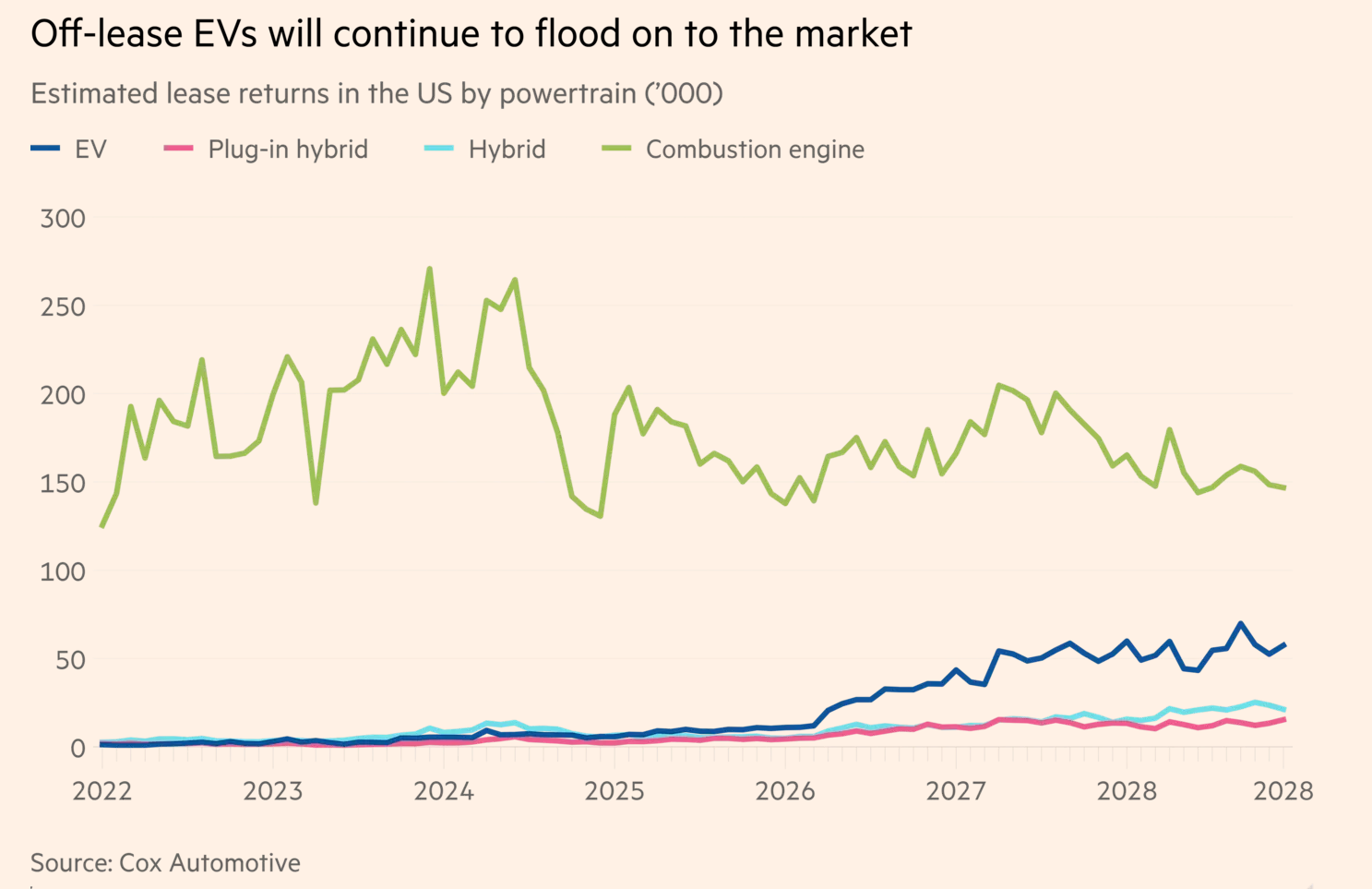
Strengths: This article captures a counterintuitive dynamic in the US auto market . . . new EV sales are slumping, but used EV sales are surging. Its key strengths are:
- The Used EV Surge Signal: First-quarter used EV sales up 12% year on year and 17% on the previous quarter. This is not a marginal increase; it is a demand shift. The article identifies the mechanism: hundreds of thousands of leased EVs from the early 2020s are returning to market as leases expire. The supply glut is creating an affordability breakthrough.
- The Price Gap Collapse: The average price gap between used EVs and used petrol-powered vehicles has collapsed from $4,923 to $1,334 . . . a 73% reduction. Stephanie Valdez Streaty of Cox called it “a meaningful reset in EV pricing.” This is the market solving the affordability problem that tax credits were designed to address.
- The Petrol Price Context: Average petrol prices in the US pushed past $4 a gallon this week for the first time since 2022. The article explicitly connects the used EV surge to the petrol price shock . . . though it notes that analysts are cautious about drawing a direct causal link. The timing is suggestive: petrol prices spike, used EV sales surge.
- The Gateway Frame: Jessica Caldwell’s characterization of used EVs as a “gateway” to EV ownership is a crucial insight. First-time EV buyers can now enter the market at a lower price point, with less risk, and with vehicles that have already depreciated. If they have a positive experience, they may buy new EVs in the future.
- The New EV Slump Context: New EV sales are estimated to have slumped 28% year on year following the Trump administration’s withdrawal of the $7,500 consumer tax credit. This is the policy volatility trap in action. The same administration that is dismantling EV incentives is also responsible for the Iran war that pushed petrol prices past $4. The policy incoherence is staggering.
- The Charging Infrastructure Acceleration: Mike Murphy’s note that “the build-out of US charging infrastructure had accelerated last year despite the slowdown in EV sales” is a crucial counterpoint to the “inadequate charging infrastructure” concern. The infrastructure is being built, even if sales have temporarily slumped.
Weaknesses: The article has no significant weaknesses. It is concise, data-driven, and strategically informed. If pressed, one could note that:
- The Causal Ambiguity: The article reports that used EV sales surged in the first quarter, and that petrol prices passed $4 a gallon this week. The timing does not perfectly align. The article does not establish a clear causal link between the petrol price spike and the used EV surge . . . though the implication is clear. Analysts are described as “cautious” about drawing conclusions.
- The Gender Dimension (SDG 5): As with almost all auto industry reporting, the article is silent on gender. The analysts quoted are not identified by gender (Valdez Streaty is a woman; Caldwell is a woman; Levy and Murphy are men). The article does not ask whether women and men have different preferences for EVs, different access to charging, or different responses to petrol price shocks.
- The Charging Infrastructure Gap: The article notes that “inadequate charging infrastructure” remains a concern for mainstream consumers. It does not quantify the gap. How many chargers are needed? How many exist? How fast is the build-out? The article raises the issue but does not provide the data to assess it.
Opportunities for C.A.T.: This article provides C.A.T. with a critical data point on the US EV market . . . and a case study in the policy volatility trap:
- The Used EV Gateway: The “gateway” frame is a powerful narrative. C.A.T. can use this to argue that the transition does not require everyone to buy a new $60,000 EV. The used market can democratise access. The 12% surge in used EV sales is evidence that this channel is working.
- The Price Gap Collapse as Market Signal: The collapse of the price gap from $4,923 to $1,334 is a market signal that EVs are becoming cost-competitive without subsidies. The $7,500 tax credit withdrawal is a policy setback, but the market is finding its own path to affordability. C.A.T. can use this to argue that the transition has its own momentum.
- The $4 Petrol Shock: The return of $4 petrol is a political and economic event. C.A.T. can use this to connect the Iran war (which caused the petrol price spike) to consumer behaviour (used EV surge). The crisis is accelerating the transition . . . even in the US, where the administration is hostile to EVs.
- The Lease Expiration Wave: The article identifies a specific mechanism: leases from the early 2020s are expiring, flooding the market with used EVs. This wave will continue. C.A.T. can track whether the used EV market remains strong as more leases expire.
- The Infrastructure Build-Out: Murphy’s note that charging infrastructure accelerated last year despite the sales slowdown is a crucial insight. C.A.T. can use this to argue that the transition is not just about sales; it is about building the enabling infrastructure. The infrastructure is being built, even if the political signals are mixed.
Threats:
- The biggest threat is that the used EV surge is temporary. The article attributes the surge to a “glut of hundreds of thousands of cheap pre-owned EVs” from expiring leases. Once that glut is absorbed, prices may rise again. The 12% year-on-year increase is impressive, but the article does not project whether the trend will continue.
- A second threat is that the charging infrastructure gap persists. The article notes that “inadequate charging infrastructure” remains a concern for mainstream consumers. If the build-out does not keep pace with the used EV surge, new EV owners may have a poor experience, undermining the “gateway” effect.
- A third threat is that the policy volatility trap continues. The Trump administration has withdrawn the $7,500 tax credit. It could also impose tariffs on EV imports or dismantle charging infrastructure funding. The used EV market is less vulnerable to policy changes than the new EV market, but it is not immune.
- A fourth threat is that the petrol price spike reverses. The article connects the used EV surge to $4 petrol. If the Iran war ends and oil prices fall, the urgency for consumers may fade. The used EV surge could be a short-term response to a temporary shock.
- A fifth threat is that the new EV slump persists. The article reports that new EV sales slumped 28% year on year. If the used EV market is a “gateway,” it should eventually lead to new EV sales. The article does not provide evidence that this is happening. The gateway could be a one-way door: used EV buyers may stay in the used market, never buying new.
Analysis Through Lenses:
United Nations Lens (IPCC/UNFCCC): From a UN climate governance perspective, this article is a case study in the limits and possibilities of market-driven transition. The US has withdrawn from the Paris Agreement. The Trump administration has dismantled EV incentives. Yet the used EV market is surging. The transition is not waiting for policy. The IPCC has long argued that carbon pricing and subsidies are necessary to drive the transition. The US experience suggests that markets can find their own path . . . but the path is slower and more uneven than it would be with supportive policy.
EU Green New Deal Lens: For Brussels, this article should be read as evidence that the transition can survive policy hostility . . . but not thrive. The US used EV market is surging despite the withdrawal of federal incentives. But new EV sales have slumped 28%. The EU has maintained its EV incentives and its regulatory framework. The result is a more stable and predictable transition. The US experience is a warning: policy volatility has a cost.
Draghi Report Lens: Mario Draghi’s report called for Europe to close the investment and innovation gap with China and the US. This article shows that the US EV market is in a strange place: used EVs are surging, but new EVs are slumping. The gap between the US and China (where EV adoption is far higher) is widening. Europe is somewhere in the middle. Draghi’s call for investment in clean tech manufacturing is a call to ensure that Europe does not fall behind both the US and China.
Mark Jacobson Lens: Through Jacobson’s framework, this article is a mixed verdict. The good news: used EV sales are surging, price gaps are collapsing, and charging infrastructure is being built. The bad news: new EV sales have slumped 28%, and the US is still far from Jacobson’s 100% renewable transport vision. Jacobson would say that the transition is happening, but not fast enough. The used EV surge is a positive sign, but it is not sufficient. The policy volatility trap (the $7,500 tax credit withdrawal) is a self-inflicted wound.
SDG Ratings:
| SDG | Rating | Rationale |
|---|---|---|
| SDG 1 No Poverty | 4/10 ★★★★☆☆☆☆☆☆ | Affordability gap closing; used EVs cheaper; petrol at $4/gallon hits household budgets |
| SDG 2 Zero Hunger | 0/10 ☆☆☆☆☆☆☆☆☆☆ | Not addressed |
| SDG 3 Good Health and Well-Being | 2/10 ★★☆☆☆☆☆☆☆☆ | Air pollution benefits of EV transition implicit, not explored |
| SDG 4 Quality Education | 1/10 ☆☆☆☆☆☆☆☆☆☆ | Not addressed |
| SDG 5 Gender Equality | 0/10 ☆☆☆☆☆☆☆☆☆☆ | Complete absence. Women’s access to EVs, charging infrastructure, and financing . . . all invisible |
| SDG 6 Clean Water and Sanitation | 0/10 ☆☆☆☆☆☆☆☆☆☆ | Not addressed |
| SDG 7 Affordable and Clean Energy | 8/10 ★★★★★★★★☆☆ | EV affordability, petrol prices, energy transition in transport |
| SDG 8 Decent Work and Economic Growth | 4/10 ★★★★☆☆☆☆☆☆ | Auto industry, leasing market, used car dealers; job quality not addressed |
| SDG 9 Industry, Innovation and Infrastructure | 7/10 ★★★★★★★☆☆☆ | EV manufacturing, charging infrastructure build-out |
| SDG 10 Reduced Inequalities | 5/10 ★★★★★☆☆☆☆☆ | Used EVs democratise access; price gap closing; affordability remains a barrier |
| SDG 11 Sustainable Cities and Communities | 3/10 ★★★☆☆☆☆☆☆☆ | Urban air quality, charging infrastructure in cities; not explored |
| SDG 12 Responsible Consumption and Production | 3/10 ★★★☆☆☆☆☆☆☆ | EV lifecycle, battery recycling; not addressed |
| SDG 13 Climate Action | 8/10 ★★★★★★★★☆☆ | EV transition, petrol displacement, emissions reduction |
| SDG 14 Life Below Water | 0/10 ☆☆☆☆☆☆☆☆☆☆ | Not addressed |
| SDG 15 Life on Land | 1/10 ☆☆☆☆☆☆☆☆☆☆ | Not addressed |
| SDG 16 Peace, Justice and Strong Institutions | 4/10 ★★★★☆☆☆☆☆☆ | Iran war as driver, policy volatility (tax credit withdrawal), Trump administration |
| SDG 17 Partnerships for the Goals | 2/10 ★★☆☆☆☆☆☆☆☆ | Not addressed |
5th April 2026: Financial Times Journalists Anne-Sylvaine Chassany and Aysun Bora report that a citizens’ initiative to restrict motorised traffic in Berlin’s city centre has sparked an uproar ahead of the September election, with posters from Chancellor Friedrich Merz’s Christian Democratic Union warning “Car ban. Banned” and far-right Alternative for Germany declaring “No car is illegal!” The initiative would sharply reduce car use inside the ring road, with exemptions for work, disabilities, emergency services, and police. Kai Wegner, the CDU mayor seeking re-election, has dismissed it as a “well-intentioned dream of an urban idyll” that would become a “nightmare.” Even the Greens have stopped short of publicly backing the initiative for fear of an anti-Green backlash. The initiative’s organisers need 175,000 signatures by early May to trigger a local referendum. Campaigner Gerald Stephani said: “There’s controversy everywhere at first, but once it’s implemented, people are happy. Sales go up, gastronomy, quality of life, tourism . . . everyone benefits.” The debate reflects the powerful symbolism of the car in Germany, where car ownership has long been associated with individual freedom. Yet about 28% of residents within Berlin’s ring road own a car, compared with about 30% in Paris and 38% in London https://www.ft.com/content/8ac85c84-7947-4ed0-8c41-12733b71c88d?syn-25a6b1a6=1
Overall C.A.T. Usefulness: 9/10 ★★★★★★★★★☆
Strengths: This article captures a critical front in the climate transition . . . the battle over urban space and mobility. Its key strengths are:
- The Culture War Flashpoint: The article frames the car debate as a “culture war flashpoint,” pitting “environmentally minded urban residents against suburban commuters.” This is accurate and important. The transition is not just about technology and economics; it is about identity, freedom, and the shape of the city. The car is not a machine; it is a symbol.
- The Poster Language: The CDU’s “Car ban. Banned” and AfD’s “No car is illegal!” are not policy proposals; they are identity-markers. The article uses them effectively to convey the emotional intensity of the debate. The fact that the CDU . . . Merz’s party . . . is running on an anti-car-ban platform is a measure of how politically sensitive the issue has become.
- The German Auto-Nation Frame: Peter Mair’s quote . . . “Germany is an auto-nation. It’s how people identify themselves . . . not just with their car, but with what it represents: the power of German industry” . . . is the historical and cultural context that makes Berlin’s debate different from Paris or London. The car is not just a mode of transport; it is the engine of the postwar economic miracle.
- The Generational Shift: The article notes that “a younger generation, more likely to use public transport or bicycles, is increasingly challenging the car’s sacrosanct status.” The statistic is striking: 28% of residents within Berlin’s ring road own a car, compared with 30% in Paris and 38% in London. The car’s dominance is not inevitable; it is already declining.
- The CDU’s Car-Friendly Turn: The article documents the governing coalition’s shift towards a more car-friendly approach since 2023: cutting funding for bicycle lanes, softening plans to reduce parking, raising speed limits, stalling on parking fee increases, and planning to expand the ring motorway. This is not a neutral observation; it is a policy choice with consequences.
- The Stephani Optimism: Gerald Stephani’s voice . . . “There’s controversy everywhere at first, but once it’s implemented, people are happy” . . . is the counter-narrative to the CDU’s “nightmare” framing. He cites evidence from Paris and other cities: sales go up, gastronomy improves, quality of life increases, tourism benefits. The article gives him space to make the case.
Weaknesses: The article has no significant weaknesses. It is balanced, nuanced, and deeply informed. If pressed, one could note that:
- The Missing Climate Frame: The article mentions pollution and emissions but does not explicitly connect the car debate to the climate crisis. The Earth’s energy imbalance, the 1.5°C threshold, the need to reduce transport emissions . . . all are absent. The debate is framed as local quality-of-life issue rather than a global climate imperative.
- The Gender Dimension (SDG 5): As with almost all transport and urban reporting, the article is silent on gender. Women and men use cars differently. Women are more likely to be passengers, more likely to combine trips (care responsibilities), more likely to use public transport. The debate over car restrictions has gendered implications . . . who benefits, who is burdened . . . that are invisible here.
- The Suburban Commuter Voice: The article notes that the initiative would “sharply reduce car use inside the ring road” and that “people living outside the ring would effectively be prohibited from driving into the city centre.” The article quotes a CDU politician making this argument but does not quote a suburban commuter directly. The voice of those who would be most affected is absent.
Opportunities for C.A.T.: This article provides C.A.T. with a critical case study in the politics of urban mobility:
- The Auto-Nation Frame: Mair’s “auto-nation” framing is a gift. It explains why the German car debate is different from the French or British debates. C.A.T. can use this to argue that the transition must account for national identity and industrial history. You cannot just swap an EV for a petrol car; you must also address what the car represents.
- The 28% Statistic: The fact that only 28% of residents within Berlin’s ring road own a car . . . compared with 38% in London . . . is a powerful data point. C.A.T. can use it to argue that the car’s dominance is already waning. The transition is not being imposed from above; it is being demanded from below.
- The CDU’s Vulnerability: The article documents the CDU’s car-friendly turn. But it also notes that even some CDU figures (Mair) express scepticism about Berlin’s car dependency. C.A.T. can track whether this issue becomes a liability for the CDU in the September election. If the initiative qualifies for a referendum, the car ban could mobilise voters on both sides.
- The Paris Comparison: The article cites Paris and other cities as evidence that reclaiming space from cars boosts economic activity. C.A.T. can use this to counter the “nightmare” framing. The evidence is clear: pedestrianisation and car restrictions do not kill cities; they revive them.
- The Generational Shift: The article notes that a younger generation is challenging the car’s status. C.A.T. can use this to argue that the transition is demographic. The children of Youth4Planet are less likely to own cars, more likely to use public transport and bicycles. The car ban initiative is not radical; it is catching up with where young people already are.
Threats:
- The biggest threat is that the initiative fails to qualify for a referendum. The organisers need 175,000 signatures by early May. If they fall short, the car-friendly status quo will continue. The CDU’s “nightmare” framing will have won by default.
- A second threat is that the initiative qualifies but loses the referendum. The article notes that the debate is polarised. If the car ban is defeated, it could set back urban mobility transitions across Germany. Other cities will look to Berlin as a cautionary tale.
- A third threat is that the car-friendly turn becomes permanent. The CDU has cut funding for bicycle lanes, softened parking restrictions, raised speed limits, and expanded the ring motorway. These are not reversible overnight. Even if the political winds shift, the infrastructure will remain.
- A fourth threat is that the Greens’ caution backfires. The article notes that the Greens have “stopped short of publicly backing the initiative for fear of an anti-Green backlash.” If the initiative fails, the Greens will be criticised for not supporting it. If it succeeds, they will have no credibility to claim credit. Caution is not always a winning strategy.
- A fifth threat is that the debate remains polarised and symbolic. The CDU’s “Car ban. Banned” posters are not policy; they are identity signalling. If the election is fought on symbols rather than substance, the actual work of reducing emissions and improving mobility will be delayed.
Analysis Through Lenses:
United Nations Lens (IPCC/UNFCCC): From a UN climate governance perspective, this article is a case study in the politics of urban mitigation. Transport is a major source of emissions. The IPCC has long called for modal shift . . . from cars to public transport, cycling, and walking. Berlin’s debate is where that call meets political reality. The UNFCCC process cannot dictate urban policy. It can only provide the scientific evidence. The Berlin debate shows that evidence is not enough. The car’s symbolic power must be addressed directly.
EU Green New Deal Lens: For Brussels, this article should be read as a warning. Germany is the EU’s largest economy. If Berlin cannot reduce car dependency, the EU’s transport decarbonisation goals are at risk. The Green Deal’s “Fit for 55” package includes targets for reducing transport emissions. But those targets depend on cities like Berlin to implement policies like car restrictions. The article shows that the political obstacles are formidable.
Draghi Report Lens: Mario Draghi’s report called for Europe to close the investment and innovation gap. It did not address urban mobility. But the two are connected. German industry . . . the auto industry . . . is central to the European economy. If Germany cannot transition away from car dependency, its industrial base will be threatened. The car ban debate is not just about local quality of life; it is about the future of German manufacturing.
Mark Jacobson Lens: Through Jacobson’s framework, this article is about the demand side of the transition. Jacobson’s roadmaps focus on supply . . . wind, solar, storage, EVs. But they also assume demand reduction, including modal shift. The Berlin car ban initiative is exactly the kind of demand-side policy Jacobson’s models require. Yet the article shows that such policies are politically difficult. Jacobson would likely say: the transition is not just about technology; it is about politics.
SDG Ratings:
| SDG | Rating | Rationale |
|---|---|---|
| SDG 1 No Poverty | 3/10 ★★★☆☆☆☆☆☆☆ | Parking fees, access to city centre for work; distributional impacts not explored |
| SDG 2 Zero Hunger | 0/10 ☆☆☆☆☆☆☆☆☆☆ | Not addressed |
| SDG 3 Good Health and Well-Being | 6/10 ★★★★★★☆☆☆☆ | Air pollution, pedestrian safety, quality of life . . . central to campaigners’ arguments |
| SDG 4 Quality Education | 1/10 ☆☆☆☆☆☆☆☆☆☆ | Not addressed |
| SDG 5 Gender Equality | 0/10 ☆☆☆☆☆☆☆☆☆☆ | Complete absence. Car use, public transport access, and care responsibilities have gendered dimensions . . . all invisible |
| SDG 6 Clean Water and Sanitation | 0/10 ☆☆☆☆☆☆☆☆☆☆ | Not addressed |
| SDG 7 Affordable and Clean Energy | 4/10 ★★★★☆☆☆☆☆☆ | Car dependency vs. public transport; not central |
| SDG 8 Decent Work and Economic Growth | 5/10 ★★★★★☆☆☆☆☆ | Auto industry jobs, economic activity in city centre (gastronomy, tourism) |
| SDG 9 Industry, Innovation and Infrastructure | 6/10 ★★★★★★☆☆☆☆ | Ring motorway expansion, bicycle lanes, parking infrastructure |
| SDG 10 Reduced Inequalities | 5/10 ★★★★★☆☆☆☆☆ | Suburban commuters vs. urban residents; access for people with disabilities noted |
| SDG 11 Sustainable Cities and Communities | 10/10 ★★★★★★★★★★ | Core focus; urban mobility, car dependency, public space, quality of life |
| SDG 12 Responsible Consumption and Production | 4/10 ★★★★☆☆☆☆☆☆ | Car use, modal shift; not central |
| SDG 13 Climate Action | 7/10 ★★★★★★★☆☆☆ | Emissions reduction implied, not central; climate framing largely absent |
| SDG 14 Life Below Water | 0/10 ☆☆☆☆☆☆☆☆☆☆ | Not addressed |
| SDG 15 Life on Land | 1/10 ☆☆☆☆☆☆☆☆☆☆ | Not addressed |
| SDG 16 Peace, Justice and Strong Institutions | 6/10 ★★★★★★☆☆☆☆ | Citizens’ initiative, referendum process, political debate, CDU/AfD posters |
| SDG 17 Partnerships for the Goals | 2/10 ★★☆☆☆☆☆☆☆☆ | Not addressed |
3rd April 2026: Financial Times Journalists Attracta Mooney and Rachel Millard report that more than 65 leading UK climate scientists have warned against new oil and gas drilling in the North Sea, urging the government to prioritise renewable energy as a more cost-effective response to the energy crisis caused by the Middle East war. The intervention comes amid mounting political pressure to reverse the current ban on new exploration licences, with the opposition Conservative Party and Reform UK calling for increased domestic production. The scientists argue that about 90% of North Sea reserves have already been extracted and additional production would have little effect on global prices. Bill McGuire, professor emeritus at University College London, said: “More drilling means adding carbon to the atmosphere that wouldn’t otherwise be added. And this is the last thing we need at a time when the rate of global heating has doubled.” Ella Gilbert, the climate scientist who co-ordinated the letter, said: “It’s totally nonsensical to be extracting more dangerous fossil fuels in response to this energy crisis. In the long run, North Sea oil and gas will push prices up for ordinary people.” Critics argue that the UK sources some 75% of its total energy from oil and gas and will continue to use fossil fuels for decades, and that North Sea output has significantly lower emissions than imported gas. However, the independent Climate Change Committee has found only a small emissions advantage when UK production is compared to the global average https://www.ft.com/content/5059e45b-3a3c-4cf4-8b44-6cadc92e8422?syn-25a6b1a6=1
Overall C.A.T. Usefulness: 10/10 ★★★★★★★★★★
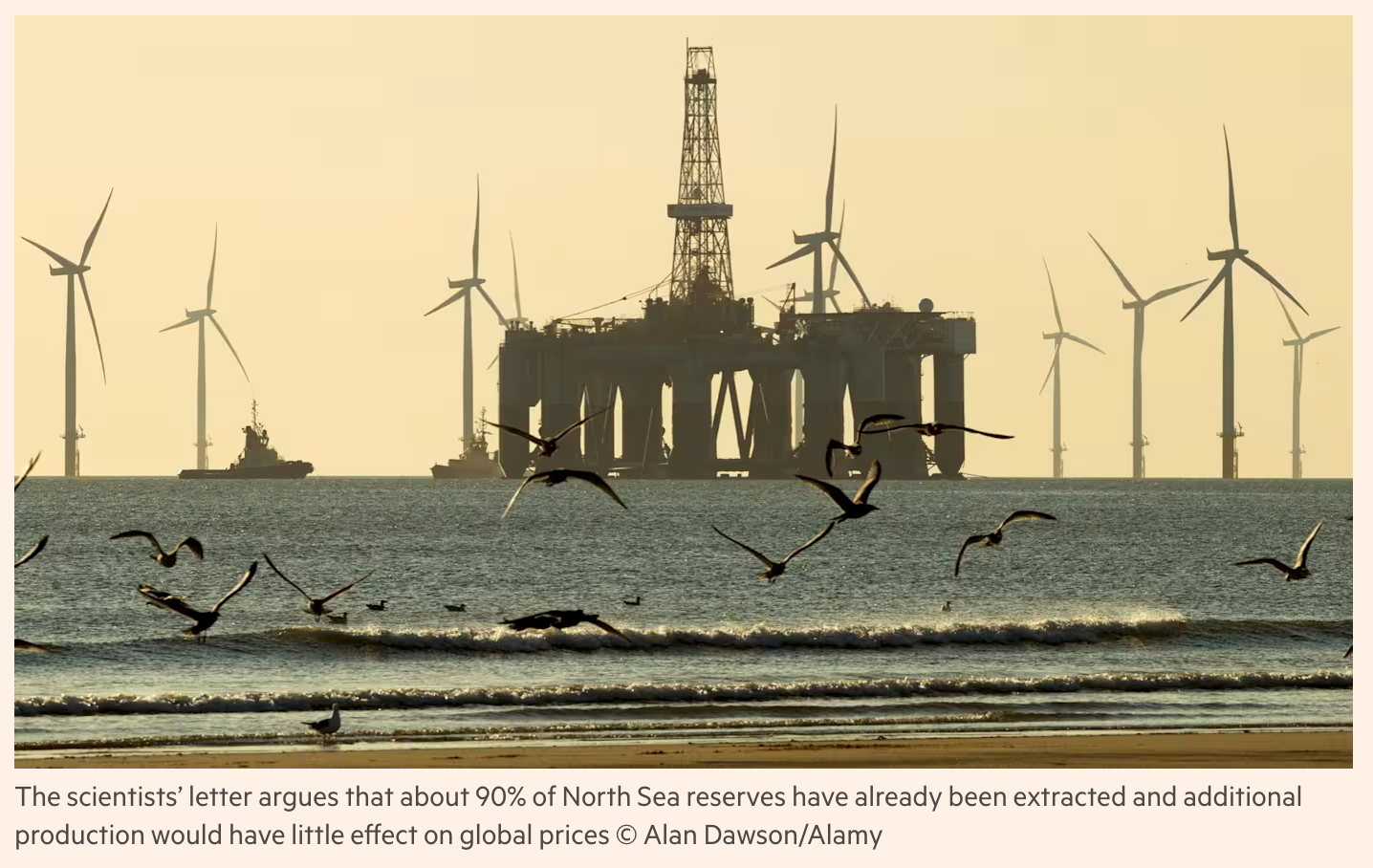
Strengths: This article captures a critical moment in UK energy policy . . . the clash between energy security panic and climate science. Its key strengths are:
- The 65 Scientists Signal: The open letter from more than 65 leading UK climate scientists is not a marginal voice; it is the scientific establishment weighing in against new drilling. The signatories include Bill McGuire (UCL) and Richard Allan (University of Reading). This is not activism; it is expertise.
- The 90% Extraction Figure: The scientists argue that about 90% of North Sea reserves have already been extracted. Additional production would have “little effect on global prices.” This is a devastating counter-argument to the “energy security” case. The North Sea is not a new Saudi Arabia; it is a depleted basin. The marginal barrels from new drilling will not lower UK bills.
- The “Rate of Global Heating Has Doubled” Warning: McGuire’s quote is the climate heart of the article. “More drilling means adding carbon to the atmosphere that wouldn’t otherwise be added. And this is the last thing we need at a time when the rate of global heating has doubled.” This connects the North Sea debate directly to the Earth’s energy imbalance documented in earlier articles.
- The Gilbert Frame: Ella Gilbert’s language . . . “It’s totally nonsensical to be extracting more dangerous fossil fuels in response to this energy crisis”. . . is uncompromising. She is not a cautious academic; she is a campaigner. The article gives her space to make the case that renewables are cheaper and that North Sea extraction will “push prices up for ordinary people.”
- The Political Spectrum: The article maps the political divides clearly. Conservatives and Reform UK want to “get Britain drilling again.” The Liberal Democrats oppose new drilling. Labour has banned new exploration licences but allows “tiebacks” to existing fields. Business leaders are divided: Greg Jackson of Octopus Energy backs continued extraction; James Alexander of the UK Sustainable Investment and Finance Association calls expanded drilling a “knee-jerk reaction.”
- The Emissions Advantage Debate: The article includes the critics’ argument that North Sea output has “significantly lower emissions than imported gas.” But it also notes that the independent Climate Change Committee has found “only a small emissions advantage” and that this would be “offset by increased production adding to fossil fuel use.” This is balanced reporting.
Weaknesses: The article has no significant weaknesses. It is balanced, scientifically informed, and politically nuanced. If pressed, one could note that:
- The Missing Renewable Cost Context: The article notes that in the latest offshore wind subsidy auction, developers were guaranteed £90.91 per megawatt hour, compared to current spot prices of around £96. It does not note that renewable costs have fallen dramatically over time and are expected to continue falling. The snapshot comparison is accurate but may be misleading without the trend line.
- The Gender Dimension (SDG 5): As with almost all energy and climate reporting, the article is silent on gender. The scientists quoted are not identified by gender (McGuire and Allan are men; Gilbert is a woman). The article does not explore the gendered impacts of North Sea drilling, energy prices, or the transition.
- The “Tiebacks” Loophole: The article notes that Labour allows “tiebacks” to existing fields. It does not explain what this means or how much additional production could be achieved through this loophole. The ban on new exploration licences may be less absolute than it appears.
Opportunities for C.A.T.:
This article provides C.A.T. with a critical case study in the politics of fossil fuel extraction during a crisis:
- The 90% Depletion Argument: The scientists’ argument that the North Sea is largely depleted is a powerful counter to the “drill, baby, drill” narrative. C.A.T. can use this to argue that new drilling is not a solution to the energy crisis; it is a distraction. The marginal barrels will not lower prices.
- The “Rate of Global Heating Has Doubled” Frame: McGuire’s warning connects the North Sea debate to the fundamental physics of the climate crisis. C.A.T. can use this to argue that every ton of carbon matters. The North Sea is not an exception; it is part of the problem.
- The Gilbert “Nonsensical” Frame: Gilbert’s language . . . “totally nonsensical”. . . is a gift. C.A.T. can use it to cut through the polite technocratic discourse. The push for new drilling in a depleted basin, during a climate crisis, with renewables cheaper, is not a reasonable disagreement; it is nonsensical.
- The Political Mapping: The article provides a clear map of where UK political parties stand on North Sea drilling. C.A.T. can use this to track whether the issue becomes a defining divide in the next election. The Conservatives are betting on “get Britain drilling again.” Labour is betting on the transition. The outcome of that bet will shape UK emissions for decades.
- The Spain Comparison: Gilbert notes that countries which accelerated their transition . . . such as Spain . . . are enjoying lower power prices and greater resilience to energy shocks. C.A.T. can use this to argue that the solution to the energy crisis is not more fossil fuels; it is more renewables.
Threats:
- The biggest threat is that the political pressure for new drilling succeeds. The Conservatives and Reform UK are both calling for increased domestic production. If Labour caves to pressure, the ban on new exploration licences could be reversed. The scientists’ letter would be ignored.
- A second threat is that the “tiebacks” loophole is larger than it appears. The article does not quantify how much additional production could be achieved through tiebacks to existing fields. If the loophole allows significant new extraction, the ban on new licences may be symbolic rather than substantive.
- A third threat is that the emissions advantage argument gains traction. Critics argue that North Sea gas has lower emissions than imported LNG. Even if the advantage is small, it could be enough to justify new drilling in the minds of policymakers. The Climate Change Committee’s finding that the advantage is “small” and “offset” is nuanced; nuance is often lost in political debate.
- A fourth threat is that the renewable cost argument is overstated. The article notes that offshore wind developers were guaranteed £90.91 per megawatt hour, compared to spot prices of around £96. The difference is not large. If gas prices fall, the economic case for renewables weakens. The article does not address this vulnerability.
- A fifth threat is that the scientists’ letter is dismissed as “activist” rather than “expert.” The line between climate science and climate advocacy is blurred. Policymakers who want to drill can dismiss the letter as political. The article does not address this credibility challenge.
Analysis Through Lenses:
United Nations Lens (IPCC/UNFCCC): From a UN climate governance perspective, this article is a test of whether the UK will honour its climate commitments under pressure. The UK has legally binding net zero targets. The independent Climate Change Committee advises the government. The scientists’ letter is a direct appeal to follow the science. Yet the political pressure for new drilling is intense. The UNFCCC process cannot compel the UK to keep its ban on new licences. The outcome depends on domestic politics.
EU Green New Deal Lens: For Brussels, this article should be read as a case study in the politics of the transition. The UK is no longer in the EU, but its energy policy choices have implications for the continent. If the UK opens the North Sea to new drilling, it could increase global fossil fuel supply, potentially lowering prices and undermining the EU’s transition. If the UK keeps the ban, it sets an example for other European nations. The Green Deal’s success depends partly on what the UK does.
Draghi Report Lens: Mario Draghi’s report called for Europe to close the investment and innovation gap. This article shows that the UK is debating whether to invest in the past (new North Sea drilling) or the future (renewables). Draghi’s report would side with the future. The question is whether UK policymakers will follow that logic.
Mark Jacobson Lens: Through Jacobson’s framework, this article is a case study in the irrationality of new fossil fuel extraction. Jacobson’s roadmaps for 100% renewables show that the transition is technically feasible and economically beneficial. New North Sea drilling is not a bridge; it is a detour. Every ton of carbon extracted from the North Sea will be burned. Every ton burned will add to the Earth’s energy imbalance. The scientists’ letter is Jacobson’s argument in political form.
SDG Ratings:
| SDG | Rating | Rationale |
|---|---|---|
| SDG 1 No Poverty | 4/10 ★★★★☆☆☆☆☆☆ | Energy bills, fuel poverty; scientists argue new drilling will push prices up |
| SDG 2 Zero Hunger | 0/10 ☆☆☆☆☆☆☆☆☆☆ | Not addressed |
| SDG 3 Good Health and Well-Being | 3/10 ★★★☆☆☆☆☆☆☆ | Air pollution from fossil fuels; not central |
| SDG 4 Quality Education | 1/10 ☆☆☆☆☆☆☆☆☆☆ | Not addressed |
| SDG 5 Gender Equality | 0/10 ☆☆☆☆☆☆☆☆☆☆ | Complete absence. Energy policy, fossil fuel extraction, and the transition have gendered dimensions . . . all invisible |
| SDG 6 Clean Water and Sanitation | 0/10 ☆☆☆☆☆☆☆☆☆☆ | Not addressed |
| SDG 7 Affordable and Clean Energy | 9/10 ★★★★★★★★★☆ | Core focus; North Sea drilling, energy security, renewable costs |
| SDG 8 Decent Work and Economic Growth | 5/10 ★★★★★☆☆☆☆☆ | North Sea jobs, renewable jobs; critics argue drilling supports jobs |
| SDG 9 Industry, Innovation and Infrastructure | 6/10 ★★★★★★☆☆☆☆ | North Sea infrastructure, renewable grid, battery storage |
| SDG 10 Reduced Inequalities | 3/10 ★★★☆☆☆☆☆☆☆ | Energy bills affect lower-income households disproportionately; not explored |
| SDG 11 Sustainable Cities and Communities | 2/10 ★★☆☆☆☆☆☆☆☆ | Not addressed |
| SDG 12 Responsible Consumption and Production | 4/10 ★★★★☆☆☆☆☆☆ | Fossil fuel extraction, emissions intensity |
| SDG 13 Climate Action | 10/10 ★★★★★★★★★★ | Core focus; emissions, global heating, transition |
| SDG 14 Life Below Water | 2/10 ★★☆☆☆☆☆☆☆☆ | North Sea marine environment; not explored |
| SDG 15 Life on Land | 1/10 ☆☆☆☆☆☆☆☆☆☆ | Not addressed |
| SDG 16 Peace, Justice and Strong Institutions | 5/10 ★★★★★☆☆☆☆☆ | Political debate, scientists’ intervention, Climate Change Committee |
| SDG 17 Partnerships for the Goals | 3/10 ★★★☆☆☆☆☆☆☆ | Scientists’ collective action (open letter); not central |
2nd April 2026: Financial Times Journalists Andres Schipani, Dan Clark, Joseph Cotterill, Amy Borrett, A. Anantha Lakshmi, Adam Shaw, and Sam Fleming report that the Iran war and resulting high global energy prices have forced the countries around the world into fuel-saving measures, including working from home. The Philippines’ President Ferdinand Marcos Jr has declared a national energy emergency. Goto Monster, a popular eatery in Manila’s business district, has seen a 30-40% drop in customers. Cashier Cedric Gonzalvo said: “I’m worried. It’s possible I might lose my job.” According to the US Energy Information Administration, 83% of liquefied natural gas and 84% of crude oil shipped through the Strait of Hormuz in 2024 was bound for Asia. Thailand is encouraging remote work for civil servants and asking residents to reduce air conditioning usage. Vietnam is promoting cycling and carpooling. Indonesia has asked civil servants to work from home once a week. Pakistan has kicked off its domestic cricket league with matches in empty stadiums. The IMF has found that oil price shocks “trigger sharp and persistent employment losses,” particularly in oil-importing countries with large energy-intensive sectors. The OECD estimates that in a “downside scenario” with oil prices averaging $135 per barrel in the second quarter of 2026, global GDP would fall 0.5% by the second year of the shock compared with baseline projections, with Asia-Pacific OECD countries hardest hit (0.95% reduction) https://www.ft.com/content/a9f56d68-4cdd-47f7-873e-ca6ac0ea8962?syn-25a6b1a6=1
Overall C.A.T. Usefulness: 10/10 ★★★★★★★★★★
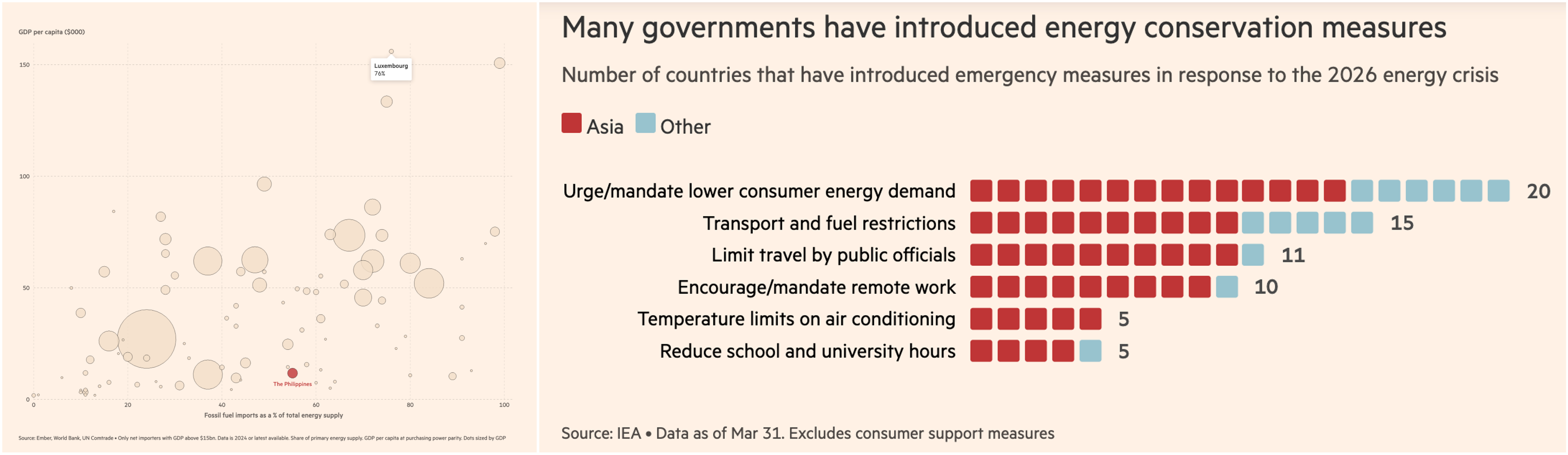
Strengths: this article translates the macro-shocks of the Iran war into the micro-reality of a cashier in Manila fearing for his job. Its key strengths are:
- The Human Entry Point: Cedric Gonzalvo is not a statistic. He is a cashier at Goto Monster in Manila’s business district. He has seen a 30-40% drop in customers. He is worried he might lose his job. This is the human face of the energy crisis. The article does not let the reader forget that behind every economic indicator is a person.
- The 83% and 84% Figures: According to the US Energy Information Administration, 83% of LNG and 84% of crude oil shipped through the Strait of Hormuz in 2024 was bound for Asia. This is not a marginal dependency; it is near-total. The article quantifies the vulnerability that previous articles have described qualitatively.
- The Rationing Wave: The article documents a wave of energy conservation measures across Asia: the Philippines working from home, Thailand reducing air conditioning, Vietnam promoting cycling and carpooling, Indonesia civil servants working from home once a week, Pakistan playing cricket in empty stadiums. This is the IEA’s demand reduction call translated into government policy.
- The IMF Employment Study: The article cites IMF research finding that oil price shocks “trigger sharp and persistent employment losses,” particularly in oil-importing countries with large energy-intensive sectors. Five years after the shock, employment-to-population ratios are nearly 0.45% lower. This is not a short-term disruption; it is a long-term scar.
- The OECD GDP Estimate: The OECD estimates that in a “downside scenario” with oil prices averaging $135 per barrel in Q2 2026, global GDP would fall 0.5% by the second year of the shock. Asia-Pacific OECD countries would be hardest hit with a reduction of 0.95%. Europe would see a 0.75% hit. The US, as a net energy exporter, is relatively insulated.
- The “Rock and a Hard Place” Frame: Clemens Graf von Luckner’s quote . . . “every policymaker is choosing between a rock and a hard place”. . . captures the impossible choice facing emerging economies. They can use fiscal space for fuel subsidies (risking debt crisis) or let prices rise (triggering social unrest). They are “effectively forced to bet on the situation in the Middle East reversing.”
Weaknesses: the article has no significant weaknesses. It is comprehensive, humane, and analytically rigorous. If pressed, one could note that:
- The Missing Southeast Asia Chart: The first image you provided shows a striking comparison: Luxembourg imports 65% of its fossil fuel supply with a GDP per capita of $150,000; the Philippines imports 55% with a GDP per capita of $5,000. The article does not include this chart or make this comparison. The vulnerability of low-income, import-dependent countries is the story. The chart tells it visually.
- The Gender Dimension (SDG 5): As with almost all economic reporting, the article is silent on gender. Gonzalvo is a man. The policymakers quoted are predominantly men. The energy crisis has gendered impacts . . . women are more likely to be in the informal economy, more likely to bear the burden of care when work patterns shift, more likely to be affected by fuel price increases . . . all invisible.
- The Energy Conservation Measures Chart: The second image shows the number of countries that have introduced emergency energy conservation measures. Asia leads in every category: transport and fuel restrictions, limiting travel by public officials, encouraging remote work, temperature limits on air conditioning, reducing school and university hours. The article mentions these measures but does not include the chart or synthesise the data.
Opportunities for C.A.T.: this article provides C.A.T. with a devastating portrait of the human and economic costs of fossil fuel dependency:
- The Gonzalvo Frame: The cashier at Goto Monster is the story. C.A.T. can use his voice to humanise the energy crisis. The children of Youth4Planet in wealthy countries may not see themselves in Gonzalvo. But they can understand that the same crisis that is emptying restaurants in Manila is also affecting the global economy they will inherit.
- The 83% and 84% Asia Dependency: These figures are a devastating vulnerability. C.A.T. can use them to argue that Asia’s energy security depends on a single chokepoint . . . and that chokepoint is now controlled by a hostile power. The transition to renewables is not optional; it is a strategic imperative for the world’s most populous region.
- The IMF Employment Scars: The finding that employment-to-population ratios are nearly 0.45% lower five years after an oil price shock is a powerful argument against fossil fuel dependency. The costs are not just short-term; they are persistent. C.A.T. can use this to argue that the transition is not just about emissions; it is about economic stability.
- The OECD GDP Losses: The estimated 0.95% GDP loss for Asia-Pacific OECD countries is a significant economic hit. C.A.T. can use this to argue that the fossil fuel system is not just unreliable; it is expensive. The transition is not a cost; it is an investment in avoiding these losses.
- The Luxembourg vs. Philippines Comparison: The chart you provided is the story. Luxembourg imports 65% of its fossil fuel supply but has a GDP per capita of $150,000. The Philippines imports 55% but has a GDP per capita of $5,000. The same vulnerability . . . import dependence . . . produces vastly different outcomes because of wealth. C.A.T. can use this to argue that the transition is a matter of survival for low-income countries.
Threats:
- The biggest threat is that the demand destruction becomes permanent in the worst way . . . not through a managed transition to renewables, but through economic collapse. The IMF study shows that oil price shocks cause “sharp and persistent employment losses.” If the crisis persists, the jobs lost in Manila, Dhaka, and Jakarta may not return.
- A second threat is that the subsidy spiral leads to debt crises. Countries that use fiscal space to subsidise fuel prices are betting that the crisis is short-term. If the crisis persists, they will exhaust their fiscal space and face sovereign debt crises. The “rock and a hard place” is real.
- A third threat is that the energy conservation measures are insufficient. The article documents a wave of measures . . . working from home, reducing air conditioning, promoting cycling, empty stadiums. But it does not estimate whether these measures are enough to close the supply-demand gap. If they are not, the crisis will worsen.
- A fourth threat is that the rich countries outbid the poor countries. Holger Schmieding’s quote . . . “rich enough to outbid anyone else if we have to”. . . is a chilling reminder that energy markets are not fair. The Philippines cannot outbid Germany for LNG. The poor will lose.
- A fifth threat is that the crisis accelerates the transition in rich countries but leaves poor countries behind. Europe and the US may invest in renewables and emerge stronger. The Philippines, Bangladesh, and Pakistan may be left with depleted fiscal space, damaged economies, and continued fossil fuel dependence. The transition must be just, or it will not be sustainable.
Analysis Through Lenses:
United Nations Lens (IPCC/UNFCCC): From a UN climate governance perspective, this article is a disaster scenario. The UNFCCC process was designed to prevent climate change, but it has no mechanism to respond to an energy crisis of this magnitude. The IEA’s demand reduction call is being implemented not by choice but by necessity. The Loss and Damage fund, established at COP28, was meant to help vulnerable countries cope with climate impacts. But the Iran war is not a climate impact; it is a geopolitical crisis. The fund does not apply. The Philippines is on its own.
EU Green New Deal Lens: For Brussels, this article should be read as a warning of what could happen if the transition is not accelerated. Europe is richer than Asia, and it has made more progress on renewables. But Europe still imports 90% of its fossil fuels (from the 6th March article). The same vulnerability that is devastating the Philippines could devastate Europe if the crisis spreads. The Green Deal is not just about climate; it is about survival.
Draghi Report Lens: Mario Draghi’s report called for Europe to close the investment and innovation gap. This article shows what happens when a country fails to close that gap. The Philippines is not a European country, but the lesson applies. Import dependence is a vulnerability. The transition is not optional. Draghi’s call for investment in resilience is a call to avoid the fate of Manila.
Mark Jacobson Lens: Through Jacobson’s framework, this article is a vindication. The countries that have invested in renewables are less vulnerable. The countries that have not are suffering. The solution is not more fossil fuels; it is the end of fossil fuels. Jacobson’s roadmaps show the way. The question is whether the political will exists to follow them.
SDG Ratings:
| SDG | Rating | Rationale |
|---|---|---|
| SDG 1 No Poverty | 8/10 ★★★★★★★★☆☆ | Job losses, reduced purchasing power, economic contraction . . . central to the story |
| SDG 2 Zero Hunger | 3/10 ★★★☆☆☆☆☆☆☆ | Restaurant closures, reduced consumption; not central |
| SDG 3 Good Health and Well-Being | 4/10 ★★★★☆☆☆☆☆☆ | Stress, anxiety, working from home, reduced air conditioning; not explored |
| SDG 4 Quality Education | 2/10 ★★☆☆☆☆☆☆☆☆ | Reduced school and university hours noted in chart; not explored in text |
| SDG 5 Gender Equality | 0/10 ☆☆☆☆☆☆☆☆☆☆ | Complete absence. The energy crisis has gendered impacts . . . all invisible |
| SDG 6 Clean Water and Sanitation | 0/10 ☆☆☆☆☆☆☆☆☆☆ | Not addressed |
| SDG 7 Affordable and Clean Energy | 10/10 ★★★★★★★★★★ | Core focus; energy prices, rationing, import dependence, transition |
| SDG 8 Decent Work and Economic Growth | 9/10 ★★★★★★★★★☆ | Job losses, GDP contraction, employment scars . . . central to the story |
| SDG 9 Industry, Innovation and Infrastructure | 5/10 ★★★★★☆☆☆☆☆ | Energy-intensive manufacturing, supply chains |
| SDG 10 Reduced Inequalities | 9/10 ★★★★★★★★★☆ | Rich vs. poor countries; Luxembourg vs. Philippines comparison; “rich enough to outbid” |
| SDG 11 Sustainable Cities and Communities | 3/10 ★★★☆☆☆☆☆☆☆ | Urban employment, working from home; not central |
| SDG 12 Responsible Consumption and Production | 6/10 ★★★★★★☆☆☆☆ | Energy conservation measures, demand destruction, subsidies |
| SDG 13 Climate Action | 7/10 ★★★★★★★☆☆☆ | Energy crisis context; transition implied but not central |
| SDG 14 Life Below Water | 0/10 ☆☆☆☆☆☆☆☆☆☆ | Not addressed |
| SDG 15 Life on Land | 1/10 ☆☆☆☆☆☆☆☆☆☆ | Not addressed |
| SDG 16 Peace, Justice and Strong Institutions | 6/10 ★★★★★★☆☆☆☆ | Iran war as driver, national energy emergencies, government measures |
| SDG 17 Partnerships for the Goals | 4/10 ★★★★☆☆☆☆☆☆ | Global energy markets, IMF, OECD, IEA |
31st March 2026: Financial Times Journalists Thomas Hale, Wenjie Ding, Cheng Leng, and Joe Leahy report that the US and Israel’s war on Iran is expected to help China’s exporters gain global market share from rivals in countries hit harder by high energy prices and supply chain shocks, according to economists. Chinese factories should be able to maintain steady production thanks to the country’s large oil reserves and domestic energy supplies, while the war’s disruption could spur a longer-term shift to green energy that would benefit Chinese industry. Fred Neumann, chief Asia economist at HSBC, said: “One could certainly see China take more market share globally as a result of the energy shock.” Only about 6% of China’s energy consumption depends on imports from the Gulf, insulating producers from the higher energy costs that competitors are struggling to absorb. Capital Economics estimates China’s export growth in 2026 will hit 6%, up from 5% before the war. A manager at an exporter in Hangzhou said US and European clients were reversing “China plus one” strategies, shifting orders from Vietnam and Cambodia back to China due to disruptions linked to the oil shock. However, Chinese manufacturers’ profit margins are not immune. A plastic maker in Wenzhou said the cost of flame retardants had doubled or tripled: “This March we are set for a record loss. To survive now, we must weather the storm with our clients . . . we have to shoulder the cost together” https://www.ft.com/content/5c353173-5c60-4ec0-8920-409caf77c4d7?syn-25a6b1a6=1
Overall C.A.T. Usefulness: 10/10 ★★★★★★★★★★
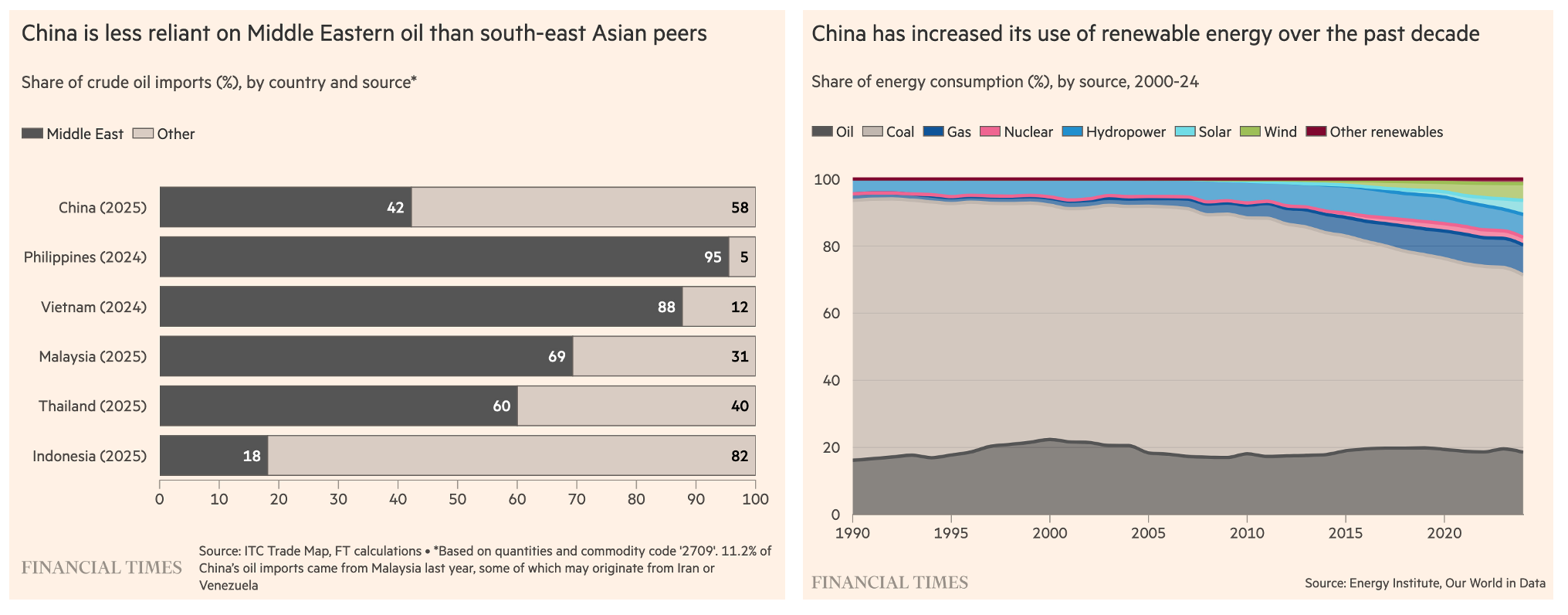
Strengths: this article captures a pivotal moment in global trade . . . the Iran war is reshaping competitive dynamics, and China is positioned to gain. Its key strengths are:
- The 6% Gulf Import Figure: Only about 6% of China’s energy consumption depends on imports from the Gulf. This is the most important number in the article. It explains why Chinese factories can keep running while competitors in Vietnam, Thailand, and Indonesia . . . which depend heavily on Middle East oil . . . are struggling. The energy security that China built through electrification, renewables, and strategic reserves is now a competitive advantage.
- The “China Plus One” Reversal: The article reports that US and European clients are reversing “China plus one” strategies, shifting orders from Vietnam and Cambodia back to China. This is a stunning development. The diversification away from China, which was a deliberate strategy to reduce supply chain risk, is now reversing because the alternative supply chains are more vulnerable to the energy crisis.
- The Export Growth Upgrade: Capital Economics has raised its estimate for China’s export growth in 2026 from 5% to 6%. The upgrade is directly attributed to the war. China is not just weathering the crisis; it is gaining market share.
- The Citi “Supply-Side Resilience” Frame: Xiangrong Yu’s note . . . “China’s supply-side resilience may even allow it to expand export market share . . . echoing the dynamic seen during the Covid shock in 2020” . . . is a crucial insight. The same dynamic that made China the “factory of the world” during the pandemic is repeating. When global supply chains are disrupted, China’s integrated, resilient industrial base becomes more attractive.
- The Profit Margin Reality Check: The article does not portray China as immune. A plastic maker in Wenzhou said the cost of flame retardants had doubled or tripled: “This March we are set for a record loss.” Huang Yiping of the PBOC noted that “imported inflation will weigh on China’s economy.” The article balances the competitive advantage story with the profit margin reality.
- The Consumer Impact: The article notes that China announced “the biggest increase in retail petrol and diesel prices on record.” Social media users posted pictures of queues at petrol stations. One Guangdong blogger wrote: “Absolutely crazy! First time in my life to see the gas station running out of oil.” The crisis is affecting Chinese consumers too.
Weaknesses: the article has no significant weaknesses. It is comprehensive, balanced, and analytically rigorous. If pressed, one could note that:
- The Missing Downstream Sector Analysis: The article notes that “downstream sectors, such as consumer discretionary, may struggle as they can’t pass on higher input costs.” It does not quantify how many jobs or how much output is at risk. The plastic maker’s story is powerful, but it is one data point.
- The Gender Dimension (SDG 5): As with almost all trade and industrial reporting, the article is silent on gender. The factory managers, economists, and executives quoted are predominantly men. The workers who will lose jobs if downstream sectors struggle . . . and the households that will bear the burden of petrol price increases . . . have gendered dimensions that are invisible.
- The “China Plus One” Reversal Scope: The article reports that a manager saw signs of reversal. It does not estimate the scale of the shift. Is this a trickle or a flood? The answer matters for the economies of Vietnam, Thailand, and Indonesia.
Opportunities for C.A.T.: this article provides C.A.T. with a critical case study in how energy security translates into economic competitiveness:
- The 6% Advantage: The statistic that only 6% of China’s energy consumption depends on Gulf imports is a devastating competitive advantage. C.A.T. can use this to argue that energy security is not just about resilience; it is about economic power. The countries that invested in the transition are now reaping the rewards.
- The “China Plus One” Reversal Frame: The reversal of diversification strategies is a stunning development. C.A.T. can use this to argue that the energy crisis is reshaping global supply chains. The assumption that diversification away from China is inevitable is being tested. China’s resilience is winning.
- The Citi “Covid Echo” Frame: Yu’s comparison to the 2020 Covid shock is a powerful framing. C.A.T. can use this to argue that the energy crisis, like the pandemic, is accelerating concentration in China. The “factory of the world” is becoming even more dominant.
- The Profit Margin Vulnerability: The plastic maker’s record loss is a reminder that China is not invincible. C.A.T. can use this to argue that even the most resilient economies are vulnerable to energy shocks. The transition is not complete. The dependence on imported inputs (like sulphur from the Middle East) is a remaining vulnerability.
- The Petrol Queue Image: The photos of queues at petrol stations in China . . . “Absolutely crazy! First time in my life to see the gas station running out of oil” . . . are a powerful reminder that no country is fully insulated. C.A.T. can use this to humanise the crisis in China, where the narrative of resilience might otherwise suggest immunity.
Threats:
- The biggest threat is that the “China plus one” reversal is temporary. If the energy crisis ends and supply chains stabilise, the diversification away from China could resume. The article does not project whether the shift is permanent.
- A second threat is that the profit margin squeeze forces Chinese factories to raise prices, eroding their competitive advantage. The plastic maker’s record loss is a warning. If input costs continue to rise, Chinese exporters may not be able to maintain their price advantage.
- A third threat is that the consumer demand hit in China offsets the export gain. The article notes that “consumer demand in China could also take a hit” from higher petrol prices. If domestic demand weakens, Chinese producers will rely even more on exports, but overseas markets may also be weakening.
- A fourth threat is that the “imported inflation” that Huang Yiping warned about becomes severe. China has been experiencing deflationary pressure. Imported inflation from the energy shock could shift China from deflation to inflation . . . but the “wrong” kind, driven by costs rather than demand.
- A fifth threat is that the crisis accelerates the transition in China . . . but also accelerates the transition elsewhere. The article notes that the crisis “could spur countries to accelerate adoption of renewable energy and electric vehicles . . . benefiting China, which is the leading supplier.” This is an opportunity, but it also means that competitors may eventually reduce their dependence on Chinese supply chains.
Analysis Through Lenses:
United Nations Lens (IPCC/UNFCCC): From a UN climate governance perspective, this article is a case study in the geopolitical consequences of the energy transition. China invested in energy security . . . renewables, strategic reserves, diversified imports . . . and is now reaping the rewards. Countries that did not invest are suffering. The UNFCCC process has focused on emissions reduction, not energy security. This article suggests that the two are linked. The countries that reduce emissions fastest may also be the most resilient to energy shocks.
EU Green New Deal Lens: For Brussels, this article should be an emergency alert. The “China plus one” reversal means that European companies that diversified supply chains away from China are now reconsidering. If the energy crisis persists, Europe could become even more dependent on Chinese manufacturing. The Green Deal’s emphasis on strategic autonomy is not just about energy; it is about supply chains. Europe must invest in its own industrial resilience, or it will be at China’s mercy.
Draghi Report Lens: Mario Draghi’s report called for Europe to close the investment and innovation gap with China. This article shows that the gap is not just about technology; it is about energy security. China’s 6% Gulf import dependence is a structural advantage that Europe cannot match without massive investment in renewables, storage, and domestic energy production. Draghi’s call for €800bn in annual investment is a call to close this gap.
Mark Jacobson Lens: Through Jacobson’s framework, this article is a vindication. Jacobson’s roadmaps for 100% renewables are not just about emissions; they are about energy security. China’s investment in renewables has reduced its dependence on Gulf imports to 6%. Countries that follow Jacobson’s roadmaps will achieve similar resilience. Countries that do not will remain vulnerable. The war is proving Jacobson’s case in real time.
SDG Ratings:
| SDG | Rating | Rationale |
|---|---|---|
| SDG 1 No Poverty | 4/10 ★★★★☆☆☆☆☆☆ | Job losses in Vietnam, Thailand, Indonesia; Chinese plastic maker facing record loss |
| SDG 2 Zero Hunger | 0/10 ☆☆☆☆☆☆☆☆☆☆ | Not addressed |
| SDG 3 Good Health and Well-Being | 1/10 ☆☆☆☆☆☆☆☆☆☆ | Not addressed |
| SDG 4 Quality Education | 1/10 ☆☆☆☆☆☆☆☆☆☆ | Not addressed |
| SDG 5 Gender Equality | 0/10 ☆☆☆☆☆☆☆☆☆☆ | Complete absence. The factory managers, economists, and executives quoted are predominantly men. The workers affected by supply chain shifts have gendered dimensions . . . all invisible |
| SDG 6 Clean Water and Sanitation | 0/10 ☆☆☆☆☆☆☆☆☆☆ | Not addressed |
| SDG 7 Affordable and Clean Energy | 9/10 ★★★★★★★★★☆ | Core focus; energy security, Gulf imports, strategic reserves, transition |
| SDG 8 Decent Work and Economic Growth | 8/10 ★★★★★★★★☆☆ | Export growth, market share, “China plus one” reversal, profit margins |
| SDG 9 Industry, Innovation and Infrastructure | 10/10 ★★★★★★★★★★ | Core focus; supply chains, manufacturing resilience, industrial policy |
| SDG 10 Reduced Inequalities | 5/10 ★★★★★☆☆☆☆☆ | China gains; Vietnam, Thailand, Indonesia lose; distributional impacts not explored |
| SDG 11 Sustainable Cities and Communities | 1/10 ☆☆☆☆☆☆☆☆☆☆ | Not addressed |
| SDG 12 Responsible Consumption and Production | 5/10 ★★★★★☆☆☆☆☆ | Supply chains, consumption patterns, “China plus one” reversal |
| SDG 13 Climate Action | 6/10 ★★★★★★☆☆☆☆ | Energy crisis context; transition implied but not central |
| SDG 14 Life Below Water | 0/10 ☆☆☆☆☆☆☆☆☆☆ | Not addressed |
| SDG 15 Life on Land | 1/10 ☆☆☆☆☆☆☆☆☆☆ | Not addressed |
| SDG 16 Peace, Justice and Strong Institutions | 6/10 ★★★★★★☆☆☆☆ | Iran war as driver, trade policy, supply chain governance |
| SDG 17 Partnerships for the Goals | 4/10 ★★★★☆☆☆☆☆☆ | Global trade, “China plus one” reversal, supply chain relationships |
30th March 2026: Financial Times Journalist Alexandra White reports that the majority of start-ups at the progressive South by Southwest (SXSW) tech, film, music, and arts event in Austin, Texas avoided using words related to climate in pitching to investors, as even green-related company founders have adjusted to the political backdrop. The pitch competition at SXSW has collectively raised more than $22 Billion since 2009. This year, 70% of sustainability-related start-ups avoided activist or “values forward” framing, according to Chris Valentine, the SXSW pitch event producer. Just 18% of companies referenced sustainability and greenhouse gas emissions directly, although many more implied it through language about infrastructure, resilience, efficiency, or waste reduction. Valentine said: “The landscape that we’re living in now has changed so certain kinds of words or terminologies need to look a bit differently to exist. Sustainability and climate doesn’t have the same type of strength that it had previously.” John Khazraee, founder of water monitoring start-up MayimFlow, said the language shift towards risk management reflected “reality”: “When I talk to a CFO or a data centre operator, they’re not asking me about my environmental mission. They’re asking what it costs when a pipe bursts and a server goes down.” Bryan Stubbs, CEO of Cleveland Water Alliance and a judge at the event, said: “If you walk in saying I’m going to save the world, you’ve just lost 90% of your potential investors. The investor wants to know if they’re going to get a return on their investment” https://www.ft.com/content/332714be-cbd2-41d3-a426-45bf8b66c933?syn-25a6b1a6=1
Overall C.A.T. Usefulness: 9/10 ★★★★★★★★★☆
Strengths: this article captures a significant cultural and strategic shift in how climate-related start-ups are positioning themselves to investors. Its key strengths are:
- The 70% Statistic: 70% of sustainability-related start-ups avoided activist or “values forward” framing at SXSW. This is not a marginal shift; it is a strategic retreat. The article quantifies the “greenhushing” phenomenon that Christian documented in earlier analyses. The language of climate action is being suppressed not by law, but by perceived investor preference and political risk.
- The 18% Direct Reference: Only 18% of companies directly referenced sustainability and greenhouse gas emissions. The rest used coded language: infrastructure, resilience, efficiency, waste reduction. The article captures the semantic shift in real time.
- The Valentine Quote: Chris Valentine’s observation . . . “Sustainability and climate doesn’t have the same type of strength that it had previously”. . . is a stark admission from a producer of a progressive tech event. SXSW is not a conservative gathering. If the language of climate action is fading even there, the shift is real.
- The Khazraee Reality Check: John Khazraee’s framing . . . “when I talk to a CFO, they’re not asking me about my environmental mission. They’re asking what it costs when a pipe bursts and a server goes down”. . . is a masterclass in strategic reframing. He is not abandoning climate action; he is translating it into the language of risk management. The mission remains; the pitch changes.
- The Political Backdrop: The article explicitly connects the language shift to the Trump administration’s attacks on climate action, the withdrawal from the Paris Agreement, and the legal actions by “red state” attorneys-general against asset managers like BlackRock, State Street, and Vanguard. The political context is not background; it is the cause.
- The Stubbs Bottom Line: Bryan Stubbs’s quote . . . “If you walk in saying I’m going to save the world, you’ve just lost 90% of your potential investors. The investor wants to know if they’re going to get a return on their investment”. . . is the brutal reality of venture capital. The article does not moralise; it reports.
Weaknesses: the article has no significant weaknesses. It is concise, well-sourced, and strategically informed. If pressed, one could note that:
- The Missing Counter-Example: The article reports that 70% avoided activist framing. It does not profile the 30% that did not. Are those companies based outside the US? Are they targeting different investors? The article could have provided a counterpoint.
- The Gender Dimension (SDG 5): As with almost all business reporting, the article is silent on gender. The founders quoted are men. The judges and producers quoted are men. The article does not explore whether women founders face different pressures or use different framing strategies.
- The Long-Term Risk: The article reports the shift in language. It does not assess whether this shift is strategic or corrosive. Are founders genuinely abandoning climate goals, or are they just changing how they talk about them? The article raises the question but does not answer it.
Opportunities for C.A.T.: this article provides C.A.T. with a critical case study in the politics of climate communication:
- The “Greenhushing” Quantified: The 70% statistic is a powerful data point. C.A.T. can use it to argue that the political backlash against climate action is having a chilling effect on language. The same companies that were talking about “saving the world” are now talking about “resilience” and “efficiency.” The mission has not changed; the vocabulary has.
- The Khazraee Translation Strategy: Khazraee’s approach is a model. He has not abandoned climate action; he has translated it into the language of risk management. C.A.T. can use this as a case study in strategic communication. The frame is not the mission; the mission can be served by many frames.
- The SXSW Bellwether: SXSW is a bellwether for tech and culture. If the language of climate action is fading there, it is fading everywhere. C.A.T. can use this to argue that the political backlash has real consequences for how climate solutions are discussed and funded.
- The Investor Pragmatism: Stubbs’s quote . . . “the investor wants to know if they’re going to get a return on their investment”. . . is a reminder that venture capital is not philanthropy. C.A.T. can use this to argue that climate solutions must be economically viable. The transition will not happen on goodwill alone.
- The Risk Management Frame: The article documents a shift from “climate action” to “risk management.” C.A.T. can use this to argue that the two are not contradictory. Climate change is a risk. Mitigating it is risk management. The frame is not a retreat; it is an adaptation.
Threats:
- The biggest threat is that the language shift becomes a mission shift. If founders stop talking about climate goals, they may eventually stop pursuing them. The article does not assess this risk, but it is real.
- A second threat is that the chilling effect spreads. If 70% of sustainability-related start-ups are avoiding activist framing at SXSW, the same dynamic is likely playing out in boardrooms, pitch meetings, and conferences across the US. The language of climate action is being driven underground.
- A third threat is that the risk management frame is insufficient. Khazraee’s water monitoring start-up addresses a real risk . . . pipe bursts, server downtime. But not all climate solutions can be framed as risk management. Some require upfront investment in public goods with diffuse benefits. Those solutions may struggle for funding in the current environment.
- A fourth threat is that the political backlash intensifies. The article notes that “red state” attorneys-general are taking legal action against asset managers for climate engagement. If the legal risk increases, even the coded language of “resilience” and “efficiency” may become too risky.
- A fifth threat is that the US falls further behind. The article does not compare the US to Europe or China. But the implication is clear: while US start-ups are scrubbing climate language from their pitches, Chinese companies (like CATL) are scaling marine batteries, and European start-ups may be benefiting from a more supportive policy environment. The US could lose the clean tech race.
Analysis Through Lenses:
United Nations Lens (IPCC/UNFCCC): From a UN climate governance perspective, this article is a case study in the unintended consequences of political backlash. The UNFCCC process depends on voluntary action by businesses and investors. If US start-ups are avoiding climate language because of political risk, the voluntary action that the UNFCCC relies on may be undermined. The irony is that the US withdrawal from the Paris Agreement was supposed to free businesses to act. Instead, it has created a chilling effect.
EU Green New Deal Lens: For Brussels, this article should be read as an opportunity. While US start-ups are scrubbing climate language from their pitches, European start-ups can lean into the Green Deal’s supportive policy environment. The EU can attract talent and capital that is fleeing the US political backlash. The Green Deal is not just about regulation; it is about creating a safe space for climate innovation.
Draghi Report Lens: Mario Draghi’s report called for Europe to close the investment and innovation gap with China and the US. This article suggests that the US is creating a hostile environment for climate tech investment. Europe can seize this moment. By providing policy certainty and a supportive regulatory framework, Europe can attract the start-ups that are being chilled in the US. Draghi’s call for investment must include the innovation ecosystem, not just manufacturing.
Mark Jacobson Lens: Through Jacobson’s framework, this article is a case study in the political obstacles to the transition. Jacobson’s roadmaps assume that the technology exists and the economics work. They do not assume that climate start-ups will be afraid to use the word “climate.” The political backlash documented in this article is a barrier that Jacobson’s models do not capture. The transition is not just about technology; it is about the political environment for innovation.
SDG Ratings:
| SDG | Rating | Rationale |
|---|---|---|
| SDG 1 No Poverty | 1/10 ☆☆☆☆☆☆☆☆☆☆ | Not addressed |
| SDG 2 Zero Hunger | 0/10 ☆☆☆☆☆☆☆☆☆☆ | Not addressed |
| SDG 3 Good Health and Well-Being | 1/10 ☆☆☆☆☆☆☆☆☆☆ | Not addressed |
| SDG 4 Quality Education | 1/10 ☆☆☆☆☆☆☆☆☆☆ | Not addressed |
| SDG 5 Gender Equality | 0/10 ☆☆☆☆☆☆☆☆☆☆ | Complete absence. The founders, judges, and producers quoted are predominantly men. Women founders may face different pressures . . . all invisible |
| SDG 6 Clean Water and Sanitation | 2/10 ★★☆☆☆☆☆☆☆☆ | MayimFlow (water monitoring) mentioned; not central |
| SDG 7 Affordable and Clean Energy | 4/10 ★★★★☆☆☆☆☆☆ | Climate start-ups implied; not central |
| SDG 8 Decent Work and Economic Growth | 5/10 ★★★★★☆☆☆☆☆ | Start-up ecosystem, venture capital, investment returns |
| SDG 9 Industry, Innovation and Infrastructure | 8/10 ★★★★★★★★☆☆ | Core focus; start-ups, innovation, technology commercialisation |
| SDG 10 Reduced Inequalities | 1/10 ☆☆☆☆☆☆☆☆☆☆ | Not addressed |
| SDG 11 Sustainable Cities and Communities | 1/10 ☆☆☆☆☆☆☆☆☆☆ | Not addressed |
| SDG 12 Responsible Consumption and Production | 2/10 ★★☆☆☆☆☆☆☆☆ | Implied; not central |
| SDG 13 Climate Action | 7/10 ★★★★★★★☆☆☆ | Core focus; climate language, greenhushing, political backlash |
| SDG 14 Life Below Water | 0/10 ☆☆☆☆☆☆☆☆☆☆ | Not addressed |
| SDG 15 Life on Land | 1/10 ☆☆☆☆☆☆☆☆☆☆ | Not addressed |
| SDG 16 Peace, Justice and Strong Institutions | 5/10 ★★★★★☆☆☆☆☆ | Political backlash, legal actions, freedom of speech |
| SDG 17 Partnerships for the Goals | 3/10 ★★★☆☆☆☆☆☆☆ | Investor-founder relationships, pitch competitions |
27th March 2026: Financial Times Journalists Jamie Smyth, Martha Muir, Sarah White, and Rachel Millard report that the Trump administration is seeking to halt the remaining offshore wind projects in the US, offering buyouts to companies developing them in exchange for fossil fuel investments. The Department of the Interior has held talks with several companies with offshore wind leases to persuade them to enact deals similar to the one agreed with TotalEnergies on Monday, under which the French oil company will be reimbursed nearly $1bn it had poured into its offshore wind lease and will invest the funds in oil and gas projects. President Donald Trump has described offshore wind as the “worst . . . most expensive form of energy.” There are 43 active offshore wind leases off the coast of the US. However, a series of “stop work” orders issued by the administration against projects led by Ørsted, Dominion Energy, and Equinor have been blocked by court rulings following cases brought by the companies. The administration’s strategy has now shifted towards incentivising companies to give up their leases and instead pump those funds into fossil fuel projects. Markus Krebber, chief executive of RWE (which paid $1.1bn for a lease off New York), said: “We were forced to exit nuclear and we went to courts and got a lot of money for that. We got compensation to get out of coal. And here they now get compensation to get out of offshore” https://www.ft.com/content/a73e04be-ebf1-44cf-9876-f4b521f009b7?syn-25a6b1a6=1
Overall C.A.T. Usefulness: 10/10 ★★★★★★★★★★
Strengths: this article captures a new and aggressive phase in the Trump administration’s war on clean energy. Its key strengths are:
- The Buyout Strategy: The administration is no longer just issuing stop-work orders (which courts have blocked); it is now offering buyouts. The TotalEnergies deal is the template: the company gets reimbursed nearly $1bn for its offshore wind lease and agrees to invest the funds in oil and gas projects. This is not just obstruction; it is active redirection of capital from renewables to fossil fuels.
- The 43 Leases at Risk: There are 43 active offshore wind leases off the coast of the US. The article does not estimate the total value at stake, but the numbers are staggering: RWE paid $1.1bn for a lease off New York; Invenergy and energyRe paid $645mn for a site near New York; TotalEnergies is getting nearly $1bn reimbursed. The administration is attempting to unwind billions of dollars of clean energy investment.
- The Krebber Compensation Frame: Markus Krebber’s quote is devastating. “We were forced to exit nuclear and we went to courts and got a lot of money for that. We got compensation to get out of coal. And here they now get compensation to get out of offshore.” He is drawing a direct line between the German Energiewende (paying utilities to exit nuclear and coal) and the Trump administration’s strategy (paying companies to exit offshore wind). The difference, of course, is that Germany was paying to accelerate the transition to renewables. The US is paying to reverse it.
- The Court Blockades: The article notes that a series of “stop work” orders have been blocked by court rulings. The courts are still a bulwark against executive overreach. But the administration has adapted: instead of ordering projects to stop, it is offering companies a financial incentive to leave voluntarily.
- The Renewable-Focused Companies’ Dilemma: The article notes that Engie and EDP are renewables-focused companies. “They would ideally want payment and a way out if they can, but unlike Total they can’t do this transaction with a pledge to invest in fossil fuels.” This is a crucial detail. Not every company can be bought off. Some have business models that do not include oil and gas. The administration’s buyout strategy may not work for them.
- The Near-Complete Projects: Equinor’s Empire Wind project is more than 60% complete. Its chief executive said he wasn’t sure if any US government offer would be relevant. Sunk costs are a defence. The administration cannot easily buy out projects that are already mostly built.
Weaknesses: the article has no significant weaknesses. It is comprehensive, well-sourced, and strategically informed. If pressed, one could note that:
- The Missing Total Cost Estimate: The article reports individual lease values ($1.1bn for RWE, $645mn for Invenergy, $1bn reimbursement for TotalEnergies). It does not estimate the total cost to US taxpayers if the administration buys out all 43 leases. The number would be staggering.
- The Gender Dimension (SDG 5): As with almost all energy and political reporting, the article is silent on gender. The executives quoted are men. The administration officials are men. The companies mentioned are led predominantly by men. The gendered impacts of halting offshore wind projects . . . jobs lost, communities affected . . . are invisible.
- The Missing Climate Impact: The article reports the policy and the financial details. It does not quantify the emissions impact of halting 43 offshore wind leases. How much clean energy would have been generated? How much carbon would have been displaced? The article does not ask.
Opportunities for C.A.T.: this article provides C.A.T. with a critical case study in the active reversal of the energy transition:
- The Buyout as a New Tactic: The administration has moved from obstruction (stop-work orders) to active reversal (buyouts). C.A.T. can use this to argue that the US is not just slowing the transition; it is actively trying to reverse it. The TotalEnergies deal is a template. Other companies may follow.
- The Krebber Parallel: Krebber’s comparison to Germany’s nuclear and coal exit compensation is a powerful framing. C.A.T. can use it to ask: what is the difference between paying companies to exit fossil fuels (Germany) and paying them to exit renewables (US)? The answer is the difference between transition and regression.
- The Court as Bulwark: The article notes that stop-work orders have been blocked by courts. C.A.T. can use this to argue that the judiciary remains a check on executive power. The legal battles over offshore wind are not over. The courts may also block the buyout strategy if it is deemed an unlawful use of funds.
- The Renewable-Focused Companies’ Resistance: Engie and EDP cannot be bought off with fossil fuel investments. C.A.T. can use this to argue that some companies are committed to the transition. The administration’s strategy has limits.
- The Near-Complete Projects’ Immunity: Equinor’s Empire Wind is more than 60% complete. C.A.T. can use this to argue that the transition is not easily reversible. Once projects reach a certain stage, the sunk costs are a defence against political attacks.
Threats:
- The biggest threat is that the buyout strategy succeeds. If other companies follow TotalEnergies, the administration could unwind billions of dollars of offshore wind investment. The 43 active leases could be reduced to a handful. The US offshore wind industry could be set back a decade.
- A second threat is that the buyout strategy is ruled legal. The article does not assess the legal basis for the administration’s offer. If courts accept that the government can reimburse companies for leases and require them to invest in fossil fuels, the precedent could be used for other clean energy sectors.
- A third threat is that the renewable-focused companies find a way to accept the buyout without investing in fossil fuels. The article notes that Engie and EDP “would ideally want payment and a way out if they can, but unlike Total they can’t do this transaction with a pledge to invest in fossil fuels.” If they find a loophole, the administration’s strategy could still succeed in killing offshore wind without redirecting capital to oil and gas.
- A fourth threat is that the near-complete projects are not immune. Equinor’s chief executive said he wasn’t sure if any offer would be relevant. But if the administration offers enough money, even a 60% complete project could be abandoned. The price would be high, but the administration has shown it is willing to spend.
- A fifth threat is that the buyout strategy spreads to other clean energy sectors. If the administration successfully buys out offshore wind leases, it may try similar tactics with solar, onshore wind, and battery storage. The TotalEnergies deal could be the first domino.
Analysis Through Lenses:
United Nations Lens (IPCC/UNFCCC): From a UN climate governance perspective, this article is a disaster. The US is not just failing to meet its climate commitments; it is actively dismantling clean energy infrastructure. The IPCC’s scenarios for 1.5°C assume rapid deployment of renewables. The Trump administration is doing the opposite. The UNFCCC process has no mechanism to stop it. The Loss and Damage fund, established at COP28, was meant to help vulnerable countries cope with climate impacts. It was not designed to compensate companies for abandoning offshore wind projects at the behest of a hostile administration.
EU Green New Deal Lens: For Brussels, this article should be read as a warning and an opportunity. The warning: the US is becoming an unreliable partner for clean energy investment. European companies with US offshore wind leases (EDP, Engie, RWE) are now at risk. The opportunity: the EU can position itself as a stable, predictable market for offshore wind. The Green Deal’s ambition to scale offshore wind can attract the capital that is fleeing the US.
Draghi Report Lens: Mario Draghi’s report called for Europe to close the investment and innovation gap with China and the US. This article shows that the US is deliberately destroying its own clean energy industry. The gap is not just about Europe catching up; it is about the US falling behind. Draghi’s call for investment in clean tech is a call to seize the opportunity that US retreat is creating.
Mark Jacobson Lens: Through Jacobson’s framework, this article is a case study in political sabotage. Jacobson’s roadmaps for 100% renewables require massive deployment of offshore wind. The Trump administration is trying to prevent that deployment. The buyout strategy is not a market outcome; it is a political intervention. Jacobson would argue that the solution is not to negotiate with the administration but to vote it out. The transition cannot succeed if the government is actively working against it.
SDG Ratings:
| SDG | Rating | Rationale |
|---|---|---|
| SDG 1 No Poverty | 2/10 ★★☆☆☆☆☆☆☆☆ | Job losses from halted projects; not explored |
| SDG 2 Zero Hunger | 0/10 ☆☆☆☆☆☆☆☆☆☆ | Not addressed |
| SDG 3 Good Health and Well-Being | 2/10 ★★☆☆☆☆☆☆☆☆ | Air pollution from fossil fuel investments; not explored |
| SDG 4 Quality Education | 1/10 ☆☆☆☆☆☆☆☆☆☆ | Not addressed |
| SDG 5 Gender Equality | 0/10 ☆☆☆☆☆☆☆☆☆☆ | Complete absence. The executives, officials, and analysts quoted are predominantly men. The impacts of halting offshore wind on women workers and communities . . . invisible |
| SDG 6 Clean Water and Sanitation | 0/10 ☆☆☆☆☆☆☆☆☆☆ | Not addressed |
| SDG 7 Affordable and Clean Energy | 5/10 ★★★★★☆☆☆☆☆ | Offshore wind vs. fossil fuels; central to the debate |
| SDG 8 Decent Work and Economic Growth | 4/10 ★★★★☆☆☆☆☆☆ | Jobs in offshore wind vs. oil and gas; not quantified |
| SDG 9 Industry, Innovation and Infrastructure | 8/10 ★★★★★★★★☆☆ | Offshore wind infrastructure, fossil fuel investments |
| SDG 10 Reduced Inequalities | 1/10 ☆☆☆☆☆☆☆☆☆☆ | Not addressed |
| SDG 11 Sustainable Cities and Communities | 1/10 ☆☆☆☆☆☆☆☆☆☆ | Not addressed |
| SDG 12 Responsible Consumption and Production | 2/10 ★★☆☆☆☆☆☆☆☆ | Not addressed |
| SDG 13 Climate Action | 9/10 ★★★★★★★★★☆ | Core focus; halting offshore wind, redirecting capital to fossil fuels |
| SDG 14 Life Below Water | 3/10 ★★★☆☆☆☆☆☆☆ | Offshore wind marine impacts; not central |
| SDG 15 Life on Land | 1/10 ☆☆☆☆☆☆☆☆☆☆ | Not addressed |
| SDG 16 Peace, Justice and Strong Institutions | 7/10 ★★★★★★★☆☆☆ | Executive action, court rulings, legal battles, rule of law |
| SDG 17 Partnerships for the Goals | 3/10 ★★★☆☆☆☆☆☆☆ | Government-company negotiations, international companies (TotalEnergies, RWE, EDP, Engie) |
26th March 2026: Financial Times Journalist Attracta Mooney reports that India, one of the world’s biggest greenhouse gas emitters, has set out a climate plan with modest goals for renewable energy and emissions cuts for the next decade, as the country grapples with its rising energy needs. In the much-delayed blueprint submitted to the UN, the Modi government pledged to reduce emissions relative to GDP by 47% by 2035 compared with 2005. This means India’s absolute emissions will continue to rise alongside economic growth. The plan also said renewables would make up 60% of its cumulative installed electricity capacity by 2035 . . . short of the country’s Central Electricity Authority estimates that by 2036 nearly 70% of India’s electricity capacity would come from non-fossil fuel sources. However, India added a record 35 gigawatts of solar PV in the first 11 months of 2025, a 68% increase on the same period in 2024. UN climate chief Simon Stiell said India was on its way to becoming a solar energy “super power.” But Lauri Myllyvirta of the Centre for Research on Energy and Clean Air said the “targets underestimate the country’s potential for transformative clean energy growth.” Vibhuti Garg of the Institute for Energy Economics and Financial Analysis said: “India’s revised NDCs are a step in the right direction, but they fall short of the ambition required at this stage of the energy transition” https://www.ft.com/content/7eb1342e-629b-4ed7-86f4-9b8309271745?syn-25a6b1a6=1
Overall C.A.T. Usefulness: 9/10 ★★★★★★★★★☆
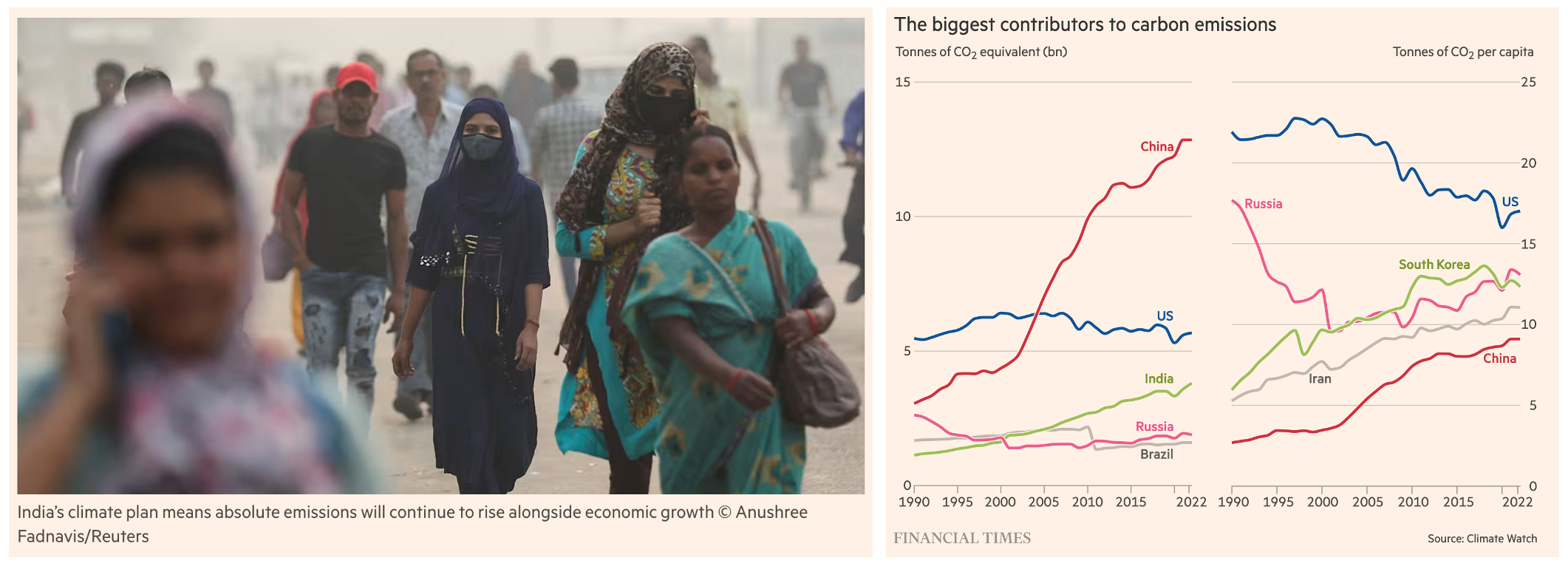
Strengths: this article captures a critical moment in global climate governance . . . the world’s most populous country (and third-largest emitter) has submitted its climate plan, and it is a study in modest ambition. Its key strengths are:
- The 47% Intensity Reduction Target: India pledged to reduce emissions relative to GDP by 47% by 2035 compared with 2005. This is an intensity target, not an absolute reduction target. The article is clear that “absolute emissions will continue to rise alongside economic growth.” This is the fundamental tension of development: India’s emissions will increase as its economy grows, even as its carbon intensity improves.
- The 60% Renewables Target vs. 70% Potential: The plan says renewables will make up 60% of installed electricity capacity by 2035. But India’s own Central Electricity Authority estimates that nearly 70% of capacity could come from non-fossil fuel sources by 2036. The government is lowballing its own potential. This is a political choice, not a technical ceiling.
- The 35GW Solar Record: India added a record 35 gigawatts of solar PV in the first 11 months of 2025 . . . a 68% increase on the same period in 2024. This is not a target; it is a performance. The article uses this data to show that India’s clean energy industry is moving faster than its government’s ambition.
- The Stiell “Super Power” Frame: UN climate chief Simon Stiell said India was on its way to becoming a solar energy “super power.” This is a notable endorsement from the UNFCCC’s top official. It signals that the international community sees India as a leader in clean energy deployment, even if its official targets are modest.
- The Myllyvirta Critique: Lauri Myllyvirta’s quote . . . “targets underestimate the country’s potential for transformative clean energy growth”. . . is the analytical heart of the article. The gap between what India could do and what it has committed to do is the story. Myllyvirta notes that India’s “booming clean energy industry is highly likely to deliver much faster progress than policymakers were prepared to commit to.”
- The Garg Bottom Line: Vibhuti Garg’s assessment . . . “a step in the right direction, but they fall short of the ambition required”. . . is a fair summary. The article does not praise or condemn; it reports the range of expert opinion.
Weaknesses: the article has no significant weaknesses. It is balanced, data-rich, and analytically sound. If pressed, one could note that:
- The Coal Reality: The article notes that coal-fired power made up more than 70% of electricity generation at the end of 2025. It does not project when this share might decline. The 35GW solar record is impressive, but coal remains dominant. The article could have explored the tension between solar deployment and coal persistence more deeply.
- The Missing Per Capita Context: The image you provided shows China’s total emissions (roughly 15bn tonnes CO2 equivalent) dwarfing India’s (roughly 3bn tonnes). But on a per capita basis, India’s emissions are far lower than China’s, the US, or Europe. The article mentions that “its people still consume far less energy than the global average” but does not provide the per capita data. The chart tells a more nuanced story than the text.
- The Gender Dimension (SDG 5): As with almost all climate policy reporting, the article is silent on gender. The experts quoted are predominantly men (Ghosh, Myllyvirta, Purkayastha, Stiell; Garg is a woman). The gendered impacts of India’s energy transition . . . access to clean cooking fuel, women’s participation in the solar workforce, differential energy needs . . . are invisible.
Opportunities for C.A.T.: this article provides C.A.T. with a critical case study in the politics of climate ambition in the developing world:
- The Intensity vs. Absolute Frame: India’s target is an intensity target, not an absolute reduction target. C.A.T. can use this to explain the difference between developed and developing country commitments. The US and Europe can cut absolute emissions. India cannot . . . yet. Its emissions will rise as its economy grows. The question is how fast they rise.
- The 35GW Solar Record as Evidence: The 35GW of solar installed in 11 months is a staggering number. C.A.T. can use this to argue that India’s clean energy industry has its own momentum. The government’s modest targets may be irrelevant; the market is moving faster.
- The Myllyvirta “Underestimate” Frame: Myllyvirta’s critique . . . that the targets underestimate India’s potential . . . is a useful frame. C.A.T. can use it to argue that climate ambition is not just about what governments pledge; it is about what industries can deliver. India’s solar boom is a case study in delivery exceeding ambition.
- The Stiell “Super Power” Endorsement: Stiell’s endorsement is a signal that the UNFCCC sees India as a leader. C.A.T. can use this to argue that the centre of gravity in climate action is shifting from developed to developing countries. The US is retreating; China is leading; India is emerging.
- The Coal vs. Solar Tension: The article documents the tension: coal is still 70% of generation, but solar is growing at 68% year on year. C.A.T. can use this to argue that the transition is not linear. The two can coexist for a time. The question is when the crossover happens.
Threats:
- The biggest threat is that India’s modest targets become self-fulfilling. If the government does not create policy conditions for faster renewable deployment, the industry’s momentum could stall. The 35GW record was achieved under existing policies; future growth depends on continued support.
- A second threat is that coal remains dominant for decades. The article notes that coal was 70% of generation at the end of 2025. If solar growth slows, coal’s share could remain high well into the 2030s. India’s absolute emissions would rise faster than necessary.
- A third threat is that India’s per capita emissions catch up to the global average. The article notes that Indians “still consume far less energy than the global average.” As the country develops, energy consumption per capita will rise. If that energy comes from coal, the emissions impact will be severe.
- A fourth threat is that the gap between ambition and potential becomes a political liability. Myllyvirta and Garg both note that India could do more. If the international community pressures India to raise its ambition, the Modi government could resist, leading to a standoff.
- A fifth threat is that the US retreat undermines India’s transition. The article notes that the US is retreating from climate leadership. If developed countries do not provide the climate finance and technology transfer they promised, India may struggle to achieve even its modest targets.
Analysis Through Lenses:
United Nations Lens (IPCC/UNFCCC): From a UN climate governance perspective, this article is a reality check. The Paris Agreement requires all countries to submit increasingly ambitious NDCs. India has submitted a plan that is modest. The UNFCCC process has no mechanism to force India to be more ambitious. Stiell’s “super power” comment is an attempt at moral suasion, not compulsion. The article shows the limits of the UN process. It can celebrate progress, but it cannot mandate it.
EU Green New Deal Lens: For Brussels, this article should be read as an opportunity and a challenge. The opportunity: India’s solar boom creates demand for European technology and investment. The challenge: if Europe retreats from climate leadership, India may look to China instead. The EU’s Green Deal should include a strong partnership with India on clean energy. The article shows that India is moving . . . but it could move faster with the right support.
Draghi Report Lens: Mario Draghi’s report called for Europe to close the investment and innovation gap with China and the US. India is not a competitor in the same way. But the article shows that India is emerging as a clean energy powerhouse. Europe should see India as a partner, not a rival. Draghi’s call for investment in clean tech should include investment in India’s transition.
Mark Jacobson Lens: Through Jacobson’s framework, this article is a mixed verdict. The good news: India added 35GW of solar in 11 months. The bad news: coal is still 70% of generation. Jacobson’s roadmaps for 100% renewables require a rapid phase-out of coal. India is not there yet. But the trajectory is promising. The 68% year-on-year solar growth is exactly what Jacobson’s models prescribe. The question is whether India can sustain that growth rate for a decade.
SDG Ratings:
| SDG | Rating | Rationale |
|---|---|---|
| SDG 1 No Poverty | 4/10 ★★★★☆☆☆☆☆☆ | Energy access, economic growth; not central |
| SDG 2 Zero Hunger | 0/10 ☆☆☆☆☆☆☆☆☆☆ | Not addressed |
| SDG 3 Good Health and Well-Being | 3/10 ★★★☆☆☆☆☆☆☆ | Air pollution from coal; not explored |
| SDG 4 Quality Education | 1/10 ☆☆☆☆☆☆☆☆☆☆ | Not addressed |
| SDG 5 Gender Equality | 0/10 ☆☆☆☆☆☆☆☆☆☆ | Complete absence. Energy access, clean cooking, and workforce participation have gendered dimensions . . . all invisible |
| SDG 6 Clean Water and Sanitation | 0/10 ☆☆☆☆☆☆☆☆☆☆ | Not addressed |
| SDG 7 Affordable and Clean Energy | 9/10 ★★★★★★★★★☆ | Core focus; solar deployment, renewables target, coal dependence |
| SDG 8 Decent Work and Economic Growth | 6/10 ★★★★★★☆☆☆☆ | Economic growth, emissions intensity, jobs in solar |
| SDG 9 Industry, Innovation and Infrastructure | 8/10 ★★★★★★★★☆☆ | Solar manufacturing, grid integration, clean energy industry |
| SDG 10 Reduced Inequalities | 3/10 ★★★☆☆☆☆☆☆☆ | Energy access for poor; not explored |
| SDG 11 Sustainable Cities and Communities | 2/10 ★★☆☆☆☆☆☆☆☆ | Not addressed |
| SDG 12 Responsible Consumption and Production | 4/10 ★★★★☆☆☆☆☆☆ | Energy consumption, emissions intensity |
| SDG 13 Climate Action | 9/10 ★★★★★★★★★☆ | Core focus; NDC, emissions targets, Paris Agreement |
| SDG 14 Life Below Water | 0/10 ☆☆☆☆☆☆☆☆☆☆ | Not addressed |
| SDG 15 Life on Land | 2/10 ★★☆☆☆☆☆☆☆☆ | Carbon sink pledge (tree and plantation development) |
| SDG 16 Peace, Justice and Strong Institutions | 3/10 ★★★☆☆☆☆☆☆☆ | UN process, NDC submission, governance |
| SDG 17 Partnerships for the Goals | 5/10 ★★★★★☆☆☆☆☆ | Brics chair, international climate finance, UNFCCC |
25th March 2026: Financial Times Journalists Ian Johnston and Attracta Mooney report that oil and gas companies including Norway’s Equinor and a lobby group backed by Shell, TotalEnergies, and ConocoPhillips have called for the EU to drop an effective ban on future drilling in the Arctic, seizing on arguments about energy security in response to an EU consultation on its Arctic policy. Norway’s KonKraft group said: “There is no European energy security without Arctic energy.” In 2021, the EU committed to work towards an international moratorium on oil and gas drilling as part of its Arctic strategy, but it is now reviewing that strategy. Ella Westlake of InfluenceMap said the industry was trying to take “advantage of geopolitical instability to repeat misleading arguments that present fossil fuels rather than renewable energy as the solution to energy security.” Nareg Terzian of the International Association of Oil & Gas Producers (whose members include Shell, TotalEnergies, and ConocoPhillips) argued that a ban “would send the wrong signal at the worst possible time,” adding that “restricting production from regions like northern Norway would not reduce demand, but risks increasing reliance on supplies with higher emission intensity.” Under the Trump administration, the US this month launched auctions for the right to drill in the National Petroleum Reserve in the Alaskan Arctic, drawing what it said were $163mn in bids https://www.ft.com/content/1bb72cf7-5fc6-4ee9-ae76-73f7937407f1?syn-25a6b1a6=1
Overall C.A.T. Usefulness: 10/10 ★★★★★★★★★★
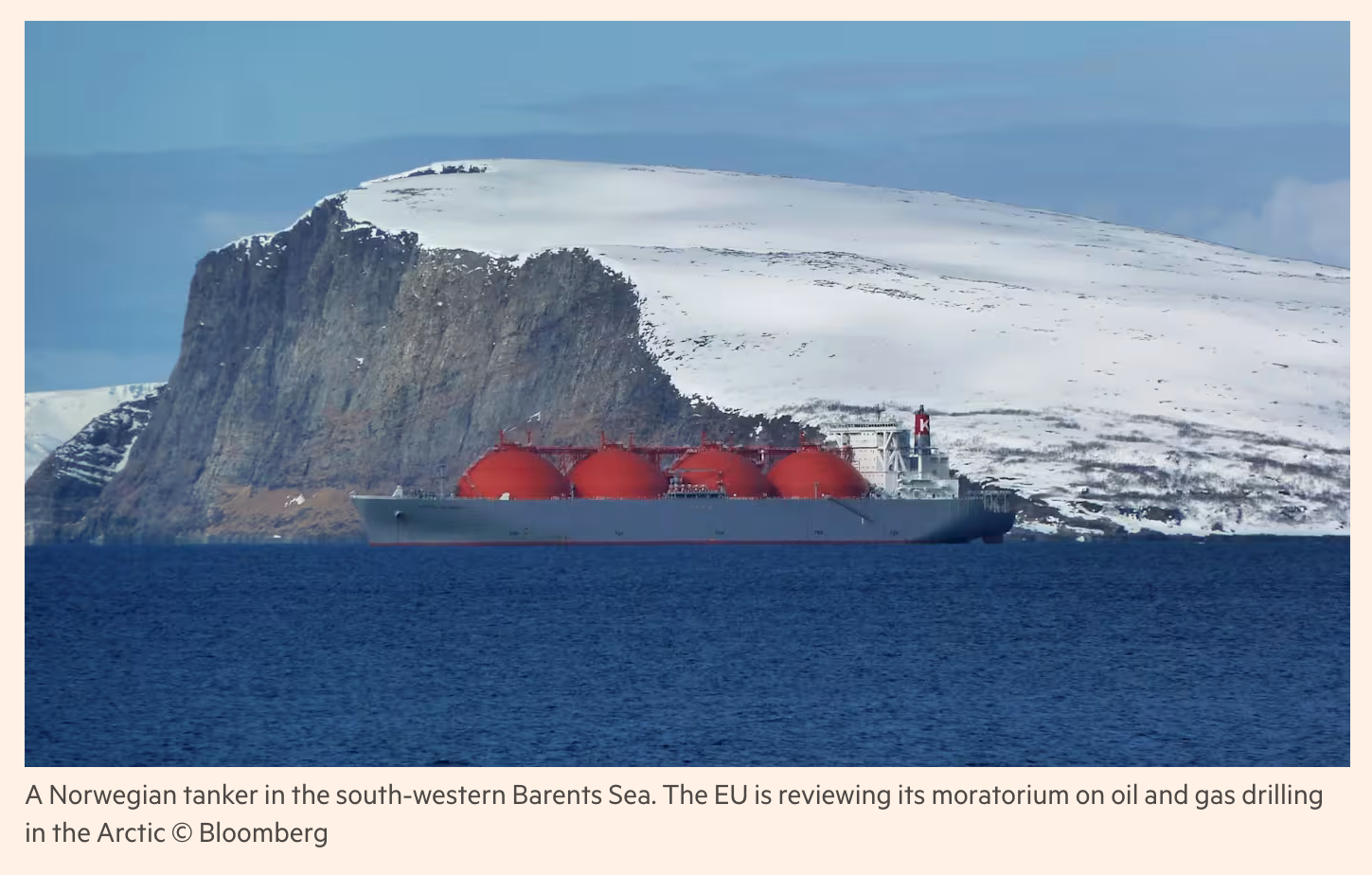
Strengths: this article captures a coordinated lobbying push by the oil and gas industry to exploit the energy security crisis for Arctic drilling. Its key strengths are:
- The “No European Energy Security Without Arctic Energy” Frame: KonKraft’s statement is a direct challenge to the EU’s Arctic moratorium. The industry is framing Arctic drilling as a matter of survival, not profit. This is a strategic shift in language: not “drill because it’s profitable,” but “drill because otherwise Europe will freeze.”
- The Geopolitical Opportunity: The article notes that the EU is reviewing its Arctic strategy, which was concluded before Russia’s full-scale war on Ukraine. The industry is seizing on the energy security crisis to reopen a policy that was settled. Westlake’s quote . . . “advantage of geopolitical instability”. . . names the tactic explicitly.
- The Terzian “Wrong Signal” Argument: Nareg Terzian’s framing . . . a ban “would send the wrong signal at the worst possible time”. . . is a classic industry argument. It sounds reasonable on its face: of course Europe should not restrict supply during a crisis. But the article includes Westlake’s counter: the industry is presenting fossil fuels rather than renewables as the solution.
- The Emissions Intensity Argument: Terzian also argues that restricting Arctic production “risks increasing reliance on supplies with higher emission intensity.” This is a more sophisticated argument: Arctic gas, he claims, is cleaner than LNG shipped from elsewhere. The article does not fact-check this claim, but it includes the argument, which is balanced reporting.
- The US Parallel: The article notes that the Trump administration has launched auctions for drilling in the Alaskan Arctic, drawing $163mn in bids. The US and the industry are moving in the same direction. The EU is the battleground. The article connects the two fronts.
- The InfluenceMap Warning: Westlake’s organisation, InfluenceMap, tracks corporate lobbying on climate policy. The article gives her space to call the push “alarming” and to warn that it “risked undoing decades of work to tackle climate change.” The industry’s arguments are presented, but so is the counter.
Weaknesses: the article has no significant weaknesses. It is concise, well-sourced, and strategically informed. If pressed, one could note that:
- The Missing Fact-Check on Emissions Intensity: Terzian claims that Arctic gas has lower emissions intensity than alternatives. The article does not verify or challenge this claim. It is a technical question that requires data. The reader is left to take the industry’s word for it.
- The Gender Dimension (SDG 5): As with almost all energy and lobbying reporting, the article is silent on gender. The executives, lobbyists, and analysts quoted are predominantly men. The impacts of Arctic drilling on Indigenous communities (which include women) are not explored.
- The Missing Indigenous Voice: The Arctic is not uninhabited. Indigenous communities in Norway, Russia, Canada, Alaska, and Greenland have lived in the Arctic for millennia. Their voices are absent from this article. The debate over Arctic drilling is not just about energy security; it is about sovereignty, tradition, and survival.
Opportunities for C.A.T.: this article provides C.A.T. with a critical case study in crisis-driven lobbying:
- The “Energy Security” Frame as a Weapon: The industry has learned to use the language of energy security. C.A.T. can use this to argue that the same frame can be used for renewables. Solar and wind are also energy security. The industry is not wrong that Europe needs secure energy; it is wrong that Arctic gas is the only answer.
- The Geopolitical Opportunism Exposed: Westlake’s quote . . . “advantage of geopolitical instability”. . . is a gift. C.A.T. can use it to argue that the industry is not responding to the crisis in good faith; it is exploiting it. The same crisis that is devastating households in Manila is being used to justify drilling in the Arctic.
- The EU as a Battleground: The EU is reviewing its Arctic strategy. The industry is lobbying hard. C.A.T. can track this policy review as a key indicator of whether Europe will hold the line or retreat. The outcome will shape Arctic policy for a generation.
- The US-Arctic Connection: The Trump administration is moving in the opposite direction, auctioning drilling rights in Alaska. C.A.T. can use this to argue that the US is becoming a petrostate, as Rana Foroohar argued. The Arctic is the next frontier.
- The “Wrong Signal” Frame: Terzian’s argument that a ban “would send the wrong signal at the worst possible time” is a classic industry frame. C.A.T. can use it to ask: what signal would Arctic drilling send? The signal that the industry can exploit any crisis to open new frontiers. The signal that climate commitments are conditional.
Threats:
- The biggest threat is that the EU caves to industry pressure. The article notes that the policy discussions are “embryonic.” If the industry succeeds in weakening the Arctic moratorium, the EU’s climate credibility would be severely damaged.
- A second threat is that the “energy security” frame succeeds. The industry has learned to speak the language of policymakers. If European leaders accept that Arctic gas is a matter of survival, the moratorium will fall.
- A third threat is that the emissions intensity argument goes unchallenged. Terzian claims that Arctic gas is cleaner than alternatives. If this claim is false (or misleading), the industry could use it to justify drilling that actually increases emissions.
- A fourth threat is that the US Arctic drilling sets a precedent. The Trump administration has auctioned drilling rights in Alaska. If the EU follows, the Arctic could become a new front in the fossil fuel expansion. The environmental risks are severe.
- A fifth threat is that the Indigenous voice is ignored. The Arctic is not empty. Indigenous communities have fought for decades to protect their lands from drilling. If the EU and the US open the Arctic, those communities will be overridden. The justice implications are profound.
Analysis Through Lenses:
United Nations Lens (IPCC/UNFCCC): From a UN climate governance perspective, this article is a disaster in the making. The IPCC has warned that Arctic warming is accelerating. Drilling in the Arctic would release carbon that has been trapped for millennia. The UNFCCC process has no mechanism to stop the EU or the US from opening the Arctic. The Paris Agreement depends on voluntary action. The industry is exploiting the crisis to push for the opposite of voluntary action.
EU Green New Deal Lens: For Brussels, this article should be a test of resolve. The Green Deal’s credibility depends on whether the EU can resist industry lobbying. The Arctic moratorium was a signature achievement. If it falls, the message to the world is that Europe’s climate commitments are negotiable. The industry is using the Iran war as a wedge. The question is whether the EU will hold the line.
Draghi Report Lens: Mario Draghi’s report called for Europe to close the investment and innovation gap with China and the US. It did not call for opening the Arctic to drilling. The two are not in tension. Europe can invest in renewables and energy efficiency without drilling in the Arctic. The industry’s argument that Arctic gas is necessary for energy security is a false choice.
Mark Jacobson Lens: Through Jacobson’s framework, this article is a case study in the fossil fuel industry’s last gasp. Jacobson’s roadmaps for 100% renewables show that the world does not need Arctic gas. The industry knows this. That is why it is lobbying so hard. The crisis is an opportunity to lock in fossil fuel infrastructure for decades. Jacobson would say: the solution is not Arctic gas; it is renewables, storage, and efficiency. The industry’s arguments are not good faith; they are survival.
SDG Ratings:
| SDG | Rating | Rationale |
|---|---|---|
| SDG 1 No Poverty | 1/10 ☆☆☆☆☆☆☆☆☆☆ | Not addressed |
| SDG 2 Zero Hunger | 0/10 ☆☆☆☆☆☆☆☆☆☆ | Not addressed |
| SDG 3 Good Health and Well-Being | 1/10 ☆☆☆☆☆☆☆☆☆☆ | Not addressed |
| SDG 4 Quality Education | 1/10 ☆☆☆☆☆☆☆☆☆☆ | Not addressed |
| SDG 5 Gender Equality | 0/10 ☆☆☆☆☆☆☆☆☆☆ | Complete absence. Indigenous women in Arctic communities are on the front lines of drilling fights . . . all invisible |
| SDG 6 Clean Water and Sanitation | 1/10 ☆☆☆☆☆☆☆☆☆☆ | Not addressed |
| SDG 7 Affordable and Clean Energy | 8/10 ★★★★★★★★☆☆ | Energy security, Arctic gas, renewables as alternative |
| SDG 8 Decent Work and Economic Growth | 2/10 ★★☆☆☆☆☆☆☆☆ | Oil and gas jobs; not central |
| SDG 9 Industry, Innovation and Infrastructure | 4/10 ★★★★☆☆☆☆☆☆ | Arctic drilling infrastructure |
| SDG 10 Reduced Inequalities | 2/10 ★★☆☆☆☆☆☆☆☆ | Indigenous communities affected; not explored |
| SDG 11 Sustainable Cities and Communities | 1/10 ☆☆☆☆☆☆☆☆☆☆ | Not addressed |
| SDG 12 Responsible Consumption and Production | 3/10 ★★★☆☆☆☆☆☆☆ | Fossil fuel consumption, emissions intensity |
| SDG 13 Climate Action | 9/10 ★★★★★★★★★☆ | Core focus; Arctic drilling, emissions, climate impact |
| SDG 14 Life Below Water | 5/10 ★★★★★☆☆☆☆☆ | Arctic marine ecosystems at risk from drilling |
| SDG 15 Life on Land | 6/10 ★★★★★★☆☆☆☆ | Arctic tundra, biodiversity loss, ecosystem damage |
| SDG 16 Peace, Justice and Strong Institutions | 4/10 ★★★★☆☆☆☆☆☆ | Lobbying, EU policy review, corporate influence |
| SDG 17 Partnerships for the Goals | 3/10 ★★★☆☆☆☆☆☆☆ | Industry coordination, EU consultation process |
25th March 2026: Financial Times Journalists Kana Inagaki and Jim Pickard report that the UK government has announced a new £1 Billion push to convince more businesses to switch to electric trucks and vans, running to 2030, as the government works to strengthen energy security amid fuel price rises caused by the Iran war. Companies will save up to £81,000 per lorry when buying the heaviest zero-emission truck (40% of the cost), while an existing grant will continue to offer a discount of up to £5,000 for switching to electric vans. An additional £170 Million will help businesses and public authorities save up to £1 Million when installing charging infrastructure. Keir Mather, minister for aviation, maritime and decarbonisation, said: “The crisis in the Middle East shows that energy security and resilience for businesses large and small is more important than ever.” Sales of electric vans increased 34% year on year to 3,853 units during the first two months of 2026, but their market share of 12% was well below the 24% target for this year under the UK’s zero emission vehicle mandate. The electric share for trucks was just 1.4% in 2025 https://www.ft.com/content/68a214ad-fa5b-4a1a-b17f-86539f334ef8?syn-25a6b1a6=1
Overall C.A.T. Usefulness: 9/10 ★★★★★★★★★☆
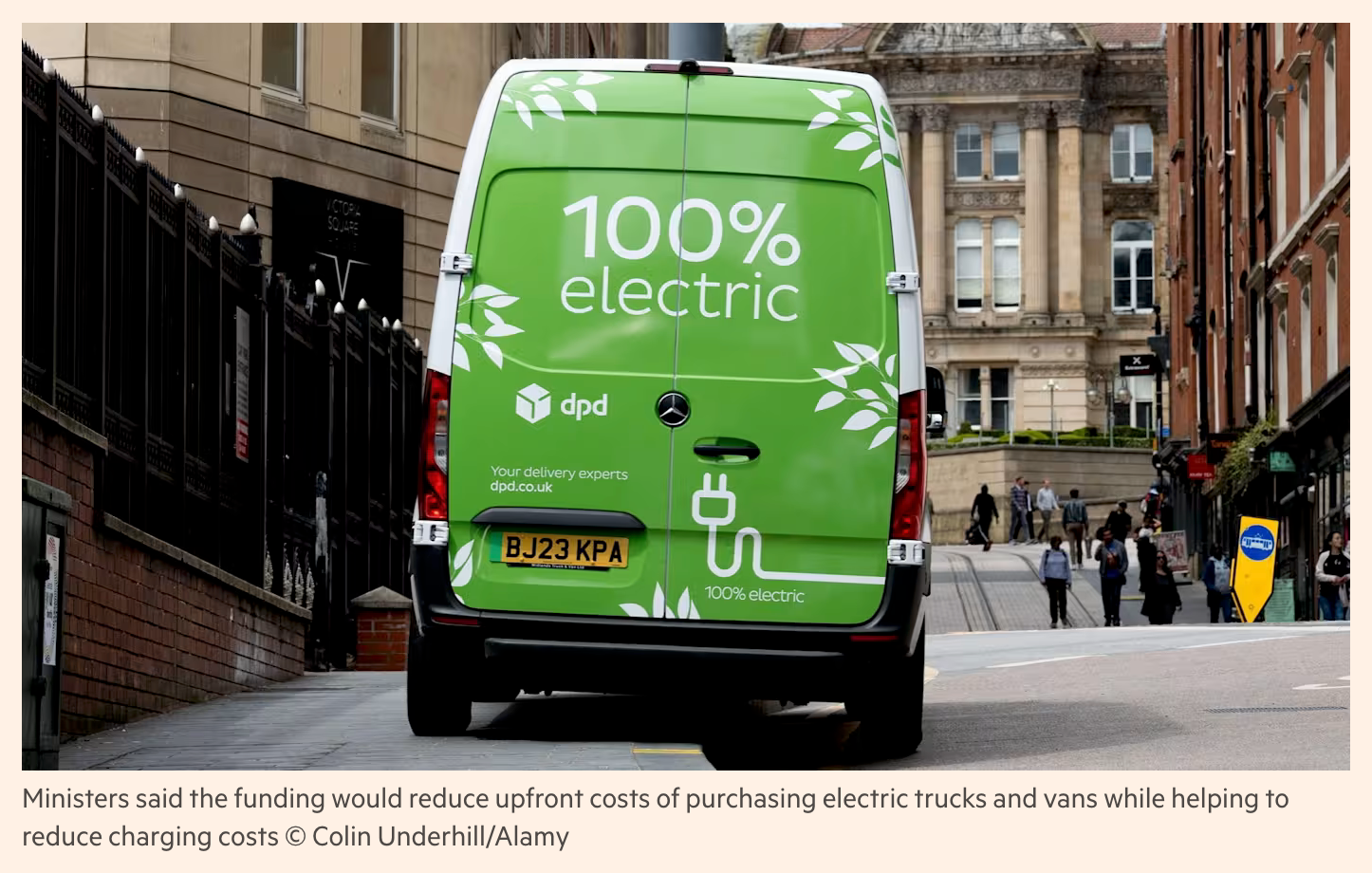
Strengths: this article captures a significant policy intervention to accelerate the electrification of commercial vehicles in the UK. Its key strengths are:
- The £1bn Signal: The UK government is putting serious money behind the electric transition for trucks and vans. £1bn is not symbolic; it is material. The article specifies the per-vehicle savings: up to £81,000 per lorry (40% of the cost), up to £5,000 per van, and up to £1mn for charging infrastructure. These numbers are concrete and compelling.
- The Energy Security Frame: Keir Mather’s quote . . . “the crisis in the Middle East shows that energy security and resilience for businesses large and small is more important than ever”. . . connects the policy directly to the Iran war. The article is explicit: the funding is a response to fuel price rises caused by the conflict. The same crisis that is driving up petrol and diesel prices is now driving policy to accelerate the transition.
- The Electric Van Growth (34%): Sales of electric vans increased 34% year on year in the first two months of 2026. This is real momentum. The article does not rely on future projections; it reports current growth. The market is moving.
- The Gap Reality Check: The article is honest about the gap between targets and reality. Electric vans have a 12% market share, well below the 24% target. Electric trucks are at just 1.4%. The funding is designed to close that gap. The article does not pretend the transition is easy.
- The M&S Endorsement: Julian Bailey of M&S welcomed the funding. M&S is aiming to be net zero by 2040 and already has 24 electric vehicles in its fleet. The inclusion of a real business validates the policy.
- The Hawes Caveat: Mike Hawes of the SMMT supported the measures but called for “grid connection prioritisation, dedicated commercial vehicle charging infrastructure and regulation that reflects the diversity of operators’ uses and requirements.” The article includes the industry’s feedback, not just the government’s announcement.
Weaknesses: the article has no significant weaknesses. It is balanced, data-driven, and strategically informed. If pressed, one could note that:
- The Missing Comparison to Car Subsidies: The article notes that the government “last year resumed offering consumer subsidies to increase the purchase of EVs.” It does not compare the scale of the truck and van funding (£1bn) to the car subsidies. Context would help readers understand the relative priority.
- The Gender Dimension (SDG 5): As with almost all transport and industrial reporting, the article is silent on gender. The transport and logistics industry has a gender profile. Women are underrepresented in truck driving and fleet management. The article does not ask whether the transition to electric trucks will affect women differently.
- The Missing Grid Capacity Analysis: The article notes that “concerns about charging infrastructure and grid capacity” are barriers to the transition. It does not quantify the gap. How much grid capacity is needed? How much exists? The article raises the issue but does not provide the data.
Opportunities for C.A.T.: this article provides C.A.T. with a critical case study in crisis-driven policy:
- The Energy Security Frame as Policy Driver: The Iran war is accelerating policy, not just rhetoric. Mather explicitly connects the funding to the crisis. C.A.T. can use this to argue that the transition is not just about climate; it is about resilience. The same argument works for households (solar panels) and for fleets (electric trucks).
- The £81,000 Per Lorry Figure: The per-vehicle savings are large enough to drive decisions. C.A.T. can use this to argue that the economics of the transition are improving. The upfront cost barrier is being addressed directly.
- The 34% Growth vs. 24% Target Gap: The gap between 12% market share and the 24% target is a reality check. C.A.T. can use this to argue that policy needs to be more aggressive. The funding is a step, but it may not be enough.
- The 1.4% Truck Share: Electric trucks are at just 1.4%. This is the next frontier. C.A.T. can use this to argue that the transition is uneven. Cars and vans are ahead; trucks are far behind. The funding is targeting the laggards.
- The Grid and Charging Infrastructure as Enablers: Hawes’s call for “grid connection prioritisation” and “dedicated commercial vehicle charging infrastructure” is a reminder that vehicles are only part of the system. C.A.T. can use this to argue that infrastructure investment must keep pace.
Threats:
- The biggest threat is that the funding is insufficient. £1bn over five years is significant, but the scale of the transition is massive. The article notes that the electric share for trucks was just 1.4% in 2025. Closing that gap will require sustained investment.
- A second threat is that the grid cannot keep pace. The article notes that “concerns about charging infrastructure and grid capacity” are barriers. If the grid is not upgraded, the electric trucks will have nowhere to charge.
- A third threat is that the zero emission vehicle mandate is weakened. The article notes that the government will review the mandate for cars and vans in early 2027. If the mandate is loosened, the demand signal for electric vans and trucks could weaken.
- A fourth threat is that the EU and US policy retreat undermines UK supply chains. The article notes that “an increasing number of manufacturers are also walking back EV targets following a reversal in US policy on vehicle emissions as well as a loosening of the EU’s 2035 petrol ban.” If global demand for electric vehicles weakens, the cost of components could rise.
- A fifth threat is that the 34% growth rate slows. The article reports strong growth in electric van sales. But the growth rate may not be sustainable. If the funding does not translate into sustained demand, the 24% target will be missed.
Analysis Through Lenses:
United Nations Lens (IPCC/UNFCCC): From a UN climate governance perspective, this article is a positive development. The UK has legally binding net zero targets. The funding is a concrete step towards meeting those targets. The UNFCCC process cannot mandate such policies; it can only encourage them. The UK’s action is a model for other countries. The fact that the funding is framed as energy security, not just climate, is a lesson for the UNFCCC: the language of resilience resonates.
EU Green New Deal Lens: For Brussels, this article should be read as a reminder that the UK is no longer in the EU. The UK is setting its own policies, and they are ambitious. The EU’s own targets for electric vans and trucks are similar. The question is whether the EU will match the UK’s funding. The Green Deal’s success depends on member states investing in the transition. The UK is showing the way.
Draghi Report Lens: Mario Draghi’s report called for Europe to close the investment and innovation gap. The UK is not in the EU, but it is a European economy. The £1bn funding is a form of investment in the transition. Draghi’s call for €800bn in annual investment across the EU would dwarf this amount. The UK’s action is a reminder that national governments can act. The EU must coordinate and scale.
Mark Jacobson Lens: Through Jacobson’s framework, this article is good news. Jacobson’s roadmaps for 100% renewables include the electrification of all transport, including trucks and vans. The UK’s funding is a step in that direction. But Jacobson would note that the 1.4% electric truck share is far too low. The transition needs to accelerate. The funding is a start, but it is not enough.
SDG Ratings:
| SDG | Rating | Rationale |
|---|---|---|
| SDG 1 No Poverty | 2/10 ★★☆☆☆☆☆☆☆☆ | Not addressed |
| SDG 2 Zero Hunger | 0/10 ☆☆☆☆☆☆☆☆☆☆ | Not addressed |
| SDG 3 Good Health and Well-Being | 2/10 ★★☆☆☆☆☆☆☆☆ | Air pollution reduction from electric vans and trucks; not explored |
| SDG 4 Quality Education | 1/10 ☆☆☆☆☆☆☆☆☆☆ | Not addressed |
| SDG 5 Gender Equality | 0/10 ☆☆☆☆☆☆☆☆☆☆ | Complete absence. The transport and logistics industry has a gender profile . . . all invisible |
| SDG 6 Clean Water and Sanitation | 0/10 ☆☆☆☆☆☆☆☆☆☆ | Not addressed |
| SDG 7 Affordable and Clean Energy | 9/10 ★★★★★★★★★☆ | Core focus; electric trucks and vans, energy security, fuel price shocks |
| SDG 8 Decent Work and Economic Growth | 5/10 ★★★★★☆☆☆☆☆ | Logistics industry, fleet operations; job quality not addressed |
| SDG 9 Industry, Innovation and Infrastructure | 9/10 ★★★★★★★★★☆ | Core focus; charging infrastructure, grid capacity, vehicle manufacturing |
| SDG 10 Reduced Inequalities | 1/10 ☆☆☆☆☆☆☆☆☆☆ | Not addressed |
| SDG 11 Sustainable Cities and Communities | 4/10 ★★★★☆☆☆☆☆☆ | Urban air quality, delivery fleets; not central |
| SDG 12 Responsible Consumption and Production | 3/10 ★★★☆☆☆☆☆☆☆ | Not addressed |
| SDG 13 Climate Action | 9/10 ★★★★★★★★★☆ | Core focus; decarbonisation of transport, net zero target |
| SDG 14 Life Below Water | 0/10 ☆☆☆☆☆☆☆☆☆☆ | Not addressed |
| SDG 15 Life on Land | 1/10 ☆☆☆☆☆☆☆☆☆☆ | Not addressed |
| SDG 16 Peace, Justice and Strong Institutions | 3/10 ★★★☆☆☆☆☆☆☆ | Government policy, energy security as driver |
| SDG 17 Partnerships for the Goals | 3/10 ★★★☆☆☆☆☆☆☆ | Government-business partnership (M&S, SMMT) |
24th March 2026: Financial Times Journalists Martha Muir and Rachel Millard report that the Trump administration has agreed to pay TotalEnergies almost $1 Billion to pull out of offshore wind in the US and invest instead in oil and gas production, as it tries to boost supplies of fossil fuels. The Department of the Interior will reimburse the French energy company the full $928 Million cost of its two offshore wind leases in exchange for the company cancelling the leases and spending the money on oil and gas. Interior Secretary Doug Burgum said offshore wind was “expensive, unreliable [and] environmentally disruptive” and that the oil and gas investment would help “lower Americans’ monthly bills.” TotalEnergies CEO Patrick Pouyanné said the deal would fund its Rio Grande LNG project, as well as oil production in the Gulf of Mexico and shale gas production. “Considering that the development of offshore wind projects is not in the country’s interest, we have decided to renounce offshore wind development in the US, in exchange for the reimbursement of the lease fees,” he said. The company has also pledged “not to develop any new offshore wind projects in the US.” The two leases, off the coasts of New York and North Carolina, had a combined potential capacity of about four gigawatts https://www.ft.com/content/ae51ca5e-b45d-4a31-952b-e7c611b0e5b6?syn-25a6b1a6=1
Overall C.A.T. Usefulness: 10/10 ★★★★★★★★★★
Strengths: this article captures a “landmark” deal in the Trump administration’s war on clean energy . . . the first major buyout of an offshore wind lease, with the explicit condition that the money be redirected to fossil fuels. Its key strengths are:
- The $928mn Reimbursement: The administration is paying TotalEnergies nearly $1bn to walk away from offshore wind. This is not a theoretical offer; it is a completed deal. The money will be spent on LNG (Rio Grande project), Gulf of Mexico oil, and shale gas. The administration is actively redirecting capital from renewables to fossil fuels.
- The “Not in the Country’s Interest” Frame: Pouyanné’s statement . . . “considering that the development of offshore wind projects is not in the country’s interest, we have decided to renounce offshore wind development in the US”. . . is a remarkable admission. The CEO of a major international energy company is publicly stating that offshore wind is not in America’s interest. He is not saying it is unprofitable; he is endorsing the administration’s political framing.
- The Burgum Language: Doug Burgum’s characterization of offshore wind as “expensive, unreliable [and] environmentally disruptive” is the administration’s talking points. The article gives him space to make the case. But it also notes that courts have allowed projects to proceed despite the administration’s national security claims. The factual record contradicts the rhetoric.
- The LNG to Europe Angle: Pouyanné notes that the Rio Grande LNG project could “help supply gas to Europe.” This is the energy security argument in action. The administration is framing fossil fuel investment as a service to allies. The article does not challenge this framing, but it reports it.
- The Four Gigawatts Lost: The two leases had a combined potential capacity of about four gigawatts. The article does not convert this into homes powered or emissions avoided, but the number is large. Four gigawatts of offshore wind is a significant amount of clean energy. It is being traded for fossil fuels.
- The “No New Offshore Wind” Pledge: TotalEnergies has pledged “not to develop any new offshore wind projects in the US.” This is not just a cancellation of existing leases; it is a forward commitment. The company is exiting the US offshore wind market entirely.
Weaknesses: the article has no significant weaknesses. It is concise, well-sourced, and strategically informed. If pressed, one could note that:
- The Missing Cost-Benefit Analysis: The article reports the deal but does not estimate the cost to US taxpayers or the climate impact. $928mn is being paid to a French company to abandon clean energy. What else could that money have bought? The article does not ask.
- The Gender Dimension (SDG 5): As with almost all energy and political reporting, the article is silent on gender. The executives and officials quoted are men. The impacts of the deal on workers (including women) in offshore wind vs. oil and gas are not explored.
- The Missing Comparison to Other Leaseholders: The article notes that Total’s leases were not included in the December cancellation because they were not yet under construction. It does not say whether other pre-construction leaseholders are in similar talks. The Total deal could be the first of many.
Opportunities for C.A.T.: this article provides C.A.T. with a definitive case study in the active reversal of the energy transition:
- The Buyout as a Template: The Total deal is a template. The administration has shown that it is willing to pay companies to abandon clean energy. Other leaseholders may follow. C.A.T. can track whether this becomes a trend.
- The “Not in the Country’s Interest” Frame as a Warning: Pouyanné’s statement is a warning. The administration is not just opposing offshore wind; it is actively framing it as against the national interest. C.A.T. can use this to argue that the US is becoming a petrostate, as Rana Foroohar warned.
- The LNG to Europe Angle: The administration is using energy security as a justification. C.A.T. can use this to argue that the same logic applies to renewables. Europe needs energy security. Renewables provide it. The administration is offering LNG as a solution, but it is a temporary fix that locks in dependence.
- The Four Gigawatts Lost: Four gigawatts of offshore wind is a significant loss. C.A.T. can use this to quantify the damage. The emissions from the fossil fuels that replace that clean energy will be with us for decades.
- The “No New Offshore Wind” Pledge: TotalEnergies has exited the US offshore wind market entirely. C.A.T. can use this to argue that the administration’s strategy is working . . . from the industry’s perspective. The question is whether other companies will follow.
Threats:
- The biggest threat is that other leaseholders follow TotalEnergies. The article notes that there are 43 active offshore wind leases. If other companies accept similar buyouts, the US offshore wind industry could be wiped out.
- A second threat is that the buyout strategy is ruled legal. The article does not assess the legal basis for the deal. If courts accept that the government can pay companies to abandon clean energy and redirect the funds to fossil fuels, the precedent could be used for other sectors.
- A third threat is that the “no new offshore wind” pledge spreads. TotalEnergies has committed to not developing any new offshore wind projects in the US. If other companies make similar pledges, the industry will struggle to attract investment even for future projects.
- A fourth threat is that the deal emboldens the administration to go further. The Total deal is a success from the administration’s perspective. It may now target other clean energy sectors . . . solar, onshore wind, battery storage . . . with similar buyouts.
- A fifth threat is that the LNG to Europe argument succeeds in framing fossil fuels as the solution to energy security. The article notes that Pouyanné said the gas would also supply US data centres. The administration is building a narrative: fossil fuels are reliable, renewables are not. The Total deal is a down payment on that narrative.
Analysis Through Lenses:
United Nations Lens (IPCC/UNFCCC): From a UN climate governance perspective, this article is a disaster. The US is not just failing to meet its climate commitments; it is actively paying companies to abandon clean energy and invest in fossil fuels. The IPCC’s scenarios for 1.5°C require rapid deployment of offshore wind. The US is doing the opposite. The UNFCCC process has no mechanism to stop it. The Paris Agreement depends on voluntary action. The US is demonstrating that voluntary action can be reversed.
EU Green New Deal Lens: For Brussels, this article should be a call to action. The US is abandoning offshore wind. Europe can seize the opportunity. European companies (like TotalEnergies, though it is French) are being paid to exit the US market. Europe should be the stable, predictable market for offshore wind. The Green Deal’s ambition to scale offshore wind can attract the capital that is fleeing the US.
Draghi Report Lens: Mario Draghi’s report called for Europe to close the investment and innovation gap with China and the US. The US is deliberately destroying its own clean energy industry. The gap is not just about Europe catching up; it is about the US falling behind. Draghi’s call for investment in clean tech is a call to seize the opportunity that US retreat is creating.
Mark Jacobson Lens: Through Jacobson’s framework, this article is a case study in political sabotage. Jacobson’s roadmaps for 100% renewables require massive deployment of offshore wind. The Trump administration is paying companies to abandon it. The Total deal is not a market outcome; it is a political intervention. Jacobson would argue that the solution is not to negotiate with the administration but to vote it out. The transition cannot succeed if the government is actively working against it.
SDG Ratings:
| SDG | Rating | Rationale |
|---|---|---|
| SDG 1 No Poverty | 2/10 ★★☆☆☆☆☆☆☆☆ | Not addressed |
| SDG 2 Zero Hunger | 0/10 ☆☆☆☆☆☆☆☆☆☆ | Not addressed |
| SDG 3 Good Health and Well-Being | 2/10 ★★☆☆☆☆☆☆☆☆ | Air pollution from fossil fuels; not explored |
| SDG 4 Quality Education | 1/10 ☆☆☆☆☆☆☆☆☆☆ | Not addressed |
| SDG 5 Gender Equality | 0/10 ☆☆☆☆☆☆☆☆☆☆ | Complete absence. The executives and officials quoted are men. The workers affected by the shift from offshore wind to oil and gas have gendered dimensions . . . all invisible |
| SDG 6 Clean Water and Sanitation | 0/10 ☆☆☆☆☆☆☆☆☆☆ | Not addressed |
| SDG 7 Affordable and Clean Energy | 5/10 ★★★★★☆☆☆☆☆ | Offshore wind vs. oil and gas; central to the debate |
| SDG 8 Decent Work and Economic Growth | 3/10 ★★★☆☆☆☆☆☆☆ | Jobs in offshore wind vs. oil and gas; not quantified |
| SDG 9 Industry, Innovation and Infrastructure | 7/10 ★★★★★★★☆☆☆ | Offshore wind infrastructure, LNG, oil and gas |
| SDG 10 Reduced Inequalities | 1/10 ☆☆☆☆☆☆☆☆☆☆ | Not addressed |
| SDG 11 Sustainable Cities and Communities | 1/10 ☆☆☆☆☆☆☆☆☆☆ | Not addressed |
| SDG 12 Responsible Consumption and Production | 2/10 ★★☆☆☆☆☆☆☆☆ | Not addressed |
| SDG 13 Climate Action | 10/10 ★★★★★★★★★★ | Core focus; halting offshore wind, redirecting capital to fossil fuels |
| SDG 14 Life Below Water | 3/10 ★★★☆☆☆☆☆☆☆ | Offshore wind marine impacts; not central |
| SDG 15 Life on Land | 1/10 ☆☆☆☆☆☆☆☆☆☆ | Not addressed |
| SDG 16 Peace, Justice and Strong Institutions | 6/10 ★★★★★★☆☆☆☆ | Executive action, government-industry deal, rule of law |
| SDG 17 Partnerships for the Goals | 4/10 ★★★★☆☆☆☆☆☆ | Government-company negotiation (TotalEnergies) |