In Support of a Living Future: Why Useldingen Should Heed Marcel Wolff’s Call
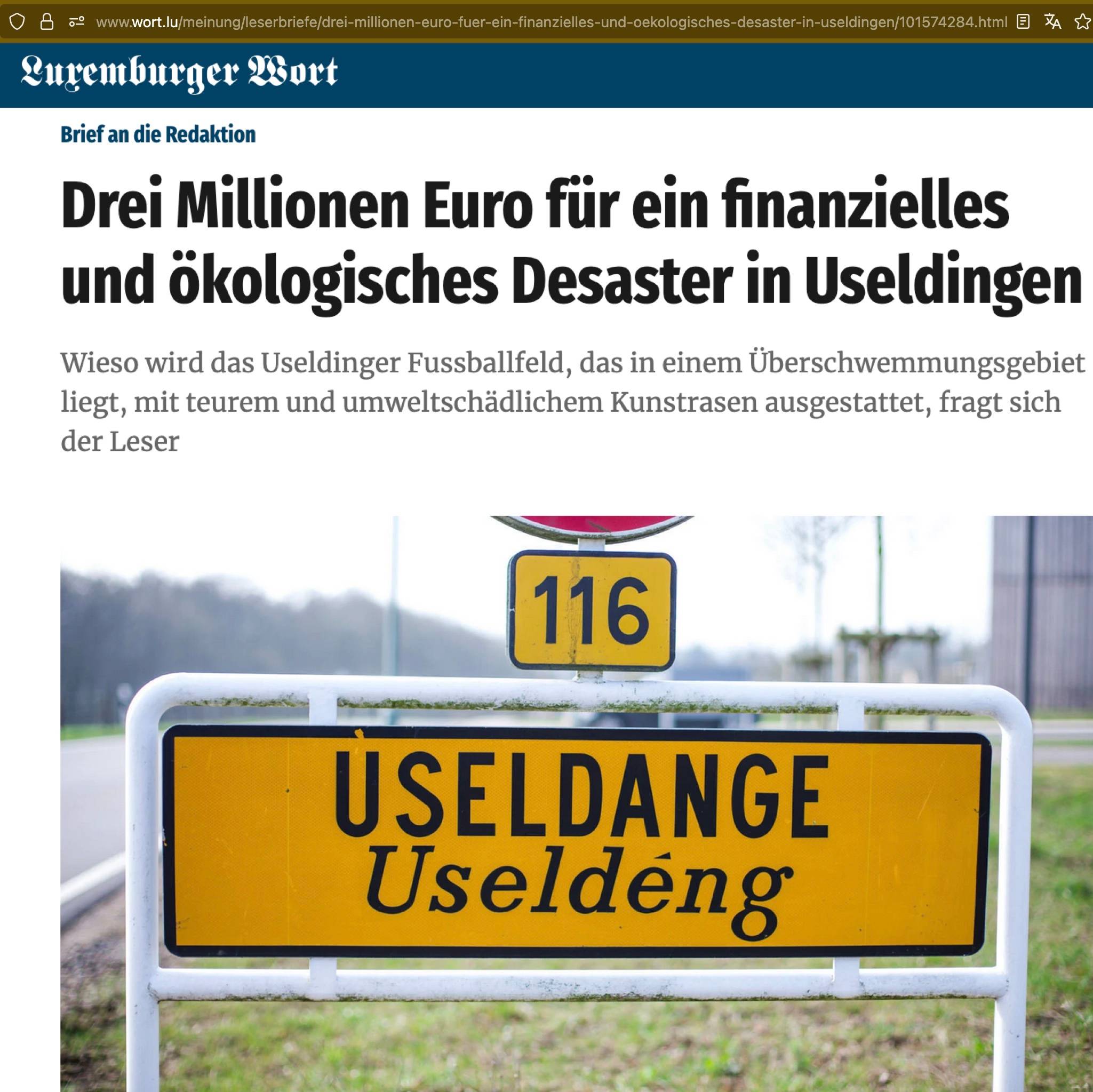
Have you read Marcel Wolff’s recent Luxemburger Wort Letter to the Editor, which questions the planned artificial turf field in Useldingen? Take a moment . . . and read it here: https://www.wort.lu/meinung/leserbriefe/drei-millionen-euro-fuer-ein-finanzielles-und-oekologisches-desaster-in-useldingen/101574284.html (subscription required). With a profound sense of recognition and gratitude, Marcel’s clear-eyed analysis of the financial and ecological pitfalls of this project . . . is a service to the community. Marcel’s warning are not merely as a local concern, but as a poignant case study with national relevance. Mr. Wolff has correctly identified a profound contradiction; I would like to stand with him and explore its deeper roots through the lens of soil health and systemic thinking.
1. The Illusion of Permanence on an Impermanent Foundation
Mr. Wolff masterfully highlights the core irony: while Useldingen invests €1.6 million to renature a nearby area . . . literally healing a damaged landscape . . . it plans to suffocate living soil under a synthetic pitch just meters away. Marcel’s concern that this repeats past mistakes is valid and essential.
This is not modernization. It is the suffocation of the very natural systems we claim to value. Natural soil in a floodplain acts as a sponge, absorbing and slowing water. A compacted, artificial field, as Mr. Wolff implies, can only exacerbate runoff and flooding problems. He is right to question why we would hard-wire the errors of the past into our future.
2. The Unseen Costs Mr. Wolff Invites Us to See
Mr. Wolff rightly points to the obvious hazards: micro-plastic pollution, extreme heat, and recurring cleanup costs. A natural turf system functions as a carbon sink, a cooling surface, and a living habitat. Its synthetic replacement, as he notes, offers none of these virtues and introduces significant new risks.
Supporting his argument, there is a quieter loss that rarely enters policy debate. When human beings come into contact with living soil, something measurable and extraordinary happens. Scientists studying soil bacteria such as Mycobacterium vaccae have found that these microbes interact with our immune and nervous systems in ways that reduce stress and elevate mood¹. Human studies have confirmed that brief contact with “living soil” can lower inflammation markers and produce states of relaxed alertness².
We are, in a profound biological sense, meant to touch the ground. When a child slides across natural turf, their body and mind participate in a subtle exchange with the soil biome. When that soil is replaced by plastic, this dialogue is severed. Mr. Wolff’s plea to leave children with real grass is, it turns out, supported by both ecology and human biology.
3. A Question of Values and Shared Responsibility
The €3 million price tag Mr. Wolff questions . . . is indeed only the beginning. Each flood will add tens of thousands in cleaning, and each decade will bring the costly removal of degraded plastic. These are recurring liabilities, just as he warns (text continues below) . . .
Beyond the financial arithmetic lies the deeper question of values that his letter poses. What are we teaching our children when we replace living grass with plastic? That convenience outweighs care? That sterile uniformity is preferable to a dynamic, living surface? In Youth4Planet’s work, we encourage young people to be stewards. It is difficult to inspire that respect when their own community chooses plastic over soil. Mr. Wolff’s argument is, at its heart, about the kind of legacy we wish to leave.
4. The Better Path Forward That Mr. Wolff Implies
Useldingen has the opportunity to pivot toward the smarter, sustainable approach implied by Mr. Wolff’s critique. The solution is not synthetic convenience, but professional stewardship of a living system.
I need not look further than my own notes from 2019, scribbled on a napkin while planning a season’s work. This sketch is a practitioner’s roadmap for the kind of living turf system that aligns perfectly with the future Mr. Wolff advocates for (text continues below) . . .

The principles are clear and cyclical, a world away from rolling out a plastic carpet. They respect the rhythm of soil and season. For any community, the foundational steps are straightforward:
A Pathway to a Biodynamic Living Lawn
- Test Your Soil: begin with a soil analysis from a Luxembourgish laboratory (e.g., LIST, ASTA).
- Aerate for Life: if compacted, aerate before spring growth, leaving plugs to break down naturally.
- Nourish the Biome: top-dress with compost or worm castings to feed microbial life.
- Sow for Resilience: overseed seasonally with perennial ryegrass and Bermuda grass for year-round durability.
This is the craft of creating a playing surface that is high-performing, alive, cooling, and absorbing: a tangible expression of the values Mr. Wolff champions.
5. Joining the Call for a Living Future
Marcel Wolff’s fundamental question is the correct one: is a costly plastic field for sporting teams necessary, or should we leave the children with real grass?
His letter is more than a critique. His letter is an advocacy for a principle that aligns with our highest environmental and communal goals. True progress lies in designing with nature, not against it: invest in living soil rather than sealing it. This is the decent, responsible path that respects both taxpayers and our children’s future.
Luxembourg has the resources to lead by example. Useldingen has clear choices: it can become a case study of outdated thinking, or it can heed Marcel Wolff’s concerns . . . and demonstrate what pragmatic, principled local climate action looks like.
Let us stand with Marcel’s call to learn from the past. Let us join him in choosing to invest in a living future.
Questions? Would you like to discuss? Contact Youth4Planet’s C.A.T. (Climate Action Tiger) and Y4P Ambassador Christian Thalacker for feedback: christian@youth4planet.org
———————————————————————–
P.S. To Do List for a Biodynamic Living Lawn (Adapted from Christian Thalacker’s handwritten field-notes and submitted entries to the Allett Creative Stripes Competition, 2019–2020):
- Test your soil’s pH. Luxembourg’s communal or national agricultural laboratories (LIST, ASTA) can analyze your sample for nutrients and organic matter balance.
- If your soil is compacted, aerate before spring. Hand aeration for small plots or rental equipment for large ones. Leave plugs on the surface to decompose naturally.
- Topdress with compost or worm castings. One kilogram per square metre, gently raked in. This living amendment feeds microbial life and restores porosity.
- Seed with perennial ryegrass in autumn or late winter. Supplement with Bermuda grass during hot summers for dual resilience. A full list of European turfgrass seed and sod growers can be found through the European Turfgrass Producers Association directory: https://turfgrassproducers.eu/growers-suppliers/
P.P.S. The official voice of Luxembourg’s environmental policy affirms this path. The Luxembourg Ministry of the Environment, Climate and Biodiversity recently stated in an online post:
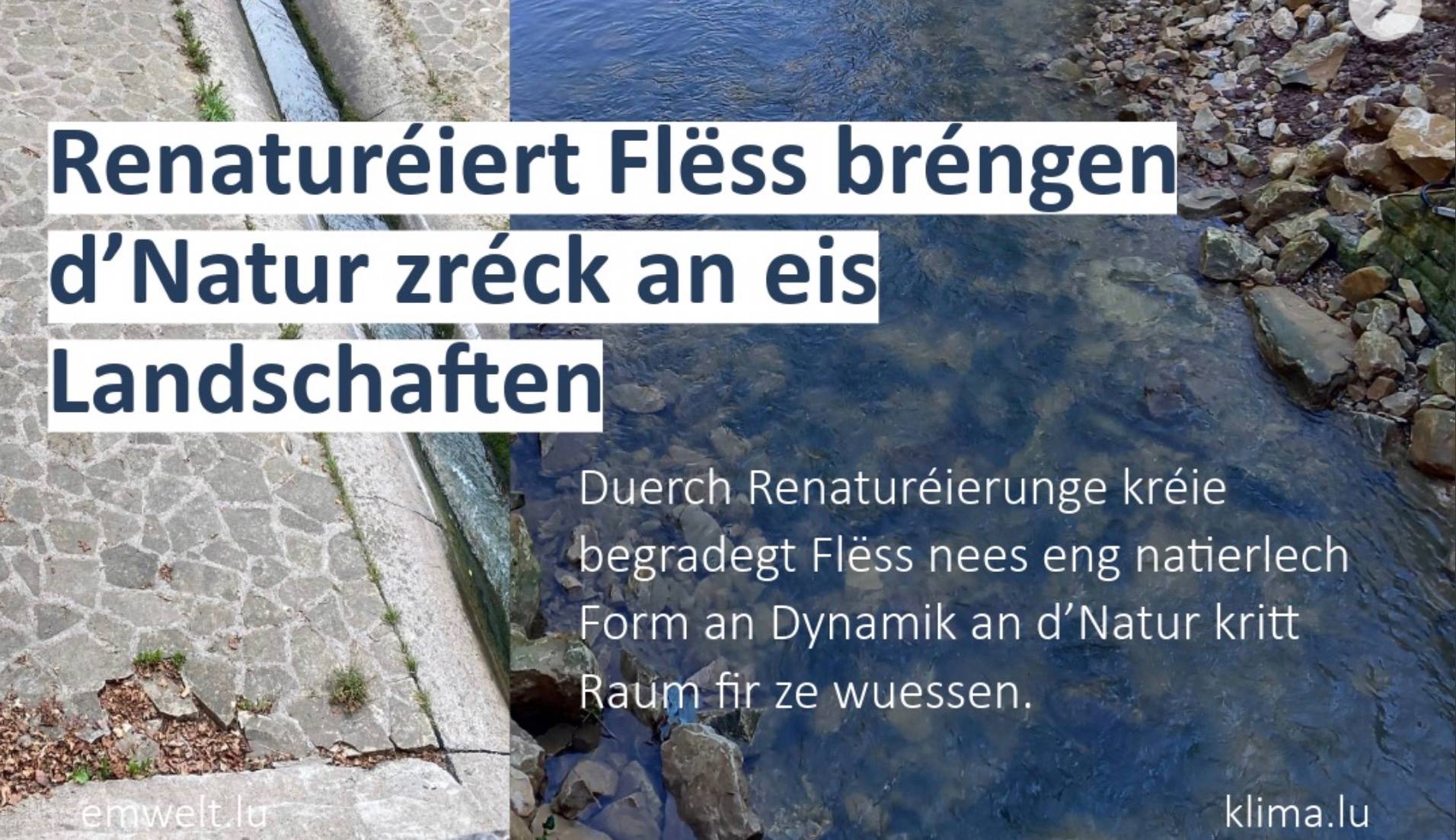
“Renaturéiert Flëss bréngen d’Natur zréck an eis Landschaften – mat villen positiven Effekter:
✅ Méi Liewensraim fir Déieren a Planzen
✅ Natierlechen Héichwaasserschutz
✅ Frësch Loft a besser Waasserqualitéit
✅ Plaz fir Erhuelung an Entspanung
Renaturéierungen hëllefen net nëmmen der Natur, mee och eisem Klima an eiser Gesondheet. Jidderee profitéiert – Mënsch, Déier an Ëmwelt!”
The same logic applies to our soils. Renaturation . . . whether rivers or football fields . . . is not a niche environmental concept. Renaturation is the foundational principle for a resilient, healthy, and fiscally sane future.
———————————————————————–
Footnotes:
- Lowry, C.A. et al. “Identification of an immune-responsive mesolimbocortical serotonergic system: Potential role in regulation of emotional behavior.” Neuroscience (2007), https://pmc.ncbi.nlm.nih.gov/articles/PMC1868963/
- Physiological Responses of Adults during Soil-mixing Activities Based on the Presence of Soil Microorganisms: A Metabolomics Approach, https://www.researchgate.net/publication/360304937_Physiological_Responses_of_Adults_during_Soil-mixing_Activities_Based_on_the_Presence_of_Soil_Microorganisms_A_Metabolomics_Approach.
Further Reading
- “Earthworms and their impact on your lawn.” ICL Growing Solutions Turf & Landscape Knowledge Hub, https://icl-growingsolutions.com/turf-landscape/knowledge-hub/earthworms-and-their-impact-on-your-lawn/
- European Turfgrass Producers Association directory: https://turfgrassproducers.eu/growers-suppliers/
- Premium Bermuda Grass Seed. LERAVA, https://lerava.com/en/products/premium-bermuda-grass-seed
- REEL and Battery-Powered Mowers, Allett Lawn Mowers, https://allett.co.uk/
- The Incredible Science of Football Pitches, Tifo Football, 2022, https://www.youtube.com/watch?v=frGHtxOkVl8
- How Wimbledon Maintains its Perfect Grass Courts, BBC, https://www.youtube.com/watch?v=_oSKZiyxQew