Why this series exists: This series is not about nostalgia for 1936. This series is about why 1936 never really ended.
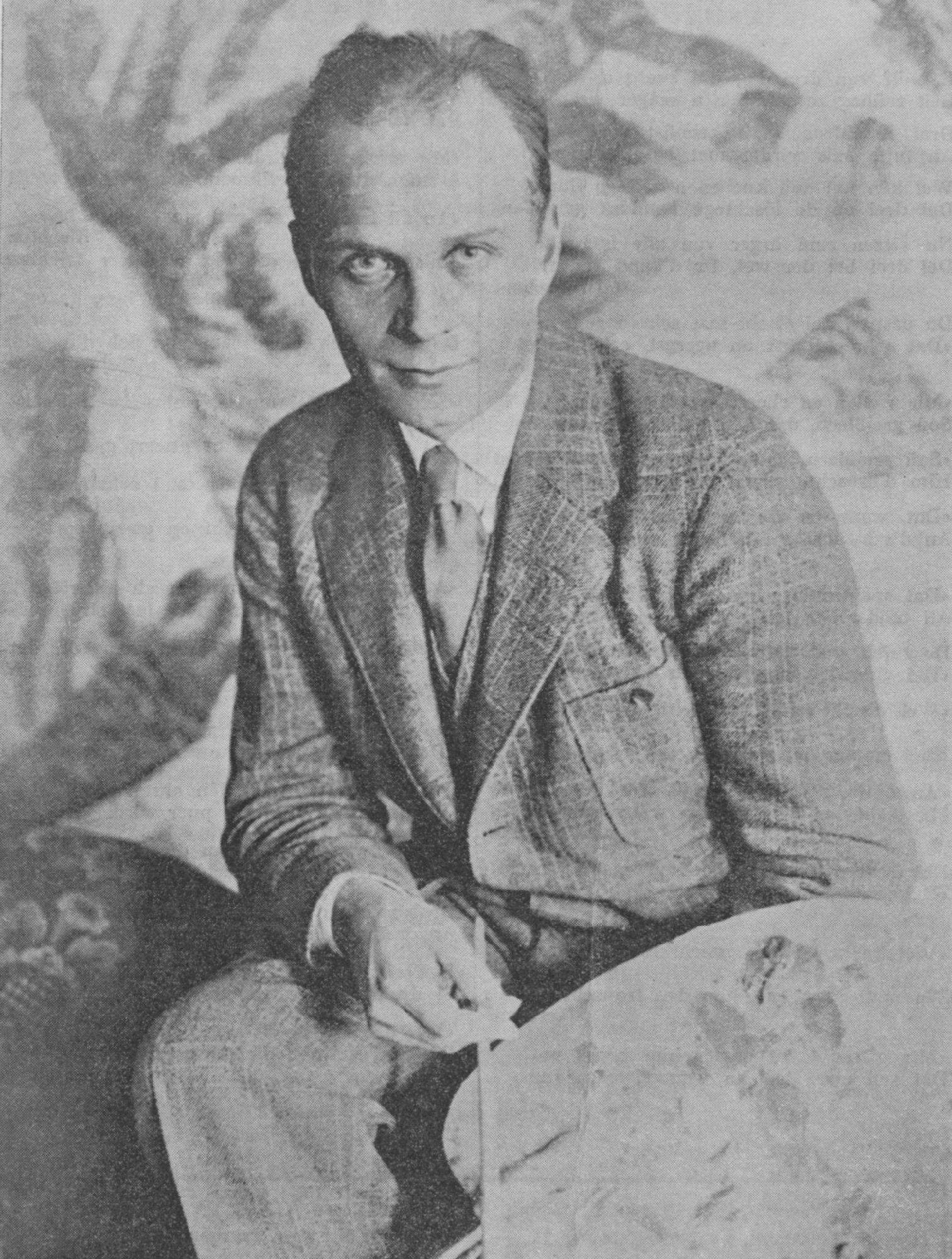
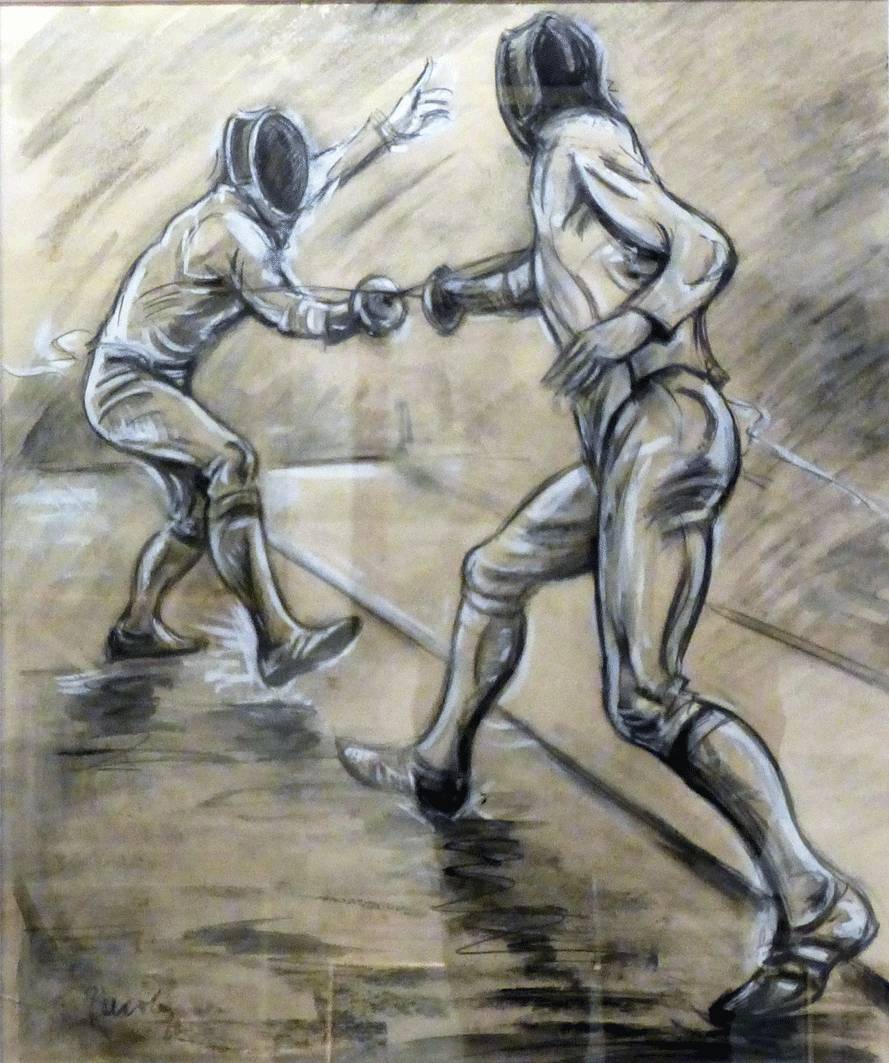
Born in the Hollerich neighborhood of Luxembourg in 1891, Jean Jacoby studied Art at the École supérieure des arts décoratifs in Strasbourg. He began his professional life in Germany as a drawing teacher (1912–1918) at the Lewin-Funcke School in Berlin. After the First World War, he worked in Wiesbaden, before returning to Alsace to take over the art department of a printing house in Strasbourg.
Jacoby became internationally known in 1923, when he won the French Auto Competition with his drawing “Hurdle Runner” . . . prevailing over 4,000 other participants. From 1926 to 1934, he worked in Berlin as an illustrator and artistic director for two Ullstein-Verlag publications, the Berliner Illustrirte Zeitung and the Grüne Post. During this period, he also founded a nationwide radio-program guide, Sieben Tage, designed to serve listeners across Germany.
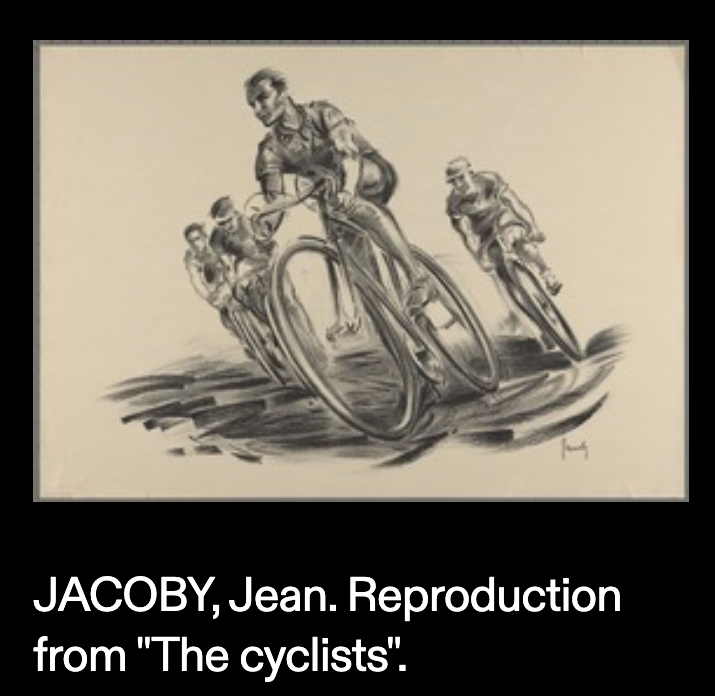
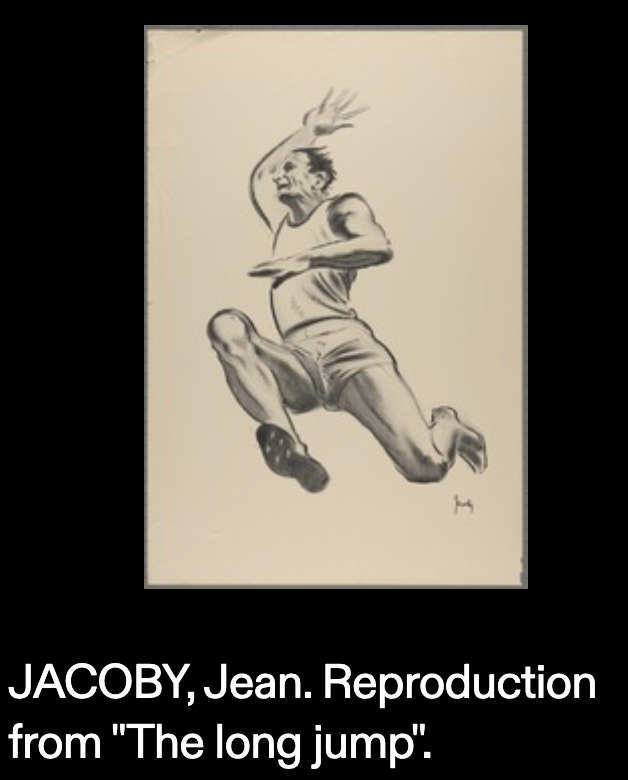
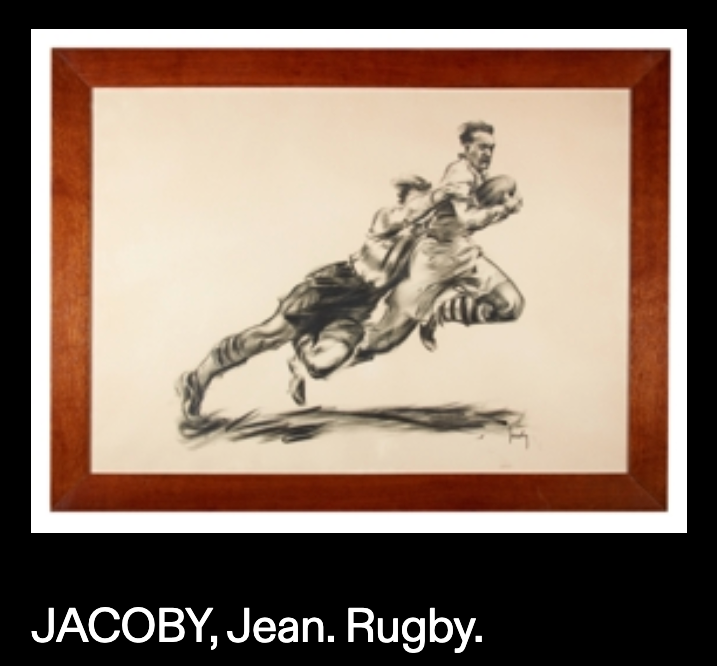
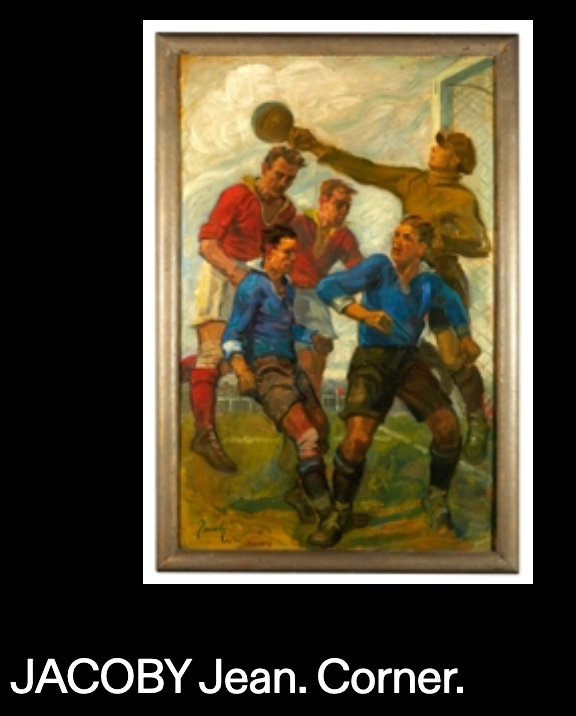
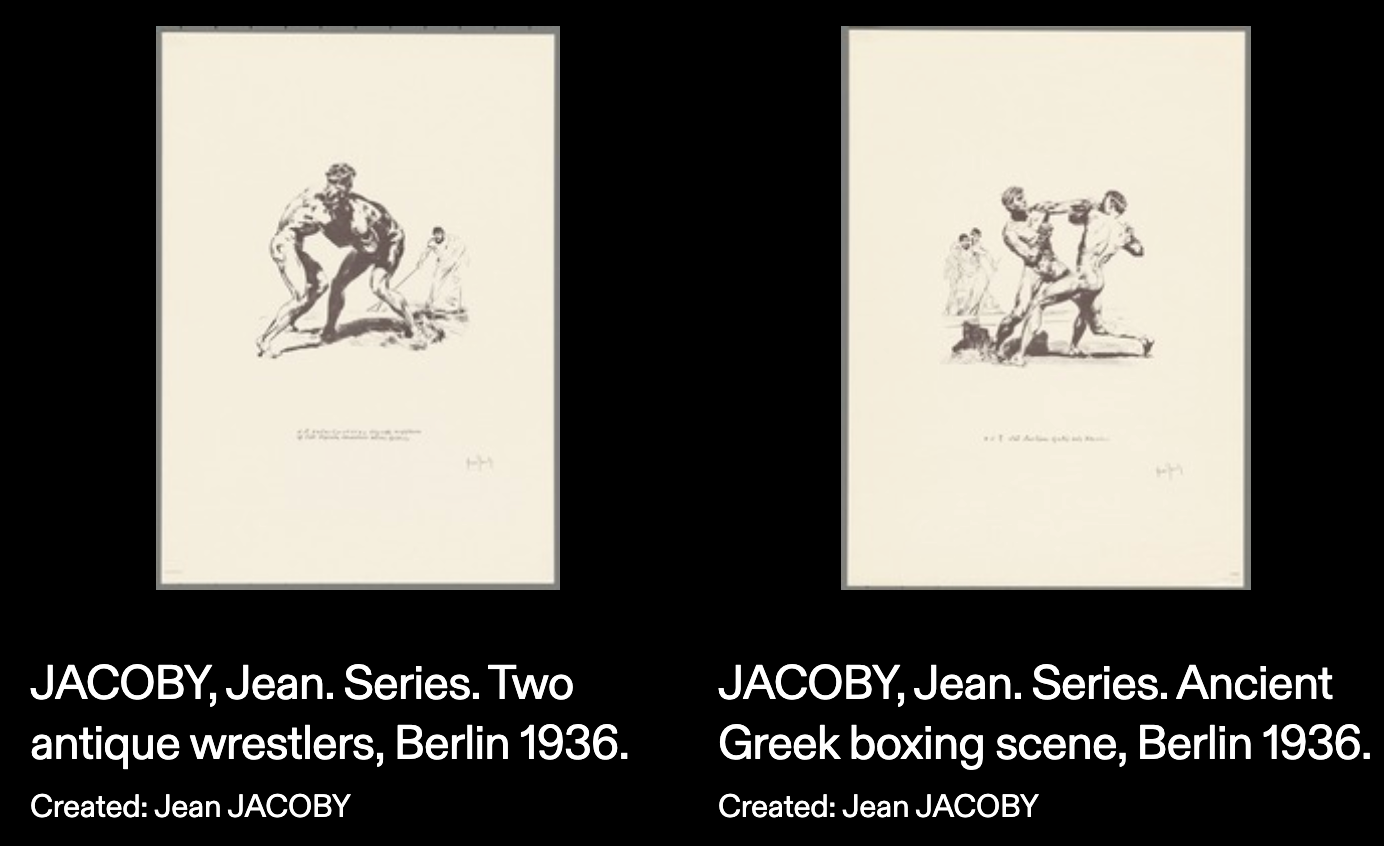
Jean Jacoby became the most celebrated sports artist of his time. He won Olympic Gold medals for Art in 1924 and 1928 . . . the only artist in history to twice do so. His drawings captured what propaganda could not tolerate: struggle, risk, imbalance, individuality. Excellence as effort, not destiny. By 1936, the world he helped define had been dismantled.
Berlin, once a laboratory of modernity, had become a “stage-set”. Sport was no longer a contest but a weapon. Art was no longer inquiry but ornament. Truth was no longer something to be discovered but something to be managed.
Jacoby stood precisely at that hinge-point.
He was not persecuted loudly. He was not imprisoned. He was not exiled by decree. He was soft-erased: diminished by committees, sidelined by aesthetics, acknowledged only enough to neutralize him. His Olympic submissions were accepted but never allowed to win. His work was hung but never allowed to speak.
This is why Jean Jacoby matters to Youth4Planet.
Most collapses do not begin with violence. They begin with normalization. With respectable silence. With the slow conversion of excellence into inconvenience.
Why is this series structured month by month?
Each article in this series takes one month of 1936 and places it under a microscope. Not to recount events . . . but to expose mechanisms.
• January asks how old stabilizing narratives die, and what rushes in to replace them?
• February asks how spectacle launders moral failure?
• March asks how corrupted systems reward boldness and punish integrity?
• April asks whether engagement with broken institutions is ever neutral?
• May asks how architecture, scale, and permanence encode ideology?
• June asks who controls the moral rehearsal of the future?
• July asks how simultaneous realities anesthetize conscience?
• August asks how truth survives when absorbed . . . reframed . . . or tokenized?
• September asks what happens when silence finishes the work that spectacle began?
These are not historical questions. They are operational ones.
What is the Jacoby Dilemma . . . and why it is not abstract?
Across the year 1936, one conflict repeats in different forms. It becomes explicit in March and never lets go:
Do you engage with a corrupted system and risk complicity . . .
or refuse it and risk irrelevance?
This is what we call the Jacoby Dilemma.
Jacoby submitted his work to Berlin because it was the last arena where his form of truth still officially mattered. He traveled there because he believed witnessing still had value. He returned broken because witnessing without power extracts a cost.
Youth4Planet exists because your generation is being pushed into this same dilemma . . . but at planetary scale.
Do we engage fossil fuel companies to accelerate transition . . . or reject them outright?
Do we participate in global summits that perform urgency while approving new extraction?
Do we use platforms that distort truth because they still reach people . . . or abandon them?
This series does not provide clean answers because history never does.
What it provides is pattern recognition.
Why does every article end with a question?
The questions at the end of each month are not rhetorical flourishes. They are hand-offs.
Jean Jacoby’s tragedy was not that he failed to answer them. It is that he answered them alone.
Youth4Planet is built on the opposite premise: that the only way out of corrupted systems is solidarity: moral courage coordination . . . new platforms, new metrics, new economies, new recognition systems that do not require permission from those who benefit from delay.
The questions ask:
• What are we building that does not need their validation?
• Where are we confusing performance with progress?
• What truths are we allowing to become exceptions instead of system changers?
• Which silences will future generations read as complicity?
These are Youth4Planet questions because climate action without moral clarity simply reproduces the business-as-usual, the vicious circles, and the violence of the past . . . with greener language.
Why Jean Jacoby belongs to the climate generation
Jacoby understood something essential:
Truth is dynamic.
Power wants it static.
Climate Science is dynamic. Democracy is dynamic. Justice is dynamic. They all involve instability, revision, effort, recalibration. Authoritarianism . . . fossil dependency . . . extractive economics . . . all promise frozen certainty.
Jean Jacoby died in September 1936, officially of heart failure. In reality, Jean Jacoby died of historical exhaustion. He saw too clearly what was being rehearsed, and how little resistance remained.
His grave went unmarked for 85 years.
This series exists so that silence does not finish its work.
It exists to insist that measurement without memory is dangerous, that clean energy without decency is hollow, that spectacle without accountability always returns with sharper teeth.
Jean Jacoby does not ask you to admire him.
He asks you not to repeat the conditions and the mistakes he suffered through.
The questions that close each month are now yours.
Not to answer alone . . .
but to build answers strong enough that no future regime, market, or algorithm can erase them again.
JANUARY 1936: on the 28th of January, in the deep cold of an English winter, King George V was laid to rest at Windsor Castle. His funeral was a radio event above all . . . a mass ritual of sound, tightly controlled imagery, and unseen interiors, experienced by millions through the crackle of the BBC’s live broadcast. It was the last great pageant of an old order: authority mediated through voice, tradition, and respectful distance. An era of empires and certainties was being buried with the king.
In Berlin, the planners for a new order were not thinking in sound. They were thinking in image, choreography, and scalable spectacle. The blueprints for the colossal Reich Sports Field were finalized. The purpose of the coming Summer Olympics was not just sport, but the projection of an ideal in pure, overwhelming visual terms. While Britain mourned a king through the ear, Germany prepared to seduce the world through the eye. January was a month of quiet, determined preparation beneath a blanket of snow and the static of a fading paradigm.
Jacoby’s World: The Artist in the Borderlands
In a small apartment in Mulhouse, a town in the historically disputed territory of Alsace, Jean Jacoby, 44, sharpened his pencils and contemplated a void. The vibrant, modernist Berlin art world where he was a star . . . a colleague of Jewish illustrators at the progressive Ullstein Verlag, a friend to avant-garde painters and footballers like Sepp Herberger . . . was gone. It had been dismantled, and its spirit crushed.
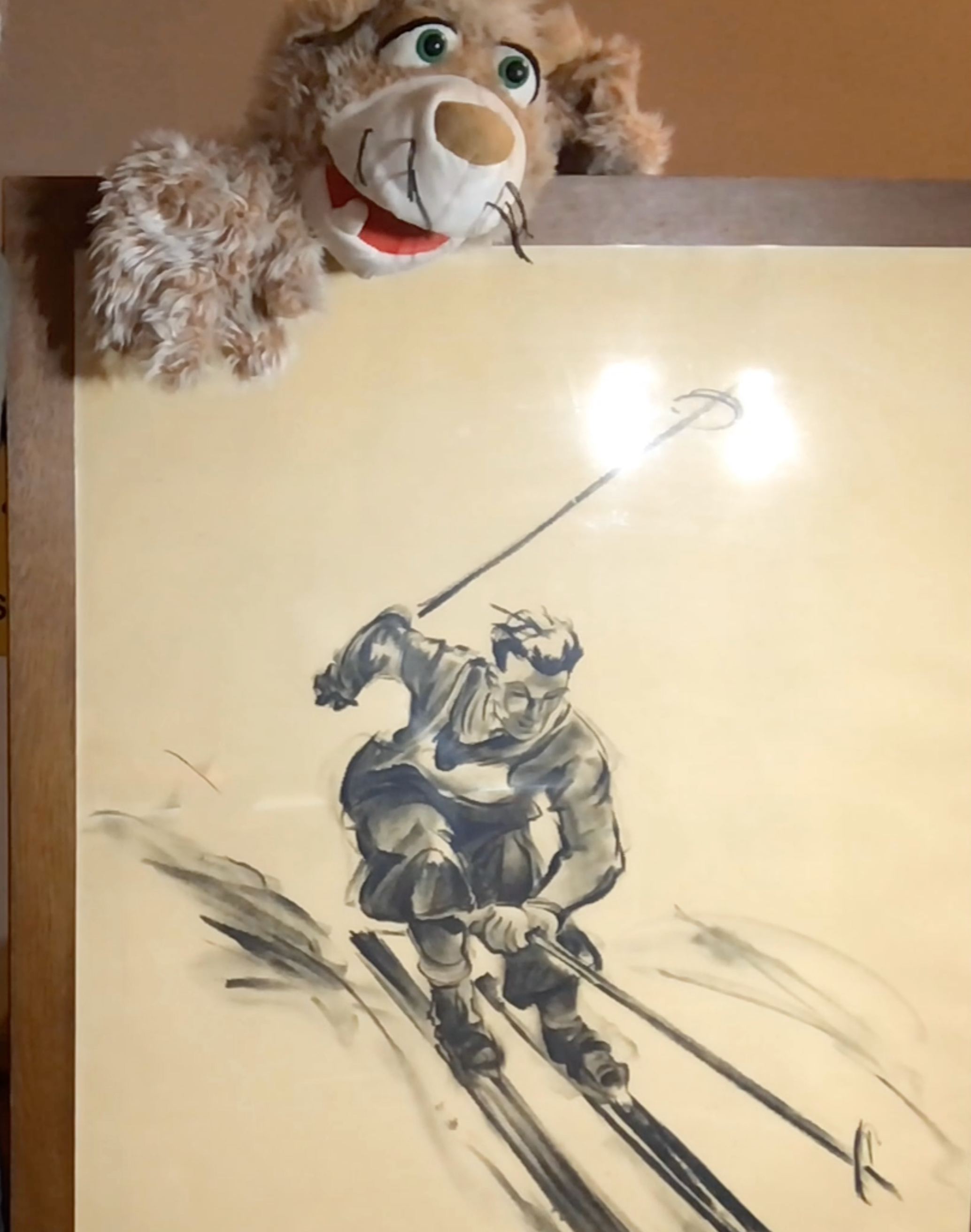
Before him were sketches. One was a dynamic study of a downhill skier, a subject mirroring the alpine skiing events set to debut at the Winter Games in Garmisch-Partenkirchen the next month. Yet, as he drew this modern kineticism, the regime preparing to host that very event was systematically branding modern art as “degenerate.” He was creating work that was perfectly of the Olympic moment and utterly anathema to its political curators.
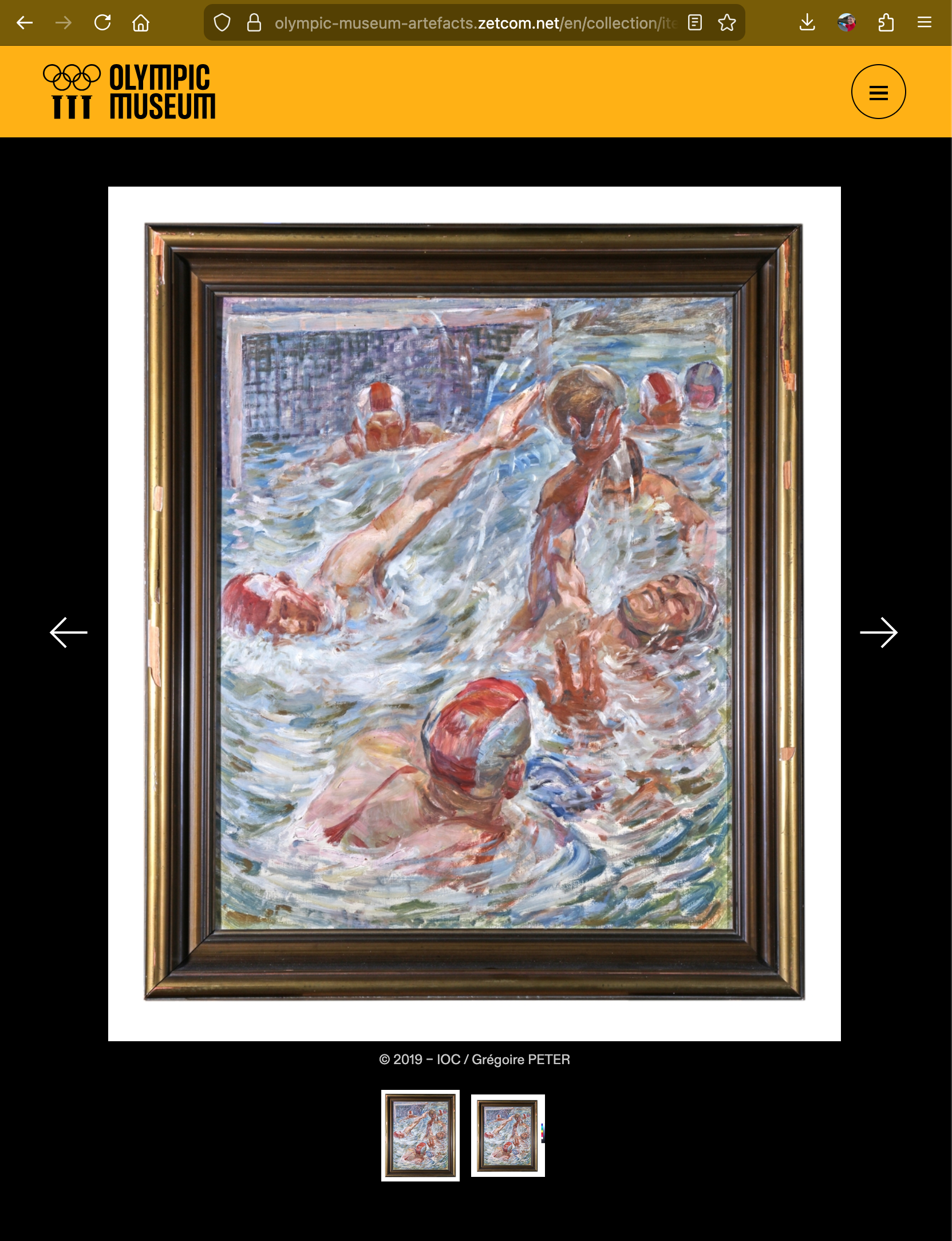
His hesitation was profound. This packet was for the Berlin Olympic Art Competition, the same discipline that crowned him with gold in Paris (1924) and Amsterdam (1928). But the taste of diminishment was already familiar. At the last Games in Los Angeles, 1932, his powerful drawing had been deemed worthy only of an “Honorable Mention” . . . a diplomatic consolation prize. To submit now was to engage with the very apparatus that destroyed his professional home. Yet, not to submit was to surrender the last arena where his form of excellence was sovereign. He was a man of borderlands . . . a Luxembourger by birth, French by education and German in his professional milieu . . . living in French Alsace . . . preparing to send his hybrid, borderless art into the heart of a regime demanding rigid purity. This “soft-erasure” was not an isolated act of 1936. It was the product of a system established years earlier. In 1933, the Nazi regime passed the “Law for the Restoration of the Professional Civil Service” . . . “Gesetz zur Wiederherstellung des Berufsbeamtentums, shortened to Berufsbeamtengesetz” . . . purging “unreliable” elements from cultural institutions. It created the Reich Chamber of Culture, forcing all artists to join a state-controlled guild to work legally. Jacoby’s dilemma was manufactured by this pre-built machinery of control.
Flash Forward: The Spectacle Without a Soul
Today, our screens are not flickering novelties but the very atmosphere we breathe. The spectacle is . . . too often . . . constant, algorithmic, and weaponized. A U.S. President dominates one feed with a performance of nostalgic grievance, crafting a simulacrum of a past that never was. We have mastered the tool of mass visual persuasion, but shattered the covenant of shared, verifiable reality that a king’s funeral, for all its pomp, once ritualistically . . . affirmed. The crisis is no longer of what is broadcast. The crisis is of what is true.
The Clean Tech Parallel: Building the Real
While some traffic in destructive nostalgia, a tangible, silent revolution is being built. In laboratories and on factory floors, the focus is not on crafting images . . . but on forging a new physical reality. The race for solid-state batteries, perovskite solar cells, and green hydrogen is the antithesis of empty spectacle. It is a competition measured in watt-hours and tons of CO2 sequestered. This is the 21st century’s true “projection of power” . . . not on a propaganda stage . . . but in the gritty, honest arithmetic of the grid. It is a future that Jean Jacoby . . . the analyst of motion . . . would understand: one based on the measurable laws of physics, not the whims . . . the mutable whims . . . of ideology.
Questions for Youth4Planet:
What old, stabilizing fictions have we lost? What persuasive tools are we unthinkingly unleashing into that vacuum?
If Jacoby’s struggle was to preserve artistic truth within a corrupted spectacle, is our struggle to preserve factual, historical, and moral truth . . . especially within a corrupted information universe? Is the starting-pistol fired in January 1936 . . . for a race we are still running?
FEBRUARY 1936: from the 6th through 16th February, the pristine valley of Garmisch-Partenkirchen in the Bavarian Alps . . . was transformed into a stage of frost and flags for the Fourth Olympic Winter Games. A record 28 nations sent 646 athletes . . . beguiled by the promise of sport. The world watched as alpine skiing made its dramatic Olympic debut on the slopes of the Gudiberg. Norway’s Ivar Ballangrud dominated speed skating, and in a stunning upset, Great Britain’s ice hockey team defeated Canada for gold.
But this was not merely sport. It was the first full-scale international deployment of the Nazi propaganda machine. The regime executed a masterstroke of deception: by official order, all public anti-Jewish signs were temporarily removed. The violent racism was hidden behind a fresco of Bavarian charm and Olympic politeness. The newly constructed ice stadium, a marvel of artificial refrigeration, symbolized the cold, calculated control at the heart of the spectacle. The world’s press, largely convinced by the façade . . . reported on the games’ efficiency. The lesson for the Nazis was unequivocal: the world wished to be charmed. The World would trade moral clarity . . . Decency . . . for the thrill of competition.
The Aesthetic Battlefield
This was not just public relations, but an aesthetic conquest. The regime promoted a vision of beauty as purity, order, and timeless strength . . . an art of frozen heroism. Against this, Jean Jacoby’s art was a subtle act of resistance. His skier was not a hero posed on a peak, but a body in a dialogue with gravity, risk, and skill. The regime understood that to control what was deemed beautiful was to control what was deemed good and true.
The Transactional Lie
The removal of the anti-Semitic signs was a cynical, temporary bargain . . . with the International Olympic Committee: legitimacy in exchange for a brief suspension of visible hate. It reduced a profound moral crisis to a two-week logistics problem. In that act, they wrote the playbook for modern “ethics-washing,” where the performance of virtue is a currency to be spent, not a principle to be lived.
Jacoby’s Submission
As the world marveled at the skaters’ precise arcs, Jean Jacoby in Mulhouse sealed the parcel containing his soul. His drawings . . . including Abfahrtslauf (Ski) . . . were mailed to Berlin. The irony was a physical weight: he was mailing a depiction of the very sport the world was celebrating, but his artistic language was the antithesis of the static, collective ideal being promoted in those same Alps.
He was once the “Pacemaker of German Sports Drawing.” Now, he was a supplicant to the taste of men like “Mjölnir” (Hans Schweitzer), the regime’s chief cartoonist, whose art existed to ridicule and destroy the pluralistic democracy that Jacoby’s Berlin once represented. The world was not in the dark. As Jacoby mailed his submission, audiences watched Universal Newsreel’s “Red Cross Unit Bombed in Ethiopia” (12th February 1936), showing Italian war crimes. Yet, this horror was framed as distant “exclusive footage,” a spectacle of atrocity that could be consumed without demanding a coherent moral or political response. This fragmentation of crisis is part of the anesthetic.
Flash Forward: The Spectacle of Solutions
The 1936 playbook . . . using global sport to launder a reputation . . . is now a well-established industry. Yet a more consequential race unfolds in parallel.
While some nations invest in stadiums of illusion, others execute a long-term strategy of hard-power transition, achieving dominance in solar panels, batteries, and electric vehicles. This is not sports-washing; it is infrastructure-building. The victory is measured not in fleeting goodwill, but in permanent geopolitical leverage—and potentially, a stabilized climate.
But we must be vigilant: even this vital path can be framed as mere spectacle. The clean tech revolution, for all its substance, can be narrated as a nationalist competition for “dominance.” Our task is to champion metrics . . . carbon counting, carbon curves, circular economy percentages . . . with winning persistence.
Questions for Youth4Planet:
In our era of climate crisis, does the very model of the nomadic, resource-intensive mega-event now represent a dangerous anachronism? Should the future of global celebration be fulcrum in permanent, sustainable venues . . . or in distributed, low-footprint, digitally-augmented festivals of human excellence?
Are we, in our hunger for spectacle, still building ice palaces on melting ground?
The Jacoby Dilemma
March 1936: on the 7th March 1936, the sound of German infantry boots echoed across the bridges of the Rhineland for the first time in 17 years. In a breathtaking violation of international treaties, Hitler ordered tens of thousands of troops to reoccupy the demilitarized zone. It was a colossal bluff . . . the force was under orders to retreat if France resisted.
France mobilized, then hesitated. Stanley Baldwin’s Britain counseled restraint. The world watched, and did nothing. The gamble succeeded completely. Without a shot fired, Hitler shattered the post-WWI security architecture. Appeasement crystallized as policy. The lesson for dictators was clear: shamefully shameless boldness pays. The path to war was paved with democratic doubt and hand-wringing.
The Verdict Arrives
As headlines screamed of the Rhineland crisis, a quieter, professional verdict arrived for Jean Jacoby. The official results of the Berlin Olympic Art Competition were finalized. His life’s work . . . drawings that captured the essence of athletic motion . . . had been judged by the regime’s cultural commissars.
He received no medal. Only another “Honorable Mention.” A bureaucratic cruelty, a piece of paper that translated to: “We acknowledge your existence, but we deny your excellence.” The jury, led by the Nazi painter Adolf Ziegler, favored monumental, ideological art. Jacoby’s dynamic, humane drawings were deemed unworthy of gold in the same month the regime celebrated its own aggressive, masculine potency.
The two events were not coincidental. They were two expressions of the same will to power: one over territory, the other over truth. Jacoby’s art, which sought the individual struggle within sport, was rejected by a state that glorified only the collective, triumphant march.
The Birth of “The Jacoby Dilemma”
This convergence gave birth to the central conflict of the year, and of our time: The Jacoby Dilemma.
- Do you engage with a corrupted system, hoping to salvage a sliver of integrity from within . . . at the cost of your complicity?
- or . . . Do you refuse, retaining your purity but surrendering your platform, your voice, and any chance of direct intervention?
In March 1936, the dilemma became inescapable. For nations. For artists. For every conscience caught in the tide. The Western powers chose engagement, believing they could manage the beast. Jacoby, holding his “Honorable Mention,” now had to decide: would he submit his physical presence to Berlin as well? This was the “Jacoby Dilemma” at a global scale. In March 1936, the “March of Time” newsreel covered “Belgium’s Neutrality” . . . reporting on Nazi agitation within Belgium as Hitler remilitarized the Rhineland. It presented the crisis as a local political drama, not an existential rupture. The democratic media . . . like the democratic governments . . . engaged with the symptoms while failing to name the systemic disease.
Flash Forward: Clean Tech and the New Geopolitical Terrain
The Rhineland gambit was about seizing physical terrain with minimal force, exploiting systemic inertia. Today, the decisive terrain is decarbonized supply chains.
The parallel move is not marching battalions, but securing contracts for lithium mines, dominating the market for rare earth elements’ processing. China’s rise in clean tech is a long-term, strategic occupation of the economic and moral high-ground of the 21st century. Like the Rhineland, many in the West watched it develop, dismissed it, and now find themselves strategically outflanked. The failure of imagination is the same.
The Need for Decency: The Normalization of the Outrageous
The Rhineland worked by normalizing the outrageous. A blatant treaty violation was met with hand-wringing and negotiation, subtly reframing it as a “dispute.”
See it today in the incremental erosion of democratic norms, where lies are “debated” and corruption is “politics.” Each successful violation expands the boundaries of the acceptable. Decency is eroded not in a single collapse, but in a thousand small acquiescences to bad faith.
Questions for Youth4Planet:
Jacoby received a piece of paper that declared his art second-rate. He knew it was a political lie, but the official record bore it forever. Today, we are handed “alternative facts,” deepfakes, and rewritten histories. How do we build and defend our own “official record” . . . a foundation of truth . . . when the institutions meant to certify reality are themselves under assault?
Are our most vital projects to build a green future, and to forge and protect the tools of honest measurement and honest memory . . . that make such a future even conceivable?
April 1936: the world’s fractures were no longer cracks . . . they were canyons, and nations were choosing sides. In Spain, political fury erupted into street battles and assassinations, the violent overture to a civil war that would become the century’s ideological proxy battleground.
Simultaneously, the League of Nations performed its final, farcical act. It levied ineffective economic sanctions against Italy for an invasion that was already complete. Mussolini’s troops had marched into Addis Ababa, and the conquest was a fait accompli. The message was unmistakable: aggression not only went unpunished . . . it was rewarded with an empire. The old world order’s currency of condemnation was now worthless. Two models of response to fascist expansion had been demonstrated: appeasement (the Rhineland) and futile scolding (Ethiopia). The script for the next decade was written in April’s ledger.
The Exile’s Calculation
In Mulhouse, Jean Jacoby received the official documentation of his “Honorable Mention” from the Berlin Olympic art jury. The paper was a dead thing. The calculation it forced upon him was alive and tormenting.
He now faced the “Jacoby Dilemma” in its starkest form: Should he travel to Berlin in August?
To go was to walk into the belly of the beast . . . to personally legitimize the spectacle that had rejected his life’s work. It was to be a ghost at his own funeral. Yet, not to go was to accept total erasure, to concede the field completely. Perhaps, a faint hope whispered, his presence itself . . . seeing his works on the wall . . . could be a quiet act of witness, a thread of continuity with the real art the regime had tried to murder.
His dilemma mirrored the West’s own. To engage was to be complicit in a lie. To boycott was to surrender all influence. There was no path back to the honest competition of 1928. There were only choices between shades of compromise.
The Machinery of Erasure
Unknown to Jacoby, as he weighed his decision, the regime was finalizing plans for the “Entartete Kunst” (Degenerate Art) exhibition. In warehouses, works by his former Berlin colleagues . . . the Expressionists, the modernists . . . were being cataloged for confiscation. His own dynamic line, his capture of unstable motion, was the antithesis of the sterile, monumental art the state would soon enshrine. To travel to Berlin would be to enter a cultural ecosystem in the active process of liquidating its own soul.
This erasure was powered by a duality of technology. The radio broadcast unifying triumphs to the Volk, while the newly formalized Luftwaffe . . . presented the mechanized fist inside the velvet glove. The tools of cohesion and destruction were two sides of the same industrial coin. In 1936, British censors cut 61 feet from a March of Time newsreel . . . excising a shot that showed Dictator Mussolini in conversation with former British Prime Minister Ramsay Macdonald. This was the removal of a specific visual proof of high-level diplomatic engagement with a regime that had just used poison gas to conquer Ethiopia. This is moral cowardice rendered administrative: the refusal to defend truth openly . . . disguised as responsibility . . . where leaders choose reputational safety over ethical clarity and call the resulting silence “prudence” rather than what it is . . . fear of consequence in the face of moral duty.
Flash Forward: The New Non-Aligned Movement
April 1936 saw the world hardening into blocs. Today, the clean tech revolution is creating a new, fluid geometry of power . . . a “Climate Non-Aligned Movement.”
Nations are not choosing between old hegemonies alone. Nations are making sovereign calculations based on access to technology, critical minerals, and green capital. 2025 is not the rigid blocs of 1936, but a multi-vector scramble for the tools of survival and sovereignty.
The danger is that this scramble replicates the resource imperialism of the 1930s. The race for lithium, cobalt, and rare earth elements . . . risks creating new “Ethiopias”: weaker nations whose resources are extracted, whose sovereignty is undermined, all under the green banner of the energy transition.
The Need for Decency: The Weaponization of Chaos
The violence in Spain and the conquest of Ethiopia were not just events. The violence in Spain and the conquest of Ethiopia were weapons of chaos deployed to overwhelm and paralyze the collective conscience of the West. A flood of crises makes principled focus . . . seem . . . next to impossible.
This is the modern playbook. Flood the zone with scandals, misinformation, and cultural warfare. Overwhelm judicial systems, legislative bodies, and the public square with noise. The goal is the same: to make the cost of upholding truth seem so exhausting that society surrenders to the chaos. Decency drowns in the deluge.
Questions for Youth4Planet:
Jacoby faced a paralyzing choice between two forms of surrender. His was a lonely calculus. Your generation requires solidarity. How do we build movements and systems that transcend the “Jacoby Dilemma” . . . that create a third option, a platform of integrity so powerful it does not need to seek legitimacy from corrupt systems?
Is it in creating our own parallel economies (green, circular, digital), our own recognition systems, our own channels of truth? Is the answer not to petition the corrupted committee, but to build a better “Games” altogether?
May 1936: the future was cast in stone and proclamation. On the 9th of May, from the balcony of Rome’s Palazzo Venezia, Benito Mussolini proclaimed the birth of the Italian Empire, annexing an Ethiopia conquered by poison gas and brutality. The violence was sanitized into a pageant of imperial destiny.
In Berlin, the final stone was laid on the Reich Sports Field. Its centerpiece, the Olympic Stadium, was not a theater for sport but a temple to the cult of the body and the state . . . a concrete-and-steel bowl designed to awe 100,000 souls into submission. It was physical propaganda, a monument to the regime’s power to orchestrate reality.
The world’s athletes received their final invitations. The democratic nations, having offered only paper sanctions against Italy’s conquest, now made their quiet peace. Normalization was complete. The outrage of empire was buried under the spectacle of construction. The future, it seemed, belonged to those who built the most imposing stages.
The Return Ticket
That same month, in Mulhouse, Jean Jacoby booked his passage to Berlin. The decision was made. He would cross the bridge of compromise. Meanwhile, a more public form of refusal was being tested. That spring, the colossal airship Hindenburg . . . was prepared for its maiden transatlantic voyage. Its creator, Dr. Hugo Eckener, was the Nazi regime’s most conspicuous and problematic celebrity: a hero of German engineering who was an outspoken anti-Nazi. In 1932, Eckener had been formally asked by centrist politicians to stand as the main conservative opponent to Adolf Hitler in the presidential election. Eckener declined, believing political office would compromise his scientific mission. It was a catastrophically abstentious answer to the “Jacoby Dilemma”: a refusal of direct engagement. The regime, needing Eckener’s genius but unable to break his public stature, enacted a perfect act of state capture: they seized his creation, painted it with their symbols, and wrote him out of its story. The Hindenburg‘s May arrival in New York, filmed by Universal Newsreel as a triumph of the new Germany, was in truth a ghost ship . . . a monument to technical excellence hijacked mid-air . . . its creator’s moral clarity hidden behind a façade of totalitarian pageantry.
Was Jacoby’s return ticket . . . a small, poignant act of hope, or perhaps denial? Did it suggest a belief that he could enter the beast and leave again . . . that his integrity was portable . . . that he could witness the corruption of his life’s work without being consumed by it? He packed his sketching materials. The artist who once set the pace for an entire genre now prepared to document the regime’s greatest performance from the audience.
His journey was the personal analogue to the democracies’ diplomatic normalization. They sent their athletes to compete in the regime’s stadium. Jean Jacoby sent himself to witness the fate of his art in the regime’s exhibition. Both were acts of conditional engagement . . . the most seductive form of the Jacoby Dilemma: the belief that you can outsmart the machine from within its gears.
The Engineered Permanence and the Fleeting Truth
The stadium was built with a mindset chillingly consistent with the Nazi doctrine of “Ruin Value” (Ruinenwerttheorie) . . . the idea that buildings should be designed to decay nobly, like Roman ruins, to inspire awe in future millennia. It was an attempt to permanently colonize the future with the regime’s image of power.
Against this stone dogma, Jacoby’s art was heresy. It celebrated the transient beauty of a body in motion, a truth that exists only in a moment and then is gone. The regime’s aesthetic was of finished, static power. His was of dynamic, human becoming.
Flash Forward: The New Temples
Our new temples are Gigafactories and data fortresses . . . monuments to green energy and digital dominion. But a temple’s architecture encodes values. The Reich Sports Field was designed for surveillance and control. Our new temples carry their own codes:
Does the gigafactory prioritize circularity and workers’ dignity, or just output? Is the data fortress designed for privacy and agency, or for extraction and control?
The danger is . . . not in building big . . . but in building without a moral architecture. We cannot keep repeating the errors of 1936: marveling at scale while ignoring the ideology poured into the foundations.
The Need for Decency: The Aesthetics of Power
Mussolini’s proclamation was a masterclass in the aesthetics of power . . . the transformation of violence into theater. This strategy is timeless. See it today in the carefully staged rallies, the iconography of strongmen, the use of social media to project an aura of invincibility.
Decency is often unaesthetic. Decency is complex, nuanced, and slow. The aesthetic of power is simple, bold, and fast. Our defense must be to build an equally compelling aesthetic for integrity: to make truth, transparency, and empathy visually and emotionally resonant.
Questions for Youth4Planet:
Jacoby bought a return ticket . . . a token of belief in a personal exit strategy. Your generation inherits a world where the climate crisis offers no return ticket to a stable past. There is only the voyage forward.
Does this ultimate closure of the exit . . . force a more honest politics? Does it collapse the Jacoby Dilemma, making the only viable path the cooperative building of a viable future . . . a future whose foundations must be Decency and Sustainability . . . because no other foundation can possibly hold?
The perfected façade of May 1936 made dissent dangerous, and irrelevant. Today, our digital public squares are also engineered to drown out nuance. The question is: How do we make moral clarity and factual clarity . . . irresistible?
June 1936: Berlin had become a stage set. Every detail was choreographed: the angle of the swastika flags, the synchronized cheers of the Jungvolk, the absent anti-Jewish signs. The city was in final rehearsal for the greatest performance of the Nazi regime: the 1936 Summer Olympic Games.
Beyond the set, the machinery of terror ground on. The Columbia-Haus concentration camp operated in the district of Tempelhof. The Gestapo’s reach was absolute. The rehearsals were for spectacle; the reality was control. The world’s press began to arrive, their lenses to be carefully directed. A Potemkin peace was enforced.
The Exile Returns
Into this rehearsed city walked a ghost: Jean Jacoby. The Luxembourg artist, who had once been the celebrated “pacemaker of German sports drawing” in Berlin’s vibrant illustrated press, returned to the city of his greatest triumphs. It was now a foreign capital.
He visited the Olympic Art Exhibition in the Exhibition Park. His works were hung, but they looked spectral amidst the favored art: the monolithic sculptures, the stark paintings glorifying soil and squad. The aesthetic was one of immovable power. His drawings of skiers and footballers . . . full of risk, failure, and ephemeral grace . . . were dissonant whispers in a room shouting in stone.
He walked among the visitors, unrecognized. He was present, yet he had been disappeared. This erasure was not an artistic accident but a policy outcome. The stage-set of Berlin was not just decorated . . . it was manufactured by a captured industry. As Jacoby walked its streets, the regime was finalizing its takeover of the nation’s visual narrative. The giant UFA film studio, founded in 1917 and purchased by Nazi ally Alfred Hugenberg in 1927 . . . had been made “openly available” to Joseph Goebbels’ propaganda machine since 1933. But 1936 was the year of formalization. That spring, as Olympic rehearsals intensified, the regime forced through the legal and financial maneuvers that would, by March 1937, see UFA’s shares sold to a state-front company, Cautio Treuhand GmbH, effectively nationalizing it. An “art committee,” controlled by Goebbels, was established to dictate production. This was the structural lock: the company that would film Leni Riefenstahl’s Olympia and produce the weekly newsreels was being turned into a direct organ of the Propaganda Ministry. The “Potemkin peace” was not a spontaneous performance; it was the pre-programmed output of a corporate-state complex designed to make any other reality . . . unfilmable. Jacoby, sketching the truth of motion, was witnessing the birth of a system engineered to make all motion serve a static lie.
The Unwritten Letter: A Plea for a Moral Compass
We have no record of Jacoby’s private thoughts in June. But can we imagine the letter he did not send? Can we imagine the plea beneath his polite correspondence? It would not have been about medals. It would have been about . . . T . . . I . . . M . . . E . . . Time:
“To the Keepers of the Games,
I walk through this exhibition and see not a contest, but a foreclosure. You are not judging art of the present. You are building a past for the future . . . a past where motion is stilled, struggle is sanitized, and the individual line is dissolved into the collective monument.
My drawings capture a truth: that excellence is a dialogue with gravity, a fleeting balance against chaos. What you enshrine is a lie: that excellence is a permanent state of conquest, bestowed by the state.
Where is the compass that should connect the honest strife of the athlete to the honest struggle of the artist? Where is the courage to say that the truth of a moment . . . a jump, a line, a breath . . . is more valuable than the fiction of an eternal regime?
You are not just awarding prizes. You are curating time. And you are curating it for a future of ghosts.
Respectfully,
Jean Jacoby . . . Artist from Luxembourg . . . Two-time Olympic Gold Medalist”
Flash Forward: Rehearsing the Next Epoch
Today, we are also in rehearsal. Test-runs for green steel are conducted. Grid-scale battery farms are synchronized. This is the rehearsal for a new material basis for civilization.
Who holds the moral compass for this rehearsal? Is it rehearsing a future of equitable abundance, or a future of green authoritarianism . . . where carbon tracking becomes social control? The code written into these systems now will become the immutable law of the next century. We are, like the 1936 organizers, curating time. Are we doing it with courageous moral coordination, or with myopic technical pride?
The Need for Decency: Pointing to the Wires
The rehearsed perfection of Berlin was a weapon. It normalized the unimaginable. Today, we rehearse lies digitally: deepfake propaganda, AI-generated disinformation. These are being beta-tested now, in the June 1936 of the information age. Each successful test lowers the cost of destroying shared reality.
Decency is the refusal to accept the rehearsed lie. It is the act of pointing to the wires, the stagehands, the prisons off-set. It is the stubborn work of forensic truth-telling in an age of seamless synthetic spectacle.
Questions for Youth4Planet:
Jacoby was a ghost in a rehearsal for a world without him. You are not ghosts. You are the stagehands, the writers, the directors, the investors, the audience, the reviewers, the _ _ _ _ _ . . . of the rehearsals happening right now.
What rehearsal are you most fiercely dedicated to re-writing? And what future are you, with others of moral courage, rehearsing into being in its place?
The past, present, and future can be coordinated, but not by fate . . . only by conscious, courageous curation.
July 1936: the world’s fever spiked. On the 17th of July, a military rebellion in Spain erupted into full-scale civil war . . . a brutal preview of the ideological slaughter to come. Yet, the world’s gaze was fixated elsewhere: on Berlin, where the final, polished rehearsals for the Olympic Games were underway.
The Nazi regime offered the global media a devil’s bargain: access in exchange for complicity. Report the athletics, not the arrests. Film the swimming, not the SA patrols. The bargain was largely accepted. A two-week narcotic of sport was administered, making the surrounding fire in Spain seem like someone else’s distant war. This was the fever dream: a managed consensus, a thrilling spectacle wrapped around a void of truth.
The Diagnostician’s Report
Moving through this dream was Jean Jacoby, the two-time Olympic gold medalist in art. He visited the Olympic Art Exhibition, a sterile display of state-approved heroism where his own dynamic drawings of athletes hung like whispers in a shout. He performed his final, professional act of judgment.
He wrote a letter to the Organizing Committee. It was a masterpiece of devastating civility. He praised the exhibition’s “rather good impression,” then delivered the scalpel cut: “I must say that the level in Amsterdam was a better one.” The artists in 1928, he noted, “emphasized even more the captivating movement in sport.” Germany itself, he added, was once “better represented. Brighter and more colourful.”
This was not sour grapes. It was an expert’s forensic report on a murder. The “captivating movement” was his life’s work . . . the dynamic line. Its absence was the proof of death. The lack of color named the exiled, banned “degenerate” artists: the Max Liebermanns, the George Groszes. His polite letter was an obituary for the modern artistic spirit.
The Architecture of Simultaneity
July 1936 taught that the modern hell is multiple, simultaneous realities held in one mind. Within Berlin:
- The stadium, a stage set of perfection.
- The Columbia-Haus concentration camp in Tempelhof, holding political prisoners.
- The art exhibition, a clinical gallery of state-sanctioned forms.
Elsewhere? Anti-fascists in Amsterdam finalized the “D.O.O.D.” counter-exhibition . . . a parallel reality of protest art. Jacoby lived in this simultaneity. He carried the memory of Amsterdam’s color, witnessed Berlin’s sterile present, and understood the reality of the camp.
Meanwhile? The public’s newsreel diet was engineered to prevent this synthesis . . . by dissecting the systemic crisis into isolated, time-staggered stories. But for a different class of witness . . . this fragmentation was not a barrier to understanding, but a tool for hate-for-profit. Men like Royal Dutch Shell’s Henri Deterding (an open admirer of Hitler who sold the regime vital oil), William Farish II of Standard Oil (whose cartel agreements with IG Farben supplied the Nazis with tetraethyl lead for aviation fuel), and Henry Ford (whose German subsidiary, Ford-Werke, used slave labor and whose anti-Semitic tract “The International Jew” was a Nazi staple) did not need newsreels to connect the dots between fascist conquest, subversion, and propaganda. For them, the “architecture of simultaneity” was a deliberate operational space: they could publicly mourn the tragedy in Spain on Monday, negotiate tanker contracts for the Italian war in Ethiopia on Tuesday, and attend the Berlin Olympics as honored guests on Wednesday . . . their moral universe neatly compartmentalized by the very media fragmentation that confused the masses. The newsreel did not lie about events; it provided the alibi of ignorance. Jacoby was destroyed by seeing the whole terrible picture. These men prospered by pretending the picture did not exist.
Flash Forward: The Fever of Our Transition
We live in a global July of transition . . . a climate fever dream. The clean tech revolution is our necessary path, but it is also a land of violent contrasts.
In one zone: engineers achieve a breakthrough in solar efficiency. In other zones . . . communities are displaced for lithium mines, and forests cleared for “green” biomass. We are in the chaotic, often unjust scramble of the transition . . . the “Civil War” phase of the energy shift, where “noble” ends are . . . again and again and again . . . used to justify brutal means.
The Need for Decency: Refusing the Bargain
Decency in July 1936 would have been a journalist turning their camera from the high jump to the Gestapo van. Decency today is turning our attention from the addictive spectacle to the boring, essential truth: the climate data, the corruption ledger, the democratic process. It is refusing the devil’s bargain of engagement-at-any-cost.
Questions for Youth4Planet:
Jacoby wrote a polite letter that was really a eulogy. He spoke truth to power in a language power could dismiss but not refute.
What is the polite, undeniable truth you need to write into the record today? What is the “captivating movement” . . . the vibrant, human, dynamic truth . . . that you see being sterilized and stilled by the systems around you?
Your task is to write the letter. Not the angry scream that is easily dismissed, but the courteous, data-driven, morally unassailable indictment that becomes a permanent mark on the record. Write the report that future generations will point to and say: “That was the moment the diagnosis became undeniable.”
Where is the moral coordination Jacoby begged for? Are we building the post-carbon world with the exploitative, short-sighted logic of the carbon world?
August 1936: the world held its breath. In Berlin, the Ninth Olympic Games unfolded as the most sophisticated propaganda spectacle yet devised. It was a total artwork of state power, choreographed down to the last salute. Meanwhile . . . a counter-exhibition, “The Olympiad Under Dictatorship” (D.O.O.D.), opened in Amsterdam, displaying the “degenerate” art the Nazis had banned.
In the long jump pit, a 22-year-old American named Jesse Owens prepared for his run-up. With four gold medals, he would dismantle the core myth of Aryan supremacy . . . not with words, but with the flawless grammar of his body. The regime’s lie met the athlete’s truth in a collision that echoed around the world.
The Witness with a Sketchpad
In the stands was Jean Jacoby . . . the Luxembourg artist. Now . . . his dynamic drawings were marginalized in the official exhibition . . . deemed inferior to the regime’s preferred art of static, monumental muscle. He was a ghost in the stadium . . . a master rendered a spectator.
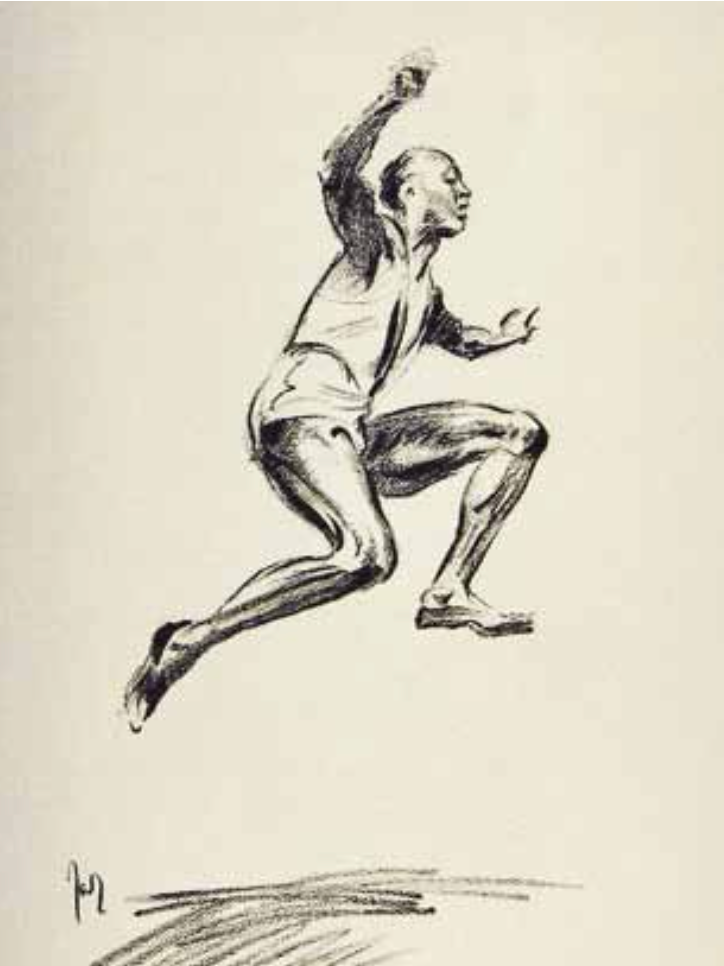
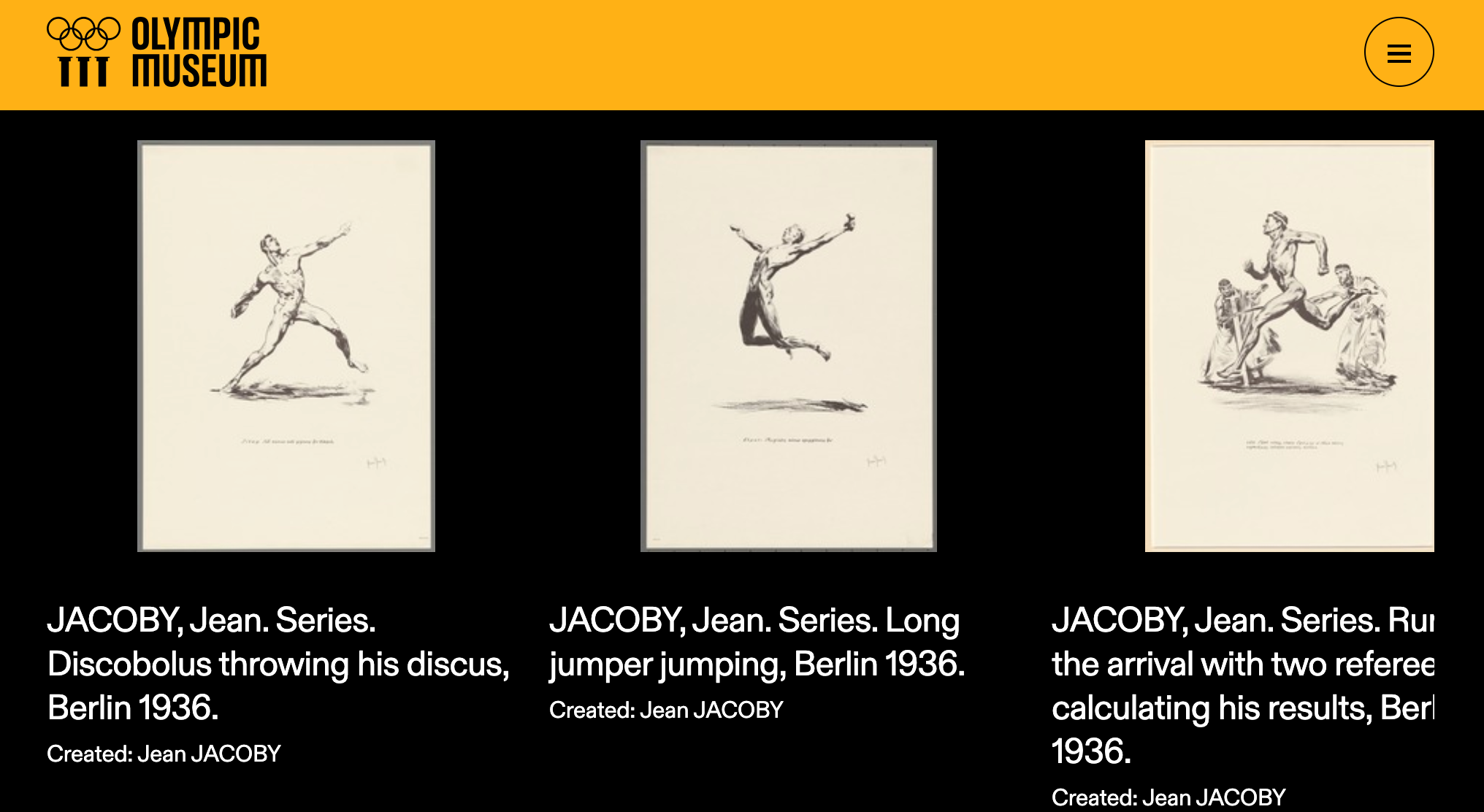
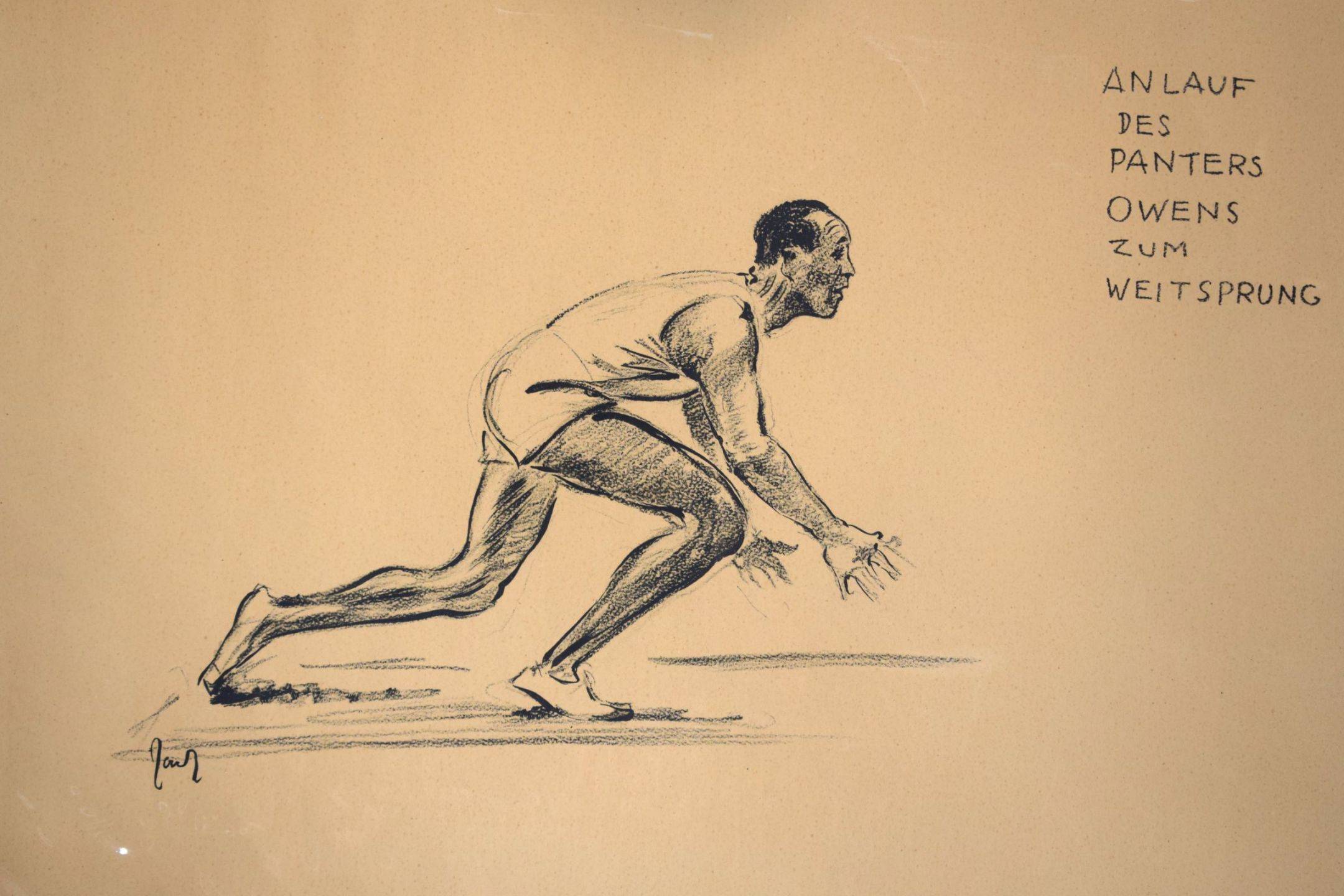
He watched Jesse Owens. Later, he produced several sketches. Under them, he did not write of politics or triumph. He wrote technical critiques, including: “The Owens’ jump is not elegant, not high. Only the product of his run-up.”
In that single line, Jacoby performed an act of profound moral courage. Amidst history’s most politicized games, he insisted on an apolitical truth. He saw not the symbol, but the structure of excellence . . . the cause and effect of speed, force, and technique. He bore witness with the dispassionate, loving eye of an artist whose medium was motion itself.
The Regime’s Digestive System
The Nazi regime had a response: wood-chip the truth. Owens was not acknowledged as refuting their ideology. He was labeled a Naturmensch . . . a racialized hiearchical slur. This quarantine of Owens’ achievement protected the core myth of systemic Aryan superiority. The lie absorbed the fact by distorting it . . . a timeless playbook for power.
The Choice: Charcoal or Film?
Two visual records emerged from August 1936:
- Leni Riefenstahl’s film Olympia: State-sponsored epic, mythologizing the body and the collective.
- Jacoby’s charcoal lithograph: Private, static, analyzing the mechanics of the individual.
One sought to immerse you in feeling. The other sought to equip you with understanding. This is the eternal choice: spectacle or forensic truth? The Universal Newsreel coverage of the 1936 Olympics, focusing on U.S. athletic triumph and Jesse Owens’ victory . . . while eliding the regime’s nature . . . chose the side of spectacle. It provided the world with a palatable, sports-centric narrative that made the moral compromise of attendance easier to swallow. It was the audio-visual version of an “Honorable Mention” for reality.
Flash Forward: Our Stadiums and Our Run-Ups
Our world is in a perpetual August 1936. We build new stadiums of spectacle and new pits of truth.
- The Stadiums: The Gigafactories, the Tech Keynotes, the Global Climate Conferences. Temples of future power.
- The Long Jump Pits: The peer-reviewed climate model, the whistleblower reports, the community lawsuits. Moments of undeniable, disruptive truth.
- The “Owens Exceptions”: The token green project used to launder a portfolio of pollution. The isolated fact used to deny a systemic crisis.
We also have our D.O.O.D. exhibitions . . . the parallel, ethical alternatives being built next door to corrupt systems: the energy cooperative, the open-source algorithm, the ethical supply chain.
The August Toolkit for Youth4Planet
August 1936 bequeaths not just history, but a field manual for when truth and spectacle collide.
- Identify the “Owens Exception”: when a system uses a token truth to disguise a structural lie, name the trick.
- Choose Charcoal Over Film: in the face of immersive spectacle, pick up the tool of forensic analysis. Be the one who makes the diagram.
- Build Your D.O.O.D.: don’t exhaust yourself forever petitioning a corrupted temple. Gather the exiled truths and build a house for them next door.
- Focus on the Run-Up: the outcome is determined by the approach. Fix the system, not just the symptom.
The Question for Now:
Who are the Jesse Owens of today? Not celebrities in the spectacle, but those whose very existence or action dismantles a central, convenient lie by the sheer, undeniable force of fact. Who, by the simple truth of their being or their work, makes the lie untenable?
Your task is not to win a race inside the stadium. Your task is to redraw the entire map, to show the links between the stadium, the silenced truths, and the sand pit where real human greatness briefly, gloriously, touched down.
September 1936: They called it heart failure. The medical report for Jean Jacoby, 45, stated it plainly. He died at his home in Mulhouse, France, on the 9th of September 1936. The official cause was biological. The real cause was historical.
One month earlier, Jacoby . . . had been in Berlin. He witnessed the Nazi regime’s Olympic spectacle, a masterpiece of propaganda that temporarily hid its hate to seduce the world. He saw his own life’s work, dynamic drawings of athletes in motion, sidelined in the state-sanctioned art exhibition in favor of sterile, monumental sculptures glorifying power. He sketched Jesse Owens, the American athlete whose victories dismantled the myth of Aryan supremacy . . . and annotated his drawing with a technician’s cool note on the athlete’s form.
He returned to Mulhouse a different man. You cannot see the camp behind the stadium and remain unchanged. You cannot witness the corruption of your craft, the weaponization of the human form, and simply go back to work. The “return ticket” is a lie. Some journeys are irreversible.
Jacoby was buried locally. For eighty-five years, his grave would bear no mention of his unparalleled achievement.
The World in September 1936: The Hangover
The Olympic flame was extinguished. The world’s athletes went home with their souvenirs and stories. The distraction was over. The regime in Berlin, its international prestige momentarily bolstered, removed the temporary masks. The anti-Jewish signs reappeared. The Nuremberg Laws were enforced with renewed vigor. The “Olympic Peace” was exposed as a tactical pause. In Spain, the civil war escalated into a brutal stalemate, a testing ground for the world war to come.
The trajectory was now locked in. The world, having chosen spectacle over solidarity, had no moral standing to object. The next to fall: Vienna, Prague, Gdańsk . . . before many more. On the very day Jacoby died, Universal Newsreel released “Terrified Civilians Flee Air Raid” (9th September 1936) about the Spanish Civil War. The world’s information machine had already moved on to the next crisis, the next spectacle of horror. Jacoby’s silent death from “historical exhaustion” was not news . . . it was a casualty of the news-cycle itself.
The Anatomy of Silence
September is not an event. It is an absence. It is the empty space where an echo should be. Jacoby’s death was a casualty of this silence . . . not a death by bullet, but by a broken heart. He was the canary in the coal mine of modern propaganda, the sensitive organism that perceived the lethal gas of the lie and succumbed.
His unmarked grave was the physical manifestation of the silence. A double erasure: first by the regime that rejected his art, then by history that forgot his name.
Flash Forward: Our Perpetual September
Our world is in a perpetual September. The spectacle of the product launch, the political rally, the climate conference fades. And what is left?
‣ Our Unmarked Graves: The sacrifice zones of the lithium mines, the e-waste dumps in the Global South, the communities displaced by a dam branded “green.”
‣ Our Heart Failures: The burnout of the climate scientist, the despair of the activist, the quiet surrender to “realism.”
‣ Our Nuremberg Laws: The backsliding on climate pledges, the new fossil fuel licenses approved the day after the net-zero speech.
The clean energy transition will be moral . . . or it will be another tomb. It cannot be measured only in terawatt-hours, but in the decibels of its silence.
The September Imperative for Youth4Planet:
Decency, in September, is the refusal to let the grave go unmarked. Decency, in September, is the refusal to let the grave go untended. Decency, in September, is the patient, physical work of returning to places that have been exhausted . . . misremembered . . . paved over . . . and tending them back into meaning.
Decency is remembering that memory itself . . . needs stewardship . . . like Soil. Our challenge is to shorten the two longest distances to us . . . the human species: the six inches . . . the ten centimeters . . . between our ears . . . and under our feet.
Jacoby’s story did not end in 1936. It ended in 2021, when a new stone was finally placed on his grave, inscribed with his name and his two gold medals. That act was more than symbolic. That act remains restorative. A small act of historical permaculture . . . returning the nutrients of truth to a depleted Public Commons of memory.
Your generation inherits a world of silent graves . . . ecological, social, historical. Your imperative is to inscribe the stones . . . and then to tend what grows around them.
‣ Find the Unmarked Graves . . . wherever and whatever they are: use data, journalism, art, and activism to locate the silenced costs of our systems. Walk them. Active Mobility to them. Map them at human cadence . . . the speed at which memory becomes musical again.
‣ Carve the Truth: inscribe them into law, into code, into curriculum, into public memory. Make them unavoidable. Design those inscriptions to circulate. The Circular Economy’s Decency is Memory that does not end as “waste”. There is no waste in Nature. It is policy that learns. Infrastructure that reuses space. Cities where yesterday’s harm becomes tomorrow’s repair.
‣ Be the Witness That Outlasts: build institutions of memory that are resilient to the entropy of silence. Not lonely monuments but Living Systems. Active Mobility Lanes that trace needed routes. Streets that tell stories with their geometry. Public Spaces that invite connections.
Do not just build the clean energy grid. Build the moral memory that will be its operating system. Because . . . without memory . . . even “clean systems” repeat vicious circles . . . just . . . more efficiently.
The story of Jean Jacoby does not end in the silence of September 1936. It ends with you. It ends when you choose whether his gold medals remain a forgotten footnote, or become the cornerstone of a new Olympics of the human spirit. An Olympics where Decency is not a ceremony, but a daily practice . . . where Remembrance is regenerative . . . where Active Mobility reconnects . . . where the Future moves forward . . . without leaving our loved ones behind.