Luxembourg and the Micro-Grid Marathon
There are hiccups running through much of Europe’s climate debate: we keep framing the Energy Transition and Green New Deal as burdensome sacrifices . . . as trillion €uro costs . . . as moral obligations we must endure. The data no longer supports that framing.
First, what we are facing today is not a “climate problem” with economic side-effects.
What we are facing today are Electricity System Bottlenecks that are already constraining growth, health, and sovereignty. Climate Action is simply the most decent and direct roadmap out.
Luxembourg, of all places, is uniquely positioned to understand this. We are a nation with a rich legacy built on infrastructure intelligence: steel, finance, satellites, data. Today? Electricity has become the new limiting factor. Data Centers queue for grid-access. Industry faces volatility. Electrification accelerates faster than centralized grids can respond. Waiting for slow, expensive grid expansion is the conservative choice only in appearance. In reality, it is the riskiest option on the table.
The alternative already exists: it is called Distributed Energy Resources . . . micro-grids . . . virtual power plants . . . systems that generate, store, and manage energy where it is actually used. This is not theory. It is happening now, from India to Nigeria to the Netherlands. The lesson is simple . . . and to some . . . this lesson appears unsettling: resilience no longer comes from scale alone. It comes from intelligence.
This is where Energy Kindness enters the conversation . . . not as sentiment, but as system architecture. Energy Kindness means building a grid that is:
- Kind to the Economy . . . because it removes bottlenecks instead of creating them.
- Kind to Households and Businesses . . . because it lowers bills and deflates price volatility.
- Kind to Life . . . because it eliminates the pollution that drives what one should correctly label “planetary cannibalism”: incarnating in increased hospital admissions, cognitive impairment, and long‑term ecological debts.
- Kind to Democracy . . . because it distributes empowerment and agency alongside power.
The numbers matter here.
According to peer‑reviewed 100% renewable energy modelling co-authored by Stanford University Civil Engineering Professor Mark Jacobson, Luxembourg stands to gain over 7,000 long‑term construction jobs plus 11,000+ operations jobs from a full transition to wind, water, solar, and storage. Health cost savings exceed $1.4 billion annually. Average payback time sits just over two years. Levelized energy costs fall by more than €0.07/kWh compared to fossil‑fuel and nuclear baselines. The combined energy, health, and climate dividend surpasses €10,000 per capita.
These are not “aspirational” figures. They are peer-reviewed, conservative, system-level estimates that exclude many secondary benefits . . . resilience during heatwaves . . . avoided grid congestion . . . reduced capital expenditure on transmission lines that take a decade to permit . . . let alone build.
Now imagine applying this logic deliberately: Luxembourg launching annual Micro-Grid Marathons . . . not a one-off pilot, but sequenced national efforts. Data-center resilience hubs that remove pressure from the main grid. Industrial micro-grids that lock in predictable energy costs for electrifying and decarbonizing production. Rural Energy Islands that cut household bills while improving air quality and community sovereignty. All orchestrated by the national grid operator that evolves from asset owner to intelligence provider.
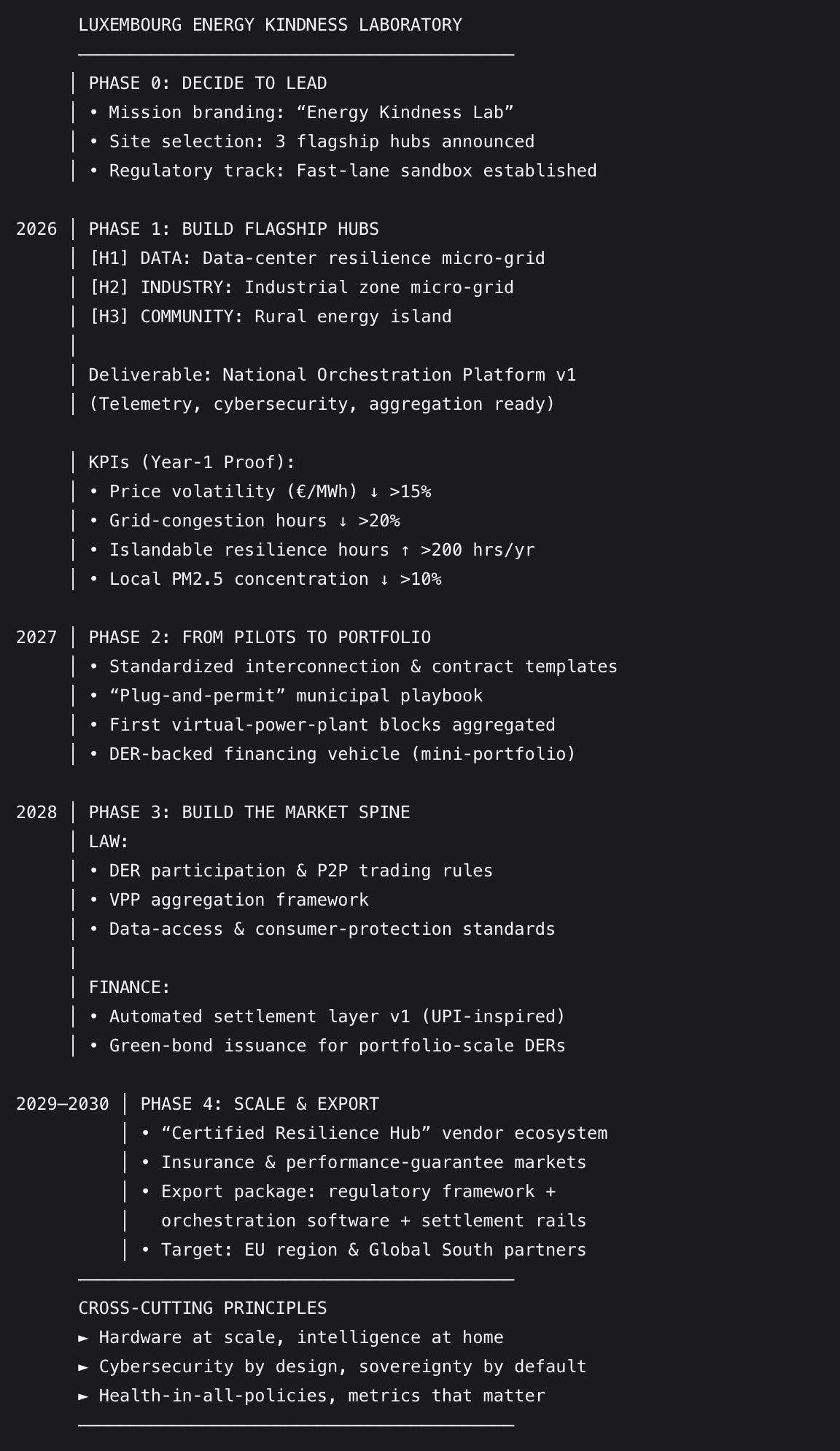
This is not a retreat from the asset-owners’ role. It is an evolutionary expansion of it: orchestration is where value is moving. Software, aggregation, cybersecurity, market design . . . this is where long-term, exportable competence lives. In time, these micro-grid platforms become infrastructure assets in their own right. Bankable. Investable. Potentially IPO-able . . . not as speculation, but as regulated resilience.
Finance understands this instinctively. That is why DER-backed green bonds are already emerging. Energy cash flows, diversified across thousands of assets, are among the most stable revenues imaginable. Luxembourg does not need to invent this market. We are uniquely equipped to professionalize it for Europe.
Some will object that hardware comes from abroad. That is true . . . and irrelevant. Sovereignty in the twenty-first century does not mean owning every line of code, every glass screen and every bolt in every iphone. Sovereignty in the twenty-first century means owning the intelligence layer. The standards. The cybersecurity. The orchestration logic. Europe does not need to out-manufacture. We need to out-design.
This is where the moral dimension clarifies the picture.
Air Pollution is not abstract. It is cancer, asthma, heart disease, missed school days, shortened lives. Replacing fossil fuels with geothermal, solar, wind, hydro-power and battery storage is not just a climate strategy . . . it is a public health intervention at national, regional and continental scale. When we speak of Energy Kindness, this is what we mean: systems that professionally prevent harm before harm occurs.
Luxembourg has always punched above its weight by choosing the future early. Steel before others. Finance before others. Satellites before others. Energy Resilience is the next chapter. Not because it is fashionable . . . but because it is rational.
For Youth4Planet? This matters deeply. Generations are tired of being told to wait, to compromise, to accept half-measures. The Micro-Grid Marathon is not about waiting for miracles. It is about using what already works . . . now . . . at scale . . . with care.
Energy Kindness is not naïve. It is what competence looks like when guided by decency.
The marathon has already begun.
The only question is whether Luxembourg chooses to lead . . . or to participate late.
Further Reading:
- Bloomberg Podcast: Electricity is now holding back growth across the global economy:
- Bloomberg news article: Global businesses are undermining the environment even though they rely on nature for key raw materials and critical services such as pollination and water filtration, according to a major report endorsed by more than 150 countries. “A focus on growth as measured by the gross domestic product” has resulted in significant damage to the natural world, says the study released on Monday. Nearly 80 scientists and industry expertsspent three years working on the report, which is designed to inform investment decisions and national policies: https://www.bloomberg.com/news/articles/2026-02-09/more-than-150-countries-agree-that-focus-on-gdp-harms-nature?srnd=phx-green
- Bloomberg news article: As extreme weather becomes more frequent, investors are examining how much money can realistically be made from climate adaptation. Jenn-Hui Tan, chief sustainability officer at Fidelity International, which oversees about $1.1 trillion, said the investment case for adapting to climate change is far less straightforward than for reducing emissions. Mitigation has produced clear growth opportunities such as renewable energy and electric vehicles, while adaptation — focused on protecting assets from damage caused by wildfires, floods and droughts — is harder to monetize: https://www.bloomberg.com/news/articles/2026-02-04/fidelity-calls-out-limits-of-extreme-weather-adaptation-bets?srnd=phx-green
- Bloomberg news article: China’s grid spending hit a record last year and is set to rise steadily through 2030, underscoring Beijing’s push to ease transmission bottlenecks. Grid investment climbed 5% to 639.5 billion yuan ($92 billion) in 2025, according to data from the China Electricity Council. Spending on new-generation power capacity, by contrast, has faced constraints from a solar slowdown, official data for the first 11 months of the year showed. China’s dominant state-owned grid operators — the State Grid Corp. of China and China Southern Power Grid Co. — have steadily lifted their spending in recent years. Their combined budgets are set to reach nearly 1 trillion yuan this year and grow further through the end of the decade: https://www.bloomberg.com/news/articles/2026-02-03/china-grid-spending-hits-record-as-beijing-tackles-bottlenecks
- Bloomberg news article: The hardest part of building a wind farm along the misty ridges of southern Laos wasn’t hauling 25-ton blades up mountain roads or laying 71 kilometers (44 miles) of cables in thick vegetation. It wasn’t even removing unexploded bombs left over from the Vietnam War. Instead, it was bureaucracy that kept engineering veteran Nat Hutanuwatr up at night — the delicate diplomacy and seemingly endless paperwork required for neighboring Southeast Asian nations to share clean electricity. It was, he says, like “climbing a series of Everests.” After more than a decade of government talks, biodiversity surveys and financial negotiations, Hutanuwatr’s Monsoon Wind started exporting power to Vietnam this month. Its 133 turbines bring a heterogeneous region of 700 million people one step closer to a long-awaited supergrid — a vast, interconnected power network that will eventually carry clean energy from the expansive north to densely populated islands to the south: https://www.bloomberg.com/news/articles/2025-07-29/the-hurdles-behind-building-southeast-asia-s-supergrid-for-clean-energy-future
- Amazon Bookstore: Still No Miracles Needed Revised Edition by Stanford University Professor Mark Z. Jacobson https://www.amazon.com/Still-No-Miracles-Needed-Technology/dp/1009662473
- Financial Times news article: There is a new “breakout star” in the battery storage market . . . Saudi Arabia is ‘breakout star’ of battery storage market in 2025 . . . Volta Foundation has published its latest annual report on the state of the battery market — a 767-slide feast of information and data on the booming sector. It starts with an eye-popping statistic showing just how strong a year grid-scale batteries had in 2025: of the cumulative capacity installed as of the end of December, 40 per cent was added last year. The growth of solar panels and wind turbines means demand is high for batteries to smooth out power supplies, while battery costs have fallen to all-time lows thanks in part to better manufacturing processes: https://www.ft.com/content/c8317604-f31e-4e10-b52e-9b3b248af403
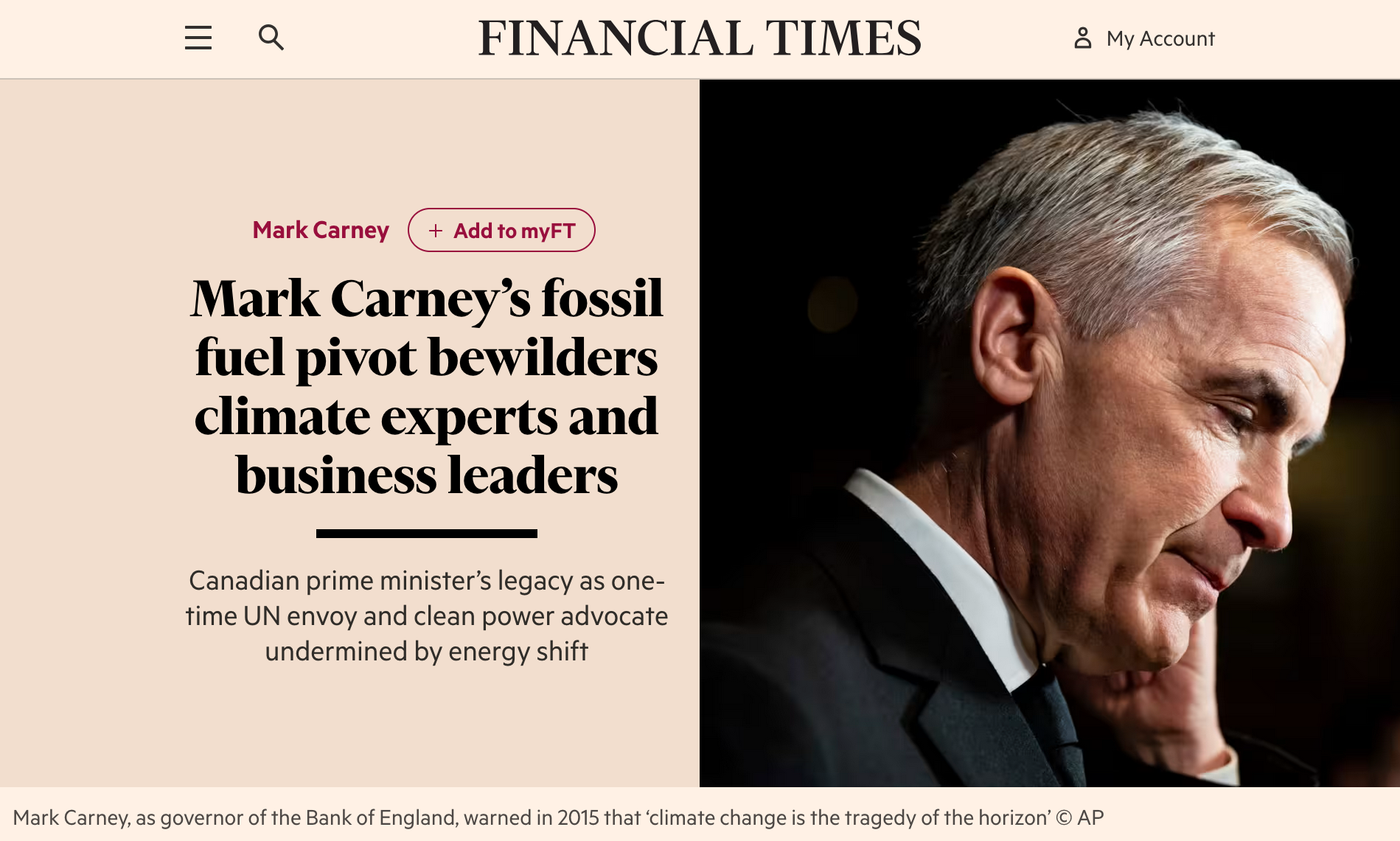
- Financial Times op-ed article from Florian Krampe: The writer is director of the climate change and risk programme at the Stockholm International Peace Research Institute – President Donald Trump’s push to acquire Greenland earlier this year sparked alarm in European capitals . . . Currently, we are making 21st-century security decisions with 20th-century climate assumptions. Nuclear deterrence is inherently fragile and climate change is an additional destabilising factor. Focusing diplomatic energy on territorial disputes in Greenland while the physical conditions supporting deterrence degrade is strategically shortsighted. The physics of the Arctic are changing. Our security architecture must acknowledge this reality.: https://www.ft.com/content/b44f12c2-7468-45e9-ab6a-7ddd18658405
- Financial Times news article: Snowstorm knocks out power and grounds US and Canadian flights . . . More than half a million people across the US were without power early on Tuesday morning eastern time, according to tracking website Poweroutage.com, after as many as 870,000 lost connection at the peak of the storm on Sunday night The hardest hit were the states of Mississippi, Tennessee and Louisiana, with power in Texas gradually being restored after its mass outage . . . Nearly 18,000 flights from Saturday to Monday were cancelled across the US, according to flight-tracking site FlightAware, leaving passengers stranded at airports across the US. Airlines cut more than 11,130 flights on Sunday alone. Sunday’s cancellations were the highest number since the coronavirus pandemic: https://www.ft.com/content/875708c1-a682-48b1-a000-d327d0b05362