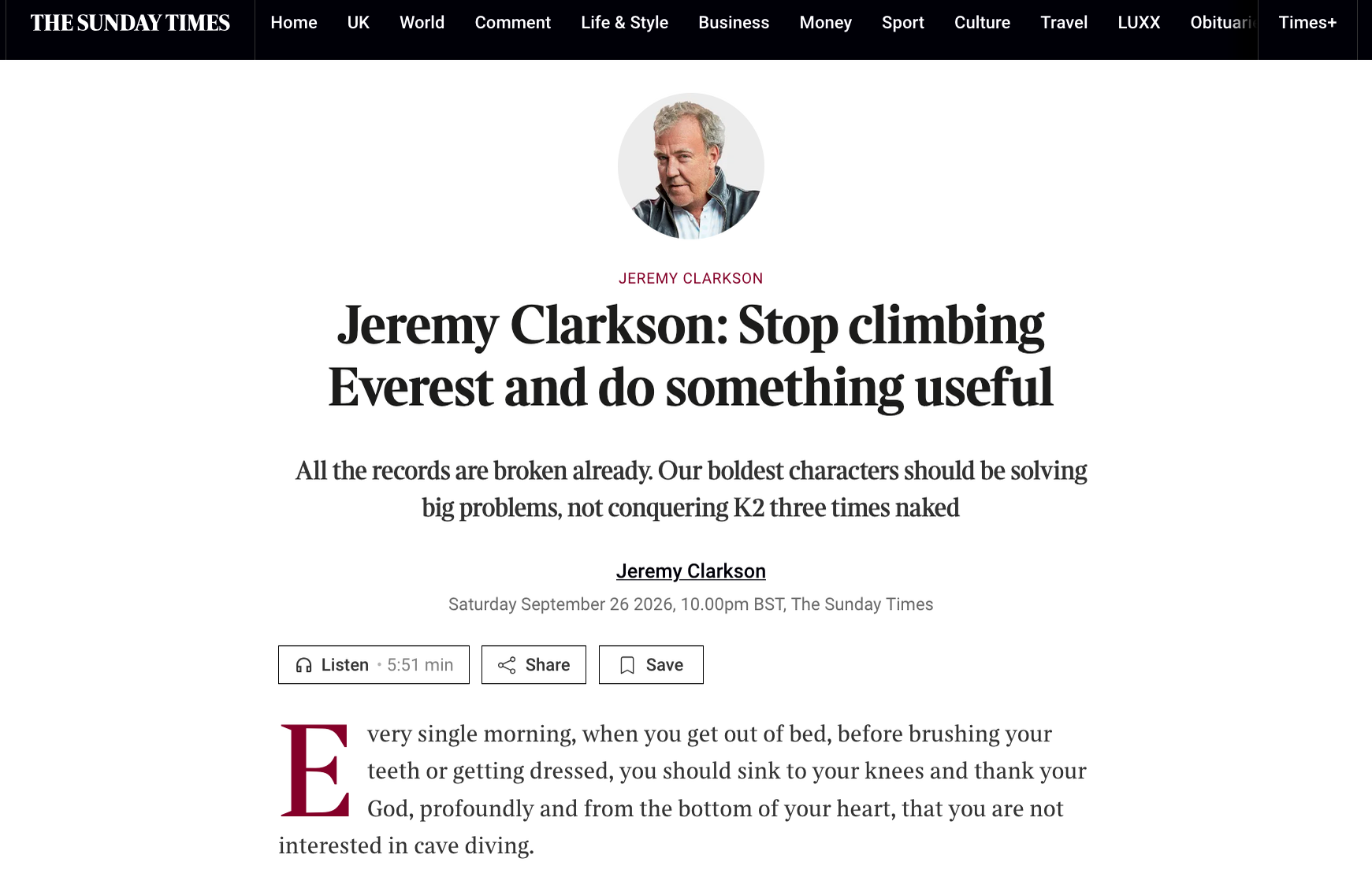
We do not lack courage, intelligence or capital. We lack more useful mountains to climb. When I was much, much younger . . . I looked forward to Jeremy Clarkson’s columns in The Sunday Times. Jeremy then and now writes with panache, taking an engineering problem, a political absurdity or an ill-advised adventure and making it vividly memorable. Since becoming a farmer, Jeremy occasionally strikes something profound. Farming has a way of introducing even the most wildly over-confident person to forces that cannot be negotiated with: soil, water, weather, disease, animal behaviour and the limits of one’s own knowledge. In his latest column, Stop climbing Everest and do something useful (https://www.thetimes.com/comment/columnists/article/jeremy-clarkson-stop-climbing-everest-and-do-something-useful-9nh7n9ggz) Jeremy asks what should become of people born with overdrive appetites for discovery and achievement now that the great mountains have been climbed and the old records broken. Should they climb the same peaks faster, more often or under increasingly extreme conditions, or could some of that courage be redirected toward challenges whose solutions would leave the world genuinely better? Jeremy proposes problems large enough to deserve our boldest minds. Beneath the humour, I hear an important question: where are we directing our coveted capabilities, and what “return” is society receiving from them?
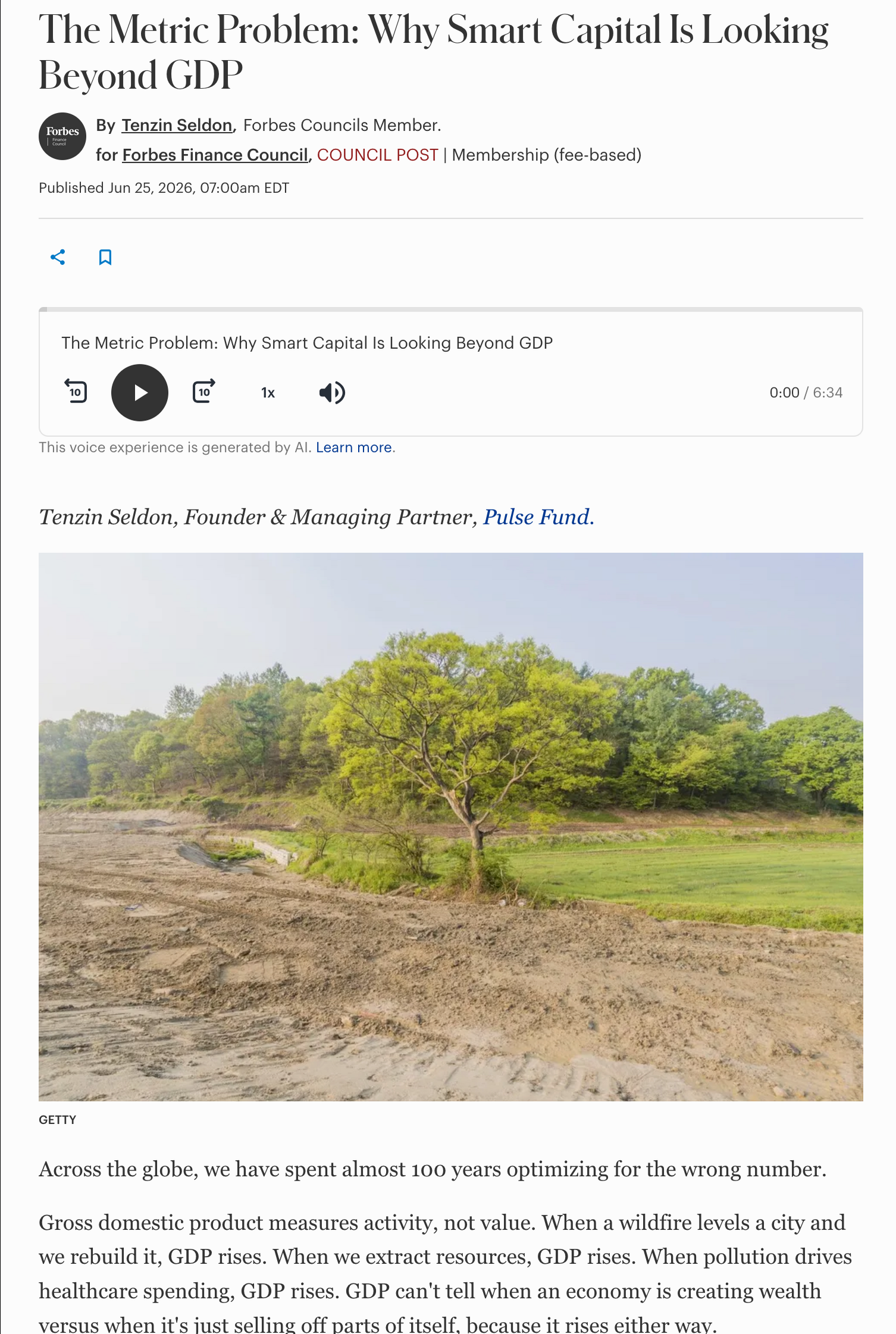
That question has been percolating since reading another essay, Tenzin Seldon’s The Metric Problem: Why Smart Capital Is Looking Beyond GDP (https://www.forbes.com/councils/forbesfinancecouncil/2026/06/25/the-metric-problem-why-smart-capital-is-looking-beyond-gdp/). Tenzin begins from a different place: Gross Domestic Product measures economic activity, but it cannot reliably distinguish between durable value creation and the consumption of the systems on which value depends. A wildfire destroys homes and reconstruction raises GDP. Pollution causes illness and healthcare expenditure raises GDP. Soil is depleted, water is contaminated and communities are weakened, yet the transactions generated along the way may still be reported as economic progress. The activity enters the numerator while much of the damage disappears from the denominator. Tenzin calls her lens Gross Domestic Regeneration, or GDR. It asks whether economic activity restores or consumes the ecological, social and economic foundations on which lasting prosperity depends. Growth should be measured not only by what is produced, but also by what is restored.
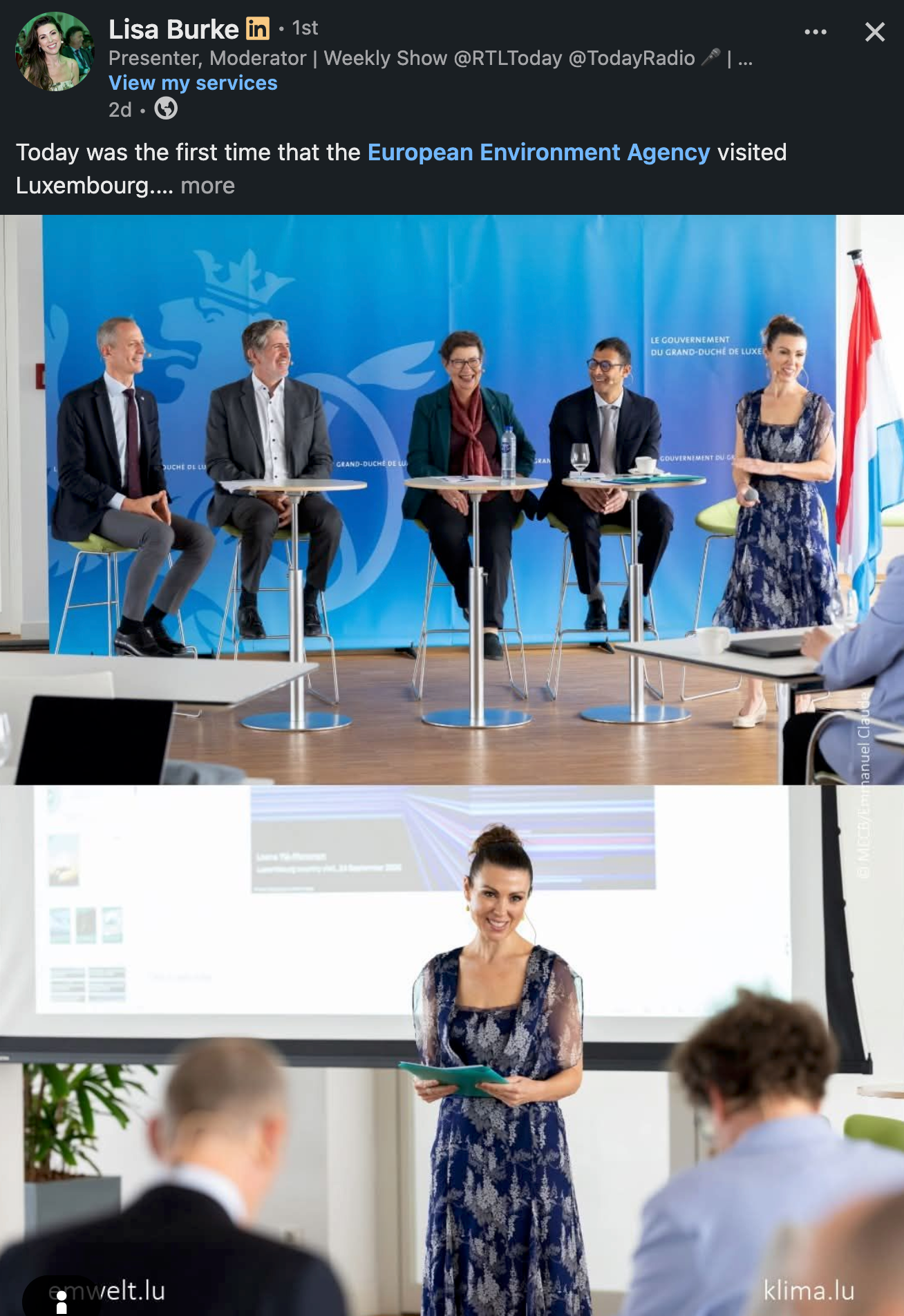
A few days after Tenzin presented GDR at the NAT Gala, the term (and its author) were mentioned during a European Environment Agency workshop hosted by Luxembourg’s Ministry of the Environment, Climate and Biodiversity. Tenzin was not in the room and most of us had never met her, yet her idea had travelled there and was being discussed by name. When she learned about the exchange, she described it as a groundswell: an idea beginning to move independently of its author. I found that generous. She did not treat the idea as something to control: she recognised that a framework becomes useful when other people carry it into new rooms, test it against reality and help it evolve.
Jeremy and Tenzin are not making the same argument, and I would not want to recruit either of them into the other’s work. Their difference is precisely what makes the conversation interesting. Jeremy asks where courage should be directed, while Tenzin asks whether our economic scoreboard can distinguish durable progress from economic spectacle: impressive activity whose depleted foundations, transferred costs and accumulating liabilities remain outside the frame. One is asking how we define a worthwhile adventure. The other is asking how we define worthwhile growth. Together, their essays leave me wondering whether courage itself needs a better scoreboard. The answer is YES. No serious investor would evaluate a company from revenue growth alone. A Berkshire Hathaway-style assessment would examine depreciation, liabilities, management integrity, productive capacity, competitive durability and whether the business is quietly consuming the foundations of its own success. Why should the assessment of a country be less disciplined?
We count what moves through the economy. We celebrate the numerator while neglecting the denominator. GDR’s numerators include healthy soil, healthy air and healthy water, plus renewable energy & battery storage, functioning ecosystems, productive skills, dependable infrastructure, social trust and livelihoods capable of withstanding disruption. Its denominators include resource depletion, pollution, preventable illness, precarious work, ecosystem loss, stranded assets, institutional fragility and costs transferred to people who received little or none of the original benefit. The essential question is not merely what was gained and lost, but who owns the numerator and who is required to absorb the denominator? That question matters to ministries of finance and environment, central banks, insurers, pension funds, regulators and long-term investors. It matters to every board allocating capital and every government borrowing from the future. Healthy ecosystems, social trust and climate stability are not decorative environmental benefits. They are productive assets. When a company or country strengthens them, it builds capacity; when it draws them down, an honest accounting system should record the liability.
GDR is not yet a universally standardised national statistic, and that should invite serious participation . . . rather than reflexive dismissal. How should GDR’s baselines be established? Which indicators belong in each dimension? How do we prevent one restored wetland from being used to conceal much larger damage elsewhere? Who verifies the information? How do we ensure that a company cannot select a flattering numerator while exporting its denominator beyond the reporting boundary? The governance will matter as much as the mathematics. The indicators must be transparent, independently scrutinised and resistant to political or corporate cherry-picking. Otherwise, GDR risks becoming another attractive label attached to the same economic behaviour.
This is where story-tellers matter profoundly, because systemic change does not need more inaccessible reports written exclusively for people who already agree. It needs stories, arguments and instruments that ordinary people can understand, interrogate and occasionally laugh about. If European broadcasters like Denmark’s TV 2 Vejret can broadcast the changing Renewable Energy share of an electricity grid, then the BBC, RTL, M6, Deutsche Welle, Sky News, RAI News, ARD Tagesschau/ZDF Heute, TVE, CNBC and _ _ _ _ _ can make Gross Domestic Regeneration visible too. Let’s reimagine financial broadcasts displaying not only GDP, quarterly earnings and market prices, and also independently verified regeneration gauge.

We need conversations about:
- What was restored?
- What was depleted?
- Who benefited?
- Who paid?
- Did today’s gain increase tomorrow’s productive capacity?
- Did today’s gains merely borrow against tomorrow’s productive capacity?
Decency should not be reserved for one political tribe, nor should environmental intelligence be presented as a sermon delivered by one group to another. It should be visible, practical, contestable and useful. I would be fascinated to hear Jeremy and Tenzin discuss this together. I can hear RTL Presenter Lisa Burke now asking . . . Jeremy: can the appetite for adventure be redirected from repeated conquest toward repair without extinguishing the excitement that makes courageous people move? Tenzin, how can GDR become a trusted public instrument without losing the interconnected ecological, social and economic intelligence that makes it different from GDP? . . . and to the Tenzins and Jeremys of the world: how do we make regeneration feel not like sacrifice or administrative compliance, but like the most ambitious undertaking available to us?
Decency incarnates when we share the same instrument panel. We do not lack courage, intelligence or capital. We too often direct them toward the wrong records because our scoreboard rewards the wrong achievements. That is a conversation worth having and a more useful mountain worth climbing. It may also give our courage, capital and public institutions a destination worthy of their considerable power.
Reflections? Questions? Ideas? Chat with Climate Action Tiger and Christian Thalacker-Heldenstein: christian@youth4planet.org